ShFDMS - Widebody Long-Range Airplane - Russian widebody airliner

kaiserbill

ACCESS: Top Secret
Senior Member
Joined
27 March 2006
Messages
1,971
Reaction score
2,042
With the Russian withdrawal from the Russo-Sino CR929, there has been speculation as to what form a new long range widebody airliner might take in Russia.
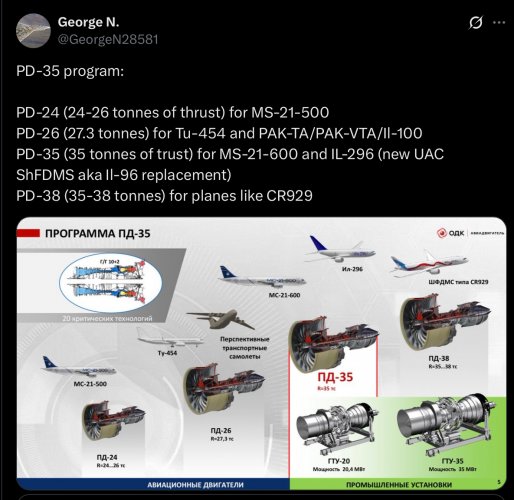
Previously mentioned and considered plans included a redesigned Ill-96 with 2 PD-35 engines, or a new design.

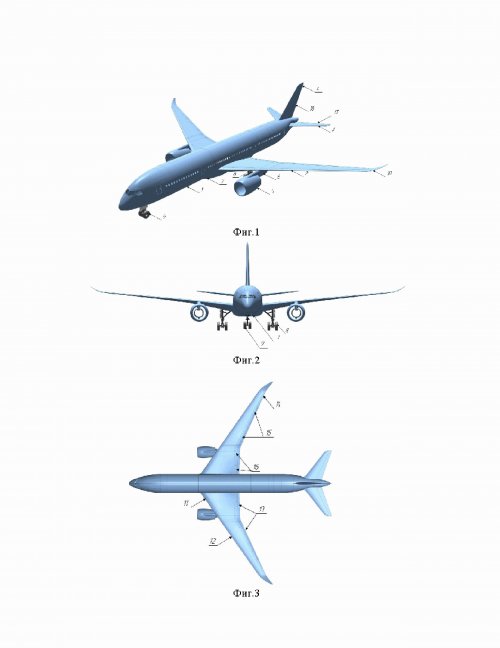
Anyway, this has been described a new design that has just been patented.
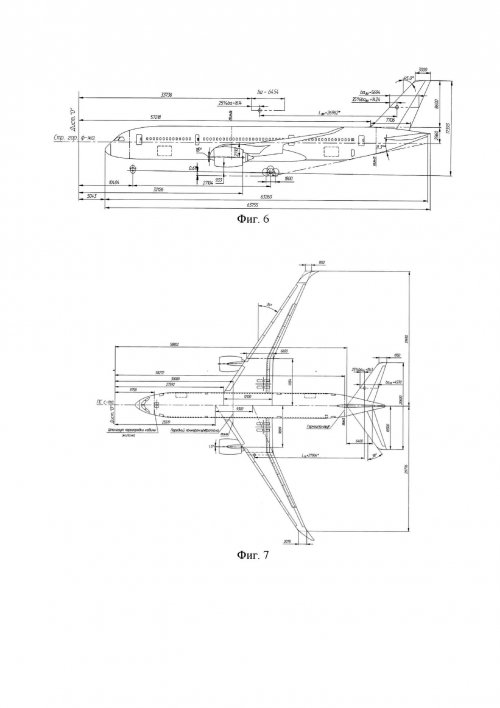
Length of 58m, span 59m.
Any thoughts?
 

Attachments

  • 00000011.jpg
    00000011.jpg
    566.9 KB · Views: 212
  • 00000010.jpg
    00000010.jpg
    359.9 KB · Views: 200
With the Russian withdrawal from the Russo-Sino CR929, there has been speculation as to what form a new long range widebody airliner might take in Russia.
Previously mentioned and considered plans included a redesigned Ill-96 with 2 PD-35 engines, or a new design.

Anyway, this has been described a new design that has just been patented.
Length of 58m, span 59m.
Any thoughts?

You only wrote part of the story.
 

Attachments

  • GzSllu8WEAE6FpQ.jpeg
    GzSllu8WEAE6FpQ.jpeg
    144.2 KB · Views: 184
  • GzSlnYbWEAAWj7R.jpeg
    GzSlnYbWEAAWj7R.jpeg
    131.6 KB · Views: 152
+ a short description of the three versions and how it compares to Boeing 787-9:

FIELD OF TECHNOLOGY TO WHICH THE INVENTION RELATES:
[0001] The invention relates to aviation technology, namely to the design of a wide-body long-range aircraft (hereinafter referred to as WLLRA).
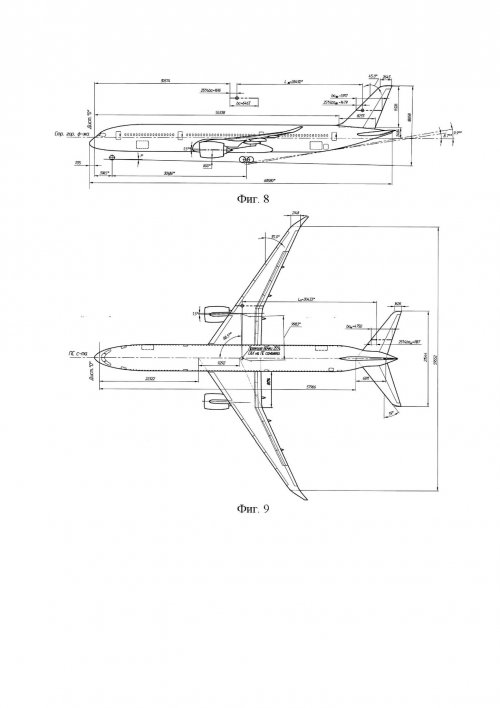
[0002] The SHFDMS is designed to carry passengers, baggage and additional paid load on regular commercial flights. The aircraft of the family are capable of flying distances of 13,600 km, 12,000 km and 10,300 km, including over oceans and featureless terrain. The capacity of the basic aircraft of the family is 281 passengers in a three-class layout. Shortened and extended versions of the aircraft with a capacity of 240 and 320 seats in a three-class layout, respectively, are also envisaged.

[0028] The family of aircraft consists of three members - SHFDMS-500, SHFDMS-600, SHFDMS-700. The fuselage length of each family member is determined based on the number of seats in a standard 3-class layout, which is 236, 281 and 320 respectively for SHFDMS-500, SHFDMS-600 and SHFDMS-700 and is L = 58420 mm, 63755 mm and 68580 mm. All members of the family have the following in common: maximum takeoff weight; wing, empennage and chassis; power plant; composition and design of systems (except for components that change their length due to a change in the length of the regular part of the fuselage).

DISCLOSURE OF THE ESSENCE OF THE INVENTION:
[0006] The technical problem that the claimed invention is aimed at solving consists of creating a wide-body long-range aircraft using polymer composite materials that has improved technical and operational characteristics.
[0007] The technical result achieved by implementing the claimed invention consists in creating a wide-body long-range aircraft using polymer composite materials, which has improved technical and operational characteristics.
[0008] In terms of operating costs per flight, the basic representative of the SHFDMS family has an advantage over its main competitor, the B787-9, of 3% in direct operating costs and about 6% in indirect operating costs. In terms of operating costs per seat-kilometer, the SHFDMS-600 has an 11-13% advantage over the B787-9 in direct operating costs and 15-17% in indirect operating costs.

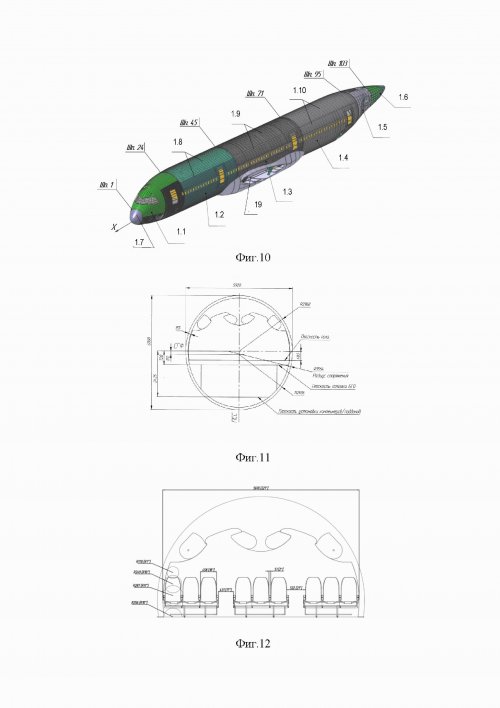
Material composition and cabin dimensions:
IMG_7314.jpeg

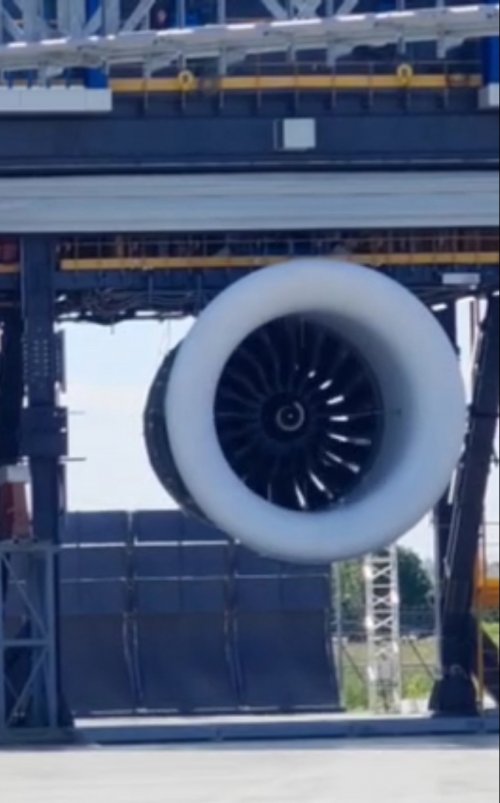
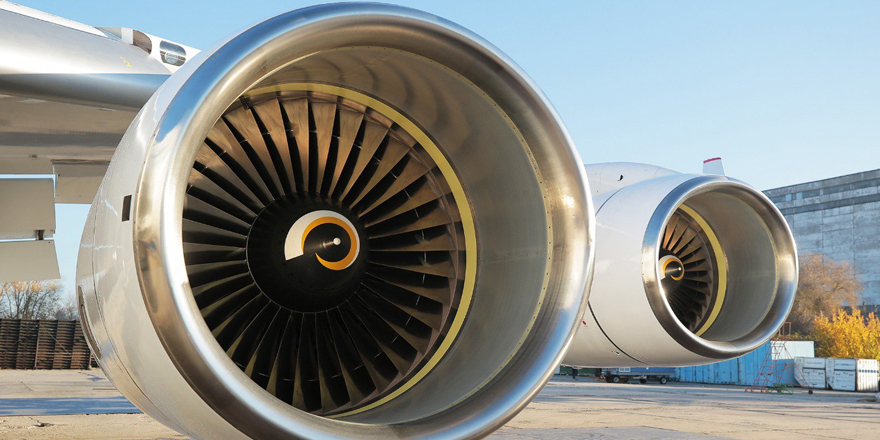
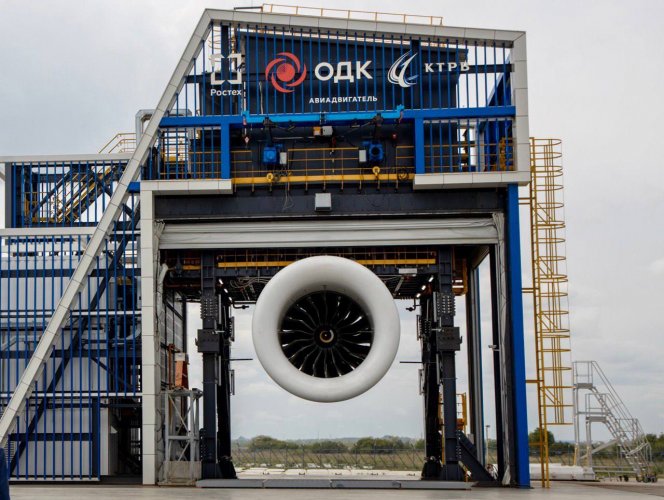
And the engine for the new wide body, PD-35 on a test stand (from last week):

IMG_7341.jpeg
Source: https://t.me/bomber_fighter/22253
 
Last edited:
I stopped paying attention after reading the following (verbatim) sentence above: "In terms of operating costs per flight, the basic representative of the SHFDMS family has an advantage over its main competitor, the B787-9, of 3% in direct operating costs and about 6% in direct operating costs' (sic) - thanks, AI...
 
That would be due to Google Translate. Here’s the original text:
[0008] По эксплуатационным расходам на рейс базовый представитель семейства ШФДМС имеет преимущество перед основным конкурентом B787-9 в 3% по непосредственным эксплуатационным расходам и около 6% по прямым эксплуатационным расходам. По эксплуатационным расходам на кресло-километр ШФДМС-600 имеет 11-13% преимущество перед В787-9 по непосредственным эксплуатационным расходам и 15-17% по прямым эксплуатационным расходам.

Using Yandex Translate it makes more sense:
[0008] In terms of operating costs per flight, the basic member of the SFDMS family has a 3% advantage over its main competitor, the B787-9, in terms of direct operating costs, and a 6% advantage in terms of indirect operating costs. In terms of operating costs per seat-kilometer, the SFDMS-600 has a 11-13% advantage over the B787-9 in terms of direct operating costs, and a 15-17% advantage in terms of indirect operating costs.
 
Can I get some leeway for the fact that english is not my mother tongue? And a promise to be more careful in the future.

Interview with the new head of UAC from 19.06.2025. He also talked about the new wide body aircraft:

Are there any plans to create a fundamentally new long-haul aircraft for Russian civil aviation?
Let me remind you that we used to carry out such work together with our Chinese comrades. And it is in this format — partnership — that it looks commercially effective, because the needs of our country alone are not enough to implement such a project. Despite the changes, the topic remains relevant, and I think that we will approach it in one way or another.

In general, there was no understanding of the engine for such a Russian project before. The situation with the PD-35 engine is currently under development. We believe that once the engine is available, we will be able to talk about a long-range aircraft. Russia needs its own long-range aircraft. However, there are some nuances to consider. What kind of aircraft is it? Is it a wide-body aircraft like the Il-96 with a PD-35 engine, or is it a medium-sized aircraft similar to the MC-21?

Source: https://rostec.ru/media/news/vadim-...se-razbirayutsya-v-futbole-i-aviatsii/#middle
 
I would think tri-jet designs would allow for easier up-grades.

New engines that change the plane's center of gravity? Just shove the tail back a little, as opposed to re-training and a software patch.

The center engine can stay an older design--maybe a turbojet only used if the two main engines fail for some reason.
 
Last edited:
I would think tri-jet designs would allow for easier up-grades.

New engines that change the planet's center of gravity? Just shove the tail back a little, as opposed to re-training and a software patch.
"shoving" the tail back is not an easy upgrade vs re-training and a software patch.
 
That would be due to Google Translate. Here’s the original text:
[0008] По эксплуатационным расходам на рейс базовый представитель семейства ШФДМС имеет преимущество перед основным конкурентом B787-9 в 3% по непосредственным эксплуатационным расходам и около 6% по прямым эксплуатационным расходам. По эксплуатационным расходам на кресло-километр ШФДМС-600 имеет 11-13% преимущество перед В787-9 по непосредственным эксплуатационным расходам и 15-17% по прямым эксплуатационным расходам.

Using Yandex Translate it makes more sense: [0008] In terms of operating costs per flight, the basic member of the SFDMS family has a 3% advantage over its main competitor, the B787-9, in terms of direct operating costs, and a 6% advantage in terms of indirect operating costs. In terms of operating costs per seat-kilometer, the SFDMS-600 has a 11-13% advantage over the B787-9 in terms of direct operating costs, and a 15-17% advantage in terms of indirect operating costs.
[forum formatting prevents me from fixing that]

If those numbers are accurate, they'd have people fighting for positions in line to buy them! Airlines make buying decisions over 1% differences in cost per seat-mile, a plane that is 10-15% cheaper to operate than the competitor will get a LOT of attention.
 
Unlike MAX, this won't be a kludge --but a ground-up new design?
This looks to be building upon the previous Russo/Sino CR929 project, but with all Russian systems independent of Western components or subsystems.
They will leverage off work done on the systems (KRET avionics for example) for the MC-21, with the PD-35 providing power.
I suspect the Chinese will eventually learn the hard way.
 
Last edited:
IMG_7788.jpeg
The PD-35 engine program has been implemented since 2017. The PD-35 is designed for wide-body passenger and transport aircraft. Previously, no domestic aircraft gas turbine engines with a thrust of 35 tons had been developed.

The technology demonstrator engine has been successfully tested in Perm at the country's largest open test stand, which can accommodate aircraft engines with a thrust of up to 50 tons.

At the first stage of testing, more than 50 launches were performed, and the engine was repeatedly brought to take-off mode, achieving a thrust of more than 35 tons. At the second stage, the performance of the high-pressure compressor and high-pressure turbine blades made of new materials, as well as the low-pressure turbine shaft made of a new domestic material, was evaluated.

Source: https://uecrus.com/press/dvigateles...tu-rossii-rezultaty-rabot-po-sozdaniyu-pd-35/
 
Back
Top Bottom