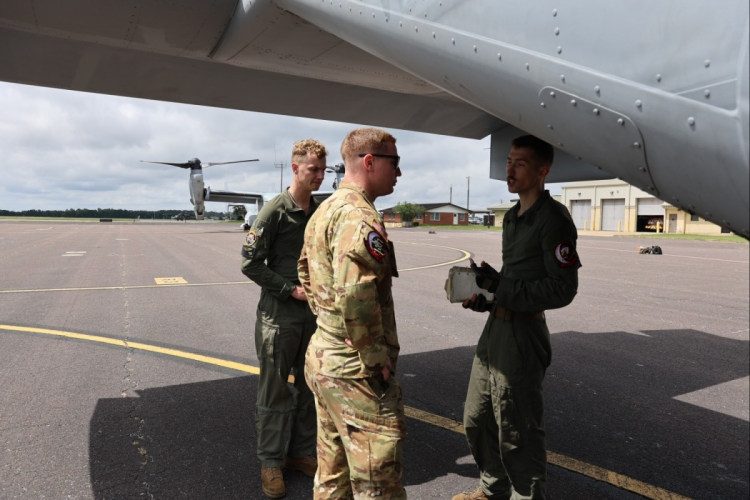
Bell MV-75 Cheyenne II (aka V-280 Valor)

Heavily disagree. Tech demos tend to look featureless and toyish.

As for the MV-75, has there been interest from other branches or foreign militaries? Any indications?
I would expect MV-75 to be the basis of the Leonardo-led team competing for the NATO medium lift helicopter replacement program.


There's been some discussion of tilt rotors replacing Seahawks and other Navy/Marine platforms, though with the incorporation of blade fold and wing stow. An MV-75 isn't getting shrunk to the size of a Seahawk when stowed, though, so anything with DDG capabilities will be a different platform.

 
There's been some discussion of tilt rotors replacing Seahawks and other Navy/Marine platforms, though with the incorporation of blade fold and wing stow. An MV-75 isn't getting shrunk to the size of a Seahawk when stowed, though, so anything with DDG capabilities will be a different platform.

Could this be the opportunity to revive SB-1 for the Navy?
 
Sadly, with such a low funding, I am dubious if any of the European Service requirements push through. Already we can foresee how most of the private choices made anteriorly to NGRC setup, are dominants in the contractors proposals.
Not good (probably).
 
Last edited:
Zero chance. SB-1 and Raider-X are right where they belong... in a museum.
Eh, Raider-X had the potential to be the best attack helicopter in US history. While Defiant X had some flaws, coaxials in naval environments have proven themselves for decades elsewhere.
 
Eh, Raider-X had the potential to be the best attack helicopter in US history. While Defiant X had some flaws, coaxials in naval environments have proven themselves for decades elsewhere.
The coaxial Kamovs with a long naval service history all have flapping rotors that are tolerant to turbulent airflows and are packaged to have good enough yaw authority. The X2 rigid rotors already have a rough ride and legendary vibration problems in smooth air, and these would just get worse in a naval environment. The propulsor and massive horizontal stabilizer drive up yaw inertia to the point that all of those aircraft have struggled with providing adequate yaw authority to military requirements.
 
The coaxial Kamovs with a long naval service history all have flapping rotors that are tolerant to turbulent airflows and are packaged to have good enough yaw authority. The X2 rigid rotors already have a rough ride and legendary vibration problems in smooth air, and these would just get worse in a naval environment. The propulsor and massive horizontal stabilizer drive up yaw inertia to the point that all of those aircraft have struggled with providing adequate yaw authority to military requirements.
Hmm, alright.

I didn't know it was that bad on the Sikorsky's
 
There's been some discussion of tilt rotors replacing Seahawks and other Navy/Marine platforms, though with the incorporation of blade fold and wing stow. An MV-75 isn't getting shrunk to the size of a Seahawk when stowed, though, so anything with DDG capabilities will be a different platform.

Bell has marketed versions of the V-280 that can be stuffed into the hangars of a DDG-51. I don't think the USN will bite, but it's a real proposal.
 
As for the MV-75, has there been interest from other branches or foreign militaries? Any indications?
There's been rumblings from USAF to replace the Pave Hawks in the CSAR squadrons, and I believe that once in service the Coast Guard will also grab it to replace their H-60s if they can get the budget. (I'm still bummed that the USCG couldn't get any Ospreys to replace their old Sea Kings back in the day!)

USMC will want to replace their H-1s with tilt-rotors, which means ~130 passenger tilt-rotors and ~175 attack. Though we could make an argument that the attack versions will be the V-247 UAVs instead of a development of the MV75.

There's the NATO helicopter program that could be an option as well.

I believe that Japan and Australia would be interested. Philippines and Indonesia would be other places where there's a need due to sheer area, but I don't know about budget to afford them.


I do not believe that the USN will take a tilt-rotor except maybe for CSAR squadrons and even then they have Ospreys available. The USN primary mission set (ASW and cargo slinging) spends a lot of time in the hover, and a helicopter has much better hover performance than a tilt-rotor.
Could this be the opportunity to revive SB-1 for the Navy?
No, the SB1 is too tall to fit into DDG hangars. Those were wrapped tightly around H-60 dimensions. Too tightly, IMO, but we're stuck with it now. Flight II Burkes should have been stretched ~20ft amidships for hangar space.

What I expect the USN to do is stick T901s into the Japanese SH-60K airframe, which is 6" taller and 12" longer than the base H60 airframe to make space for all the mission gear. If someone insists on higher speeds, they'll install a pusher prop on the back and maybe some wings, Cheyenne style, and be done with it.

 
Yes, because there is a cross shaft in that wing. Folding it is a huge problem.
They fold the tail of the H-53, and it's got a drive shaft in it.

But if you've got the overall length in the hangars for the wing to spin, do things the simplest way possible.

"Simplify, then add lightness."
 
But if you've got the overall length in the hangars for the wing to spin, do things the simplest way possible
Would assume that the Transformation be done on the deck.


And if need be to expect the Navy to look at a telescopic hanger deal like on the Frame cans to fit the length.
 
Would assume that the Transformation be done on the deck.
Right, I meant that if the hangar was long enough to hold the wing, not that they'd unfold things in the hangar.


And if need be to expect the Navy to look at a telescopic hanger deal like on the Frame cans to fit the length.
Possibly. That's an ugly option that gets in the way of flight operations, though.
 
There's been rumblings from USAF to replace the Pave Hawks in the CSAR squadrons, and I believe that once in service the Coast Guard will also grab it to replace their H-60s if they can get the budget. (I'm still bummed that the USCG couldn't get any Ospreys to replace their old Sea Kings back in the day!)

USMC will want to replace their H-1s with tilt-rotors, which means ~130 passenger tilt-rotors and ~175 attack. Though we could make an argument that the attack versions will be the V-247 UAVs instead of a development of the MV75.

There's the NATO helicopter program that could be an option as well.

I believe that Japan and Australia would be interested. Philippines and Indonesia would be other places where there's a need due to sheer area, but I don't know about budget to afford them.


I do not believe that the USN will take a tilt-rotor except maybe for CSAR squadrons and even then they have Ospreys available. The USN primary mission set (ASW and cargo slinging) spends a lot of time in the hover, and a helicopter has much better hover performance than a tilt-rotor.

No, the SB1 is too tall to fit into DDG hangars. Those were wrapped tightly around H-60 dimensions. Too tightly, IMO, but we're stuck with it now. Flight II Burkes should have been stretched ~20ft amidships for hangar space.

What I expect the USN to do is stick T901s into the Japanese SH-60K airframe, which is 6" taller and 12" longer than the base H60 airframe to make space for all the mission gear. If someone insists on higher speeds, they'll install a pusher prop on the back and maybe some wings, Cheyenne style, and be done with it.
To store the SB-1 and the Raider-X shipboard, a lot of actuation has to occur to stow the blades. Foldable blades also require blade locks which also have to be actuated plus strong enough for positive structural load margins. Now get into complexity and potential excessive weight for shipboard use. However, I think the coaxial twins could do well with land-based applications though. If LM could reduce the coax mast height, I think these could be very good birds for the right applications.
 
Making the rigid rotor coaxial compound seaworthy is near on impossible as @Hydroman points out above the excessive weight of the re-engineered rotor system alone would have been prohibitively weight intensive. Also the added systems might have compounded the already problematic vibration issues.

@Moose - with all of the bits and bobs that SOAR will want to stuff in the nose of the MV-75 I am not surprised with the ugly platypus nose.
 
@Moose - with all of the bits and bobs that SOAR will want to stuff in the nose of the MV-75 I am not surprised with the ugly platypus nose.
I'm starting to wonder how heavy the F-35 DAS is, sensors and computer(s) to stitch the different cameras together... Fit everything with DAS and call it done.
 

Looks like the U.S. Army is getting around to some of the other required efforts associated with bringing on a new aircraft.
 
I cannot wait for the LO SOF version of the -75. Some forebody faceting and chining, re-adding main gear doors, sharper nacelles, even more LO rear empennage… fun ship to work on at least some signature reduction aspects while dealing with an inherently un-stealthy design.
 

Attachments

  • IMG_4582.jpeg
    IMG_4582.jpeg
    8 MB · Views: 174
  • IMG_4583.jpeg
    IMG_4583.jpeg
    1.1 MB · Views: 144
  • IMG_4584.jpeg
    IMG_4584.jpeg
    998.8 KB · Views: 121
  • IMG_4587.jpeg
    IMG_4587.jpeg
    1.1 MB · Views: 114
Some interesting information on how the program is being worked.
It's easy to see the advantages of digital engineering, the challenges are going to come in-service, as you start to get variants in equipment fit across different units, and as the cheaper-in-the-long-run vs costlier-in-the-short run dichotomy of having to put every change into the digital twin as well as the actual aircraft flows down from PEO level into operational units.

Think of it as like comments in software, you don't need them right now, because you know exactly what you're doing and keeping them up-to-date takes time, but the guy who comes to do a change in ten years time absolutely needs to know what you did and how it works.
 
What I expect the USN to do is stick T901s into the Jaa0panese SH-60K airframe, which is 6" taller and 12" longer than the base H60 airframe

I was all set to say this didn't happen, but holy shit, it did! Attached is a Mitsubishi paper about the modifications for the SH-60K, including the cabin enlargement. Weirdly, that gets just a passing mention among all the other modifications.
 

Attachments

  • e425208.pdf
    166.4 KB · Views: 62
I was all set to say this didn't happen, but holy shit, it did! Attached is a Mitsubishi paper about the modifications for the SH-60K, including the cabin enlargement. Weirdly, that gets just a passing mention among all the other modifications.
Thanks for this... they also replaced the titanium blade spar used in the US Navy H-60's and the company has desired to get rid of the titanium spar line for years. Didn't realize the SH-60K was just a significant variant.
 
I would hope LM-Sikorsky can pull this revision back into the next-gen USN helo (I very much doubt the USN will go tilt rotor). The cabin stretch, improved rotor blades, and upgraded engines is basically just what the doctor ordered for an "MH-60X" naval helo. Maybe something different for weapon carriage, more like the ESSS wings on the Black Hawk.
 
I would hope LM-Sikorsky can pull this revision back into the next-gen USN helo (I very much doubt the USN will go tilt rotor). The cabin stretch, improved rotor blades, and upgraded engines is basically just what the doctor ordered for an "MH-60X" naval helo. Maybe something different for weapon carriage, more like the ESSS wings on the Black Hawk.
That I doubt.

Remember that a modern "lightweight" ASW torpedo is still some 800lbs. You want that as close to CG as you can get it, which likely means on a little stub pylon in line with where the rotor mast is.

Not that the next Naval helo won't have ESSS wings in addition, for when you're hanging Hellfires/JAGMs or APKWS on it.
 
Back
Top Bottom