Vertical Launch Surface to Air Missiles

Nike documentation lists one of the launch rail functions being to “guide the missile until airborne”. Which is to be expected if it’s depending wholly upon aerodynamic control for its stability. That’s conventional launch to me not VL.

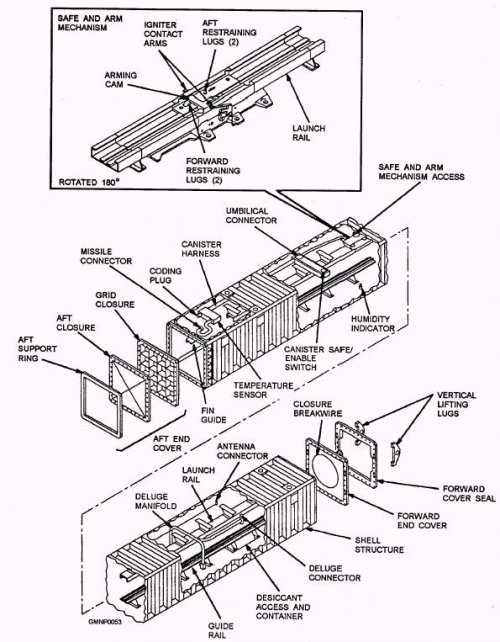
Mk 13 canisters (for SM-2) have a rail inside them, one purpose of which is to keep the missile straight (guide the missile) until it leaves the canister (becomes airborne). I feel like that's a distinction without a difference.

1753467057016.jpeg
 
It’s a rule, universally acknowledged, that every discussion of early missiles ends in a disagreement on the capabilities of German wartime developments. But here goes….

The wartime evidence for the state of development of the C2 is good, though the documentation is spread between archives in the US, UK and Germany. It’s quite easy to get hold of facsimiles of drawings, design documents, flight test reports, and discussions on the outstanding problems. These are primary sources from the Peenemunde development team. The post war intelligence interviews with senior and junior engineers from the team are also available online.

The documentation shows the C2 was where it could be expected after a year of flight testing in uniquely challenging conditions. It had not made any intercept trial against a target, had unresolved problems with air burst after engine cut off and the final five test flights were devoted to testing a new fin servo, at least the third type tried in flight testing. Four of the final five flights were deemed to be failures. And it had no proximity fuse or terminal homing seeker. The challenge of integrating it with its guidance system awaited.

Given the development test situation it would be remarkable for it to have been used operationally. And there seems to be no evidence for this at all.

Personally I think the C2 is an impressive technical achievement. The fact that its development was terminated with many problems left to be solved makes it more interesting, not less.

So I think it’s reasonable to judge the C2 as a remarkable prototype, but a significant way from being perfected.

Well, let's see. Guidance was Optical Command to Line of Sight. (Match the flare with the target by squinting through binoculars) Claims that better systems were in the works, but if they don't fly, they don't count.
Max Lateral Acceleration 6Gs.
No Proximity Fuze.

So what you've got is a Sea Cat, but bigger and with less performance.
 
Nike documentation lists one of the launch rail functions being to “guide the missile until airborne”. Which is to be expected if it’s depending wholly upon aerodynamic control for its stability. That’s conventional launch to me not VL.
On both Nike Ajax and Nike Herc, rail is shorter than the missile. Not much longer than the booster, in fact. Something coming from a VL Tube is being guided by whatever keeps it from rattling around in the tube for at least the full length of the missile. So a Tube Launch is actually "On the Rail" longer than the Nikes would be - and yes, being popped out in a cold launch still counts.
Nike's Vertical Launch also helped to decrease the Minimum Range of the system. Against a Low Altitude Target, the dart's motor startup was delayed, so that after booster burnout and separation, it could pitch into its dive more quickly, since it was going slower.
 
Brakemine was vertically launched ?
No but worked and was the result of multiple efforts.
Yes the missile itself needed revision, and some efforts were underway, when the program was shut down.
Critics of Beam Riding ignore that this method is still in military use.

But the critical point is that the UK, like others had multiple missile studies and efforts underway during WWII.
And again the deification of German efforts ignores the reality.
After examination and tests, none of the allies used them. They all focused on their own efforts.

BTW France did have several SAM efforts and there is threads on them on this site.
 
No but worked and was the result of multiple efforts.
Yes the missile itself needed revision, and some efforts were underway, when the program was shut down.
Critics of Beam Riding ignore that this method is still in military use.

But the critical point is that the UK, like others had multiple missile studies and efforts underway during WWII.
And again the deification of German efforts ignores the reality.
After examination and tests, none of the allies used them. They all focused on their own efforts.

BTW France did have several SAM efforts and there is threads on them on this site.
The title of the thread is “Vertical Launch Surface to Air missiles”. Brakemine apparently was never vertically launched. So it’s hard to see how it fits in here. What is its relevance ?
 
Well, let's see. Guidance was Optical Command to Line of Sight. (Match the flare with the target by squinting through binoculars) Claims that better systems were in the works, but if they don't fly, they don't count.
Max Lateral Acceleration 6Gs.
No Proximity Fuze.

So what you've got is a Sea Cat, but bigger and with less performance.
I’m pretty sure Sea Cat was not vertically launched ? Was there ever a proposal for this ?

This thread, as initially posted at least, was to identify fielded and proposed VL SAMs, and their relative timelines. So the “if it don’t fly it don’t count” would seem misplaced, as it makes it impossible to discuss proposals.

For a discussion on the merits of the C2 Waterfall, maybe start a new thread or revive a relevant old one with the facts you’ve laid out ? I would be happy to contribute. I can’t be the only one here slightly alarmed by the hijacking of so many threads for the “what did the Germans ever do for us” debate. It has a whiff of xenophobia.
 
Mk 13 canisters (for SM-2) have a rail inside them, one purpose of which is to keep the missile straight (guide the missile) until it leaves the canister (becomes airborne). I feel like that's a distinction without a difference.

View attachment 779143
Tom

I think the point you and others have made is correct. I was mistaken in considering the elimination of a launch rail as a necessary pre-requisite for a system to be considered VL. I was unaware of VL rounds that lacked a v=0 attitude control mechanism, such as TVC, and of canisters with dedicated launch rails.

On that basis Nike Ajax has to be considered VL, as do the rounds launched from various canisters with an internal vertical guide rail.
 
The title of the thread is “Vertical Launch Surface to Air missiles”. Brakemine apparently was never vertically launched. So it’s hard to see how it fits in here. What is its relevance ?
In the context of workable systems in the early years of course and the fact German efforts were just not worth it.
 
Here's some French vertical launch SAMs that were prototypes in the late 40's through the late 50's.

Sud Est SE 4400, a ramjet with solid fuel booster:

R.9948f36b9a69f9641ebef818c3f211b2


Sud Est SE 4300

OIP.QN3YyPMOwQ5ey3t4xZ9F-wHaJz


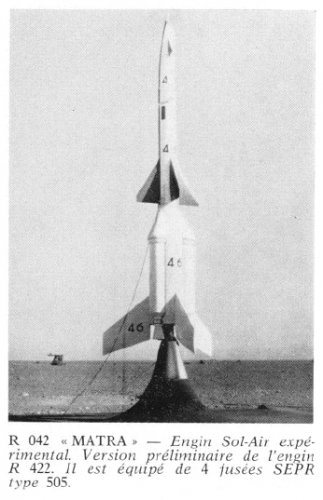
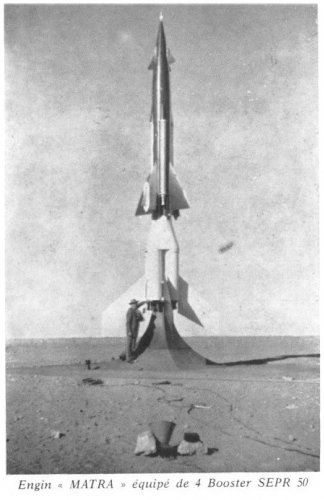
Matra R 422

79288-f2a35915d3d75ba07bbb3106da6f0a98.jpg


79292-232c60e0db8392c42026dabba578c7b6.jpg


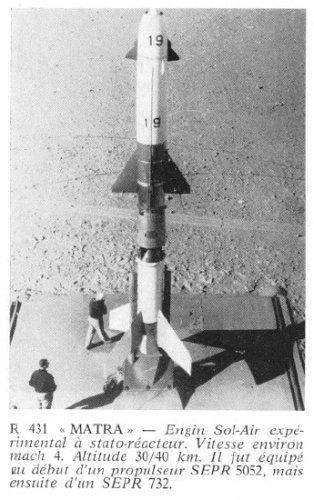
Matra R 431 ramjet SAM

79290-44b46b08d581c5e1ab6756445ab5852c.jpg
 
No but worked and was the result of multiple efforts.
Yes the missile itself needed revision, and some efforts were underway, when the program was shut down.
Critics of Beam Riding ignore that this method is still in military use.
Yes beam riding is still in use but it is almost exclusively limited to optical wavelengths, the one exception to my knowledge being the 9M123 Khrizantema which employs a secondary millimeter wave guidance.

Use of Lasers and very high frequencies mean that the issues with beam riding guidance, namely the increasing spread of the guidance beam, are minimized. This spread reduced accuracy at range and when combined with a low altitude aim point the reflections off the water/land would cause the missile to drift up, likely missing the target.

Radar Beamriding was always understood as a stopgap measure until better homing methods could be refined. Moving to the modern era where radar homing types haven't replaced it, variations of command guidance have largely supplanted it's specific niche both for complete guidance systems for short range systems and as a midcourse phase for longer range ones.
 
Yes beam riding is still in use but it is almost exclusively limited to optical wavelengths, the one exception to my knowledge being the 9M123 Khrizantema which employs a secondary millimeter wave guidance.

Use of Lasers and very high frequencies mean that the issues with beam riding guidance, namely the increasing spread of the guidance beam, are minimized. This spread reduced accuracy at range and when combined with a low altitude aim point the reflections off the water/land would cause the missile to drift up, likely missing the target.

Radar Beamriding was always understood as a stopgap measure until better homing methods could be refined. Moving to the modern era where radar homing types haven't replaced it, variations of command guidance have largely supplanted it's specific niche both for complete guidance systems for short range systems and as a midcourse phase for longer range ones.
Beam riding is also energy inefficient reducing the missile's potential range. On the other hand, it makes jamming the missile's guidance much harder to accomplish.
 
Beam riding is also energy inefficient reducing the missile's potential range. On the other hand, it makes jamming the missile's guidance much harder to accomplish.
Utilizing a separate tracking and guidance radar can aleviate this somewhat (it was the schematic for Talos' midcourse guidance) but of course that introduces extra complexity into the system.
 
Utilizing a separate tracking and guidance radar can aleviate this somewhat (it was the schematic for Talos' midcourse guidance) but of course that introduces extra complexity into the system.
Nike did the same thing. At the time, these sorts of systems were the best that could be managed largely due to the state of data processing at the time. One interesting point on Nike is that the missile tracking / guidance radar also contained the command guidance system signals that were generated and transmitted through it rather than using a separate channel, antenna, and transmitter.
 
Regarding Wasserfall guidance; keep in mind that almost nobody ever again had such big & slow (long string of 6-aircraft combat boxes of big B-17s and B-24s) targets as did the Germans.
The only exceptions post-may 45 were bombing Japan in 45 and Korea in very early 50s.

We're not talking about a need to hit a single jet here. So post-war choices are irrelevant.
The C2 barely needed any guidance at all IF IT HAD A FUNCTIONING PROX FUSE.
 
Regarding Wasserfall guidance; keep in mind that almost nobody ever again had such big & slow (long string of 6-aircraft combat boxes of big B-17s and B-24s) targets as did the Germans.
The only exceptions post-may 45 were bombing Japan in 45 and Korea in very early 50s.

We're not talking about a need to hit a single jet here. So post-war choices are irrelevant.
The C2 barely needed any guidance at all IF IT HAD A FUNCTIONING PROX FUSE.
It would still matter. The Wasserfall's warhead wasn't large enough to ensure a kill from simply flying through a bomber box. There's a lot of space between the bombers in a box, sufficient that you need accurate guidance. Against an RAF bomber stream, without precision guidance it was worthless. Messerschmitt got the idea correct with Enzian in using a 500 kg warhead. That was getting a warhead big enough to still work with a near miss.

The biggest issue wasn't the lack of a proximity fuze but rather the lack of a reasonably efficient guidance system. What the Germans had in 1945 was essentially hobbled together from bits of existing electronics into a crap system. They needed an automated radar tracking system like SCR 584. That wasn't happening. They needed millimeter wave radar. That was barely beyond prototype stage when the war ended. They need a decent fire control computer to do all the calculations. That was barely at the design phase. Their electronics industry wasn't up to the task of producing what they needed in anything close to a timely fashion.

Note, that Nike used command detonation rather than a proximity fuze and it worked because it could get close enough to the target to ensure a take down.
 
There were blast tests done to determine warhead size.
Wasserfall W10's about 300 kg warhead was rather on the cery big end.

I try to remember to show the blast test results when I'm back from vacation.

IMO the Wasserfall threat would have ended combat box usage and thus greatly helped the fighter force.

SAM effectiveness over land isn't all about damage done, it's very largely about changing the enemy's behaviour.
 
There were blast tests done to determine warhead size.
Wasserfall W10's about 300 kg warhead was rather on the cery big end.

I try to remember to show the blast test results when I'm back from vacation.

IMO the Wasserfall threat would have ended combat box usage and thus greatly helped the fighter force.

SAM effectiveness over land isn't all about damage done, it's very largely about changing the enemy's behaviour.
More likely, if somehow it were effective, and I seriously doubt that given nobody could get it to work postwar either, I'd expect the USAAF to simply send fighter-bombers ahead of the strike and have them obliterate the firing sites.

Outside of that, given the Wasserfall as the Germans built it, had about 25 km (14 NM) and a one missile-at-a-time engagement sequence, a typical site might get 2, possibly 3 with optimal conditions, shots off. Given a likely Pk of around 10% using one of the proposed guidance systems--at most--I'd say it would have been largely ineffective.

As virtually every successful SAM post war shows, what the Germans needed was something like Rheintocter using a much better solid fuel than double base nitrocellulose (aka diglycol) as booster propellant with either a solid fuel or liquid fuel sustainer on the missile. That way you point the missile at the target and let it beam ride to it. That simplifies guidance and reduces the amount of electronics you need to get the system to work.

In Vietnam, with B-52 raids, once the US started heavily using ECM on the guidance system of that SAM the Pk fell to about 2 to 3%. The Russians added an optical (TV) backup system (ground based) to it with manual control to make the missile workable in the face of heavy jamming. The USAAF was already heavily jamming German radar systems including every proposed one for guiding Wasserfall.
 
Those fighter bombers would not be escort fighters at high altitude and thus the Wasserfall threat would have helped the German fighter force even more.

Check out the mobile A-4/V-2 launcher. Impossible to find before launch.
The great SCUD hunt of 1991 and 8th AF impotencevs. V-2 show the survivability.

Check out the MCLOS images here
http://www.luft46.com/missile/wasserfl.htmland let's get back to VL SAMs.
 
Sigh....

In context.
In context of the 1940's to the 60's radar beam riding was entirely valid and affordable technique for guidance. What worked counted.

In context.
It's still viewed as a valid system, albeit for SHORAD primarily against slower flying platforms.
Yes LPI datalinks now allow command guidance as does fibre optic cable.

In context.
In context the simple beam rider has target tracking and missile guidance combined into the same radar.
Inefficient definitely but over the course of relatively short ranges acceptable.
With a more sophisticated tracking and guidance radar system more capability can be squeezed out of this at modest cost.
Seaslug was but one of several such systems of the times. The UK continued such efforts upto PT.428.

In context.
In context Seaslug under Type 901 guidance gained a pk of 0.6 and multiple impacts on targets upto and including supersonic at over 40,000ft and 28nm.
Not bad.

In context.
Primitive 'command guidance' can be achieved by separation of target tracking and missile guidance.
Essentially the beam can be offset and then progressively brought to point at the target's current location, provided by tracking.
Which can provide a much more efficient flightpath.

In context.
The basis of an AH version of Seaslug could indeed have gained such along with VL. Though likely at the expense of other efforts and arguably somewhat late.
 
Looking at the debate about what counts as Vertical Launch and what doesn't, I'm inclined to think the vertical element is being over-emphasized. The fundamental issue is not so much 'is the launch angle straight up,' but 'is placing the missile on the desired initial trajectory determined by the launcher, or by the missile'.
 
The fundamental issue is not so much 'is the launch angle straight up,' but 'is placing the missile on the desired initial trajectory determined by the launcher, or by the missile'.
I think we should refine that to "is placing the missile on the desired initial trajectory determined by the launch system or the guidance system"
As we shouldn't assume the missile itself holds that system.
 
I think we should refine that to "is placing the missile on the desired initial trajectory determined by the launch system or the guidance system"
As we shouldn't assume the missile itself holds that system.
Fair point, however the dynamics part does have to be on the missile.
 
I think we should refine that to "is placing the missile on the desired initial trajectory determined by the launch system or the guidance system"
As we shouldn't assume the missile itself holds that system.
In the case of Nike, the first 2.5 seconds of launch has it going straight up--more or less--on the booster with the controls locked like a bottle rocket. It gets to speed, and the booster falls away. The missile at that point becomes controlled and is turned to head to the target. For that first 2.5 seconds, what's keeping it going up in a straight line are the aerodynamic surfaces on the missile and booster, not the minimal launch rail.

The rail is an erector more than launcher. It's designed to allow the missile to be easily loaded in the horizontal position then when firing is to be done, raised quickly to vertical and the missile fired.
 
It's twist-steer system was copied on other British SAMs including Bloodhound and Thunderbird for example.

The Thunderbolt didn't use twist-and-steer, it used conventional tail-fins in an "X" arrangement.

Nike's Vertical Launch also helped to decrease the Minimum Range of the system.

Near vertical, the Nike Ajax and the Nike Hercules were launched three-degrees from vertical.
 
With Nike, the booster alone was sufficiently powerful (55,000 lbs. thrust) that it could launch a Nike Ajax to about 50,000+ feet without the actual missile being powered. The missile engine wasn't that powerful and was almost entirely intended just to keep the missile moving at speed overcoming drag and not much more.
 
Back
Top Bottom