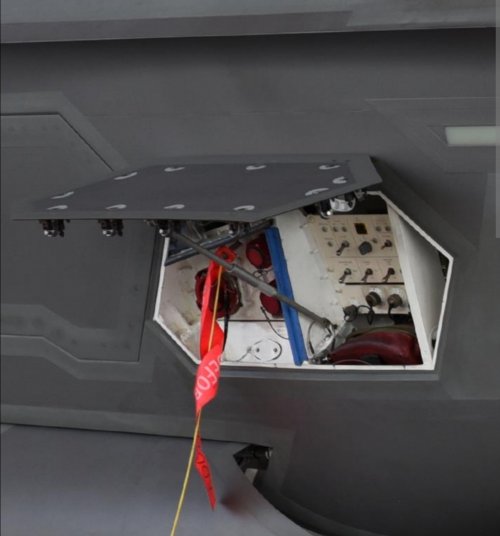
It looks like one of the ground-crew didn't properly tighten the panel's fasteners after closing it.
 
Also, It lost apparently more than the panel, the black box attached to that multiple connector trailing in the airstream must be somewhere!

Edit:
Probably not much:
161208-F-DY859-1743.JPG
 

Attachments

  • Screenshot_20250719_133529.jpg
    Screenshot_20250719_133529.jpg
    187.1 KB · Views: 45
I was wondering
what if, when using the EOTS, the camera view gets obstructed with that frame?
does the aircraft rolls or pitch a bit to compensate that?
 
This story is crazy. If your are indulgent enough to think people are reading too much here, just read back this thread's very lines putting yourself 20 years back and replacing F-35 by F-117.

And then, go back even further in time, 50 years or so, switching Lightning for Foxbat...

Let's hope I am wrong because that would be so disappointing.
 
Last edited:
I can’t pull the transcript at the moment but your favorite Ferrari NASCAR name dropping CEO mentioned a step function in capability. As much as Jim is prone to hyperbole, I don’t think he was referring to an updated -35, no matter how much better.
 
https://www.twz.com/air/reworked-f-...ed/Sales&utm_source=Sailthru&utm_medium=email
Lockheed admitted to taking huge losses on a “highly classified” aeronautical program.
The CEO again stated the aspiration to develop modifications to the F-35 that mean the company can offer 80 percent of the effectiveness of a sixth-generation fighter, at 50 percent of the cost per unit. Taiclet added that, in terms of matching capabilities, the 80 percent figure also referred to the degree of stealth, as well as “other aspects.”

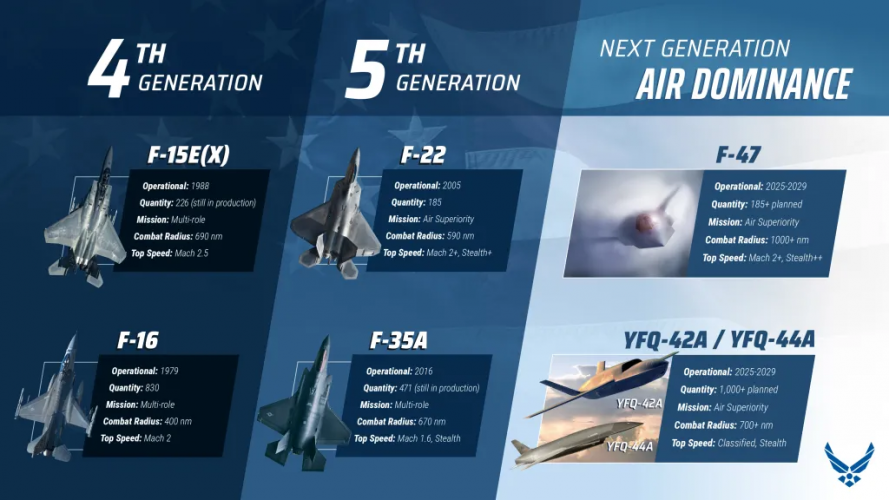
According to David Allvin, the sixth gen F-47 is "Stealth++" aircraft. The stealth degree of F-35+ is 80% of the six gen aircraft. Therefore, I suppose the "F-35+" may be a "Stealth+" aircraft like the F-22.
1753248252335.png
 
Last edited:
Is Polymarket taking wagers on if this Classified Aerospace Project LM is F-35+?
 
Funny... a few years ago, when the Swiss were running an earlier competition to replace their F/A-18s, the candidates were Typhoon, Rafale, and Gripen.
Typhoon was dropped first, then the Gripen was finally selected over the Rafale - mostly due to the cost difference allowing for purchase of more Gripens within the planned budget.
Yes and No.
There was a leak of the results of field test, and Gripen didn't reach the minimum level in most fields. So it must have been ruled out, leaving EF and Rafale.
 
The Swiss evaluation wasn't one single data point. There was the Belgium and the Finnish competitions which arrived at the same conclusion. The advantage the F-35 has is mostly down to capability and volume. It is clearly a more capable aircraft but the volume of production and fleet size makes it cost competitive.
???
thanks to simulation.
It will be very interesting to see a F-35 going to rescue a lost Cessna... in simulation.
 
According to David Allvin, the sixth gen F-47 is "Stealth++" aircraft. The stealth degree of F-35+ is 80% of the six gen aircraft. Therefore, I suppose the "F-35+" may be a "Stealth+" aircraft like the F-22.
View attachment 778858
Probably just sensor and EW upgrades at best - so all the magic or anything revolutionary isn't going to be obvious at all. The more obvious upgrades are not going to be realistic and/or affordable - stuff like radical changes to the outer mold line or adding new or an additional engine as at that point, you might as well be pitching a new aircraft.

In my opinion, the more meaningful and important part of this isn't so much "how can we continue squeezing more money with F-35s". It would probably be how to build off the technology developed for the NGAD competition and continuingly mature that in an existing platform so that in the future, Lockheed could pick up upgrade contracts or even take over the contract for the major parts of the F-47. In that sense, F-35 benefiting from these changes is the side effect while the main intent is to remain competitive against Boeing in the future.
 
Probably just sensor and EW upgrades at best - so all the magic or anything revolutionary isn't going to be obvious at all. The more obvious upgrades are not going to be realistic and/or affordable - stuff like radical changes to the outer mold line or adding new or an additional engine as at that point, you might as well be pitching a new aircraft.

In my opinion, the more meaningful and important part of this isn't so much "how can we continue squeezing more money with F-35s". It would probably be how to build off the technology developed for the NGAD competition and continuingly mature that in an existing platform so that in the future, Lockheed could pick up upgrade contracts or even take over the contract for the major parts of the F-47. In that sense, F-35 benefiting from these changes is the side effect while the main intent is to remain competitive against Boeing in the future.
I mean, A100/A101 engines getting developed out would be good. There has got to be a way to have what I'm reading as a 3-spool engine drive the LiftFan.
 
I mean, A100/A101 engines getting developed out would be good. There has got to be a way to have what I'm reading as a 3-spool engine drive the LiftFan.
If you are referring to XA100/XA101 engines, last I heard (from Kendall during an HASC meeting), those engines will fit in the A variant but questionable as to whether they fit the C variant and definitely not in the B variant so the key to making that happen is at the very minimum getting it to fit inside the C variant.

Someone has to pay for it though and so one would hope that since the navy won't pay for it, one or many of our allies can be convinced to pay for it. I can see Japan and Israel having an actual use case for the extended range from a 3 stream engine. Maybe Australia too.
 
Last edited:
If you are referring to XA100/XA101 engines, last I heard (from Kendall during an HASC meeting), those engines will fit in the A variant but questionable as to whether they fit the C variant and definitely not in the B variant so the key to making that happen is at the very minimum getting it to fit inside the C variant.

Someone has to pay for it though and so one would hope that since the navy won't pay for it, one or many of our allies can be convinced to pay for it. I can see Japan and Israel having an actual use case for the extended range from a 3 stream engine. Maybe Australia too.
I don't understand why they wouldn't fit into a Charlie.
 
I don't understand why they wouldn't fit into a Charlie.
Agreed. Remember the F135 is common to all three variants. Yes, that in the B model has some differences bu the core engine remains identical. Any replacement would be the same. That said, the likelihood of a replacement is EXTREMELY unlikely.
 
Agreed. Remember the F135 is common to all three variants. Yes, that in the B model has some differences bu the core engine remains identical. Any replacement would be the same. That said, the likelihood of a replacement is EXTREMELY unlikely.
IIRC, somehow the early adaptive engine designs weren't capable of driving the LiftFan, so were not able to be installed in the Bravos. And the F-35 Program Office said in no uncertain terms that all F-35s must fly on the same engines, so any re-engining must be able to drive the LiftFan.

As to why XA100/XA101 weren't able to drive the LiftFan, I have no clue. Nobody is sharing comparative images with adaptive engine on one side and F135-600 on the other.
 
I don't understand why they wouldn't fit into a Charlie.
Agreed. Remember the F135 is common to all three variants. Yes, that in the B model has some differences bu the core engine remains identical. Any replacement would be the same. That said, the likelihood of a replacement is EXTREMELY unlikely.
Ask Kendall. He expressed doubt as to whether it can or cannot fit in the C version when he announced that they would not be moving forward with those two engines.

These were pretty much his exact words here.

"...if there was something I regretted it was effectively we are not able to afford it. I support the decision that we did make, which is to go with the ECU which is the upgrade to the existing engine [ F135 ]. The AETP alternative offers significantly more cost, more range, and more fuel efficiency ... the only service that had a strong interest in that engine was the air force... there's a question as to whether or not you could get the AETP into the navy's version..."
 
It had been reported that the C variant tailhook system would need to be re-engineered. Not sure how extensive that work would have been.
Which could be something as simple as the new exhaust using internal volume that’s free on the A but used by an actuator on the C.

In a non stealth world, you would have options like around adding an external fairing, but any change to the outer mould line is going to be much more complex on F35.

Then again, the tail hook geometry on the C was never simple.
 
Which could be something as simple as the new exhaust using internal volume that’s free on the A but used by an actuator on the C.

In a non stealth world, you would have options like around adding an external fairing, but any change to the outer mould line is going to be much more complex on F35.

Then again, the tail hook geometry on the C was never simple.
I'd have to assume some solution could be found were there enough genuine interest in switching to the XA100 or XA101. It seems the Navy doesn't want to invest any money in such a program and might use any excuse they can find to avoid that possibility. For all of the talk over the years of how much the Air Force loathed ever having to adopt a "Navy aircraft" like the F-4 and A-7 it seems the Navy is no different when the situation is reversed. Despite the USMC-focused STOVL variant being a central part of the program going back to long-before the JSF days I get the sense they don't view it "their" aircraft. And I doubt it has anything to do with capability since in most respects it is better or at least no worse off than the E/F model F/A-18.
 
Very impressive.

The microphones and my computer speakers don't do the F-35 justice. Compared to that video and even the quartet of Thunderbird F-16s, the F-35 has a chest-rumbling deep bass to it. (Last year the locals had the Thunderbirds and the F-35 demo pilot showing off) It's not any louder than the F-16s, you could just feel the F-35's engine in your chest. Which means the F-35 engine noise carries farther.
 
Why not the F-35B?

Third stream engines of similar diameters rely on cores with smaller diameters.

F-35B lift fan is driven by a shaft. The shaft is put in motion by the engine during its rotation.

The torque put by the engine on the shaft is a function of the rpm and engine diameter.

Rpm is a limiting factor for any engine as it is driven by the engine admissible temperature range.

Small diameter cores and larger one have generally the same temperature limits that depends on available engine technology at a time for an industrial.

You can now understand why the F-35B isn't offered a 3 stream engine without drastic modifications like an increase in fuselage size, a gear driven fan etc...
 
Very impressive.

The microphones and my computer speakers don't do the F-35 justice. Compared to that video and even the quartet of Thunderbird F-16s, the F-35 has a chest-rumbling deep bass to it. (Last year the locals had the Thunderbirds and the F-35 demo pilot showing off) It's not any louder than the F-16s, you could just feel the F-35's engine in your chest. Which means the F-35 engine noise carries farther.
Is definitely a different pitch, sound so different to the Hornets I am used to.

Indeed, but then it lacks nearly all its kinematic energy = a turkey in the sky, easy to shoot.
It's Oshkosh, not Top Gun...
 
Not really: Mig29, F-18 and Mirage 2000 have shown us that having the ability to trade aggressively some speed for large alpha is a serious threat constantly in the mind of any opponent with an aspiration to survive the fight. It impacts the way they have to manage the fight, pushing them away from their performance corner.
F-35 large alpha offset is also comfortably done in yaw allowing the fighter to increase its turn rate at a very low G (the pedal turn), at any moment. Good luck dealing with that while blasting any cognition out of your brain at 9g.
 
https://www.defenseone.com/policy/2...06934/?oref=d1-category-lander-featured-river
The Air Force will increase procurement again when it can buy “F-35s that are most relevant for the fight,” Gen. David Allvin told Defense One on the sidelines of the Royal International Air Tattoo.

"In the end, because we have limited financial resources, we need to make sure that the F-35s we buy have the capability to meet the pacing threat. So, some of the delays with respect to Block 4 and TR-3 weighed into decisions by the department,” Allvin said.
 
Defense Updates has put out a video concerning the UK's getting B61 Mod 12 nukes for its' F-35As:


For the first time since at least 2008, U.S. nuclear weapons have reportedly been redeployed to British territory, with multiple sources indicating that several B61-12 thermonuclear gravity bombs were transferred this week to RAF Lakenheath in Suffolk.The weapons were most likely transported from the U.S. Air Force Nuclear Weapons Center at Kirtland Air Force Base in New Mexico to a newly modernized secure storage site at Lakenheath, which has undergone significant infrastructure upgrades in preparation for the revival of its nuclear role.​
The deployment of U.S. nuclear weapons in the UK began in 1954, initially at RAF Greenham Common and RAF Molesworth, and later extended to RAF Lakenheath. During the Cold War, Lakenheath served as a key site for U.S. nuclear forces; the last known removal of these weapons occurred in 2008 as part of broader disarmament efforts across Europe.The reported redeployment marks a significant shift in NATO’s nuclear posture in Europe, reflecting heightened tensions with Russia and a renewed focus on strategic deterrence.The Federation of American Scientists estimates that the total number of U.S. B61-12 bombs stationed in Europe has risen from approximately 100 to around 125–130, with a portion of these now believed to be deployed at RAF Lakenheath.​
In this video, Defense Updates analyzes how the UK getting B61-12 nuke for its F-35As will greatly augment deterrence against Russia?
#defenseupdates #b61mod12 #f35fighterjet
Chapters:
0:00 TITLE
00:11 INTRODUCTION
01:49 SPONSORSHIP - NordVPN
02:23 B-61 MOD 12 NUKE
04:45 F-35A FLEET AS B-61 MOD 12 CARRIER
06:18 ANALYSIS

Personally I think the UK should also seriously consider spending the money to rebuild and recommission its' WE177 bombs.
 
https://www.spiegel.de/politik/deut...eplant-a-0d71cf71-eb13-4aa1-ad27-41500beae03e
https://www.aero.de/news-50361/F-35-Umbau-von-Buechel-wird-erheblich-teurer.html
The Federal Ministry of Defense needs 644 million euros in the short term to create “weapons system-specific infrastructure” at the Büchel base.

This is reported by the news magazine “Der Spiegel”, citing a confidential submission to the budget committee. The F-35 conversion of the air base, initially estimated at 700 million euros and later at 1.2 billion euros, is now expected to cost 1.948 billion euros.
 
The WE-177 have been out of service since 1998 so I do not think that it would be good to bring them back NMaude, if the RAF were wanting its own nuclear capability back they should design their own nuclear bombs and missiles and only use the B-61s as a stand in until the UK bombs enter service.
 

Similar threads

Back
Top Bottom