European hypersonic projects

muttbutt

ACCESS: Secret
Joined
31 January 2010
Messages
422
Reaction score
608
There seems to be a pick up in the work happening around here so I think it deserves its own thread at this stage

https://aviationweek.com/aerospace-...hing-high-speed-propulsion-make-2021-comeback.
In Europe, Norway appears to be taking an early lead in high-speed/-hypersonic missile development, building off joint work with the U.S. on the Tactical High-Speed Offensive Ramjet for Extended Range (THOR-ER) Allied Prototyping Initiative demonstration program.

Nammo also is progressing with its proposed ramjet-powered artillery shell, which it unveiled in conjunction with Boeing in 2019. Nammo plans to have the round on the market for 2023-24, ready for use in Norway’s new K9 Vidar self-propelled artillery.

France is following closely behind with hypersonic efforts associated with enhancing its air- and sea-launched deterrent. The first likely to deliver results is the V-MAX Experimental Maneuvering Vehicle, which is expected to undertake a first flight during 2021. ArianeGroup is apparently the lead company for the project.

Secrecy continues to surround developments for the ASN4G, the weapon that is scheduled to replace the nuclear-armed ASMP-A air-launched missile in the deterrent mission beginning in 2035. Budget documents published in October show France is spending €1 billion ($1.2 billion) on modernization of the deterrent with the ASN4G expected to take a substantial chunk of the money.
Officials say they are looking for a balanced improvement on range and speed over the ASMP-A but note the future weapon still will need to be compatible with the Dassault Rafale, which will be the primary carrier aircraft until at least 2040.

France also is leading pan-European efforts with Finland, Italy, Netherlands and Spain to hammer out requirements for a missile-defense capability that could provide intercepts of hypersonic and supersonic cruise missiles under the Timely Warning and Interception with Space-based TheatER (Twister) initiative.

Across the English Channel, decades of hypersonic missile research may be poised to bear fruit. Ongoing studies by the UK Defense Ministry with France to replace the Exocet and Harpoon with a high-speed anti-ship missile by the late-2020s offer an opportunity to consider hypersonic options.
 
The Italian MOD, CIRA national aerospace research agency, MBDA & various private companies have started an R&D project for a hypersonic aircraft called HYPERION (Suborbital HYPERsonic spaceplane capable to support payload In Orbit iNsertion)

The aim of the project is the development of enabling technologies for a suborbital aircraft useful for '' extension of the air defense capability (surveillance and interception), against the new threats introduced by hyper-fast weapon systems.
Couple of PDF's etc in Italian.

https://www.difesa.it/Amministrazionetrasparente/segredifesa/armaereo/Pagine/determine2020.aspxhttps://www.difesa.it/Amministrazio...ocuments/ARMAEREO_2020/DAC0481del01092020.pdf
 
So it's the day after the annual (at this stage) EU funded defence projects announcements day...So mazel tov!

Anywho....the other side of the hypersonic race, defence,


ODIN’s EYE will set the basis for the development of an autonomous European early warning capability supporting
defence against ballistic missiles and novel hypersonic threats.
The project “multinatiOnal Development INitiative for a Space-based missilE earlY-warning architecture” (ODIN’s EYE)
contributes to the development of a European a space based missile early warning (SBMEW) capability to create a
situational threat awareness against ballistic and hypersonic threats and generate the basis for European or national
actions.
Through its initial studies, requirement definitions and architectures trade-offs ODIN’s EYE initiative will set the
basis for a future multilateral predevelopment programme of the SBMEW capability to serve the European strategic and
security goals.

https://ec.europa.eu/defence-industry-space/odins-eye_en
 
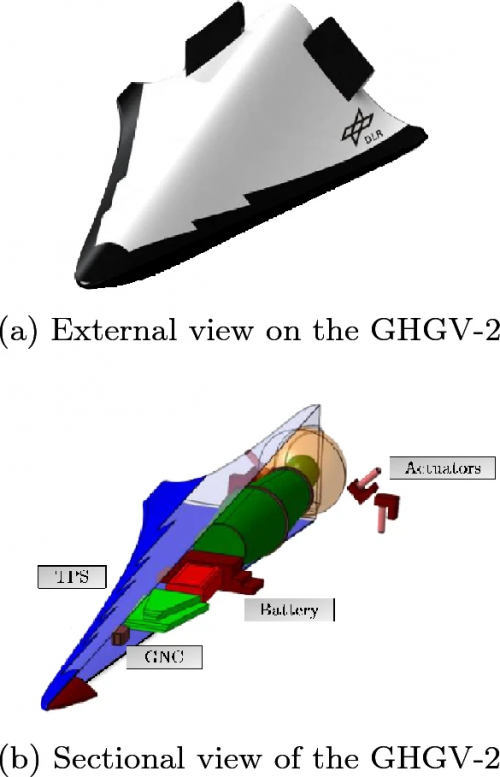
I liked DLRs all rocket spaceliner. Maybe some landing jets. Switch out with unmanned hypersonic boilerplates for the second stage…a real airframe to test.
 
Hi.

Lots of fundamental research performed at the AGARD/NATO VKI von Karman Institute documented in their numeros conference proceedings. Their test facilities enabled overseeing every kind of project. That would be a good place to stard to gain an overview of European hypersonic projects.

A.
 
MBDA hypervelocity SSM concept
DJXBZSo.jpg
 
More on the ASN4G hypersonic nuclear tipped missile:

Ainsi, on apprend que les « travaux technologiques » relatifs à cet ASN4G ont commencé dès les années 1990, « en parallèle de la prépation de l’ASMPA [A pour amélioré, ndlr] et qu’ils se sont « clairement orientés vers le domaine des très hautes vitesses ».

« Depuis, nous avons avons des moyens nous permettant de tester le missile et de simuler le vol de l’ASN4G en hypervélocité », a affirmé l’amiral de Bonnaventure, avant de précisé que MBDA a mené, en cotraitance avec l’ONERA, des études sur l’hypersonique dès les années 2000-2010, dans le cadre des programmes PROMETHEE 1, 2 et 3.

« Les performances de l’ASN4G sont encore meilleures que celles de l’ASMPA-R [R pour rénové, nldr]. L’ASN4G devrait être opérationnel à horizon 2035 et devra le rester au-delà des années 2050 : il est donc nécessaire d’anticiper les défenses sol/air de l’adversaire à cet horizon », a-t-il ajouté. D’où la mise en place au sein de MBDA d’un bureau d’étude réunissant une « dizaine de collaborateurs », chargés de mener une « continue sur la défense adverse ».

Or, a poursuvi le conseiller du Pdg de MBDA, « il apparaît que la très haute performance en vitesse et en manœuvre est la meilleure méthode pour parvenir à être détecté le plus tardivement possible, et compliquer la tâche de suivi d’un radar, voire, d’accrochage, et, enfin, à désorganiser une attaque d’un missile antimissile ».

Pour rappel, l’ASMPA-R a la particularité de pourvoir suivre plusieurs trajectoires [basse altitude, très basse altitude et haute altitude] afin d’échapper aux radars adverses. A priori, il en ira de même avec l’ASN4G… mais à des vitesses beaucoup plus élevées. « Nous entrons dans le domaine de l’hypersonique. Le facteur de charge sera, lui aussi, multiplié en phase terminale pour leurrer les défenses adverses », a insisté l’amiral de Bonnaventure.

Enfin, a-t-il conclu, « l’ASN4G, grâce à son encombrement et son poids limités, sera compatible avec le Rafale et catapultable par un porte-avions, conformément aux objectifs définis par le Président de la République. C’est une réussite technique unique au monde ».
---------------------///-----------------------------

Thus, we learn that the "technological research" relating to this ASN4G began in the 1990s, "in parallel with the preparation of the ASMPA [A for improved, editor's note] and that they were "clearly oriented towards the field very high speeds.

"Since then, we have aquired the facilities allowing us to test the missile and to simulate the flight of the ASN4G in hypersonic flight", affirmed Admiral de Bonnaventure, before specifying that MBDA carried out, in co-contracting with ONERA, hypersonic studies from 2000-2010, as part of the PROMETHEE 1, 2 and 3 programs.

“ASN4G performance is even better than ASMPA-R [R for refurbished, nldr]. The ASN4G should be operational by 2035 and will have to remain so beyond the 2050s: it is therefore necessary to anticipate the ground/air defenses of the adversary by this horizon”, he added. Hence the establishment within MBDA of a design office bringing together “ten employees”, responsible for conducting a “continuous on the opposing defense” [a red team].

However, pursued the adviser to the CEO of MBDA, "it appears that very high performance in speed and maneuvering is the best method to achieve detection as late as possible, and to complicate the task of tracking for a radar, or even , achieving a lock, and, finally, to disorganize an attack of an anti-missile missile system”.

As a reminder, the ASMPA-R has the particularity of being able to follow several trajectories [low altitude, very low altitude and high altitude] in order to escape enemy radars. it is understood that it will be the same with the ASN4G… but at a much higher speed. “We are entering the field of hypersonics. The load factor will also be multiplied in the terminal phase to deceive the opposing defenses,” insisted Admiral de Bonnaventure.

Finally, he concluded, “the ASN4G, thanks to its limited size and weight, will be compatible with the Rafale launched from an aircraft carrier, in accordance with the objectives defined by the President of the Republic. It is a unique technical achievement in the world”.

https://www.opex360.com/2023/03/12/...osante-aeroportee-de-la-dissuasion-francaise/
 
After looking at some MGCS stuff i remembered that the ATGM for it based on latest news was supposed to be hypersonic which probaly relates back to the ~2010 where there was news about a development of an hypersonic ATGM against Armata.
From: https://esut.de/2025/01/fachbeitraege/55003/auf-dem-weg-zum-main-ground-combat-system/

" Hypersonic missiles
Hyper-velocity missiles (HVM) reach a flight speed of more than Mach 5, which is about the same output speed as the on-board cannon. At the target, the velocity of the projectile is significantly lower, while the rocket engine of the HVM is controlled in such a way that the missile reaches its maximum speed when hitting the target. The HVM penetrator can be designed solely for functional requirements for effectiveness in the target without regard to ballistics.
The possible high weight of the penetrator, in combination with the high final velocity (Mach 7 has already been exceeded), results in an energy input to the target that is significantly higher than the cannon projectile.
The combat distance of the HVM overlaps with the on-board cannon. The HVM is steered to the target via an active radar seeker head. The highly agile missile allows lateral acceleration in the three-digit g-range. This can be used to combat stationary and moving targets. Top attack is possible. The possible autonomous control and the high flight speed make defensive measures by the enemy more difficult.
The development is well advanced. Next year, the system will reach TRL 6. Then the controllability is to be proven with a regulated shot. After that, a guided shot is required, among other things to prove that it can be integrated. In 2027, the decision on the use of the system in the MGCS could be made.
"
 
https://www.energy-reporters.com/in...ritics-warn-of-safety-and-financial-disaster/
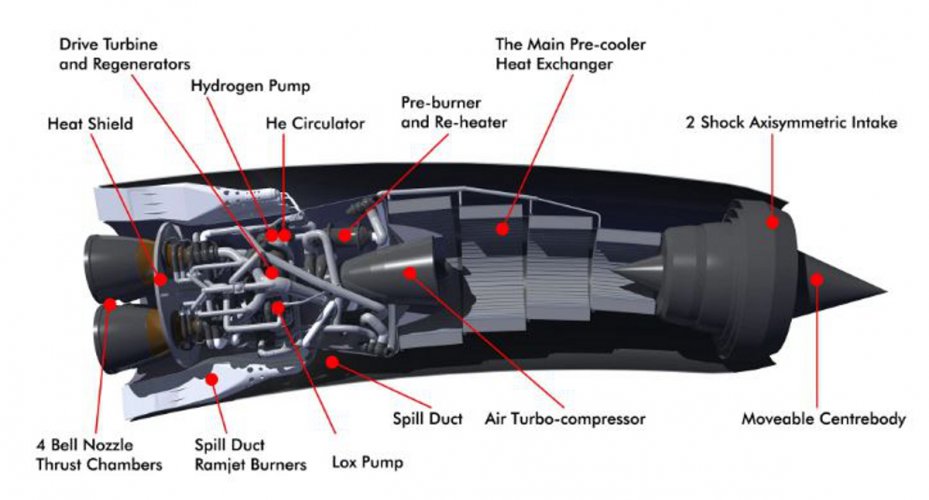
https://www.esa.int/Enabling_Suppor...NVICTUS_Europe_s_new_hypersonic_test_platform
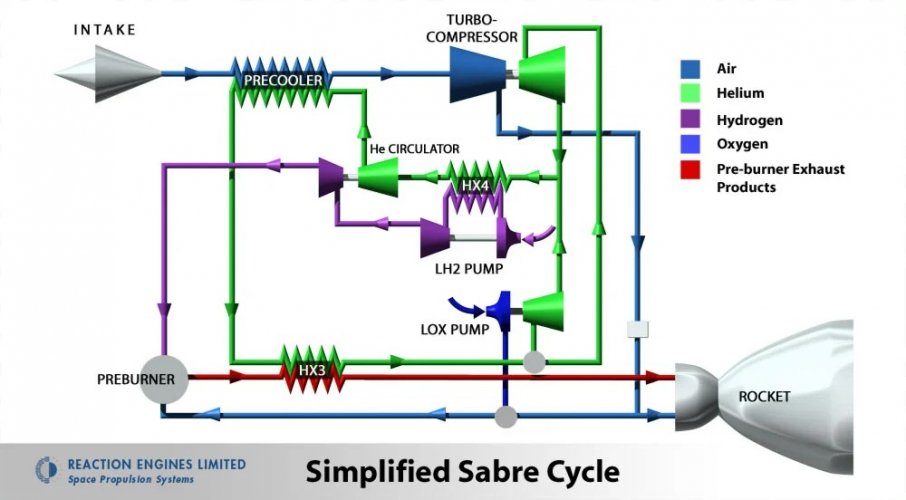
David Perigo, ESA's chemical propulsion engineer and the program's technical lead, explains: "The INVICTUS program will prove the suitability of a hydrogen-fueled precooled air-breathing propulsion system for horizontal take-off and hypersonic flight. It will provide an invaluable opportunity to test the complete engine flow path, from intake to afterburner, at full scale in an integrated aircraft."
The precooler system, building on technology developed through ESA's SABER study, was designed by UK-based Reaction Engines Ltd and funded through ESA's GSTP in its initial stages.
 

Attachments

  • sabre engine.JPG
    sabre engine.JPG
    307.2 KB · Views: 12
  • 7e9b6328-c08b-4c96-ade6-391e3cc89234.jpg
    7e9b6328-c08b-4c96-ade6-391e3cc89234.jpg
    74.3 KB · Views: 23
  • Illustration of a conceptual supersonic aircraft developed by the European Space Agency aiming...jpg
    Illustration of a conceptual supersonic aircraft developed by the European Space Agency aiming...jpg
    112.4 KB · Views: 40
Last edited:
I just found this picture in my files simply titled "ASN4G 2020" and i'm wondering : are these canards/control surfaces ?
It doesn’t really make sense, since they would likely melt at those speeds.
Sadly i can't find the original picture on the internet for a higher quality

I already posted on the canards previously … and i believe we can see them again in this picture of the THEMIS demonstrator

https://www.defense.gouv.fr/dga/act...eloppement-du-missile-hypersonique-asn4g-mbda

The DGA orders the development of the ASN4G hypersonic missile to MBDA​


Direction: DGA / Published on: June 11, 2026
  • On June 2, 2026, the Directorate-General for Arms (DGA) notified MBDA of the framework agreement for the realisation and the development of the fourth-generation nuclear Air-to-Ground missile (ASN4G).

  • Its commissioning will take place in 2035. It will be implemented by both the Strategic Air Force and the Nuclear Naval Air Force. He will be carried away by the Rafale F5.

Demoniser Themis

The performance of ASN4G, and in particular its hyper-speedity, will maintain the credibility of airborne deterrence in the face of evolving threats.

In accordance with the military programming law, the DGA is working on the modernisation of the airborne nuclear component. The ASN4G missile will replace the renovated ASMPA missile currently in service.

In a technological break with previous systems, ASN4G is based on technological and industrial know-how that few countries in the world have.
 

Attachments

  • image.jpeg
    image.jpeg
    10 KB · Views: 35
  • image.png
    image.png
    1.5 MB · Views: 49
Last edited by a moderator:
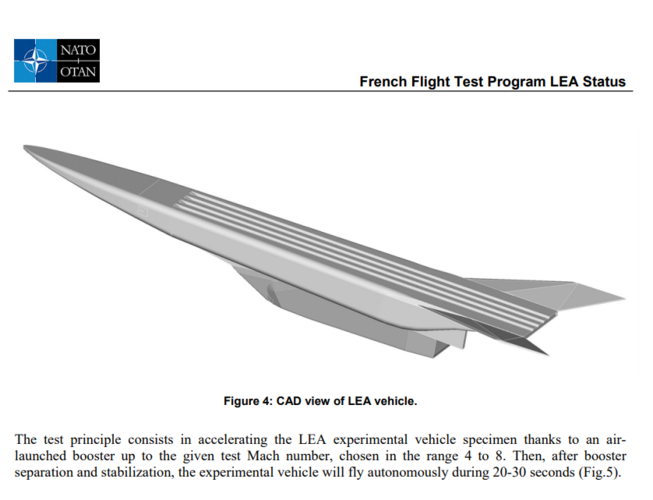
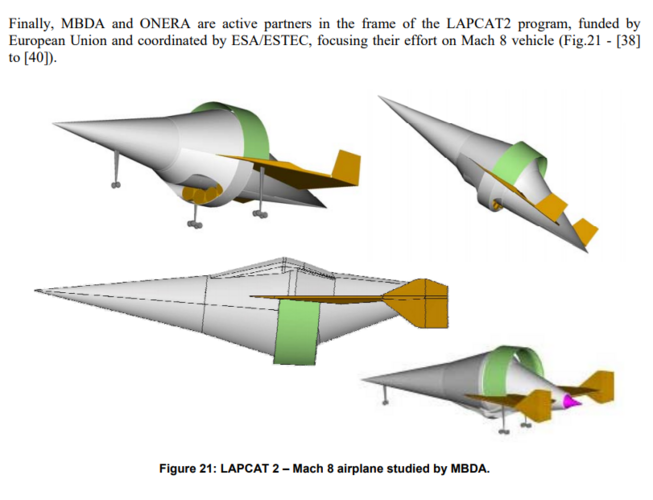
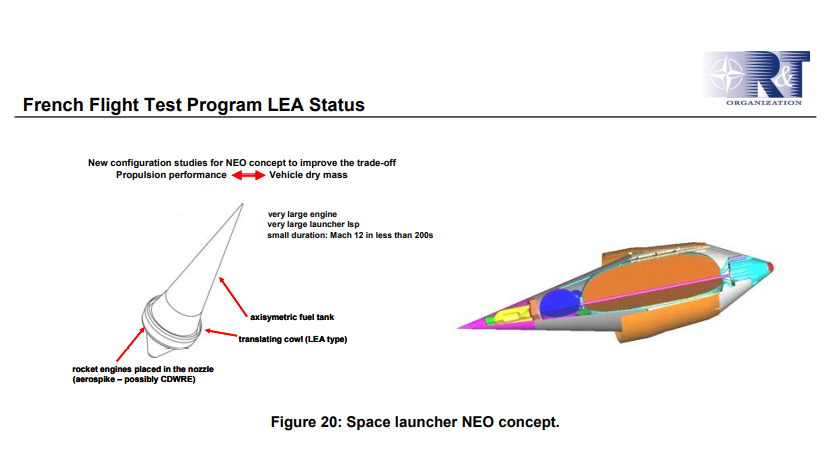
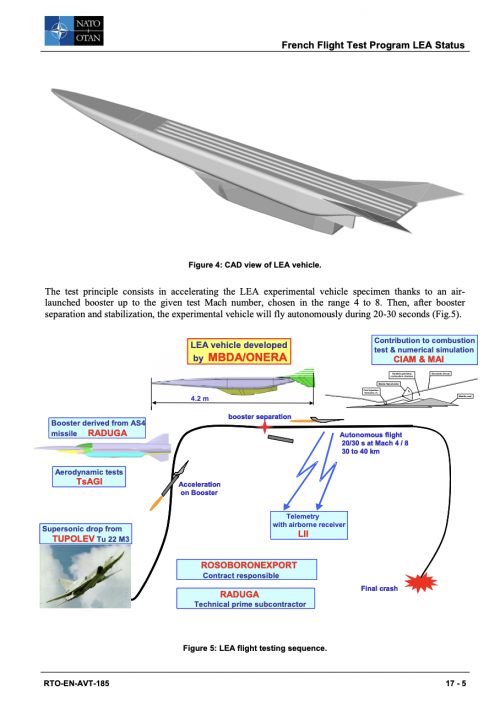
2003-2015 LEA Study by MBDA France and ONERA (with russian partners … times have changed)

https://apps.dtic.mil/sti/pdfs/ADA593055.pdf

French R&T effort for hypersonic airbreathing propulsion is focusing on needed technologies for the propulsion system and acquisition of aero-propulsive balance prediction capability. A large part of technology development effort can be led on ground and is currently dedicated to combustion chamber to ensure its performance and thermo-mechanical strength. On the contrary, it is mandatory to flight demonstrate capability to predict the aero-propulsive balance. In that view, MBDA and ONERA are leading the flight testing LEA program. Started in January 2003, the program will end in 2015 after 4 autonomous flight tests of an experimental vehicle in Mach number range 4 to 8. Guidelines for LEA vehicle and its propulsion system design have been validated in 2006 by a Preliminary Design Review.
The running Phase 2 aims at getting a detailed design while validating the aero-propulsive configuration by a first free jet test series to be performed early in 2011. It led to a Critical Design Review performed in June/July 2009…


Capture d’écran 2026-06-15 à 01.01.19.png
 

Similar threads

Back
Top Bottom