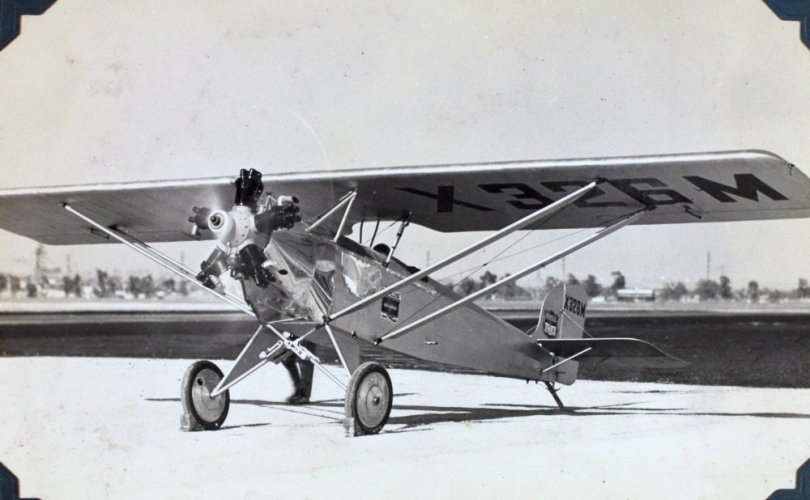
this picture comes from the collecition of the San Diego Air and Space Museum (SDASM) on Flickr. I mean it is particular interesting because it does not look too primitive like other homebuilts, and it wears a registration number. But alas, "(N)X326M, according to aerofiles.com, is assigned to a Cessna CG-2 glider.
A couple of years ago, I requested the name of this aircraft at key.aero, but nobody knew it. Do you?
this picture comes from the collecition of the San Diego Air and Space Museum (SDASM) on Flickr. I mean it is particular interesting because it does not look too primitive like other homebuilts, and it wears a registration number. But alas, "(N)X326M, according to aerofiles.com, is assigned to a Cessna CG-2 glider.
A couple of years ago, I requested the name of this aircraft at key.aero, but nobody knew it. Do you?
Interesting... I love a good aviation mystery, and this one fits the bill! Plus it's my favorite era of aviation...
And I can see that you already asked the question at theaerodrome.com as early as 2014, but received no answer (which is hardly surprising, they are strictly into very early aircraft and not very welcoming in general, I found).
Now I love a good aviation mystery even more when I'm able to solve it, and I think I just DID!
The registration [326M] is entirely logical for a Cessna CG-2 glider, since the entire 300M to 349M sequence was allocated to Cessna: most of those were CG-2 gliders (from c/n 2 to c/n 46), receiving registrations 304M to 349M. The exceptions, 322M, (the CS-1 sailplane), 337M (a Cessna AW) and 343M (the CPG-1 powered glider version of the CG-2) were still Cessna airplanes, but the aircraft in the photo is clearly no Cessna.
c/n 22, supposed to have been [326M], is one of the very rare Cessna gliders for which no data is available at all, so it would be possible that the glider was cancelled and the reg was reassigned, but it is unlikely, because if it had crashed, had been destroyed or had been de-registered, there would be evidence of that.
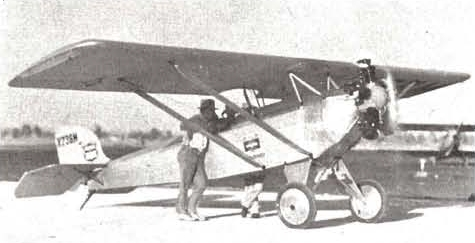
Years of researching have given me some precious habits; one of them is to envisage the possibility that the guy in charge of painting the aircraft got a case of dyslexia, since that happened on several occasions... So my next hypothesis was: "what if the REAL registration should have been X236M, but there was a mix-up?" So I checked on X236M (c/n 3), and it says: Campbell "Super Sport", registered to M. M. Campbell, Los Angeles, Calif., a single-/two-seat open-cockpit parasol-wing monoplane with Kinner K-5 engine. Hmm... Parasol-wing? Check. Kinner K-5 engine? Also check! Now take a look at this photo of X236M... it's the same aircraft, but with the rego fixed!
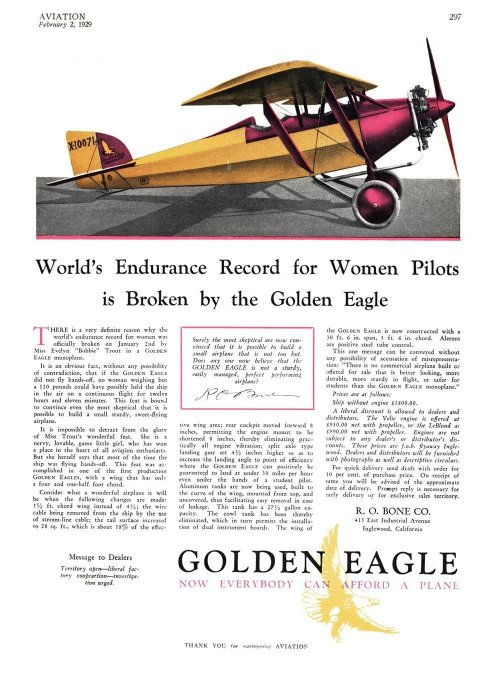
Some more searching indicated that the "Super Sport" was in fact the prototype for the "Bone Golden Eagle C-5." Indeed! The sole C-5 (C207E, c/n 105) received Group 2 Memo Approval 2-107 and was a development of the "Super Sport". It was developed into the Parasol B-2 (464, c/n 106) and Parasol P-2 (X10071, c/n 702) (differences unknown, both with Velie engines) the latter of which you can see in the advertisement below. A third Parasol of unspecified version was (C98E, c/n 704), possibly with a Le Blond engine; all these aircraft came out in 1928.
Fascinating answer, Stargazer! I never really expected anybody would solve this riddle! Best and especial thanks to you!!!!!
Well, I am German, and I have to say, in Germany, confusing registration signs is a mortal sin. Nobody would ever do this. So I would have never been able to personally get on that track.
Additional thanks for expanding my vocabulary with items "dyalexia" and "rego".
Fascinating answer, Stargazer! I never really expected anybody would solve this riddle! Best and especial thanks to you!!!!!
Well, I am German, and I have to say, in Germany, confusing registration signs is a mortal sin. Nobody would ever do this. So I would have never been able to personally get on that track.
Additional thanks for expanding my vocabulary with items "dyalexia" and "rego".
Brilliant detective work! And I love that you've factored the possibility of dyslexia into your searches (a good approach for checking the work of data entry people and copy editors of the past as well as sign painters). A non-dyslexic possibility is that the painter was working inboard from the wingtip. (Working backwards when lettering came really do a trip on your brain!)
FWIW, 'rego' for registration is an antipodean slang (Aussies and Kiwis do love creating diminutives).
This site uses cookies to help personalise content, tailor your experience and to keep you logged in if you register.
By continuing to use this site, you are consenting to our use of cookies.


 )
)