
That's all you need to know: the British were in the wrong.British law forbade textile workers to share technological information or to leave the country.

That's all you need to know: the British were in the wrong.British law forbade textile workers to share technological information or to leave the country.
I do not believe that is true with Starship being able to lift 100 tonnes at a time into LEO. And being re-launched every week or faster.On the other hand, ICBMs are cheaper to build than ICBM defense, so rather than hit the nuclear armageddon button, our adversaries might just prefer to deploy a few more warheads.
Exactly.MAD is not workable with more than two nuclear powers in the equation.
I'm not sure y'all have that nuclear powered cruise missile figured out yet, but I'll give you the hypergliders.Russia already have unconventional delivery systems (like hypersonic gliders, underwater drone-torpedoes and nuclear powered cruise missiles), so our minimal deterrense is assured anyway.
No, it's actually easier than when you know there is a launch coming.Boost phase intercept is easier in a test when you kow there will be a launch, but few seconds time window instead of minutes time window for decision-making is impractical.
Correct. The US has absolutely bullshit absurd levels of "freight-to-orbit" capabilities now, including re-launching Starships every week or even every few days. Falcon 9s or Heavies can be relaunched every 48 hours or so... Heavies are lifting 50 tonnes at a time, F9s ~17-20 tonnes, and Starships 100 tonnes.The main bottleneck would likely be kinetic interceptors production.
They probably aren't right now, but they could be. I'm assuming mass production of the SM3 EKV and 3rd stage, personally, and sticking them into a garage with the longer-ranged sensors and extra pointing motors to get the EKV mostly lined up for the intercept.I rather doubt that they are made on hundreds-per-month basic.
You should stop embarrassing yourself.No, it's actually easier than when you know there is a launch coming.
Boost-phase intercept can safely assume that any unknown launch is an attack. Someone launching rockets? They make announcements to the world that they're doing it (or they're supposed to). Which means that any unannounced launch is an attack on someone. So you engage every single unannounced launch. Same raw logic as behind a CIWS computer.
CIWS: IF (constant bearing, decreasing range), THEN engageBPI: IF (unannounced launch), THEN engage
No waiting for permission to engage. Someone launching a rocket without having issued a NOTAM to keep planes out of the flight path is at the very least actively threatening everyone flying, so their rocket needs to be shot down.

Don't be absurd. They would develope ICBM even without Hsue-Chu Tsien; it would just took them more time. They got all the basics from R-2 missile (the Soviet major improvement of German V-2 design, licensed to China) and they also received at least some data about R-5 IRBM. The Hsue-Chu Tsien contribution was very valuable, of course, but not irreplaceable.The only reason China has an ICBM program is because the US deported one highly skilled rocket scientist to China. All of this could have been prevented by a less stupid immigration policy

You mean mutually assured likelihood of damage. Not destruction. Since we're talking about the US here, the majority of nuclear states do not possess the capability to "destroy" the US through nuclear weapons, regardless of where we put the threshold (e.g. ⅓ or ¼ of population), simply because of factors like number of targets, number of warheads per target, missile/warhead availability, attrition of launchers/missiles, and defense efficiency.1. The stable state is the status quo of mutually assured destruction
Why would that be destabilizing?2. It would be destabilizing because there would be no more mutually assured destruction, just unilateral destruction possible by the side with the defense (blue team) against the side without the defense (red team)
Assuming your theory about mutually assured destruction is correct,3. Red team would have to threaten to launch a counter-force strike prior to the defense going into effect. The hope would be that the threat of nuclear annihilation would convince blue team not to finish the defenses. As blue team constructs the defenses, red team would eventually reach a point of "use it or lose it" with regard to their nuclear arsenal.
How? Because BLU would use some of their warheads to destroy RED in retaliation?A counter-force strike by red team would be prudent as it would reduce the number of warheads available for blue team to use on red team.

As clearly was the case for every non-nuclear state...???Once blue team has an impenetrable defense, red team is at their complete mercy, and must bend to their will or else take nuclear weapons to the face.
Pretty much the status quo right now though.Let's imagine, however, that blue team constructs the defenses without incident, no nuclear use by either side. Blue team later learns that red team is working on 1) their own defenses, and 2) nuclear delivery systems able to penetrate blue team's defenses.
I'm not saying it can't happen, but so far through every time we've been through this loop - how many times have nations nuked each other?Faced with possible future annihilation, blue team will be incentivized to strike now while it is still safe and effective to do so.
Shirley, you can see it's a bit of a reach.4. In reality, golden dome will never be fully constructed
Right.China (and perhaps even Russia) will be able to keep MAD intact by keeping their offensive capabilities ahead of any golden dome developments.
I can't argue against trusting the good will of an enemy, so here I conceed.The game theory of MAD has been studied for many many decades. The US and the Soviet Union signed treaties limiting missile defense development, as such development could be destabilizing. We're fortunate that golden dome is merely a grift to redistribute wealth from the average American taxpayer to the Silicon Valley robber barrons, and not an effort with a legitimate chance at acheiving its stated aims.
The only reason China has an ICBM program is because the US deported one highly skilled rocket scientist to China. All of this could have been prevented by a less stupid immigration policy. Considering the current US regime is doing everything in their power to attack universities and drive students away... I don't see anything good in the future.
1: Hypersonics fly *low* compared to ICBMs, and are thus more difficult to detect and track on long range radar.HGVs travel rather slowly. Mach 5 missiles can be intercepted by lasers or particle beam weapons.
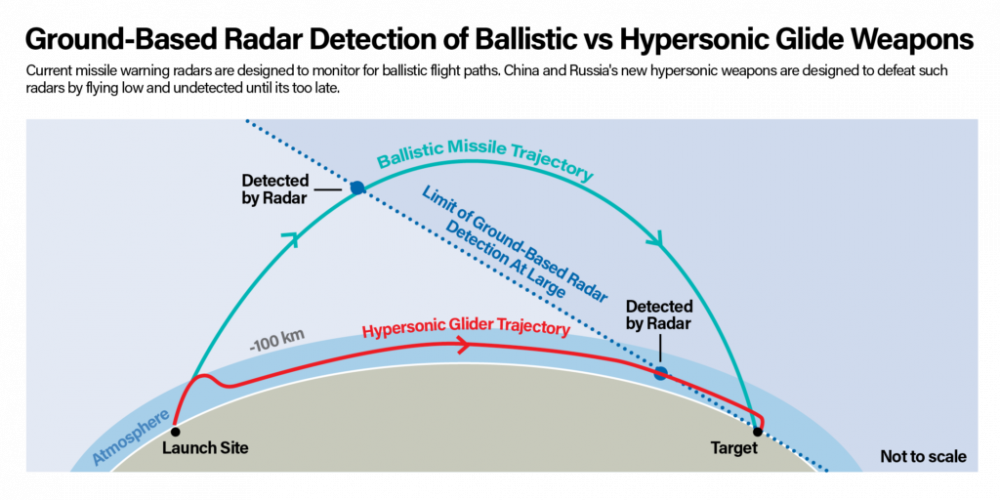
1: Hypersonics fly *low* compared to ICBMs, and are thus more difficult to detect and track on long range radar.
2: Flying low, Mach 5 missiles are in the air. Which means ground and air based lasers have to shoot through a *lot* of atmosphere to get them, only to likely encounter an incandescent sheath of air around them: opaque to lasers. And you're not using particle beams in the atmosphere.
View attachment 771335
While doubtless an adorable little laser, such a thing is unlikely in the extreme to be useful against hypersonics. It might be great against drones or even subsonic cruise missiles, but missiles that flash from horizon to horizons faster than you can mechanically track 'em?
While doubtless an adorable little laser, such a thing is unlikely in the extreme to be useful against hypersonics. It might be great against drones or even subsonic cruise missiles, but missiles that flash from horizon to horizons faster than you can mechanically track 'em?
OK. I've selected a launch site. Now talk.Nonsense. Mach 5 is slow. The SR-71 flew at Mach 3.2. "horizon to horizon" is not specific. Select a launch site. Go ahead. Then we can talk.
Okay, let's try Mach 6 missile (a nice, neat 2 km/s) flying at 30 km directly over the laser site (for simplification). The missile would be visible above horizon at about 670 km range. It would fly straight directly over laser & disappear over the horizon at the opposite side.Nonsense. Mach 5 is slow. The SR-71 flew at Mach 3.2. "horizon to horizon" is not specific. Select a launch site. Go ahead. Then we can talk.
You're not understanding.Aggressor claims civilian space launch gets a big rocket through, 5 1 Mt @500 km alt over CONUS, devastating EMP. U.S. is back in 1890 without 1890 skills and tools.
Except for all the planes flying through the launch zone. And wherever the staging drop zones are.Nonsense, the intercept altitude is far above 40k ft, no aircraft are there.
And they'll be off the day that Mach 8 missile flies by.My mind reading powers are turned off today.
You're not understanding.
I'm saying that any undeclared rocket is attacked automatically. No human interaction required.
Any declared rocket still gets watched by a human.
Except for all the planes flying through the launch zone. And wherever the staging drop zones are.
Stop embarrassing yourself.
You watched too many Hollywood movies. While EMP is annoying, it's nowhere as destructive as shown in movies. Quite a lot of crucial infrastructure is resistant to EMP by definition; put into Faraday cages or grounded metal hulls to reduce their electromagnetic emission (which also protects them from external emission). Modern microelectronic is surprisingly resistant to EMP, due to small size and very short conductors (just no length for the charge to build up). And most of modern data net run on optical cables, which are completely immune to EMP.Aggressor claims civilian space launch gets a big rocket through, 5 1 Mt @500 km alt over CONUS, devastating EMP. U.S. is back in 1890 without 1890 skills and tools.

Yeah, one little detail - technology marched on quite significantly since then. Most of modern commercial electronics is orders of magnitude smaller (and EMP-resistant) than 1980s military tech. Optical data cables in 1980s were novelty; nowadays, they and wireless are the backbone of the data connections. And increasing standards about electromagnetic pollution caused increasingly more efficient shielding over enery-producing and distributing plants.Actually, that EMP scenario is firmly rooted in science and has been published 40+ years ago already.
Almost nothing had an antenna in 1980, almost everything worked without intact microprocessors.
Back in 1980 telecom landlines were the issue. Now it's everything. A company collapses if it cannot process invoices, regardless of everything else.
Actually, that EMP scenario is firmly rooted in science and has been published 40+ years ago already.
Five 1 Mt warheads exploding 500 km above CONUS can affect electronics from so many directions that practically all civilian (computing, not power) electronics would be damaged or destroyed.
related https://apps.dtic.mil/sti/tr/pdf/ADA424218.pdf
https://en.wikipedia.org/wiki/Qian_Xuesen?wprov=sfla1Nonsense. This suggests that someone in authority let this happen. It would be helpful if you named this deported person.
Starship is currently an experimental system.Pardon me, had to read the whole thread and catch up.
I do not believe that is true with Starship being able to lift 100 tonnes at a time into LEO. And being re-launched every week or faster.
Falcon 9 is doing so. Falcon Superheavy seems to be in line to be there.Starship is currently an experimental system.
There is no guarantee it will operate as advertised.
Falcon 9 is doing so. Falcon Superheavy seems to be in line to be there.
My personal guess is, *nothing* will ever be enough for the lone Elon.Are they enough, though?
Good. From such yearning comes advancements. Being satisfied leads to stagnation.My personal guess is, *nothing* will ever be enough for the lone Elon.

No, not enough power.I am amazed at some of the replies. During the Cold War, there was "launch on warning." The person in charge had 15 minutes to decide. As submarine launched missiles appeared, launch on warning was more and more justified. HGVs travel rather slowly. Mach 5 missiles can be intercepted by lasers or particle beam weapons.
Missile Defense Agency preps $151B contract vehicle for Golden Dome
MDA previewed a draft solicitation for work on the ambitious missile-defense system.
In January 2025, President Donald Trump announced a bold initiative to strengthen America's defenses against a new generation of missile threats with the launch of the "Golden Dome"—a comprehensive missile defense system. Drawing inspiration from Israel's Iron Dome and echoing the vision of Reagan’s Strategic Defense Initiative, the Golden Dome is designed to create a layered shield capable of intercepting ballistic, cruise, and hypersonic missiles, as well as potential orbital strike systems.
Underscoring the urgency of the mission, President Trump declared that the United States must not fall behind in missile defense capabilities. To lead the initiative, U.S. Space Force General Michael Guetlein has been appointed project head. He will oversee coordination among military and industry stakeholders, including Lockheed Martin, which is targeting delivery of the first defensive systems by the end of next year—mobilizing American innovation and industrial capacity at an unprecedented scale.
In this video, Defense Updates analyzes how President Trump’s Golden Dome could provide US with a robust protective umbrella?
#defenseupdates #goldendome #usmilitary
Falcon Superheavy can lift 50 tonnes to orbit every launch. So I'd say Superheavy could do the job, but we'd need several times more Superheavies than Starships to launch the same weight per week.Are they enough, though?

