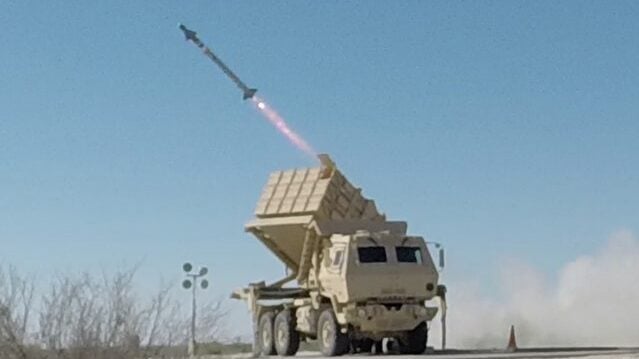
For counter drone applications, the JCO (US Army) likes to present industry problems and challenges and allow them to present mature, and rapidly maturing solutions to those problems. Last year, they focused on some swarm defeat problems with a few OEM's showcasing some gun defeat systems including 20 and 30 mm based guns. Northrop Grumman has proposed larger gun based solutions but so far no one has gone out built one and tried competing with EW, DEW and other soft or hard kill systems against large number of very small to small drones.
 
These were 2019 demonstrations, but there could well be additional variants that are demonstrated over the next year or so in support of the C-DAEM Increment 1 effort. Interestingly, the Army does indeed want a Hit To Kill weapon against the specific target types and Excalibur IB has already demonstrated a range of 62 km from early ERCA prototype testing so is likely a preferred solution.


https://www.twz.com/land/army-wants...s-to-work-cooperatively-to-find-their-targets
 
could/should be the beginning of the most important defense development in the western world but will likely languish and be forgotten.
can only infinitely repeat the above .
 
I fully admit that I'm not an expert and just a dedicated enthusiast.

With some older SPAAG models being deployed in Ukraine and seeing some success, plus Russia, China, and some EU-NATO countries having SPAAG's within their respective inventories, I don't understand why the US isn't looking to develop a dedicated modern SPAAG to combat this drone revolution.

I'm aware the US Army currently has the Sgt. Stout M-SHORAD Strykers, DE-SHORAD Strykers, and JLTV M-SHORAD models, including some that use electronic warfare and energy weapons with both the US Army and USMC (MADIS, etc.), and then we have the old Avengers with a rapid-firing .50 cal and Stingers.

However, with the future of warfare likely involving drones for quite awhile, I'm wondering why the US hasn't displayed interest in putting together a modern SPAAG. Perhaps they can use the AMPV as a base platform, which should have the survivability, internal room for customized systems and operation, the upgraded engine/power generation required, and the capability to install an unmanned modular turret.

Such a concept would be 4 x 30mm autocannons using the new 30x113mm XM1223 Multi-Mode Proximity Airburst (MMPA) round. This may be difficult, but ideally this model would also have a remote weapons station that could be installed, depending on the specific design layout to find an appropriate location, which would allow for an M2 to provide close perimeter defense without distraction from its primary mission.

One significant advantage would be modern current-generation optics technology and AI-assisted target identification and auto-tracking, using onboard radar and perhaps even a second band of radar like the USN Phalanx to track the effectiveness of the fired rounds and adjusting in real-time. Integration into the IBCS would be a clear goal. The additional auxillery energy may also allow for such a model to include electronic warfare/jamming capabilities and a supplemental energy weapon such as the Leonidas or a specific laser that has tested well in the field. Survivability can be increased by installing the Trophy APS hard-kill system, which recently announced at least partial effectiveness against FPV drones and top-attack ATGM's.

If something like this could be developed, even without that "dream" list of features, it could still be paired with a JLTV to enable some of those secondary features, such as the RWS M2 for perimeter defense and a microwave energy weapon for anti-swarm capability to supplement the autocanons. I believe this thing would be an absolute drone killing monster and ultimately ensure the cost-benefit solution swings back over to the US regarding the cost per drone kill compared to the cost per attacking enemy drone, at least on a per-shot basis excluding the R&D and production investment, but such equipment should serve for decades and ultimately payoff.

Any respectful thoughts are encouraged. Also, my apologies if this is the wrong place to propose theorized equipment, as it only notes aspects of recent systems developed rather than actually being a program confirmed as in development.
It's obviously not inevitable for armies to widely deploy mobile C-UAS systems, but why does it have to be in the form of a SPAAG?

A SPAAG dedicates most of its usable space and/or mass, as well as crew attention to its complex firing system, which unfortunately is comprised of just one element.

In the modern battlefield there will be an abundance of medium caliber cannons, machine guns, and other shooty stuff. So why do you need another medium caliber cannon but this time with a crew that doesn't know any other mission?

A proper modern SPAA should strive to bring NEW tools, such that other AFVs don't have, like powerful sensors and jammers, long range drone interceptors, microwaves and lasers and all sorts of stuff industry's pumping out to fry drones.
 
It's obviously not inevitable for armies to widely deploy mobile C-UAS systems, but why does it have to be in the form of a SPAAG?

A SPAAG dedicates most of its usable space and/or mass, as well as crew attention to its complex firing system, which unfortunately is comprised of just one element.

In the modern battlefield there will be an abundance of medium caliber cannons, machine guns, and other shooty stuff. So why do you need another medium caliber cannon but this time with a crew that doesn't know any other mission?

A proper modern SPAA should strive to bring NEW tools, such that other AFVs don't have, like powerful sensors and jammers, long range drone interceptors, microwaves and lasers and all sorts of stuff industry's pumping out to fry drones.
There are M-SHORAD Strykers and JLTV assets, we have the future multi-mission launcher/USMC Iron Dome variant, and Patriot of course, but those are all short and medium to long range static positions requiring separate launchers, trucks, radars, and control centers.

We have C-UAS drones in all forms, from offensive explosives, energy weapons on drones, net launchers, electronic warfare and so on. Then there's various programs like reusable jet engines powered missiles that can land if they didn't intercept, dedicated microwave weapons setup for both static defense and mobile variants (Stryker again I believe). I believe the US Army and USMC both have JLTVs with basic auto cannons and energy weapons/electronic warfare variants being developed or manufactured now. I'm sure they have both offensive and defensive cheap drone swarm programs in development. However, with all that said, given the performance of the SPAAG in Ukraine, and then the existence of these units in EU, RU, and Chinese militaries, I think there's a use case for them in the US inventory, particularly when I believe the US can make them much more effective over the units seeing success in Ukraine.

Here's one specific example. We have the USMC moving to Force Design 2030 and Littoral Regiments while requesting the Medium Landing Ship to setup on some of the thousands of small islands in the Pacific and provide defensive areas (apparently) by deploying unmanned systems, the JLTV NMESIS Naval Strike Missile launcher, and then containerized Tomahawk/SM-6 launchers etc. I believe a SPAAG (as described below) would be a great option to deploy with such small isolated groups for inherent anti-air defense (incoming aircraft and cruise missiles for example).

I believe a modern dedicated SPAAG with st least two medium calibre (at least 35mm, preferably 50mm) auto cannons with the new dual-feed capability, allowing selection between proximity fused AA munition and high-explosive/fragmentation/anti-armor all purpose rounds would be a great assets. Both would be programmable rounds coming out of the barrels to enable both more effective AA rounds and also allow for those all purpose rounds to explode above or behind infantry cover (or even trenches if NATO/US forces to go against trench defenses someday). I believe that type of capability would be welcomed and be useful to fill in any gaps in our current mobile M-SHORAD solutions. Particularly as there aren't a ton of those Strykers and JLTVs out there, per my knowledge.

The capability to fire on the move at any air target and also destroying nearly any target on the ground with intimidating firepower, if called upon (just as the VADS rotary cannons were known to be devastating to hit ground targets, as the air threats were nothing like today).

Taking that and combining it with modern US fire control systems and sensors/optics with a stabilized turret. Then adding either supplemental radar-guided Hellfires/JAGM/NLOS or APKWS II guided rockets (a recent Warzone article shows the rockets are accurate and agile enough to take down drones from Yemen being fired from F-16s) would also add missiles/rockets that have dual use on the air or towards ground targets. And there's always energy weapons you can add to enhance a SPAAG.

In particular, the USMC doesn't have the Stryker, their ACV doesn't appear to have anti-air capabilities planned (just a 30mm autocannon variant with no mention of C-UAS), and their potential LAV replacement IFV that does specifically focus on their C-UAS variant in their proposed lineup, may not happen now. If it does survive, production won't be until 2030 (the program is loosing momentum per recent USMC officer comments and articles).

Using the AMPV platform should have the adequate speed, mobility, and core systems to add an unmanned turret and have the necessary auxillary power for those secondary systems/onboard radar/sensors, and so on.

I think opening up the AMPV platform to help out the USMC while building some of those same platforms for the US Army would give the forces some added capability, firepower, inherent anti-air capabilities, and utility while using a proven platform in the AMPV (per full production status), only requiring the turret and added systems integration vs. developing an entirely new platform.

 
Army has made the cut and selected Boeing as one of the contestants ?? for the IFPC Increment 2 medium range interceptor against ACM threats, Boeing saying their design comes with a deep magazine, presuming relatively low diameter.


New Surface-To-Air Missile Enters Army Mid-Tier Air Defense Competition​

Lockheed Martin "Mantis" is what I read somewhere. And this is supposed to be for the sort of equivalent to the AIM-120D in terms of ground launched range right? The longer ranged of the 2 Interceptors?
Okay if the first Interceptor is the AIM 9X (II), at a $ million a piece, is there eventually going to be a competition to replace that I'm hoping pretty soon?And does this Mantis have any DNA from MHTK and/or CUDA, potentially all combined into one modular missile that can be combined together for longer range or for shorter range, just have double stacked missiles like the 2014 MHTK testing they did allowing for somewhere around like 150 interceptors in an MML?
I'm also assuming they cannot be more than like $50-100k each...
 
Also with how much Hanwha is stepping up to help rejuvenate/revitalize the US Shipbuilding industry, also with how far along they (I'm not certain which company developed their LAAD) are in developing and already close to fielding their own C-RAM Interceptor to go along with their IAMD system they're developing from scratch (KAMD with M/SAM & L/SAM etc) which looks to be quite capable.
Might LAAD Interceptor (I've read $20-50k each) enter IFPC competition, to be produced in the US obviously..?
 
Might LAAD Interceptor (I've read $20-50k each) enter IFPC competition, to be produced in the US obviously..?
IFPC competition is in its final phase. Boeing and LM led teams are left in it. Army wants a AIM-9X or near about form factor with significantly greater range. Nearly approaching AIM-120 range and an ability to down supersonic cruise missiles with onboard X-band data link for updates. I don't think you are getting that for $25K-$50K.
 
Last edited:
Why does US air defence system (patriot, THAAD, and now IFPC) consistently not provide 360 degree coverage (ie slant launch vs vertical launch)?
 
Why does US air defence system (patriot, THAAD, and now IFPC) consistently not provide 360 degree coverage (ie slant launch vs vertical launch)?
How does launch method factor in here? MEADS historically demonstrated a 360 engagement sphere with slant launch by simply using munitions with incredible boost phase divert potential.
 
How does launch method factor in here? MEADS historically demonstrated a 360 engagement sphere with slant launch by simply using munitions with incredible boost phase divert potential.
But won't that mean reduced engagement range / altitude / Pk for the same target if it was intercepted from the rear as compared to the front due to the divert process.

The frontal range may be greater for slant launch than vertical launch but the rear range would be lesser than vertical launch
 
Why does US air defence system (patriot, THAAD, and now IFPC) consistently not provide 360 degree coverage (ie slant launch vs vertical launch)?
Because the US would use many dispersed launchers to cover the full circle if they ever needed to.

Most of the design phase has been with "the enemy is only in that direction" in mind. Crud, even the USN had a pretty good idea on the direction the threats would come!
 
Why does US air defence system (patriot, THAAD, and now IFPC) consistently not provide 360 degree coverage (ie slant launch vs vertical launch)?
Because it was not a requirement. PATRIOT is a sectored system with 4 Fire Units in a Bn covering 360 degrees. Each with their own radar and launchers. THAAD likewise is a sectored system. With the introduction of IAMD-BCS and new sensors this is changing, but for now launchers will remain slanted for best kinematic performance post launch. At some point they would probably look at vertical or near vertical launchers but in the past they've considered fast slewing launchers as a good alternate if it keeps magazine size high.
 

Army’s New Sentinel A4 Radar’s First Full Deployment Will Be Defending Nation’s Capital​


Boeing, Anduril partnering for bid on IFPC 2 second interceptor​

 
Last edited:
Rafael announced it was selected with an updated Tamir missile as a contender for the second more capable interceptor than the AIM-9X Sidewinder for the Army IFPC Inc 2/Enduring Shield - will be in competition with Lockheed and Boeing/Anduril contenders. Reported Army plans fielding system sometime 2030' ish.


General Dynamics-led team unveils self-driving truck with microwave counter-drone tech​


View: https://x.com/epirus/status/2036431516134257115?s=20
 
Last edited:
The US Army recently released a broad RFI for M-SHORAD Increment 4.
  • The capability will defeat and destroy groups 1-3 UAS, as well as rotary-wing and fixed-wing close support aircraft.
  • It will support dismounted maneuver, JFE (C-130 transportable, air droppable, and sling load capable), and light mounted maneuver operations that are C-130 transportable.
  • It should be a vehicle-agnostic system that can be placed onto light army tactical vehicles such as the Infantry Squad Vehicle or a Robotic Combat Vehicle variant. Two possible systems can be considered:
    • A Self-Loading Equipment Dock (SLED) that can load and unload itself from the host vehicle without external equipment or crew lift.
    • A pallet, which requires external equipment (like a forklift) to load and unload.
  • Affordable, high TRL for a FY27-29 delivery.
  • Capable of independent, organic operation but also compatible with IBCS-Maneuver. Solutions with distributed sensing and fires will also be considered.
  • MOSA, government-owned IP, right-to-repair
  • Potential effectors: Stinger, NGSRI, Coyote, APKWS, XM914 30mm, 50 cal., M240 7.62mm, electronic warfare
 

Similar threads

Back
Top Bottom