Rotating Detonation Engines

Unless I'm mistaken, doesn't RDE require liquid fuel to operate? If that's the case it would be rather unsuitable for ICBMs since liquid fuel poses a huge challenge for maintenace and combat readiness.

There is literally no trouble at all with liquid fuel in any historic use case in professional memory of any armed force in the world.

American ICBMs will probably evolve RDE kerolox 50-50 third stages in the latter half of this century, similar to Bulava, but better.

edit: oxidizer lol
 
Last edited:
There is literally no trouble at all with liquid fuel in any historic use case in professional memory of any armed force in the world.

American ICBMs will probably evolve RDE kerolox third stages in the latter half of this century, similar to Bulava, but better.
Yes, but the issue with liquid fuel is that you cannot store them in a bunker for long duration of time unless empty but then they need to be refueled prior to launch which will take from around 30 min to 1 hour and also need deliciated launch sites and support equipment which will make them basically useless in a quick response scenario. Solid fuel ICBMs are just alot more easy to use and transport and probably cheaper as well.
 
Yes, but the issue with liquid fuel is that you cannot store them in a bunker for long duration of time

Yes you can. Sea Dart was a wooden round.

they need to be refueled prior to launch which will take from around 30 min to 1 hour

I am physically recoiling typing this but this has not been true for damn near 75 years.

Titan II's launch sequence was just as fast as Minuteman: 60 seconds or less. Literally everyone who ever experienced 1st (0th?) generation ICBM cryonic fuels is dead or in a retirement home. The only reason the USA doesn't bother with liquid fuels is because it's the oldest and least reliable ICBM force in the world after 30+ years of zero major investments in ballistic missile forces both at-sea and silo based.

Kerolox is simple but the actual use for a tactical system would probably be 50-50 or MMH/hydrazine for space and kerosene for atmosphere.

Handling procedures for all of those are well understood but since LOX boils off so it's only useful for civil space applications. Which is where the first RDREs will show up anyway. If you smell ammonia in your spacesuit, always remember: your lung cancer is not service connected.

edit: Oh fuck I realize I typed kerolox lmao. Yeah sorry my bad, in reality they'd basically be replacing monoprop motors on buses or something. Maybe an orbital insertion motor for higher dv to avoid Brilliant Pebbles or something.

DARPA made a MMH or UDMH oxidizing RDRE IIRC and AFRL tested hydrolox but that was a demonstrator not a real use case.

We kind of have to get through the atmosphere motors first and someone has to bite the bullet on SLVs with RDEs before it becomes obvious what non-cryonic oxidizer will be used though. I suspect 50-50 is the winner until it explodes in a silo again.
 
Last edited:
A rocket that explodes in its silo, or falls out of the sky after attempting to ignite a second stage, might as well be intercepted.
I meant that for ELVs the durability requirement is less than for RLVs.

Yes, but the issue with liquid fuel is that you cannot store them in a bunker for long duration of time unless empty but then they need to be refueled prior to launch which will take from around 30 min to 1 hour and also need deliciated launch sites and support equipment which will make them basically useless in a quick response scenario. Solid fuel ICBMs are just alot more easy to use and transport and probably cheaper as well.
The problem with modern liquid fuels in missiles is safety not readiness. They're hypergolic and can form noxious gases. Additionally they have slower acceleration and longer burn time, making a boost-phase intercept easier in theory.
 
Last edited:
It's a detonation rather than deflagration so you're using fuel and propellant more efficiently by making exhaust both hotter and less fuel rich.

Unfortunately: it's also a detonation. The difference between a high explosive bomb and a detonation engine is a matter of interpretation.

In a conventional rocket, the fuel/air ratio can be choosen freely, if a leaner mixture would be desirable, rockets would run leaner.

I do see the point, that it works self compressing with reduced effort in pumping the fuel and oxygen, this is the only part were I see greater simplicity.

It also matches perfectly with an aerospyke nozzle.
 
What are the benefits of a RDE relative to a conventionel rocket? Sure, you can use a lower pressure for the fuel pumps and the thermal load in the combustion "area" is lower than in a conventional combustion chamber with constant temperatures and pressue, but other than that, I don't see were it can be more efficient.

In a conventional rocket, the fuel/air ratio can be choosen freely, if a leaner mixture would be desirable, rockets would run leaner.

I do see the point, that it works self compressing with reduced effort in pumping the fuel and oxygen, this is the only part were I see greater simplicity.

Exactly, Nick.
There is a lot of nonsense about RDRE on the internet, on youtube, and even in "scientific" articles. If they don't mention laws of thermodynamics then one can ignore it.

Max Isp is achieved for a stoichiometric mixture. Lean or rich will both reduce achievable Isp.
Excess of either oxidiser or fuel reduces achievable Isp as excess acts as an energy sink.

In another topic I already wrote about RDRE: "The maximum possible Isp of a rocket engine is limited by the First Law: the sum of Enthalpy (function of temperature) and Kinetic Energy (function of velocity) can never exceed the energy content (Enthalpy plus Lower Heating Value) of the propellants, but the authors of the article don't seem to realize that. Thermodynamic laws don't play any role in their article. Often enough scientist forget the First Law when they are working on a new invention. Fixated on the interesting physics of their theory they don't think about doing a simple check of all energy in and out."

To put it simpler: one can never get more from the exhaust of a rocket engine than what was put in by the propellants, irrelevant what kind of rocket engine it is. That applies to Mass flow as well as Energy flow.

The objective in designing a rocket engine is to achieve an as low as possible exhaust Enthalpy (low exhaust temperature) thereby maximising exhaust Kinetic Energy (maximising exhaust velocity and consequently Isp).
The lower the exhaust temperature the higher the Isp will be.
Rotating detonation is irrelevant for that. It does not affect the total Energy Content of the exhaust because that is determined only by the total Energy Content of the propellants. Fancy gadgets located between propellant inlets and exhaust outlet have no impact on the overall Energy balance of the rocket engine.

RD can only give a worthwhile efficiency benefit for turbofans.
For rocket engines, (sc)ramjets and turbojets it may provide a weight and/or cost benefit, but that's it.

 
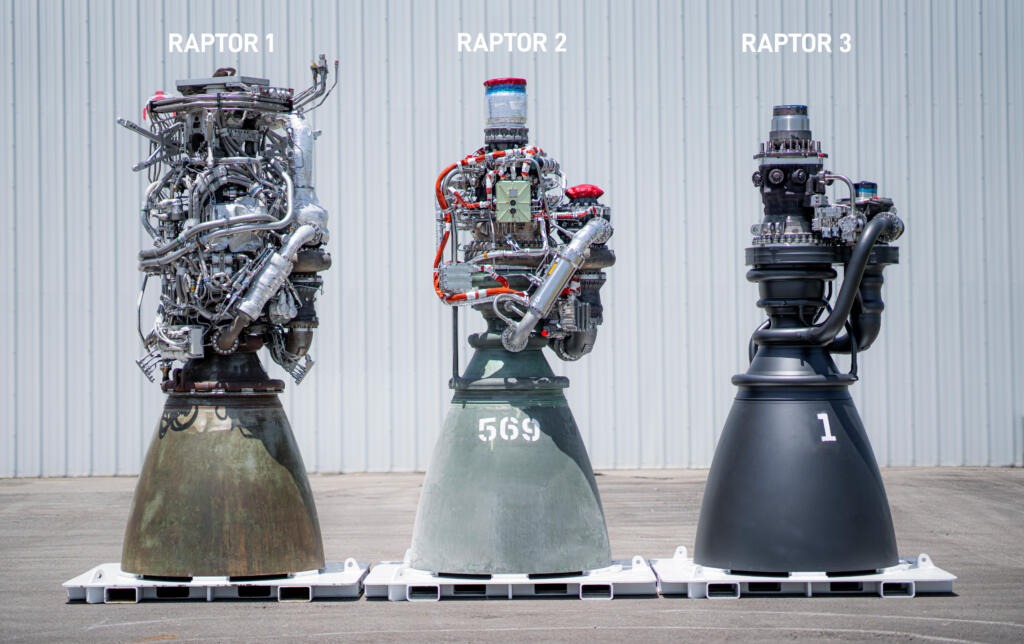
The Isp achieved in actuality are way below the maximum theoretical limits though, that's where RDEs come in. Like for methalox the amount achieved by the Raptor 3 is 350s (sea level, 380s vacuum) but the maximum theoretical is 458.7s.
 
Last edited:
@Dagger : totally agree, it could be very intesting for a turbine combuster or something like an afterburner.

Btw, you get the highest impuse in an hydrolox rocket when you burn slightly rich, so that the molecular weight is lower
 
In a conventional rocket, the fuel/air ratio can be choosen freely, if a leaner mixture would be desirable, rockets would run leaner.

I do see the point, that it works self compressing with reduced effort in pumping the fuel and oxygen, this is the only part were I see greater simplicity.

It also matches perfectly with an aerospyke nozzle.

I'm not sure but for some reason DARPA is funding RDREs so I don't think it's a super practical use case yet. Possibly better at certain high altitude regimes? Maybe they're just hedging in case scramjets remain 20 years away 20 years from now.

RDEs have a lot of use for tactical weapons between the size of AMRAAM up to PrSM or ATACMS though.
 
The Isp achieved in actuality are way below the maximum theoretical limits though, that's where RDEs come in. Like for methalox the amount achieved by the Raptor 3 is 350s (sea level, 380s vacuum) but the maximum theoretical is 458.7s.

That isp-upper-limits.pdf file is wrong. The maximum theoretical Isp for methalox is way lower than 458.7 s.

The author's simplistic calculation method is only valid for stoichiometric combustion of gaseous CH4 with gaseous O2, both at 25 oC which is the basis for the heat of combustion that one can find in various tables.
That would however be impractical in real rockets.

In reality cryogenic CH4 (LNG) and cryogenic O2 (LOx) are used, which means that one has to correct for the enthalpy differences between the cryogenic liquids and their gaseous states at 25 oC. As a consequence the maximum theoretical Isp for Methalox is much lower than he calculates.
Same story for Hydrolox.

The sciencedirect article is not about RDRE. See also the Isp values in Table 3 which are a factor 10 or so higher than feasible in an RDRE.

Btw, you get the highest impulse in an hydrolox rocket when you burn slightly rich, so that the molecular weight is lower
That would be so if gaseous H2 fuel were used, but I don't think so when cryogenic LH2 fuel is used as that would reduce the available enthalpy that can be converted into kinetic energy and therefore Isp.
 
Last edited:
RDE+dual-mode ramjet/scramjet


@Dagger : totally agree, it could be very intesting for a turbine combuster or something like an afterburner.

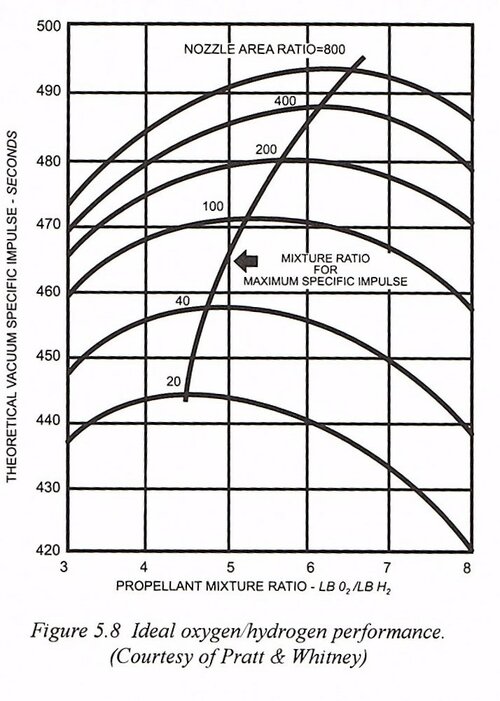
Btw, you get the highest impuse in an hydrolox rocket when you burn slightly rich, so that the molecular weight is lower
Attached is LH2/LO2 specific impulse vs fuel/air ratio vs expansion ratio determined by P&W in Dick Mulready"s book Advanced Engine Development at Pratt & Whitney
LOX Specific Impulse.jpg
 
Please note, that the stoichometric ratio is 7.936, so indeed the mixture is on the rich side.

I also believe, the RDE is intended for a dual mode propulsion with air breathing at lower altitude and pure rocket mode higher up.
 
Attached is LH2/LO2 specific impulse vs fuel/air ratio vs expansion ratio determined by P&W in Dick Mulready"s book Advanced Engine Development at Pratt & Whitney
View attachment 755475
Nice graph, but this is for actual Isp of an actual imperfect engine.

It is not the thermodynamic maximum achievable Isp irrespective of engine design (conventional or RDRE or whatever future invention) that I was talking about.

If the graph would have a line for infinite expansion ratio then the optimum O2/H2 ratio would likely be the stoichiometric ratio of 7.936

I had seen Mulready's book on webshops in the past but didn't buy it because the subtitle indicates that it is up to 1971 only.
 
Last edited:
A US-based propulsion company, Venus Aerospace, said Wednesday it had completed a short flight test of its rotating detonation rocket engine at Spaceport America in New Mexico.

The company's chief executive and co-founder, Sassie Duggleby, characterized the flight as "historic." It is believed to be the first US-based flight test of an idea that has been discussed academically for decades, a rotating detonation rocket engine. The concept has previously been tested in a handful of other countries, but never with a high-thrust engine.

"By proving this engine works beyond the lab, Venus brings the world closer to a future where hypersonic travel—traversing the globe in under two hours—becomes possible," Duggleby told Ars.
 
"Develop and demonstrate a gas-generator (solid propellant) fueled rotating detonation engine through static firing tests under relevant flight conditions for high speed operation and demonstrate performance characteristics that will translate into a tactical missile propulsion system with 2-5 times longer range (SPEAR)(US Navy)"

That's gotta be doing something like the Meteor solid fuel, where it burns into something that will burn even better in air....


Shock diamonds form in either condition. If the flow is under expanded, an oblique expansion wave forms at the nozzle exit, which is then reflected back as a shockwave when it reaches ambient on the other side, which is then reflected as an expansion wave and so on. Over expanded starts with a shock wave, which is reflected as an expansion wave.

When a C/D nozzle is over expanded, the exhaust flow tends to separate from the nozzle wall before the exit plane, causing local back flow and instability. It can cause vibratory stress that can break the nozzle. Typically rocket nozzles are under expanded at launch, and then transition toward perfect expansion as the ambient pressure decreases with altitude. Upper stage engines have longer, higher expansion nozzles because they start at lower ambient pressures toward the vacuum of space.

Plug nozzles don’t have that problem since they are using the ambient air as the “other side “ of the supersonic expansion which varies automatically as that ambient pressure changes.
So, any hypothetical SSTO or 1.5STO etc engines should likely have plug nozzles instead of bells? (While in-vacuum-only engines should probably have superexpansion nozzles to bring the exhaust temperature down to 4 kelvin.)


Yes, but the issue with liquid fuel is that you cannot store them in a bunker for long duration of time unless empty but then they need to be refueled prior to launch which will take from around 30 min to 1 hour and also need deliciated launch sites and support equipment which will make them basically useless in a quick response scenario. Solid fuel ICBMs are just alot more easy to use and transport and probably cheaper as well.
Not true at all. There are a decent number of storable fuels and oxidizers. Some of them are abuse-tolerant enough that Scud missiles used them!
 
"Develop and demonstrate a gas-generator (solid propellant) fueled rotating detonation engine through static firing tests under relevant flight conditions for high speed operation and demonstrate performance characteristics that will translate into a tactical missile propulsion system with 2-5 times longer range (SPEAR)(US Navy)"

That's gotta be doing something like the Meteor solid fuel, where it burns into something that will burn even better in air....


So, any hypothetical SSTO or 1.5STO etc engines should likely have plug nozzles instead of bells? (While in-vacuum-only engines should probably have superexpansion nozzles to bring the exhaust temperature down to 4 kelvin.)


Not true at all. There are a decent number of storable fuels and oxidizers. Some of them are abuse-tolerant enough that Scud missiles used them!
I believe all rocket based SSTO proposals have planned plug nozzles. Air breathing or partial air breathers have shown conventional nozzles.
 
I like the sound of it, really spectacular!

Looks like it is started from a catapult.

@F119Doctor : Why should air breathing rockets prefer conventional nozzles? The trick of RDE is, that you don't need a compressor for a high pressure combustion, so that air breathing becomes (at least, at lower Mach numbers) much more attractive than with conventional combustion chambers/nozzels.
 
With rocket engines, you have very high chamber pressure, which need a large divergent section for supersonic expansion, even at sea level. As you go higher with lower ambient pressure, the divergent section needs to get much longer / larger to efficiently expand the exhaust for maximum ISP. The plug nozzle, if you can make it work, automatically adjusts its expansion as the ambient pressure drops, eliminating the need for the large bell nozzle at high altitudes.

The air breathing engine has a much higher ISP since it doesn’t need to carry its own oxidizer. They operate at a much lower chamber pressure (but at a higher mass flow) so the divergent nozzle doesn’t need to be as large. A plug nozzle is still an advantage, but the only one I’ve seen is on the non-afterburning J52 for the supersonic Hounddog cruise missile. Most air breathing SSTO transition to a rocket cycle at very high altitude so the large bell nozzle isn’t over-expanded since it isn’t used at low altitude.
 
RDE engines allow for air breathing without compressor or scram compression, that's why they are potentially advantageous for air breathing rockets (If this can still be called a rocket). With RDE, the use of an aero spike alias plug nozzle is very logic step, in fact I've never seen a RDE with a bell nozzle. So it is logic what you wrote about air breathing and other combustion processes, I stil don't believe it is usefull for RDE.

Note, every SSTO needs to go through very low athmospheric pressure as well, even the air breathing types and here the plug nozzle/aero spike makes totally sense. The RED could be switched to non air breathing for high altitudes and high mach numbers and could stll be efficient due to the plug nozzle.
 
The RDE is the perfect propulsion system for the cheap mass produced drones that look to be the future of warfare.
 
There is another aspect about the combination of RDE and an aero spike. RDE produced an exhaust gas stream with variying pressures/temperatures/velocities over 360 deg. An Aerospike acts as a flexible nozzle and will adapt to this pulses unlike a fixed bell nozzle.

Edit: A bell nozzle requires a collector which would produce static back pressure, which would kill the RDE. With a static back pressure, no filling of the combustion chamber could take place.
 
Last edited:
There is another aspect about the combination of RDE and an aero spike. RDE produced an exhaust gas stream with variying pressures/temperatures/velocities over 360 deg. An Aerospike acts as a flexible nozzle and will adapt to this pulses unlike a fixed bell nozzle.
What are the practical implications of that? You mean an RDE-aerospike hybrid engine is possible?
 
Wouldn't detonation engines be hard on nozzles?

We saw a Raptor shed after being split in half with regular combustion. I would think a repeat of the Titan nozzle buzzsaw would be more likely with detonation engines.

This is why I have an interest in jacketed thrust.

"Cool" annular exhaust products in a stretching torus closest to the nozzle---a super-hot metastable fuel cooks inside the outer exhaust torus...an all chemical NSWR as it were.


No detonations---that set-up less harsh on the engine?
 
Last edited:
The ideal with an RDE is to have the detonation, and the shockwave, stay in the combustion chamber. A bell nozzle would "just" have to deal with the supersonic exhaust, a plug or spike would handle it even better
 
So what happened to the Japanese developement that was launched into space a few years ago and re-started DOD's effort on RDEs?
It looks like they hibernate like usual for a decade out of fear of sanctions again before continuing or what?
 
With rocket engines, you have very high chamber pressure, which need a large divergent section for supersonic expansion, even at sea level. As you go higher with lower ambient pressure, the divergent section needs to get much longer / larger to efficiently expand the exhaust for maximum ISP. The plug nozzle, if you can make it work, automatically adjusts its expansion as the ambient pressure drops, eliminating the need for the large bell nozzle at high altitudes.

The air breathing engine has a much higher ISP since it doesn’t need to carry its own oxidizer. They operate at a much lower chamber pressure (but at a higher mass flow) so the divergent nozzle doesn’t need to be as large. A plug nozzle is still an advantage, but the only one I’ve seen is on the non-afterburning J52 for the supersonic Hounddog cruise missile. Most air breathing SSTO transition to a rocket cycle at very high altitude so the large bell nozzle isn’t over-expanded since it isn’t used at low altitude.
A J-79 with a plug nozzle flew on an F-4, but it was mainly done to run cryogenics through the plug in an attempt to reduce the IR signature. I have no idea how successful the test results may have been.

The pictures below are from: View: https://www.flickr.com/photos/n747ge/5500422668/in/photostream/


1754502728025.png

1754503016392.png
 
Last edited:
A J-79 with a plug nozzle flew on an F-4, but it was mainly done to run cryogenics through the plug in an attempt to reduce the IR signature. I have no idea how successful the test results may have been.

The pictures below are from: View: https://www.flickr.com/photos/n747ge/5500422668/in/photostream/


View attachment 780637

View attachment 780638
Interesting for two reasons:
1. I wonder if they had a method to vary the exit area for AB operation, or was this a fixed area nozzle only good up to Mil power? In other plug nozzle schemes, plug translates forward to increase the convergent throat area.

2. The cone is exceedingly long with a shallow straight angle. Typical plug nozzles have a relatively short plug with an inverse bell shape, with flow separation not a major issue.
 
2. The cone is exceedingly long with a shallow straight angle. Typical plug nozzles have a relatively short plug with an inverse bell shape, with flow separation not a major issue.
I didn't think anything could ruin the looks of the F-4--but they found a way to do it.

Psst---that's actually a warhead ingested by accident...passing that thing must have really hurt.
 
Some at NSF think hexanitrogen might be best suited for detonation engines:

Now consider temperature. We get 185.2kcal/mol out of N2, and it's pretty complicated to figure out what the resulting temperature is, involving the Shomate equation to figure out what temperature it's gonna get to from a 70K start.

The answer, I think, maybe, is about 2300K, which is terrible. But someone else needs to do this, I don't get the math so I'm not going to try and publish that, it's an AI educated guess, worth whatever you think that is.

That's going to result in lowering of the Isp by another factor of sqrt(3600/2300) to about 265. Useless.

So running N6 through a standard De Laval nozzle system isn't going to be very useful.

Perhaps a detonation system would be better. Far beyond my skills to calculate.


Hypergolics are in that range so perhaps not so useless. Just having one tank (perhaps self-pressurizing) and a simpler engine set up is worth the price of admission. Maybe this for strap-ons: https://phys.org/news/2025-08-chemists-high-energy-compound-fuel.html
 
Last edited:

Similar threads

Back
Top Bottom