Hughes Missiles (HM-series)

SOC

I look at pictures all day
Senior Member
Joined
24 January 2006
Messages
1,380
Reaction score
709
Recently came across a new designation system I wasn't familiar with before. Or, I was familiar with two of them, but when I found the third I realized they were all part of a sequence.

I've come across three of these so far:

HM-55 (GAR-11A)
HM-58 (GAR-2A)
HM-107 (AGM-76)

There should logically be numbers for:

AIM-54
AGM-65
BMG-71
AIM-95
AIM-120
AGM-124

There should also be numbers for the other Falcon missile variants, but for those I've located a totally separate designation system, with "HM-X" only used for the two export models. Can anyone fill in any of the gaps?
 
Interesting. Couldn't find much more to add except for this extra information of the HM-55 and HM-58:

Rb 27 (initially known as RB-327) = license-built Hughes HM 55 Falcon for Sweden, AIM-26B equivalent
Rb 28 (initially known as RB-328) = license-built Hughes HM 58 Falcon for Sweden, AIM-4C/D equivalent

Sources:
http://www.flightglobal.com/pdfarchive/view/1961/1961 - 1426.html
http://uforum.forumniger.com/t1224-j-35-draken

The Hughes Falcon topic on this forum also mentions that the AIM-26B Falcon is the Hughes HM-55S.
 
It would seem that HS is also used as a prefix (presumably for "Hughes, Space"):

Thor (previously known as Marcopolo) is a family of satellites designed, launched and tested by Hughes Space and Communications (now part of Boeing Satellite Systems) for British Satellite Broadcasting (BSB), and were used for Britain's Direct Broadcast Service. Thor is owned by Telenor. Marcopolo 1 launched on 27 August 1989 on the 187th launch of a Delta rocket, and Marcopolo 2 launched on 17 August 1990, on a Delta II rocket. Marcopolo I had the Hughes designation HS376

Source: http://www.freebase.com/view/m/064kg3x
 
I came across another of this series:

HM.45 = a pulse-doppler version of the European licence-built Hughes GAR-11, weight 365lb, range 12nm (4nm at SL). Dates from 1964. BAC suggested it for a fighter version of the P.45 coupled with an unspecified 30in diameter radar.
 
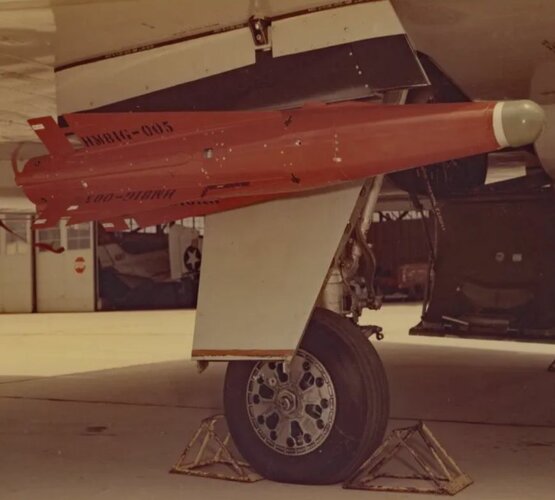
Terminal phase "hit-to-kill" anti-missile launched from a fighter..Whoa, wait what?
 
Terminal phase "hit-to-kill" anti-missile launched from a fighter..Whoa, wait what?
Apparently, that is the ARPAT Experimental Interceptor flight tested at White Sands in the early 60s. It evaluated the proposed IR seeker for the production Interceptor (which would be a totally different design and missile-launched: the plan was for multiple ARPAT Interceptors to be launched from their carrier missile).
 
ARPAT Missile Defense Could Follow Nike Zeus
Aviation Week, July 3, 1961
Advanced Research Projects Agency’s new terminal defense against ballistic missiles, known as ARPA Terminal, or ARPAT, is being designed as a less expensive and more reliable method of killing barrages of hostile ballistic missiles in their terminal phase than the Army’s Nike Zeus anti-ICBM program.

The ARPAT approach is considered an extension of Zeus and ultimately may be incorporated into it. A team consisting of Raytheon, Hughes Aircraft, International Business Machines and Boeing recently was selected by ARPA (AW June 19, p. 23), which is to be managed by the Army Rocket and Guided Missile Agency.

ARPAT will have its prime value in anticipated situations where an entire front of warheads and decoys, perhaps many miles in width and many more miles in depth, is re-entering the earth’s atmosphere. This situation, with its manifold problems of decoy discrimination, target acquisition and multiplicity of targets, might overburden Zeus.

To counter such a threat, ARPA, its Institute for Defense Analyses and almost a dozen study contractors (AW Apr. 10, p. 26) worked out details of the ARPAT concept. It would involve boosting a carrier, or lofter, into the atmosphere as the hostile warfront approached target. Somewhere between 20,000 and 100,000 ft.—below the incoming warhead barrage—retrorockets would be fired to halt the boost of the carrier long enough for it to remain stationary for a fraction of a second.

At this point, several dozen small homing interceptors, or darts, taken aloft in the carrier, could be fired simultaneously or stagger-fired. Each homing interceptor would have a small booster of its own and be capable of covering a range of several miles from the airborne launch point. The interceptors, to contain infrared or ultraviolet target seekers.

The carrier, or lofter, portion of ARPA’s current contract on ARPAT will be made by Boeing. Hughes Aircraft has responsibility for developing and flight testing the homing interceptor. Raytheon will be responsible for general acquisition and discrimination radar.

 
Terminal ICBM Defense
Aviation Week, April 10, 1961

Proposals for a contract to build a prototype of a new terminal defense against ballistic missiles known as ARPA Terminal (ARPAT) are being evaluated by the Advanced Research Projects Agency and its Institute for Defense Analyses.

ARPAT concept, which is a step beyond the Army’s Nike Zeus, envisions firing a dart-shaped platform 20,000 to 100,000 ft. into the atmosphere, where it would in turn fire a multiplicity of hypersonic projectiles in random patterns against incoming warheads. Possible advantages of the ARPAT technique would be the great number of defensive projectiles, the ability to initiate defense action before the incoming missile’s exact trajectory is calculated and the greater likelihood of a hit or deflection.

A series of preliminary three-month study contracts on ARPAT were conducted late last year by Lincoln Laboratories, General Electric, Johns Hopkins University’s Applied Physics Laboratory, Arthur D. Little, Hughes Aircraft, ACF Industries, Perkin-Elmer, Raytheon, Columbia and Cornell universities.
 
From

ODDR&E
ASSESSMENT
OF
BALLISTIC MISSILE DEFENSE PROGRAM

17 April 1961

PPD 61-33

ARPA TERMINAL
(ARPAT)

ARPAT (from ARPA Terminal) is a terminal defense system concept which was formulated in 1959 in an attempt to get around some of the problems of target identification that beset NIKE-ZEUS. During 1960, twelve paper feasibility studies were conducted on critical elements of the ARPAT concept. These study results were sufficiently promising to warrant a more intensive feasibility investigation during FY 1961 and 1962. Approximate cost of this program is $10 million through FY 1962.

The ARPAT concept is based on the assumption that moderately heavy decoys (20-200 pounds) can be built which will defy discrimination, while light decoys (20 pounds or less) may not be discriminable until they descend to about 200,000 feet altitude. To counter a threat with many decoys, ARPAT would delay final weapon commitment until targets have reached 150,000 - 200,000 feet altitude, and employ interceptors which would be sufficiently inexpensive to justify attacks on all undiscriminated objects as a matter of doctrine.

To accomplish the late final commitment, a large number (50-500) of small interceptors would be lofted to 100,000 feet altitude upon radar warning of an attack upon the area defended. These small interceptors (50-75 lbs.) would be assigned to undiscriminated targets by a specialized ground radar, and then proceed independently by homing on infrared emitted by the aerodynamically-heated re-entry bodies. Kill would be accomplished by hyper-velocity impact of portions of the interceptor structure on the target.

ARPAT, a terminal defense system like ZEUS, could not be used to defend population against a fallout attack, and if deployed for population defense, should be paralleled by a fallout shelter program.

Systems embodying the ARPAT concept appear (on the basis of the limited paper studies conducted so far) to be capable of defending localized targets against missiles accompanied by a few tens of heavy decoys. However, it may turn out that ARPAT would be inherently vulnerable to other types of countermeasures. The FY 1961-1962 program has been planned to verify experimentally the critical new technology involved in the ARPAT concept as well as to estimate system cost, effectiveness, and vulnerability to enemy countermeasures.

If this program turns out favorably, a decision made in 1963 to develop and deploy ARPAT could be accomplished by about 1970. The cost per city defended would be comparable to ZEUS projected costs. It may also turn out to be possible to integrate ARPAT and ZEUS at a cost not greatly exceeding, but with effectiveness higher, than either alone.
 

Similar threads

Back
Top Bottom