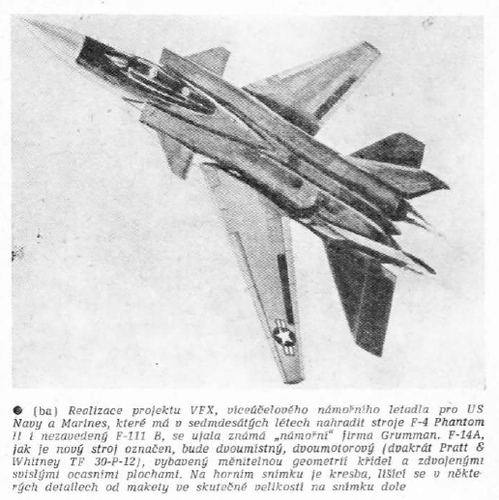
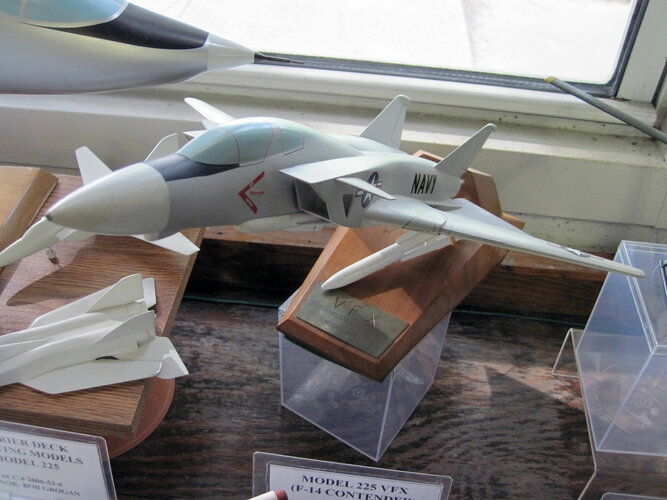
McDonnell-Douglas Model 225 VFX (F-14 alternative)

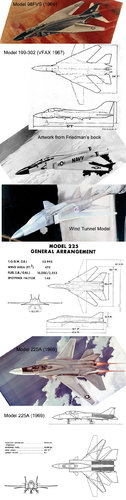
Using Model 199-302 artwork from Friedman's Fighters over the fleet, we can draw an interesting design timeline.
According to Tony Buttler (American Secret Projects: Fighters & Interceptors) page 169

McDD had undertaken a VFAX design study from the autumn of 1967, probably under Model number 222

There were two principal versions of the Model 225
225A: powered by P&W TF30-P-12
225B: same airframe but new more powerful engines either P&W JTF22A-22 or GE1/10F10B2. Provided the use of titanium, the airframe would offer the potential to go Mach 3 with that engines. A new radar could be adapted to the reconnaissance role.

Model 225C: all fighter armament removed and a 31in nose extension added to accommodate the reconnaissance sensors
 
According to Tony Buttler (American Secret Projects: Fighters & Interceptors) page 169

McDD had undertaken a VFAX design study from the autumn of 1967, probably under Model number 222

There were two principal versions of the Model 225
225A: powered by P&W TF30-P-12
225B: same airframe but new more powerful engines either P&W JTF22A-22 or GE1/10F10B2. Provided the use of titanium, the airframe would offer the potential to go Mach 3 with that engines. A new radar could be adapted to the reconnaissance role.

Model 225C: all fighter armament removed and a 31in nose extension added to accommodate the reconnaissance sensors

It appears this is correct. The 222 "Advanced Fighter / Attack Aircraft" is assigned in August 1967 ("Jarrett"), with a note "per RSC 10/27/1967".

Model 225A is assigned 27th October 1967 ("R S Chase")

Therefore it seems Model 222 was "prework" on VFAX before receiving official request and Model 225 was assigned when the actual request was assigned.

Model 225B was assigned 15 October 1968 ("R S Chase"). Model 225A was the basic F-14A equivalent, Model 225B the "F-14B" with advanced engines and avionics. B1 had P&W JTF-22A-22 and B2 had GE 1/10F10B2 engines.

Model 225C (the recce version) was also assigned 15 October 1968 ("R S Chase")

F-4 Model 98FV(S) was assigned 21 June 1966 ("L P Bradley")

Model 199 was assigned 7 May 1965 ("L P Bradley")
 
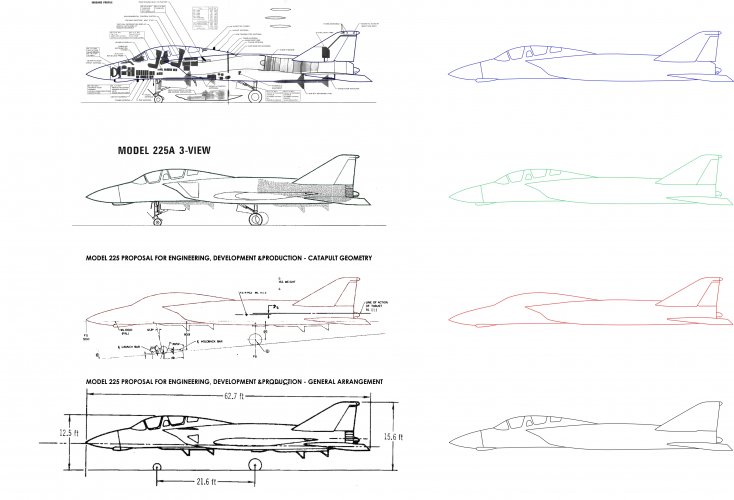
The recent finding of the General Dynamics Model 44 drawings in the other topic made me realize that out of the VFX competitors, the only proposal for which we lack detailed factory drawings is McDonnell's Model 225A (there are drawings for the production version of the F-14 Tomcat). I have been trying to find some consensus regarding the general arrangement of Model 225A, but the variance between different sources is just too big. Below, I made a small comparison of Model 225A drawings taken from different documents (side profiles). For each, I traced the main lines and then put them together:
md 225 comparison 3.jpg

md 225 comparison_2.jpg

As you can see, the differences, especially concerning the fuselage's depth, are quite big. I consider the catapult geometry drawing from the Model 225 proposal to be the most accurate, as it is the only drawing in which the fuselage stations are included, but it clearly stands out from the others - the fuselage is much lower (especially in the frontal area) and slimmer. All other drawings tend to consistently have a somewhat oversized canopy (it actually even looks somewhat unrealistic), making it impossible to combine the outline from the catapult geometry drawing with the information regarding the individual canopy parts. It's rather surprising, as usually the SAC drawings, even if very simple, are quite accurate (I've even tested it for the F-14, the level of accuracy compared to the factory drawing is quite remarkable). Does anyone have an idea why there are such differences, or is anybody aware of some other source that would provide a more definitive drawing of Model 225A? My interest is due to modelling purposes, and with such discrepancies, I just can't decide how to proceed.
 

Similar threads

Back
Top Bottom