
You are using an out of date browser. It may not display this or other websites correctly.
You should upgrade or use an alternative browser.
You should upgrade or use an alternative browser.
Solid State Laser News
- Thread starter bobbymike
- Start date
-
- Tags
- 21st century laser lasers

- Joined
- 21 April 2009
- Messages
- 14,356
- Reaction score
- 9,444
For me, the most interesting things in this post on X are the statements: "Korea's high-ranking research centers are now developing ultra high-power femto laser plasma technology for laser weapons systems. Block-III is also being developed, which is also applicable to military ships as naval versions and plans to have anti-ballistic missile capabilities."
- Joined
- 21 April 2009
- Messages
- 14,356
- Reaction score
- 9,444
Miltec news out of S. Korea last couple years or so has been quite remarkable. 5th Gen fighters, tube and long range artillery and precision fires, armored vehicles, etc.
Military technology superpower with a growing export customer base.
Military technology superpower with a growing export customer base.

Cifu
ACCESS: Confidential
- Joined
- 21 February 2008
- Messages
- 57
- Reaction score
- 63
Emm... 20kW class means it's good against slow moving balsa drones or stationary quadcopters.For me, the most interesting things in this post on X are the statements: "Korea's high-ranking research centers are now developing ultra high-power femto laser plasma technology for laser weapons systems. Block-III is also being developed, which is also applicable to military ships as naval versions and plans to have anti-ballistic missile capabilities."
We are seen this level from fiber lasers a decade ago (LaWS).
Nothing to see here...
True for the current capability reported in the post, but the post also says they are developing ultra high-power femto laser plasma technology for laser weapons system and Block III laser systems with anti-ballistic missile capabilities for the future. The post does not divulge the development timeline or power level goals for these systems under development, but they would have to output much higher power than 20kW, at least MW+ class. That's why I previously said that those systems under development are the most interesting part of the post rather than their current capability of only 20 KW. Whether they will be able to achieve the requisite powers in a useable form factor remains to be seen.Emm... 20kW class means it's good against slow moving balsa drones or stationary quadcopters.
We are seen this level from fiber lasers a decade ago (LaWS).
Nothing to see here...
Last edited:
Cifu
ACCESS: Confidential
- Joined
- 21 February 2008
- Messages
- 57
- Reaction score
- 63
One of the main problem with the military laser project is basically always over-promise then under-deliver.True for the current capability reported in the post, but the post also says they are developing ultra high-power femto laser plasma technology for laser weapons system and Block III laser systems with anti-ballistic missile capabilities for the future. The post does not divulge the development timeline or power level goals for these systems under development, but they would have to output much higher power than 20kW, at least MW+ class. That's why I previously said that those systems under development are the most interesting part of the post rather than their current capability of only 20 KW. Whether they will be able to achieve the requisite powers in a useable form factor remains to be seen.
They started with the CO2 lasers, then other forms of chemical lasers (ABL), then the fiber lasers (like the LaWS), and the free-electron lasers (FEL), now the FEMTO lasers.
Each and every one started as they can reach the MW level. Each and every one failed to deliver...
I mostly agree except for chemical lasers and fiber lasers.One of the main problem with the military laser project is basically always over-promise then under-deliver.
They started with the CO2 lasers, then other forms of chemical lasers (ABL), then the fiber lasers (like the LaWS), and the free-electron lasers (FEL), now the FEMTO lasers.
Each and every one started as they can reach the MW level. Each and every one failed to deliver...
Chemical lasers such as MIRACL, ALpha, and ABL demonstrated cw output powers at the MW level (see https://apps.dtic.mil/sti/pdfs/ADA557756.pdf and https://www.deps.org/DEPSpages/JDE/JV1N4P5-Wacks.pdf). The Boeing YAL-1 airborne laser testbed was a modified Boeing 747-400F with a megawatt-class chemical oxygen iodine laser (COIL) mounted inside. It was used to intercept a test target in January 2010, and the following month, successfully destroyed two test missiles. Funding for the program was cut in 2010 and the program was canceled in December 2011.
The difficulty for chemical lasers wasn't reaching MW levels, it was that they were too big and heavy, and used expendable fuel. Also, the eventual goals for deployed space-based lasers for strategic defense missions under SDI was 10 MW cw class, and for deployed ground-based lasers, it was 100 MW cw class. No laser to my knowledge has achieved those levels.
Fiber lasers, in my recollection, did not start out promising to reach MW levels.
Most of the researchers on fiber lasers in the late '80s to mid-'90s that I worked with thought that they would never reach even the multi-tens of KW level for useful output with good beam quality because singlemode fibers had such low power damage thresholds and multimode fibers had such poor beam quality output. At that time, for military applications, fiber lasers were thought to be suitable only for lidar.
That all changed with the advent of large mode area fibers, effective beam combination from multiple fibers techniques, and effective beam clean-up techniques starting in about the late '90s to early 2000s. Even then, they first had goals of cw power levels of multi-tens of KW from combining the outputs of multi-KW level fiber lasers. Once those levels were achieved, the goal was set at the multi-hundreds of kW cw power levels. Now that 300 kW has been achieved*, the next goals have been set at the 500 KW level and then the MW level.**
*"Sept. 15, 2022 – Lockheed Martin (NYSE: LMT) delivered to the Office of the Under Secretary of Defense for Research & Engineering OUSD (R&E) a new benchmark: a tactically-relevant electric 300 kW-class laser, the most powerful laser that Lockheed Martin has produced to date. This 300 kW-class laser is ready to integrate with the DOD demonstration efforts including the U.S. Army’s Indirect Fires Protection Capability-High Energy Laser (IFPC-HEL) Demonstrator laser weapon system.
The OUSD (R&E) selected Lockheed Martin in 2019 to scale its spectral beam combined high energy laser architecture to the 300 kW-class level as part of the High Energy Laser Scaling Initiative (HELSI), and the team recently achieved that milestone ahead of schedule." from https://news.lockheedmartin.com/202...red-Laser-to-Date-to-US-Department-of-Defense
**nLight agrees megawatt laser weapon deal
07 Nov 2023
"The high-power diode and fiber laser manufacturer nLight says that it will now receive $171 million from the US military to develop a megawatt-scale laser weapon - double the total originally awarded...
According to a recent US Congressional Research Service report on laser weapons, the US military's goal is to demonstrate a 500 kW system in 2025, and a megawatt-class system the following year. " from https://optics.org/news/14/11/9
Last edited:
I wonder if drones could trail fiber-laser cables…rise above a power plant to defend it.
Laser comm
https://techxplore.com/news/2024-07-optical-ground-stations-capture-satellite.html
Vortex cannon
https://phys.org/news/2024-08-electromagnetic-vortex-cannon-communication.html
Laser comm
https://techxplore.com/news/2024-07-optical-ground-stations-capture-satellite.html
Vortex cannon
https://phys.org/news/2024-08-electromagnetic-vortex-cannon-communication.html
Last edited:
The article makes it sound like space to ground laser communication systems are new, but they are not.I wonder if drones could trail fiber-laser cables…rise above a power plant to defend it.
Laser comm
https://techxplore.com/news/2024-07-optical-ground-stations-capture-satellite.html
The first successful laser-communication link from space was carried out by Japan in 1995 between the JAXA's ETS-VI GEO satellite and the 1.5 m (4 ft 11 in) National Institute of Information and Communications Technology (NICT)'s optical ground station in Tokyo achieving 1 Mbit/s.
As to your conjecture "I wonder if drones could trail fiber-laser cables," the answer is yes, they could. Fiber optic cables for sending video and sensor data from and guidance commands to drones and missiles were developed in the seventies through the early 2000s (See below). Such passive fiber cables could be replaced with doped actively pumped fibers to form fiber laser amplifiers with the bulky and heavy power supplies, pump diode lasers and cooling systems remaining on the ground.
From https://www.thinkdefence.co.uk/2023/05/fibre-optic-guided-missiles-efog-m-polyphem-and-others/ :
"Following work on using fibre optic cables for tethered drones in the mid-seventies, the US Army Missile Command (MICOM) started work on fibre optic guidance technology in 1982, resulting in the Fibre Optic Guided Missile (FOG-M)...
Polyphem was similar to EFOG-M but with both a longer range and a larger warhead, the concept of operation was similar.
Work started in the early eighties under the direction of Messerschmitt-Bölkow-Bloom (MBB) and as industrial consolidation took place, the project continued through Daimler Benz Aerospace, and then in partnership with Aérospatiale...
The final form missile was of a single size and weighed 140 kg, carrying a 20 kg multipurpose warhead.
In addition to a rocket booster, it had a Teledyne/Williams turbojet, providing a range of 60 km...
The first firing took place in 1995...
The British Army were observers on the programme and expressed some interest in purchasing the system to be launched from the MLRS vehicle in a programme called the Fibre Optic Missile System(FOMS)...
Like many programmes of the era, initial work from the late seventies and early eighties matured in the nineties, just in time for the end of the Cold War.
The change of threat, the subsequent reduction in funding, and the maturation of RF data links and autonomous seeker technology meant the concept of man-in-the-loop fibre optic guidance became mostly a footnote of history."
I found this article about drones using fiber telecommunications being used in the war in Ukraine: https://www.spotterglobal.com/blog/...alth-fiber-optic-drones-how-to-detect-them-12I wonder if drones could trail fiber-laser cables…rise above a power plant to defend it.
Laser comm
https://techxplore.com/news/2024-07-optical-ground-stations-capture-satellite.html
The article states: "The first fiber optic drones have appeared in the Ukraine-Russia conflict. This innovative new UAV adaptation has already been prototyped by drone designers on both sides of the conflict and, with its unique resilience and stealth aspects, may soon become a force to be reckoned with...
On March 7th, 2024, Serhii Beskrestnov also known as Serhii Flash, a Ukrainian specialist on radio electronics and electronic warfare, shared pictures of a strange new Russian FPV kamikaze drone. Beskrestnov revealed that the drone operated, not off of radio broadcast signals like most drones, but through a thin 6.2-mile spool of fiber optic cable.
By March 18th, Dronaria, a Ukrainian drone development and production group, posted a view of their own fiber-optic drone prototype."
The article "A Comprehensive Review of Micro UAV Charging Techniques" at https://www.ncbi.nlm.nih.gov/pmc/articles/PMC9229348/ states:
"Tethered UAVs can support unlimited autonomy. This technology does not require physical landing on a charging station and avoids repeated recharging. In this technology, UAVs can get a continuous power supply through a connecting cable from a charging station. This technology ensures efficient and safe data transmission. In general, copper wires are used as power supply lines. However, optical fiber technology is also used in the tethered UAV area. Fiber optic cable supports kilowatts of power transfer using high intensity optical beams. Optical fiber technology can significantly reduce the UAV payload and power lines compared to copper lines [45]. Two examples of tethered UAVs are presented in Figure 6. Muttin [46] proposed a maritime application-based tethered UAV for detecting oil pollution from ships. Moreover, Gu et al. [47] demonstrated a tethered UAV for nuclear power plants to support extremely long-endurance operations. In [48], the authors proposed a method for UAV localization in an indoor environment using a quasi-taut tether. In a recent study [49], the authors used UAV tethered technology for 3D deployment of aerial base stations."
Again, nothing new here, neither in the concept or hardware.
View: https://youtu.be/e-T0-0XxvFk
2014 presentation, 6 months after project cancelation following savage interreference targeting. Note that the vocabulary is identical and not much has evolved (you can find today half hundred of companies, if no more, around the world with the same concept and marketing vocabulary). Only the CGI get better... Sometimes.
2014 presentation, 6 months after project cancelation following savage interreference targeting. Note that the vocabulary is identical and not much has evolved (you can find today half hundred of companies, if no more, around the world with the same concept and marketing vocabulary). Only the CGI get better... Sometimes.
Last edited:
True, "nothing new here" for tethered drones using fiber cables for data communications and power transfer for surveillance applications, which was the point of my post on some things done in the 70s to early 2000s, and then my post on recent developments.Again, nothing new here, neither in the concept or hardware.
View: https://youtu.be/e-T0-0XxvFk
2014 presentation, 6 months after project cancelation following savage interreference targeting. Note that the vocabulary is identical and not much has evolved (you can find today half hundred of companies, if no more, around the world with the same concept and marketing vocabulary). Only the CGI get better... Sometimes.
The somewhat new concept is the use of doped fiber to amplify and transmit a weapons grade laser beam with the large, heavy, and power hungry components of the laser, such as the power supply, pump diode lasers, and laser cooling system on the ground, and the beam director on the UAV. I say somewhat new in that I proposed to DARPA a similar concept, but for an FMCW lidar rather than a laser weapon, back in the early 2000s, but it was not funded.
The big difference between the lidar application vs the laser weapon application is that the lidar would require transmitting tens to hundreds of watts cw laser power over the fiber, but the laser weapon would require multi-kW to hundreds of kW cw laser power depending on the target type and range. The article about UAV charging techniques indicates that "Fiber optic cable supports kilowatts of power transfer using high intensity optical beams," which indicates more than enough power transfer for lidar applications, but perhaps only enough power for a short range laser weapon against fairly vulnerable targets.
If you know of any previous or current work on this "new" concept, please post it. I haven't yet found anything online about it directly, and the closest concept I could find online was about transferring power optically over fiber to charge the tethered UAV's power system.
I found a research article on a low power lidar system with the laser system on the ground attached to the drone via a 100 m long optical fibers: "Wind sensing with drone-mounted wind lidars: proof of concept" at https://amt.copernicus.org/articles/13/521/2020/ which states:True, "nothing new here" for tethered drones using fiber cables for data communications and power transfer for surveillance applications, which was the point of my post on some things done in the 70s to early 2000s, and then my post on recent developments.
The somewhat new concept is the use of doped fiber to amplify and transmit a weapons grade laser beam with the large, heavy, and power hungry components of the laser, such as the power supply, pump diode lasers, and laser cooling system on the ground, and the beam director on the UAV. I say somewhat new in that I proposed to DARPA a similar concept, but for an FMCW lidar rather than a laser weapon, back in the early 2000s, but it was not funded.
The big difference between the lidar application vs the laser weapon application is that the lidar would require transmitting tens to hundreds of watts cw laser power over the fiber, but the laser weapon would require multi-kW to hundreds of kW cw laser power depending on the target type and range. The article about UAV charging techniques indicates that "Fiber optic cable supports kilowatts of power transfer using high intensity optical beams," which indicates more than enough power transfer for lidar applications, but perhaps only enough power for a short range laser weapon against fairly vulnerable targets.
If you know of any previous or current work on this "new" concept, please post it. I haven't yet found anything online about it directly, and the closest concept I could find online was about transferring power optically over fiber to charge the tethered UAV's power system.
"Instead of mounting the entire lidar to the drone, for the POC we only mounted the telescopes to the gimbal (attached to the drone). The telescopes were connected to the lidar located on the ground using 100 m long optical fibers. The drone was battery powered."
"...we used a non-production dual-telescope CW lidar system built by ZX Lidars (ZXT2 lidar) and an off-the-shelf drone and gimbal system (DJI Matrice 600 Pro and Ronin-MX). The selected drone and gimbal system are typically used in the motion picture industry, while the lidar was optimized for wind tunnel measurements or for turbine blade mounting, thus the transceiver units (telescopes) are separated from the rest of the lidar."
"The main reason why the POC system was built as described above was that it did not require any costly development since many of the parts were already built or were readily available off the shelf. Moreover, since we intended to investigate the overall feasibility of the proposed concept, this type of study (i.e., proof of concept) is often undertaken on a much lower budget and before investing in the build of a full prototype or product development."
This was a very low transmitted laser power (300 mW in each of 2 channels) and short range (< 50 m, data in the reported tests were taken from 0.5 m to 5 m) lidar system for proof-of-concept (POC) testing.
I found the thesis "QUASI-STATIC SCANNING AND MONOLITHIC FORWARD SCANNING ELECTROTHERMAL MEMS MIRRORS FOR LIDAR" by DINGKANG WANG, 2021 https://original-ufdc.uflib.ufl.edu/UFE0057338/00001 , which states:True, "nothing new here" for tethered drones using fiber cables for data communications and power transfer for surveillance applications, which was the point of my post on some things done in the 70s to early 2000s, and then my post on recent developments.
The somewhat new concept is the use of doped fiber to amplify and transmit a weapons grade laser beam with the large, heavy, and power hungry components of the laser, such as the power supply, pump diode lasers, and laser cooling system on the ground, and the beam director on the UAV. I say somewhat new in that I proposed to DARPA a similar concept, but for an FMCW lidar rather than a laser weapon, back in the early 2000s, but it was not funded.
The big difference between the lidar application vs the laser weapon application is that the lidar would require transmitting tens to hundreds of watts cw laser power over the fiber, but the laser weapon would require multi-kW to hundreds of kW cw laser power depending on the target type and range. The article about UAV charging techniques indicates that "Fiber optic cable supports kilowatts of power transfer using high intensity optical beams," which indicates more than enough power transfer for lidar applications, but perhaps only enough power for a short range laser weapon against fairly vulnerable targets.
If you know of any previous or current work on this "new" concept, please post it. I haven't yet found anything online about it directly, and the closest concept I could find online was about transferring power optically over fiber to charge the tethered UAV's power system.
"These methods inspire the idea of an optical scanner detached (OSD) LiDAR design proposed in this work. As shown in Figure 3-36, the OSD LiDAR consists of a detached optical scanning head and a fixed base module, both of which are connected by a thin, flexible cable with an optical fiber and electrical wires embedded. The optical scanning head is mainly composed of a 2-axis scanning MEMS mirror, weighs only 10 g, and has dimensions of 36 mm × 30 mm × 13 mm. The base module of the LiDAR includes the laser source and optical photodetector as well as their associated optics and electronics. As shown in Figure 3-36, the key difference of this OSD LiDAR from other LiDAR systems is that the optical scanner and the laser source and photodetector are in two different platforms. The optical scanner moves with the micro-robot carrying it while the laser source and optical receiver are fixed at the LiDAR base."
This configuration is also implemented in "Design of an Adaptive Lightweight LiDAR to Decouple Robot-Camera Geometry" at https://arxiv.org/html/2302.14334v2
These implementations lack the idea I had of using doped fiber segments in the tether to amplify the initially lower power laser light transmitted via a fiber to the drone, and to amplify the received signal light in the drone when sending it to the photodetector in the ground station via a fiber. The amplifying fiber segments would be large mode area, double-clad fiber to handle higher powers, and to enable the pump diode laser light to be cladding coupled.
Last edited:

Grey Havoc
ACCESS: USAP
- Joined
- 9 October 2009
- Messages
- 24,500
- Reaction score
- 18,172
At the link you provided, the Telegraph blocks most of the article unless one subscribes. Here is a link for the same story which is not blocked:
https://www.yahoo.com/news/anti-drone-laser-fires-british-172601753.html
Grey Havoc
ACCESS: USAP
- Joined
- 9 October 2009
- Messages
- 24,500
- Reaction score
- 18,172
Yeah, the DT paywall is pretty unpredictable. It can be quite annoying.
The 2017 article at https://sites.nationalacademies.org/cs/groups/bpasite/documents/webpage/bpa_184787.pdf entitled "Worldwide Timelines for Fusion Energy" states:
"Even though numerous worldwide roadmaps and plans have been developed in recent decades [1-9], the schedule for placing a fusion power plant on the grid is still uncertain. The main reasons are the recent delay in ITER schedule, the unreadiness of structural materials along with many fusion technologies, and/or the lack of funding for necessary R&D programs. At the present time, all countries are revising their roadmaps primarily because the delay in ITER...
There is a wide agreement between international fusion communities that a demonstration plant (DEMO) is the last step necessary to reduce the technical and programmatic risk associated with the first commercial power plant. Beyond ITER, multiple small-scale facilities and significant fusion technologies remain to be developed to bridge the large gap between existing fusion experiments and DEMO operation.
As Figure 2 illustrates, all countries projected operating DEMOs in 30-40 years, targeting power production from DEMO in the 2045-2055 timeframe" That figure also shows the first power plant starting operation in the late 2050s to early 2060s.
These roadmaps and timelines, however, were developed prior to the issues ITER has had since 2017.
ITER will be submitting it's latest baseline schedule revision this month, June 2024. It is expected that the new schedule will show a delay compared to the previous schedule due to Covid-19 related delays, problems with the vacuum vessel sector's welding joint region and corrosion-induced cracks in thermal shield piping, and because of modifications to ITER's configuration, phased installation and new research schedule. See https://world-nuclear-news.org/Articles/ITER-s-proposed-new-timeline-to-be-submitted-in-Ju .
Yes, it will be amazing if FLF and the UKAEA achieve net energy gain from projectile-based ICF at the M4 facility, but it will be only one small step of the many subsequent steps necessary to develop such an approach for commercial electrical power production.
Update on ITER delay:

Forest Green
ACCESS: USAP
- Joined
- 11 June 2019
- Messages
- 14,512
- Reaction score
- 31,560
Battle of the Acronyms and a Blast from the Past:
The U.S. Navy/Marine Corps High Energy Laser Expeditionary (HELEX) shown in the above post has the same acronym as an old German air defense system called High Energy Laser Experimental (HELEX):
https://laserstars.org/biglasers/continuous/weapons.html states:
(Note: The following information is from a 1992 publication: Laser Weapons The Dawn of a New Military Age, by
Major General Bengt Anderberg, (Swedish Army) and Dr. Myron L. Wolbarsht, (Duke University))
"One of the most interesting HEL weapon projects is the German air defense system called HELEX, which is an industrial joint project between Diehl, Gmb., in Nuremberg and MBB in Munich. HELEX stands for High Energy Laser Experimental. The project is still in its early stages, although the initial work started in the late 1970s. MBB together with Diehl have been commissioned by the Federal Ministry of Defense in Germany to implement and study this experimental system as a continuation of the work done previously In the following discussion, the term HELEX refers to the industrial conception of the final weapon to be delivered to combat units if the experiments are successful. The project is interesting, not only because a comparatively large amount of information has been made public so far, but also because it tries to meet a precise military requirement. Since this is not only a research program but also a very extensive development program aimed at producing a well-defined laser weapon for a future battlefield, it will be described in detail. The idealized conceptualization. is given in Fig. 5.1...
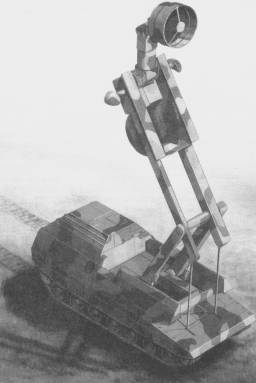
FIGURE 5.1. High-energy CO2 laser system. The laser energy is directed toward the target by a highly controllable large mirror, which, on its scaffolding, can go over buildings, trees, and other ground obstructions. Photograph courtesy of MBB/ Diehl.
The main component of the HELEX is a gas dynamic carbon dioxide laser which emits an average beam power of several megawatts over the specified mission time. To carry the laser and all of its accessories, the basic chassis from a German tank, Leopard 2, has been suggested. The supply tanks for gas, water, etc. are used for the laser fuel, while the laser itself and its coolant water are carried in the chassis...
The optics of the HELEX Must cope with the difficult task of focusing enough laser energy on the target to destroy it in the air or cause it to crash. This has to be done on the battlefield even when the atmospheric conditions are unfavorable and at a combat range of at least five to ten kilometers if the HELEX is to be cost effective within the air defense concept...
The effective range will be dependent on atmospheric conditions. Under very favorable conditions, the range against aircraft, helicopters, and missiles would be up to 6 miles; this would be reduced to 3 to 4 miles in the normally heavily polluted atmosphere over a battlefield...
Many problems still must be solved before it is even possible to decide if the HELEX concept is a valid one. To date, tests have only been done in the laboratory The scaled-down experimental weapon paid for by the German Ministry of Defense will not be available until 1993 or 1994. If this weapon is a success, and if it is possible to solve all of the very difficult problems, the development of a final air defense high-energy laser weapon based on the HELEX concept may start in the mid-nineties and should be completed about ten years later. This means that theoretically such a weapon could be produced and handed over to the combat units at the beginning of 2005. Due to the technological difficulties involved in this concept, even such a distant delivery date may be overly optimistic.
Other countries have begun developmental work on possible laser weapons along similar lines. In France, several companies together with the French National Aerospace Research Agency (ONERA) are working on a HELEX-like experimental HEL weapon. There have also been some reports on a possible collaboration between France and Germany. In the United States, a similar idea is currently under investigation in the JAGUAR project."
Gamma Ray Lasers
I came across the following optics.org article about the University of Rochester and their European collaborators being funded by the U.S. National Science Foundation (NSF) to investigate gamma ray lasers:
https://optics.org/news/15/7/48
The article states: "If successful, this project could lead to the creation of a gamma-ray free electron laser, a major goal in the scientific community, according to Di Piazza."
Interestingly, the optics.org article does not mention the prior work on gamma ray lasers at LLNL (see below) and makes it sound like it has never been done before, stating "developing lasers that produce very high energy outputs, such as gamma rays, has remained elusive...“The ability to make coherent gamma rays would be a scientific revolution in creating new kinds of light sources, similar to how the discovery and development of visible light and x-ray sources changed our fundamental understanding of the atomic world,” said Antonino Di Piazza, a professor of physics at Rochester and a distinguished scientist at the university’s Laboratory for Laser Energetics, who is the lead investigator on the NSF grant."
I wonder if this omission has anything to do with the fact that LLNL and the University of Rochester's Laboratory for Laser Energetics (LLE) have been competitors in the development of laser driven inertial confinement fusion since the 1970s.
LLNL has been working on a form of gamma ray lasers called Mono-Energetic Gamma-Ray (MEGa-Ray) technology since about 2006, achieving 0.776 MeV gamma-ray energy with its Thomson-Radiated Extreme X-ray (T-REX) source in 2008 and continuing work to make the technology more compact and more powerful with its next generation MEGA-ray light source called VELOCiRAPtOR (Very Energetic Light for the Observation and Characterization of isotopic Resonances and the Assay and Precision tomography of Objects with Radiation):
https://www.llnl.gov/article/31416/t-rex-monster-light-source-multiple-applications
https://www.llnl.gov/sites/www/files/2020-05/trex-str-aprmay-11.pdf
The latest info I could find on the MEGa-ray work at LLNL was the description of the Mono-Energetic Gamma-Ray (MEGa-ray) Test Station at LLNL in the following 2023 fact sheet:
https://pls.llnl.gov/sites/pls/files/2023-12/accelerator-complex-fact-sheet.pdf
LLNL's Innovation and Partnerships Office has a Cooperative Research And Development Agreement (CRADA) announcement for an industrial partner to develop the next generation of laser technologies for MEGa-ray systems and to create a next generation of MEGa-ray sources that could be marketed to both the industrial and academic communities:
https://ipo.llnl.gov/technologies/lasers-and-optics/advanced-laser-based-gamma-ray-systems
I came across the following optics.org article about the University of Rochester and their European collaborators being funded by the U.S. National Science Foundation (NSF) to investigate gamma ray lasers:
https://optics.org/news/15/7/48
The article states: "If successful, this project could lead to the creation of a gamma-ray free electron laser, a major goal in the scientific community, according to Di Piazza."
Interestingly, the optics.org article does not mention the prior work on gamma ray lasers at LLNL (see below) and makes it sound like it has never been done before, stating "developing lasers that produce very high energy outputs, such as gamma rays, has remained elusive...“The ability to make coherent gamma rays would be a scientific revolution in creating new kinds of light sources, similar to how the discovery and development of visible light and x-ray sources changed our fundamental understanding of the atomic world,” said Antonino Di Piazza, a professor of physics at Rochester and a distinguished scientist at the university’s Laboratory for Laser Energetics, who is the lead investigator on the NSF grant."
I wonder if this omission has anything to do with the fact that LLNL and the University of Rochester's Laboratory for Laser Energetics (LLE) have been competitors in the development of laser driven inertial confinement fusion since the 1970s.
LLNL has been working on a form of gamma ray lasers called Mono-Energetic Gamma-Ray (MEGa-Ray) technology since about 2006, achieving 0.776 MeV gamma-ray energy with its Thomson-Radiated Extreme X-ray (T-REX) source in 2008 and continuing work to make the technology more compact and more powerful with its next generation MEGA-ray light source called VELOCiRAPtOR (Very Energetic Light for the Observation and Characterization of isotopic Resonances and the Assay and Precision tomography of Objects with Radiation):
https://www.llnl.gov/article/31416/t-rex-monster-light-source-multiple-applications
https://www.llnl.gov/sites/www/files/2020-05/trex-str-aprmay-11.pdf
The latest info I could find on the MEGa-ray work at LLNL was the description of the Mono-Energetic Gamma-Ray (MEGa-ray) Test Station at LLNL in the following 2023 fact sheet:
https://pls.llnl.gov/sites/pls/files/2023-12/accelerator-complex-fact-sheet.pdf
LLNL's Innovation and Partnerships Office has a Cooperative Research And Development Agreement (CRADA) announcement for an industrial partner to develop the next generation of laser technologies for MEGa-ray systems and to create a next generation of MEGa-ray sources that could be marketed to both the industrial and academic communities:
https://ipo.llnl.gov/technologies/lasers-and-optics/advanced-laser-based-gamma-ray-systems
Laser and optics news
https://phys.org/news/2024-08-advanced-electrohydrodynamics-ultra-compact-gas.htmlhttps://phys.org/news/2024-08-squishy-lasers-reveal-tumors-babies.htmlhttps://phys.org/news/2024-07-polymer-blend-microspheres-ultra-threshold.html
Pyramid power
https://phys.org/news/2024-08-pyramid-optical-networks-unidirectional-image.html
More
https://phys.org/news/2024-07-tunable-metasurface-optical-space-path.htmlhttps://techxplore.com/news/2024-07-technique-thermal-imaging-infrared-thermography.htmlhttps://phys.org/news/2024-07-tunable-ultrasonic-liquid-crystal-diffuser.htmlhttps://techxplore.com/news/2024-07-team-biomimetic-vision-based-praying.htmlhttps://techxplore.com/news/2024-08-bio-vision-sensor-spectrally-distinctive.htmlhttps://phys.org/news/2024-08-microscopy-breakthrough-imaging-sensitive-materials.htmlhttps://phys.org/news/2024-07-explore-cell-advanced-ray-imaging.htmlhttps://phys.org/news/2024-07-bright-prospects-quantum.htmlhttps://phys.org/news/2024-07-optical-fibers-age-quantum.htmlhttps://phys.org/news/2024-07-closer-optical-universal-gate.htmlhttps://phys.org/news/2024-07-miracle-filter-bought-spintronic-devices.htmlhttps://phys.org/news/2024-07-nasa-streams-4k-video-aircraft.htmlhttps://phys.org/news/2024-07-nonlinear-encoding-diffractive-optical-processors.htmlhttps://phys.org/news/2024-08-polarization-wavelength-routers-based-diffractive.htmlhttps://phys.org/news/2024-08-electrical-impedance-tomography-extracellular-voltage.htmlhttps://phys.org/news/2024-07-ce-doped-yttria-transparent-ceramic.htmlhttps://phys.org/news/2024-07-similar-crystals-reveals-photoreactions-differ.htmlhttps://phys.org/news/2024-07-machine-method-nonlinear-optics-network.htmlhttps://techxplore.com/news/2024-07-interfacial-fracture-perovskite-emitting-devices.html
Huge
https://htyp.org/design_to_cost#Space_laser
https://phys.org/news/2024-08-advanced-electrohydrodynamics-ultra-compact-gas.htmlhttps://phys.org/news/2024-08-squishy-lasers-reveal-tumors-babies.htmlhttps://phys.org/news/2024-07-polymer-blend-microspheres-ultra-threshold.html
Pyramid power
https://phys.org/news/2024-08-pyramid-optical-networks-unidirectional-image.html
More
https://phys.org/news/2024-07-tunable-metasurface-optical-space-path.htmlhttps://techxplore.com/news/2024-07-technique-thermal-imaging-infrared-thermography.htmlhttps://phys.org/news/2024-07-tunable-ultrasonic-liquid-crystal-diffuser.htmlhttps://techxplore.com/news/2024-07-team-biomimetic-vision-based-praying.htmlhttps://techxplore.com/news/2024-08-bio-vision-sensor-spectrally-distinctive.htmlhttps://phys.org/news/2024-08-microscopy-breakthrough-imaging-sensitive-materials.htmlhttps://phys.org/news/2024-07-explore-cell-advanced-ray-imaging.htmlhttps://phys.org/news/2024-07-bright-prospects-quantum.htmlhttps://phys.org/news/2024-07-optical-fibers-age-quantum.htmlhttps://phys.org/news/2024-07-closer-optical-universal-gate.htmlhttps://phys.org/news/2024-07-miracle-filter-bought-spintronic-devices.htmlhttps://phys.org/news/2024-07-nasa-streams-4k-video-aircraft.htmlhttps://phys.org/news/2024-07-nonlinear-encoding-diffractive-optical-processors.htmlhttps://phys.org/news/2024-08-polarization-wavelength-routers-based-diffractive.htmlhttps://phys.org/news/2024-08-electrical-impedance-tomography-extracellular-voltage.htmlhttps://phys.org/news/2024-07-ce-doped-yttria-transparent-ceramic.htmlhttps://phys.org/news/2024-07-similar-crystals-reveals-photoreactions-differ.htmlhttps://phys.org/news/2024-07-machine-method-nonlinear-optics-network.htmlhttps://techxplore.com/news/2024-07-interfacial-fracture-perovskite-emitting-devices.html
Huge
https://htyp.org/design_to_cost#Space_laser
Last edited:
https://www.researchgate.net/public...Missile_Defense_Interrogating_the_Assumptions
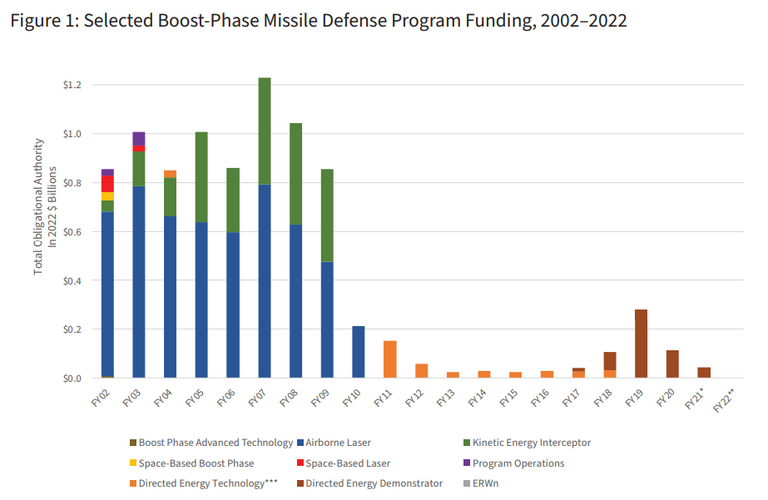
The report from The Center for Strategic and International Studies (CSIS) Missile Defense Project at the link above published in 2022 has an appendix starting on page 51 (as numbered in the article, page 58 of the PDF), entitled "Appendix 3: Implications of Directed-Energy Technology," with a nice overview and their assessment of laser technologies for boost phase ballistic missile defense as of 2022.
The section in the main body of the report entitled "Airborne Directed Energy" (starting on p. 27 (p. 34 in the PDF)) is also interesting.
The report from The Center for Strategic and International Studies (CSIS) Missile Defense Project at the link above published in 2022 has an appendix starting on page 51 (as numbered in the article, page 58 of the PDF), entitled "Appendix 3: Implications of Directed-Energy Technology," with a nice overview and their assessment of laser technologies for boost phase ballistic missile defense as of 2022.
The section in the main body of the report entitled "Airborne Directed Energy" (starting on p. 27 (p. 34 in the PDF)) is also interesting.
Forest Green
ACCESS: USAP
- Joined
- 11 June 2019
- Messages
- 14,512
- Reaction score
- 31,560
Figure 1 is blank.https://www.researchgate.net/public...Missile_Defense_Interrogating_the_Assumptions
The report from The Center for Strategic and International Studies (CSIS) Missile Defense Project at the link above published in 2022 has an appendix starting on page 51 (as numbered in the article, page 58 of the PDF), entitled "Appendix 3: Implications of Directed-Energy Technology," with a nice overview and their assessment of laser technologies for boost phase ballistic missile defense as of 2022.
The section in the main body of the report entitled "Airborne Directed Energy" (starting on p. 27 (p. 34 in the PDF)) is also interesting.
https://www.nextbigfuture.com/2020/10/250-300-kw-combat-lasers-now-and-scaling-to-megawatts.html
Current fiber laser technology could be scaled to 300 kilowatts. The new system will use solid-state laser technology and liquid cooling. Cooling large lasers are a huge part of the problem for scaling to higher power levels.
It seems like the modular liquid cooled solid state laser systems could scale into the megawatt power range.
https://newatlas.com/military/lockheed-martin-boosting-laser-weapon-500-kw/In 2015, the General Atomics 150 kilowatt laser had an energy density of 4 kilograms per kilowatt.
Encouraging that they're down to 4kg per kW, or 4 tons per megawatt 9 years ago. The question is whether this weight includes power generation and cooling or just the laser?
Last edited:
Figure 1 of the CSIS report looks fine to me in both the online viewer at Researchgate and in the downloaded PDF. I am using the Chrome browser to view both on a 64-bit Windows 10 PC. Below is a screen capture of that figure:Figure 1 is blank.
https://www.nextbigfuture.com/2020/10/250-300-kw-combat-lasers-now-and-scaling-to-megawatts.html
https://newatlas.com/military/lockheed-martin-boosting-laser-weapon-500-kw/
Encouraging that they're down to 4kg per kW, or 4 tons per megawatt 9 years ago. The question is whether this weight includes power generation and cooling or just the laser?
In a previous post, the US military's stated goal is to achieve 500 kW by 2025 and 1 MW by 2026, but I have not seen a mass per kW goal stated:Figure 1 is blank.
https://www.nextbigfuture.com/2020/10/250-300-kw-combat-lasers-now-and-scaling-to-megawatts.html
https://newatlas.com/military/lockheed-martin-boosting-laser-weapon-500-kw/
Encouraging that they're down to 4kg per kW, or 4 tons per megawatt 9 years ago. The question is whether this weight includes power generation and cooling or just the laser?
According to a recent US Congressional Research Service report on laser weapons, the US military's goal is to demonstrate a 500 kW system in 2025, and a megawatt-class system the following year." from https://optics.org/news/14/11/9
According to https://www.darpa.mil/program/high-...ight goal of,compared to ground-based systems. The High Energy Liquid Laser Area Defense System's (HELLADS) goal was less than 5 kg per kW, so it looks like that was achieved.Figure 1 is blank.
https://www.nextbigfuture.com/2020/10/250-300-kw-combat-lasers-now-and-scaling-to-megawatts.html
https://newatlas.com/military/lockheed-martin-boosting-laser-weapon-500-kw/
Encouraging that they're down to 4kg per kW, or 4 tons per megawatt 9 years ago. The question is whether this weight includes power generation and cooling or just the laser?
According to the AFRL Directed Energy Directorate 2016 publication at https://www.kirtland.af.mil/Portals/52/documents/LaserSystems.pdf "Performance requirements for the full range of AFSOC missions have yet to be specified, but AFRL assesses that a defensive LWS that weighs less than 5000 lbs. is feasible. Our target weight for a podded solution on a fighter is less than 1500 lbs."
They mention testing with a 150 kW laser. Assuming they want say twice that for a real tactical system, we're talking 1500 lbs and 300 kW for 5 lbs per kW (2.27 kg per kW), which is just a little over half of the 4 kg per kW achieved 9 years ago. If they need 500 kW in the same podded HEL, then they'll need 3 lbs per kW (1.36 kg per kW).
I would think shipborne and ground based HEL systems could accommodate a 4 kg per kW system at 500 kW power weighing 2000 kg (2 metric tons), which is one reason why I think shipborne and ground based HEL weapon systems will be widely fielded before airborne HEL weapon systems.
Forest Green
ACCESS: USAP
- Joined
- 11 June 2019
- Messages
- 14,512
- Reaction score
- 31,560
So it sounds like power source and generation is not included in the weight, since an aircraft would have its own power source and generation anyway.
Based on the following information, I think aircraft power generation capacity would need to increase in order to power the laser weapon system, but I do not know how much weight that would add.So it sounds like power source and generation is not included in the weight, since an aircraft would have its own power source and generation anyway.
From what I could find, typical wall-plug efficiencies of weapons grade fiber laser systems are 30-40% not including the thermal management system. Wall-plug efficiencies explicitly including thermal management are hard to find, but I have seen overall system efficiencies for solid state and fiber laser based HEL weapons stated as being from 10% to 20% which presumably includes thermal management.
Using 20% overall wall-plug efficiency, a 300 kW fiber-based HEL will require 1.5 MW of prime power.
According to https://dsiac.org/articles/power-generation-and-storage-for-directed-energy-systems/ Table 1, current combat aircraft power pod auxiliary generators currently produce on the order of kW's of electrical power, but have the potential to generate 100's of kW of power. This would be insufficient to support a 300 kW HEL. Thus, combat aircraft pod HELs would be limited to about 150 kW output power requiring 750 kW of prime power from an upgraded power pod auxiliary generator. I do not know how much weight the higher power pod auxiliary generator would add to the payload weight.
The 2019 DSIAC report at the above link states "significant research and development are still needed to ensure adequate power, energy, and thermal management is available for future DEWs. Namely, power control systems must be developed to handle the relatively high powers necessary for DEWs without affecting platform operations during a directed energy engagement. In addition, more research is needed on how to successfully integrate power, energy, and thermal management technologies into new and existing platforms, thus enabling the full capability of DEWs for the nation’s defense."
Forest Green
ACCESS: USAP
- Joined
- 11 June 2019
- Messages
- 14,512
- Reaction score
- 31,560
Crap, I hadn't realised the overall efficiencies were that bad, I had thought them nearer 50% for fibre lasers.

The article at https://www.laserfocusworld.com/las...pumping-going-green-cranks-up-the-laser-power states:Crap, I hadn't realised the overall efficiencies were that bad, I had thought them nearer 50% for fibre lasers.
"Typical high-power ytterbium-fiber lasers for industrial applications have wall-plug efficiency over 30%, with output to 10 kW single-mode and 100 kW multimode. The highest wall-plug efficiency in a commercial laser is more than 50% from the ECO laser series, delivering up to 6 kW continuous-wave (CW), made by IPG Photonics (Oxford, MA). To achieve that high efficiency, the pump diodes are operated at peak efficiency rather than peak power. The need for more pump diodes to reach the desired power raises the laser price, but it's a cost-effective choice in countries like Japan with very expensive power."
The article says what is included in wall-plug efficiency: "The overall or "wall-plug" efficiency measures what fraction of the input electrical power emerges as laser power. This is the product of several factors: power-supply efficiency, the laser diode's light-emitting efficiency, efficiency of coupling pump light into the laser medium, pump light absorption, how many pump photons stimulate emission, the quantum defect or energy difference between pump and output photon, and laser cavity."
Wall-plug efficiency does not include control electronics, electro-optic and powered opto-mechanical systems for routing the output beam, or thermal management.
Also, I don't think that the military laser systems have achieved higher wall-plug efficiencies than those stated for the commercial fiber lasers in the article. The 2018 article https://spectrum.ieee.org/fiber-lasers-mean-ray-guns-are-coming states:
"Lockheed scaled that technology [spectral beam combining of multiple fiber lasers] to 60 kW in a laser it delivered to the U.S. Army Space and Missile Defense Systems Command, in Huntsville, Ala., last year for installation in a battlefield-ready military truck. That laser “set a world record for [weapons-grade] solid-state laser efficiency, in excess of 40 percent,” claims Adam Aberle, lead of the command’s high-energy laser technology development and demonstration. Such high efficiency greatly eases the problem of thermal management. With that efficiency, a laser system whose beam is at 100 kW generates less than 150 kW of waste heat. Compare that with more than 400 kW of waste heat, which is what Northrop Grumman’s 2009 nonfiber laser put out while delivering a beam of the same power. On 1 March, Lockheed announced that by 2020, it would supply the U.S. Navy with two copies of a similar laser, called HELIOS, that will deliver at least as much power. The Navy will install one on a destroyer and integrate it with the ship’s battle management system, and it will test the second on land at the White Sands Missile Range, in New Mexico." (Note that the stated efficiency is the wall-plug efficiency that does not include control electronics, electro-optic and powered opto-mechanical systems for routing the output beam, or thermal management.)
I think the 10% to 20% overall efficiency includes the control electronics, electro-optic and powered opto-mechanical systems in addition to thermal management, i.e., the whole weapon system, but not the acquisition and tracking system which may include radar, millimeter wave radar, passive infrared and/or night vision sensors, and their supporting electronics and powered mechanical systems.
I did not see any details in the article on the laser itself.
The article has hardly any more information in it than is in the Wikipedia article: https://en.wikipedia.org/wiki/Peresvet_(laser_weapon)
or in this 2022 article: https://armyrecognition.com/focus-a...apon-can-blind-satellites-at-1500-km-altitude
The information at https://odin.tradoc.army.mil/WEG/Asset/Peresvet_Russian_Mobile_Laser_System states "Details about Peresvet are lacking, including: We have no idea how it finds targets, the wattage output of the laser..."
More information on laser weapon weight to power ratio goals from http://www.yygx.net/cn/article/doi/10.5768/JAO202344.0610002
"...the HELSI program has determined technical indicators such as weight/power ratio, volume/power ratio, and beam quality. Among them, the more demanding one is that the power/weight ratio of the combat light source subsystem (including the internal thermal management unit) of the laser weapon system should gradually reach 2 kg/kW. This technical indicator exceeds the 5 kg/kW indicator of the HELLADS program and is close to the 1 kg/kW indicator of the MDA directed energy program."

Table 1 uses the power in the bucket (PIB) to evaluate the laser beam quality and characterize the energy concentration of the far-field beam. The far-field divergence radius of an ideal plane wave is 1.22 λ / D , and the corresponding Airy disk power PIB 0 is 84%. Because the central bright spot of the actual beam expands outward compared to the ideal Airy disk, the divergence radius used in the actual power PIBe in the test is 1.5 λ / D.
"The high-energy lasers funded by the HELSI program include four technical solutions: spectrally combined fiber laser (SCFL), coherently combined fiber laser (CCFL), distributed gain laser (DGL), and diode-pumped alkali metal laser (DPAL)"
"...the HELSI program has determined technical indicators such as weight/power ratio, volume/power ratio, and beam quality. Among them, the more demanding one is that the power/weight ratio of the combat light source subsystem (including the internal thermal management unit) of the laser weapon system should gradually reach 2 kg/kW. This technical indicator exceeds the 5 kg/kW indicator of the HELLADS program and is close to the 1 kg/kW indicator of the MDA directed energy program."
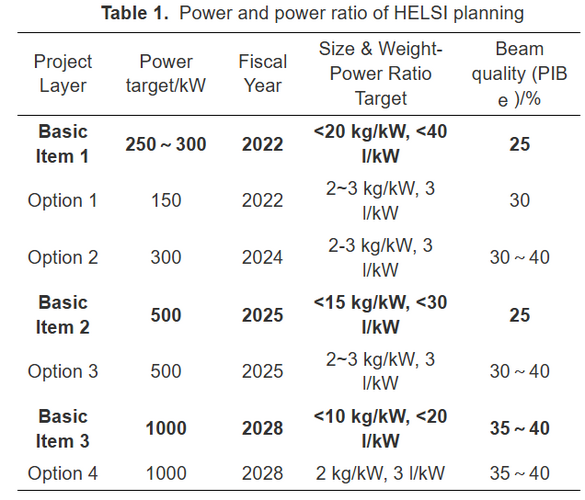
Table 1 uses the power in the bucket (PIB) to evaluate the laser beam quality and characterize the energy concentration of the far-field beam. The far-field divergence radius of an ideal plane wave is 1.22 λ / D , and the corresponding Airy disk power PIB 0 is 84%. Because the central bright spot of the actual beam expands outward compared to the ideal Airy disk, the divergence radius used in the actual power PIBe in the test is 1.5 λ / D.
"The high-energy lasers funded by the HELSI program include four technical solutions: spectrally combined fiber laser (SCFL), coherently combined fiber laser (CCFL), distributed gain laser (DGL), and diode-pumped alkali metal laser (DPAL)"
Forest Green
ACCESS: USAP
- Joined
- 11 June 2019
- Messages
- 14,512
- Reaction score
- 31,560
Lasers and more
https://phys.org/news/2024-08-hot-lasers-powerful.htmlhttps://phys.org/news/2024-08-advance-ultrashort-laser.htmlhttps://phys.org/news/2024-08-advanced-electrohydrodynamics-ultra-compact-gas.htmlhttps://phys.org/news/2024-08-source-emits-bright-entangled-photons.htmlhttps://phys.org/news/2024-08-coupling-excitons-polaritons-solar-cells.htmlhttps://techxplore.com/news/2024-08-ultra-stable-high-brightness-perovskite.htmlhttps://phys.org/news/2024-08-microwave-popcorn-particle-magnetrons-radiofrequency.html
https://phys.org/news/2024-08-hot-lasers-powerful.htmlhttps://phys.org/news/2024-08-advance-ultrashort-laser.htmlhttps://phys.org/news/2024-08-advanced-electrohydrodynamics-ultra-compact-gas.htmlhttps://phys.org/news/2024-08-source-emits-bright-entangled-photons.htmlhttps://phys.org/news/2024-08-coupling-excitons-polaritons-solar-cells.htmlhttps://techxplore.com/news/2024-08-ultra-stable-high-brightness-perovskite.htmlhttps://phys.org/news/2024-08-microwave-popcorn-particle-magnetrons-radiofrequency.html
Forest Green
ACCESS: USAP
- Joined
- 11 June 2019
- Messages
- 14,512
- Reaction score
- 31,560
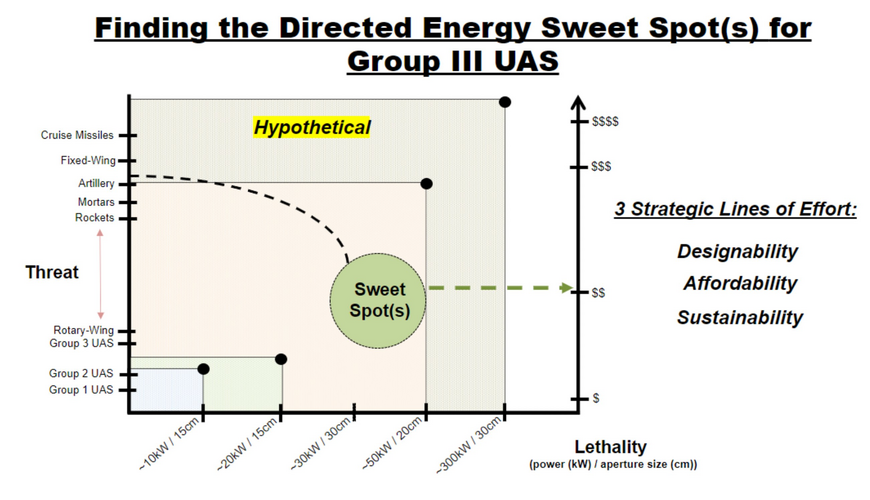
Breaking Defense "After CENTOM experiments, Army seeks more rugged counter-drone lasers to put on vehicles "August 13 - talking to Lt. Gen. Robert Rasch, the Director of Rapid Capabilities and Critical Technologies Office (RCCTO), and others
Looking for laser with capability to take out Group 1 to Group 3 UAS [<1320 lbs; <18,000 MSL (3.4 miles); 250 knots] with reliability and affordability, encountered challenges with the D M-SHORAD Stryker 50 kW under testing in CENTOM in the Middle East and planning a new competition and is encouraging the use of the JLTV platform with a competitive prototyping phase in fiscal 2025 before crowning an ultimate winner in FY26, if the Army can obtain funding.
Army focusing on "fluence" (ideal beam director and beam forming getting the power down range?) their metric of energy delivered per unit, while zeroing in on in-theater maintainability.
BlueHalo mentions a 20-to-30 KW laser will likely be the sweet spot for the competition and is working to design laser with more modular parts though for some components, like the optics says you still need a clean room, which presume a negative?
PS An oversight? Breaking Defense does not mention the Lockheed Martin and nLight offerings of their versions of D M-SHORAD
https://breakingdefense.com/2024/08...gged-counter-drone-lasers-to-put-on-vehicles/
Looking for laser with capability to take out Group 1 to Group 3 UAS [<1320 lbs; <18,000 MSL (3.4 miles); 250 knots] with reliability and affordability, encountered challenges with the D M-SHORAD Stryker 50 kW under testing in CENTOM in the Middle East and planning a new competition and is encouraging the use of the JLTV platform with a competitive prototyping phase in fiscal 2025 before crowning an ultimate winner in FY26, if the Army can obtain funding.
Army focusing on "fluence" (ideal beam director and beam forming getting the power down range?) their metric of energy delivered per unit, while zeroing in on in-theater maintainability.
BlueHalo mentions a 20-to-30 KW laser will likely be the sweet spot for the competition and is working to design laser with more modular parts though for some components, like the optics says you still need a clean room, which presume a negative?
PS An oversight? Breaking Defense does not mention the Lockheed Martin and nLight offerings of their versions of D M-SHORAD
https://breakingdefense.com/2024/08...gged-counter-drone-lasers-to-put-on-vehicles/
Similar threads
-
Lockheed Martin Demonstrates Weapons Grade High Power Fiber Laser
- Started by seruriermarshal
- Replies: 11
-

-
-
-