USAF/USN 6th Gen Fighters - F/A-XX, F-X, NGAD, PCA, ASFS News & Analysis [2008- 2025]

Status
Not open for further replies.
I know there was an airbone small turbo prop filled with people used during the gwot because some spreadsheet genius at dod figured out it was cheaper to have a plane full of people looking at sigint data (and not saving it) versus building some satellite and drone system of systems behemoth

similarly - will adding 'autonomy' to a lethal drone be cheaper than just paying some dude to fly it?

The old catch phrase is to use autonomy for "dull, dirty and dangerous" tasks - but by all accounts manned air-combat (while exceedingly dangerous) is anything but "dull and dirty"
 
Not that much cheaper. You still need a sufficiently-big engine. You still need all the sensors.
Agreed.
If NGAD goes with a clean-sheet 75,000-lb unmanned battlecruiser/C3 node, the basic aircraft size and weight may be 20% to 30% less than the manned equivalent, but the flyaway cost reduction may, at best, be half that amount.

The primary cost driver here is the avionics/sensor suite, essentially a fixed cost. As you point out, the engines and other major subsystems may come in a bit cheaper, but nothing too exciting, particularly for a production run of 200 aircraft.

Additionally, unmanned vs. manned comparisons tend to downplay or underestimate the cost of requisite ground- and space-based infrastructure (after all, someone else's program(s) will pay that bill), as well as the cost differences for training and readiness (usually due to a lack of fidelity in the system description, which is all the poor cost estimators have to work with.)
 
When people expect fully high-tier combat-capable and autonomous UCAVs to cost some percent of manned fighters - 30 mil reaper immediately comes to mind.
 
When people expect fully high-tier combat-capable and autonomous UCAVs to cost some percent of manned fighters - 30 mil reaper immediately comes to mind.
Yep.
Flyaway cost for the Navy's MQ-4C and MQ-25A are currently at $140M a pop. And the latter's avionics suite is pretty much just Comm/Nav stuff.
Flyaway cost does not include the cost for unique shipboard or shore infrastructure, nor for unique training or readiness.

As a co-worker of mine said 32 years ago, "the design alternative we know the least about is the most attractive".
 
Two executives who lost the bid are asking questions. AFAIK the USAF has a very clear idea of what it wants from Incr 1 but is willing to learn for incr 2.
They are right, CCA is not the Holy Grail it is a tool but not the Grail, Air Force still need powerfull high tech aircraft.
 
AF leadership has done a lot of analysis and spent a lot of money on the development of NGAD platform including demonstrators the prototypes, and are at this late date unsure about moving forward.

Do you trust that they have done their homework on CCAs? Affordable mass makes sense from a financial perspective? But is the technology mature enough to make unmanned systems a critical component of the AF's strategy for meeting the threat from the PRC? Is there a detailed and well thought out concept of operations? It doesn't seem so. Performance, basing, logistics, payload, sensors, cost, the level of low observability. How much of this has been defined?

If they are having second thought about the NGAD platform because of the threat have they thought about what happens when the Chinese start producing CCAs also? One thing is certain. With their dithering, the AF leadership is losing valuable time. The fleet gets older and the Chinese are moving forward. It seems we no longer have the initiative and are reacting.
 
AF leadership has done a lot of analysis and spent a lot of money on the development of NGAD platform including demonstrators the prototypes, and are at this late date unsure about moving forward.

Do you trust that they have done their homework on CCAs? Affordable mass makes sense from a financial perspective? But is the technology mature enough to make unmanned systems a critical component of the AF's strategy for meeting the threat from the PRC? Is there a detailed and well thought out concept of operations? It doesn't seem so. Performance, basing, logistics, payload, sensors, cost, the level of low observability. How much of this has been defined?

If they are having second thought about the NGAD platform because of the threat have they thought about what happens when the Chinese start producing CCAs also? One thing is certain. With their dithering, the AF leadership is losing valuable time. The fleet gets older and the Chinese are moving forward. It seems we no longer have the initiative and are reacting.

The USAF seems unsure with regards to NGAD but very confident with regards to CCA. I do not have access to sufficient information to judge those outlooks. I would say though that letting the PRC develop UCAV technology in front of the U.S. hardly seems like a war winning idea. The concept of unmanned fighters could fundamentally alter the balance or power or perhaps come to nothing, but the USAF sitting on its ass will not solve anything. I certainly would not want to bet against modern computing power and cognition in this day and age, let alone next decade.
 
The USAF seems unsure with regards to NGAD but very confident with regards to CCA. I do not have access to sufficient information to judge those outlooks. I would say though that letting the PRC develop UCAV technology in front of the U.S. hardly seems like a war winning idea. The concept of unmanned fighters could fundamentally alter the balance or power or perhaps come to nothing, but the USAF sitting on its ass will not solve anything. I certainly would not want to bet against modern computing power and cognition in this day and age, let alone next decade.
The AF seems unsure about CCAs. They have floated a lot of ideas with regard to capabilities, size, range, etc. You don't do that if you know what you are doing.

What makes it worse is that CCAs are a risky bet on the future. If they get this wrong. If the technology is not mature. If the concept of operations is not well thought out. Then this risks being a boondoggle worse than the Zumwalts and LCS. It comes with greater risks than any manned fighter because it has never been done before. Is being primarily being driven by budgetary considerations? Or will it make the manned fleet more effective. I don't think anyone knows.
 
In case you guys haven´t noticed, the recent video of Boeing manufacturing line for the EX and the MQ-25* shows wings for half a dozen of airframe already completed waiting to be mated to fuselages**.

Hardly a US slow thing.

MQ-25 Screenshot 2024-07-18 190524.png

*The MQ-25 will the first operational carrier borne UAV in world history as the first autonomous air tanker.
** Unless you think those are Boeing P-51EX Cavalier II ones!
 
Hate to be a debbie downer putting a wet blanket over next-gen tacair. After 42 years immersed in the military-industrial complex, half of that in an aeronautical engineering role, my juices still flow when I think of what NGAD, NGAP, PCA, CCA, F/A-XX, etc. could (or should) become. From all appearances, the next-gen technologists have done many great things, for which we should be appreciative.

I fear that there is another obstacle, a solid brick wall, facing the acquisition and fielding of these weapon systems in the timeframe that most of us believe is necessary. The federal national debt is that wall.

In August 2010, Adm. Mike Mullen, Chm of the JCS, famously said:
"I believe that our debt is the greatest threat to our national security".
http://www.cnn.com/2010/US/08/27/debt.security.mullen/index.html
https://ogc.osd.mil/Portals/99/testMullen06152011.pdf


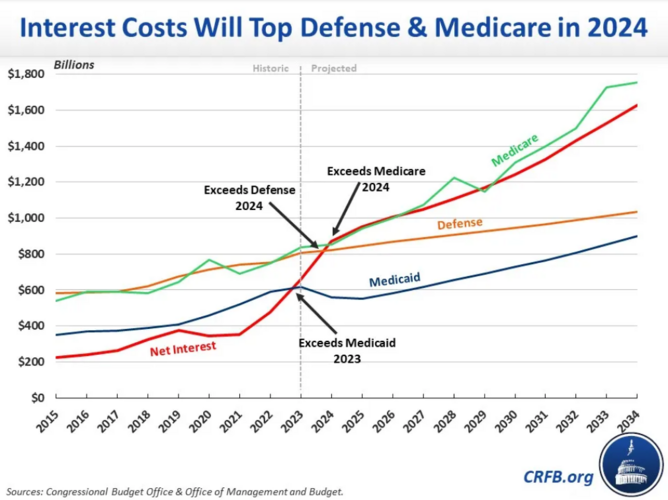
The attached chart shows that we've now at the point where the interest payments on US debt have surpassed US defense spending.

I think Kendall may have overplayed his hand with Congress. He now realizes that a budget plus-up for NGAD/NGAP/CCAs is not going to happen, nor is Congress willing to put out a supplemental appropriation for the nuclear triad.
[The Navy's fiscal situation is not different -- except F/A-XX development took a wave-off last year, and now has been effectively grounded].

Can't come up with any other reason why the Air Force NGAD/PCA flagship program seems to have stalled. The RFP was issued in May 2023 for goodness sake.

Do We Spend More On Interest Than Defense -2024-02-20.png
 
I think the immediate reasons for the NGAD slowdown have pretty clearly been characterized already: externally, from the USAF point of view, the budget capping effects of the Continuing Resolutions and now the Budget Control Act; and internally to the USAF, the massive spike in silo modernization and cabling costs for Sentinel. Together, the CRs, the BCA, and Sentinel overruns ate into the NGAD budget.

All of those also not helped by inflation or glacial clearance approval processes.

No need to assume some outlandish Sci-Fi scenario where Congresspeople actually think about the financial picture instead of blaming the other side's policy preferences!
 
I think the immediate reasons for the NGAD slowdown have pretty clearly been characterized already: externally, from the USAF point of view, the budget capping effects of the Continuing Resolutions and now the Budget Control Act; and internally to the USAF, the massive spike in silo modernization and cabling costs for Sentinel. Together, the CRs, the BCA, and Sentinel overruns ate into the NGAD budget.

All of those also not helped by inflation or glacial clearance approval processes.

No need to assume some outlandish Sci-Fi scenario where Congresspeople actually think about the financial picture instead of blaming the other side's policy preferences!
Ok, I don't think we're saying different things.
The CRs and the BCA aren't new, they pre-date when Kendall submitted his FY25 POM last July. The big 'surprise' since then is the ICBM overun, which he has to accomodate in the FY26 POM this July. Kendall would have known this fiscal dilemma was coming months ago.
To me it looks like he kept charging ahead anyway, hoping that the relevant Congressional committees would be receptive to some budgetary relief for NGAD or the ICBM leg of the nuclear triad. I previously wrote that he was 'trying to fit 5 lbs in a 2-lb bag'. I think this gambit was unsuccessful.

Edit: Alphabet soup, sorry. The POM covers the 5-year future year defense plan (FYDP) and presents the Services and Defense Agencies’ proposal on how they will balance their allocation of available resources.
 
Last edited:
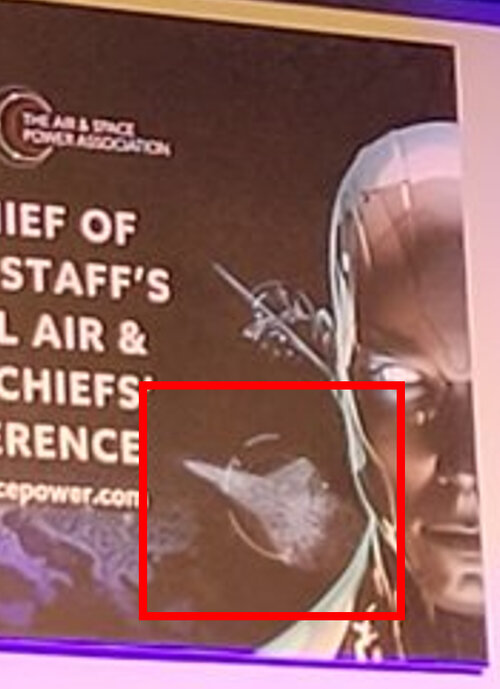
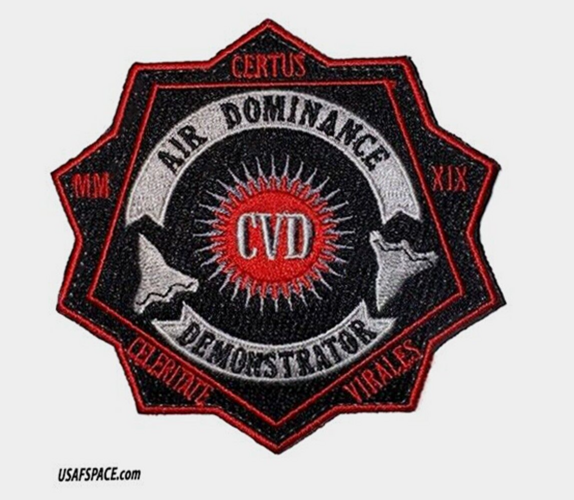
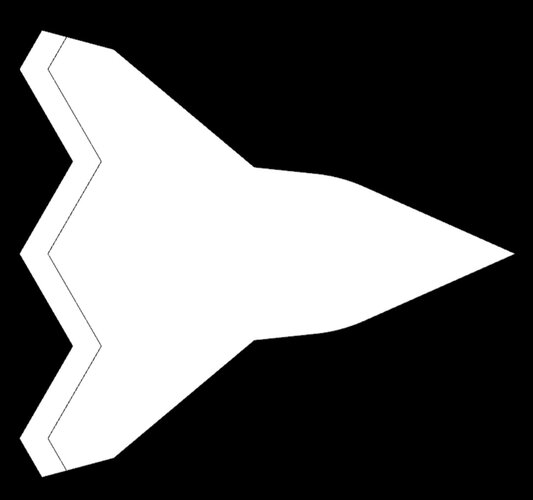
Sorry for the size , the shape is the same of the one on the patch
 
The AF seems unsure about CCAs. They have floated a lot of ideas with regard to capabilities, size, range, etc. You don't do that if you know what you are doing.
Have you looked at how many different aircraft designs there were in the Century Series?

There's probably a lot of questions about how far and how much load the CCAs need to carry. USAF has an idea, but is aware that paper plans may not survive contact with the enemy. So they're assuming that the CCA designs may need to change. May prove to need to carry more AAMs or whatever.

But they can fly CCAs with 2x AAMs right now.


What makes it worse is that CCAs are a risky bet on the future. If they get this wrong. If the technology is not mature. If the concept of operations is not well thought out. Then this risks being a boondoggle worse than the Zumwalts and LCS. It comes with greater risks than any manned fighter because it has never been done before. Is being primarily being driven by budgetary considerations? Or will it make the manned fleet more effective. I don't think anyone knows.
We've been flying drones for 30+ years.

We've been flying a hi-low mix of aircraft for 50+ years.
 
I'll say it again, it's not worth designing USAF fighters around extended legs in the Pacific. If we're worried about China, the entirety of their country that is not along the SCS is wide open and available to our current fighters. Leave the Pacific to the Navy to keep the waterways open.
 
I'll say it again, it's not worth designing USAF fighters around extended legs in the Pacific. If we're worried about China, the entirety of their country that is not along the SCS is wide open and available to our current fighters. Leave the Pacific to the Navy to keep the waterways open.
Except for having to fly over the pole and over Russian Siberia, or fly over the Himalayans from bases in India etc.

All of the cities and industrial centers are on the ocean side of the country.
 
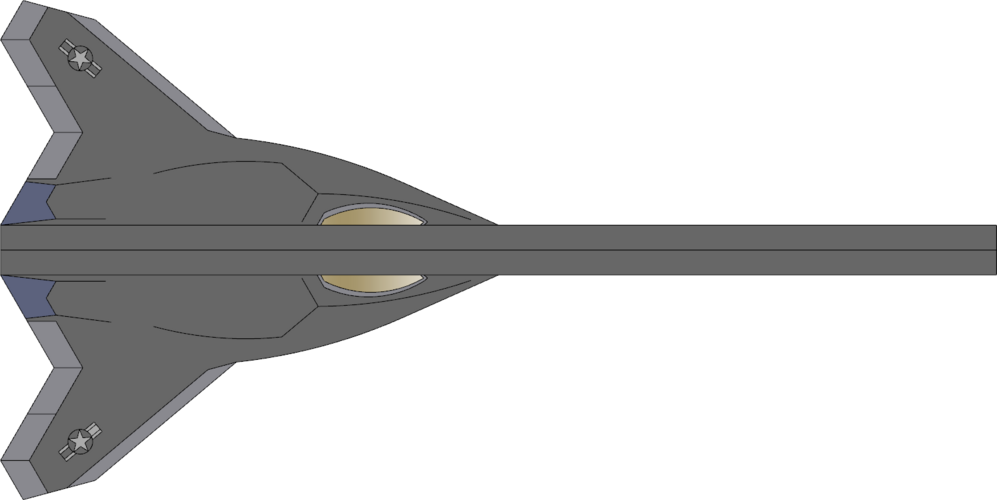
Haha, looks more of a size that is associated with a stealthy LMF.

I get the feeling that Allvin may personally want to be an advocate for applying the CCA methodology to future crewed fighters, meaning digital design, short fatigue life, shorter service life, lower tech, avoiding long sustainment costs, avoiding long tech development or fielding, rapid development, etc.

A bit like C.Q. Brown came into office expressing interest in a next gen non-VLO fighter, and making the F-35 the "Sunday fighter" that generally would fly less, avoid the desert, etc, but still be available for high end conflict. I am NOT necessarily trying to link Allvin's ideas to Brown's as specific concepts, just saying that I think both of them were giving voice to personal preferences (which they have probably now talked up to the AS 2050 people) rather than speaking ex officio about finalized official Air Force conclusions.
 
Last edited:
I get the feeling that Allvin may personally want to be an advocate for applying the CCA methodology to future crewed fighters, meaning digital design, short fatigue life, shorter service life, lower tech, avoiding long sustainment costs, avoiding long tech development or fielding, rapid development, etc.

A bit like C.Q. Brown came into office expressing interest in a next gen non-VLO fighter, and making the F-35 the "Sunday fighter" that generally would fly less, avoid the desert, etc, but still be available for high end conflict. I am NOT necessarily trying to link Allvin's ideas to Brown's as specific concepts, just saying that I think both of them were giving voice to personal preferences (which they have probably now talked up to the AS 2050 people) rather than speaking ex officio about finalized official Air Force conclusions.
I can definitely see wanting to make the planes only last about 20-30 years not 40-50, because of how fast technology has advanced. FFS, F-22s have computer chips made in the early 1990s in them!

It also helps keep the different aircraft makers involved, since pretty much as soon as the contract is signed and the NGAD is in IOC, you start designing the replacement.

Plus, now the design and delivery of a new plane can be staggered. High end fighter designed, start designing low end fighter that enters service ~10 years after high end plane hits IOC. Soon as the low end fighter hits IOC, start designing new high end fighter. repeat.

Though as a side note, I'm kinda expecting the USAF to also need an actual medium-ish bomber. Something with half the range of the B21 but the same bombload. An F-15E/F-111 replacement.
 
I'll say it again, it's not worth designing USAF fighters around extended legs in the Pacific. If we're worried about China, the entirety of their country that is not along the SCS is wide open and available to our current fighters. Leave the Pacific to the Navy to keep the waterways open.

Where would these mythical fighters be based out of and how many nuclear powers would they have to overfly?
 
Though as a side note, I'm kinda expecting the USAF to also need an actual medium-ish bomber. Something with half the range of the B21 but the same bombload. An F-15E/F-111 replacement.

Why? What need would this fill vice more B-21s, given the dearth of bases to deploy them?
 
Why? What need would this fill vice more B-21s, given the dearth of bases to deploy them?
Given that I'm imagining it as being essentially a "Strike NGAD," it's got speed and more capable air to air.

Because in the case of major shooting wars kicking off, the US cannot afford to be using any of the ~100 B-21s to deliver conventional explosives in 2000lb sized chunks.
 
Except for having to fly over the pole and over Russian Siberia, or fly over the Himalayans from bases in India etc.

All of the cities and industrial centers are on the ocean side of the country.

It's a smaller issue to tackle than dealing with the heavily entrenched Western Pacific where there are fewer basing options and lots of water inbetween.

There is plenty of accessible infrastructure in western China that would cripple the nation if struck. Russia isn't heavily defended in that region either.
 
Have you looked at how many different aircraft designs there were in the Century Series?

There's probably a lot of questions about how far and how much load the CCAs need to carry. USAF has an idea, but is aware that paper plans may not survive contact with the enemy. So they're assuming that the CCA designs may need to change. May prove to need to carry more AAMs or whatever.

But they can fly CCAs with 2x AAMs right now.


We've been flying drones for 30+ years.

We've been flying a hi-low mix of aircraft for 50+ years.
You could also say we've been flying drones since Vietnam. But saying that, as well as flying ISR and other assets in a permissive environment, underplays the significance of Kendall's affordable mass concept. It's revolutionary and as such is very risky.

Regarding the Century Series model. Different time. Different place. Simpler technology, more hardware than software dependent. Did it really produce great fighters? Or was its value mainly an approach which developed technology and helped the Air Force determine what attributes it wanted in its fighters?

You may be emulating the broad outlines of the idea with CCAs with a similar approach. Will it work from a cost and engineering perspective? Will it provide systems which help the AF counter China without wasting a lot of money on dead ends?

In general you are also right about the hi-lo mix, but CCAs are different. Short ranged fighters are not joining long range bomber as they ingress. You are not integrating a flight of F-16s and F-15s in the same package. You are giving a manned fighter an AI wingman that is flying a dissimilar aircaraft with different performance characteristic and sensors. The "low mix" is more like a non expendable weapon that is an extension of the manned fighter than a wingman.

The challenge for the AF is they have to get this right. It is not the 1950s and 60s. There is not a lot of cash it can burn through in order to try different things.
 
You could also say we've been flying drones since Vietnam.

Not really, post 1973 after US forces pulled out of south Vietnam the USAF had dropped Firebee drone programme (IIRC it was quite successful in North Vietnam) like hot potato within a few years (Which was a very short-sighted move IMO).
 
Status
Not open for further replies.

Similar threads

Back
Top Bottom