New Fonthill Book - Rocket Interceptors 1941-1947

Justo Miranda

ACCESS: Above Top Secret
Senior Member
Joined
2 December 2007
Messages
9,911
Reaction score
16,160
Website
www.amazon.com
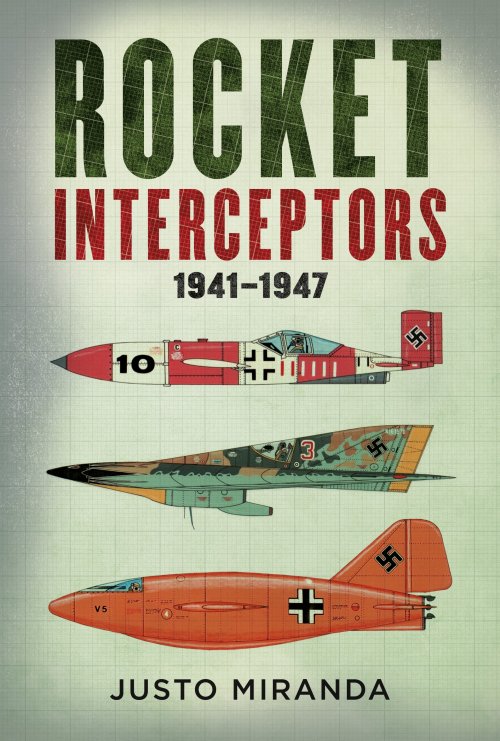
Rocket Interceptors 1941-1947


CONTENTS​

First Flights

RRG Raketen-Ente

Opel/Hatry RAK.1

Espenlaub E-7

Espenlaub E-15

Heinkel He 176 V1

Heinkel He 176 V2

Daytime combats over the Reich

The Sturmböck assault rammer

The Gleitjäger concept

Blohm und Voss P.186

Akaflieg Stuttgart FS-17

DFS Liege-Kranich II

Berlin B9

Blohm und Voss BV 40 (December 13, 1943)

Verbrauchsflugzeug competition

DFS Eber Entwurf II

DVL Jagdsegler Entwurf II

Zeppelin Fliegende Panzerfaust

Solid-propellants rockets

The Bordjäger concept

Arado E 381 Kleinstjäger

Blohm und Voss BV 40 (with HWK 109-507)

Messerschmitt P.1103 (September 12, 1944)

Rammschussjäger specification

Selbstopfermanner

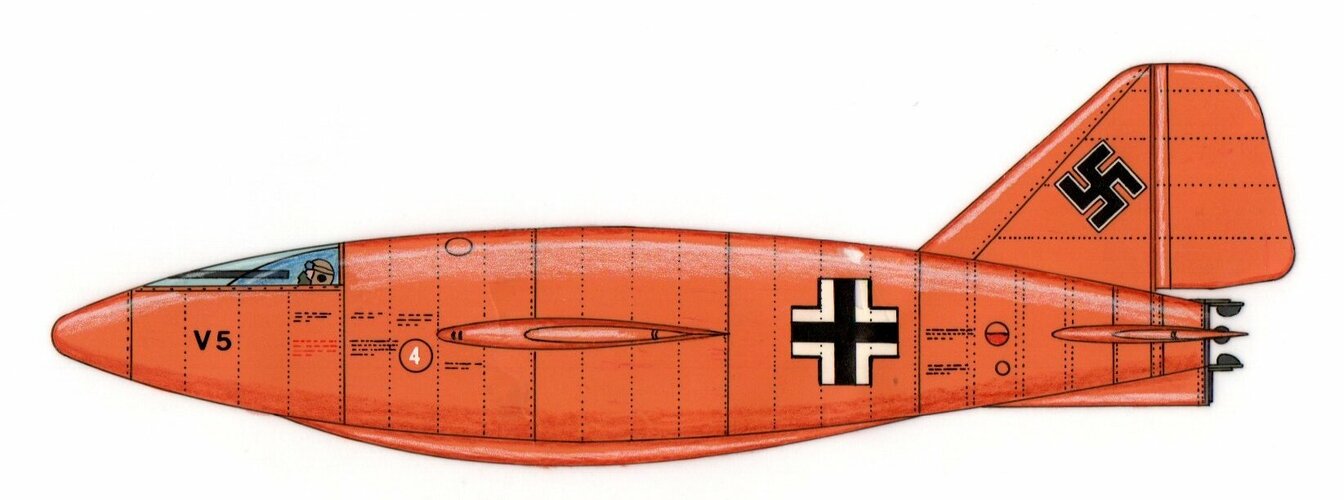
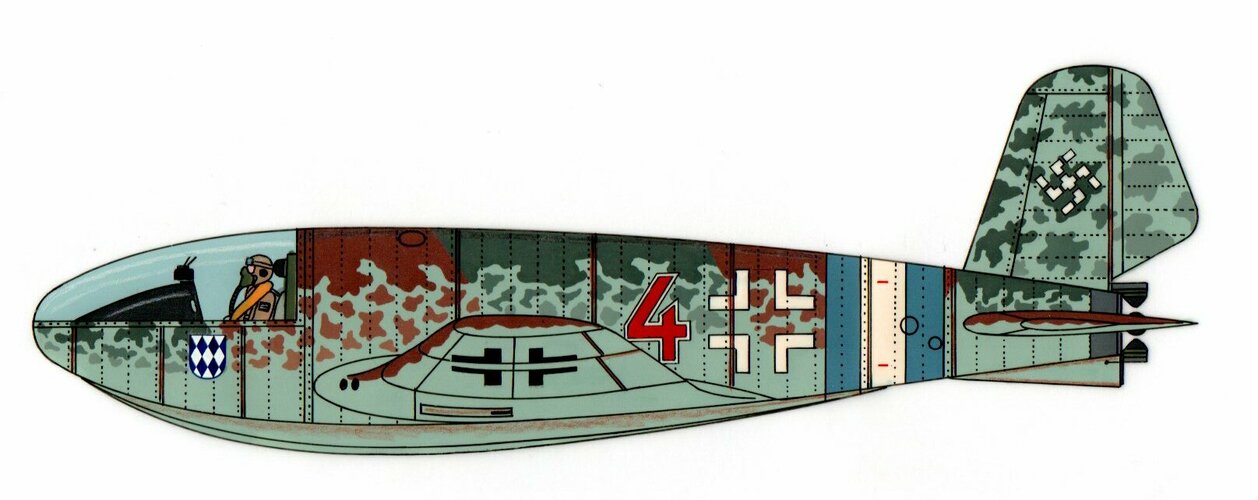
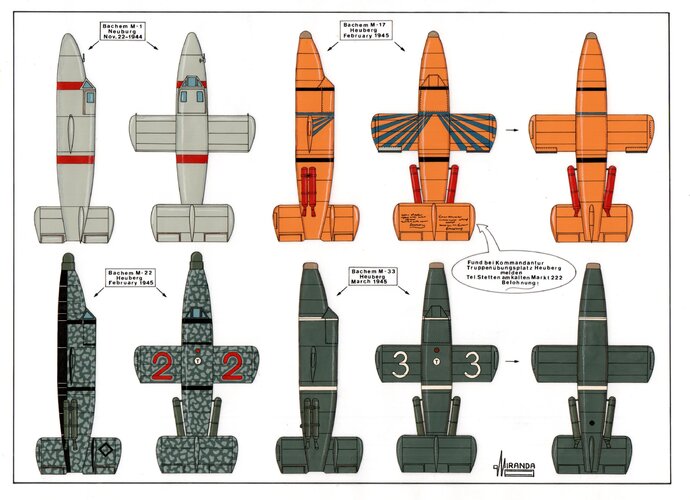
Bachem Rammers

DFS Eber Entwurf I

DVL Jagdsegler Entwurf I

Focke-Wulf Rammjäger

Gotha P.54

Me P.1103 Rammjäger (July 6, 1944)

Zeppelin Rammer

Turbojet/Rocket Mixed Powerplant

The Hochleistungsjäger concept

Rocket propellants composition

Me 262 Interzeptor and Me 262 Heimatschützer programmes

Arado TEW 16/43-15

Focke-Wulf 1-TLR Jäger Projekt V

Focke-Wulf P.011.001

Focke-Wulf Ta 183 Ra-1

Focke-Wulf 1-TL Jäger Projekt VI (Flitzer I)

Heinkel He 162.01-42 (March 12, 1945)

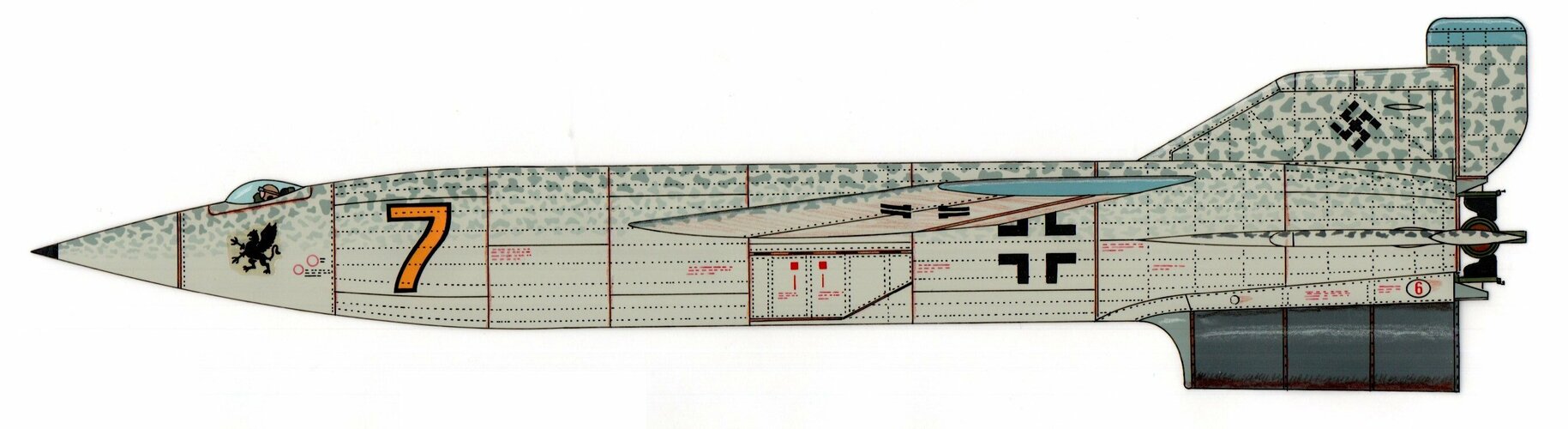
Horten Ho XIIIb Überschalljäger

Gotha P.60 A/R

Combat Rocket Planes

Messerschmitt Me 163 Komet

Lippisch DFS 39

Lippisch DFS 40

Lippisch Projekt X

Lippisch-DFS 194

Messerschmitt Me 163 A

Grunau Baby

DFS 108 F53 Habicht

DFS 108 G53 Stummel Habicht

Messerschmitt Me 163 A-0

Erprobungskommando (EK) 16

Messerschmitt Me 163 B-0

Messerschmitt Me 163 B-1

Messerschmitt Me 163 B-2

The Hasag Sondergerät SG 500 Jagdfaust

Jagdeschwader (JG) 400

Chasing the Mach One - German Supersonic Projects

Messerschmitt P.1106 (December 14, 1944)

Messerschmitt P.1106 (January 12, 1945)

Messerschmitt P.1106 R

Lippisch Überschall Delta

Lippisch DM-1

Lippisch DM-2

Lippisch DM-3

Siebel/DFS 346

The Strahlrohrjäger concept

Messerschmitt Me 262 A-1 with Sänger ramjets

Messerschmitt P.1101 L (Lorinantrieb)

Skoda-Kauba SK P14-01

Skoda-Kauba SK P14-02

Heinkel He P.1080

Lippisch Delta VI with Lorin Stahlrohr

Lippisch LP.12

Lippisch P.13

Lippisch P.13a

Blohm und Voss Manuell Gesteuertes Raketenprojektil

Stöckel Rammschussjägern

Focke-Wulf Ta 283

Focke-Wulf Jäger mit 2 Lorin-Triebwerken und 1 TL

Objektschutzjäger programme

Messerschmitt P.1103 (September 12, 1944)

Messerschmitt P.1104

Messerschmitt Me P.1104 Entwurf XVIII-118 (September 22, 1944)

Sombold/Bley So.344 Rammsuchssjäger

Junkers EF.127.02

The Reinmetall-Borsig Sondergerät SG 118 Rohrblocktrommel

Focke-Wulf Volksjäger (December 1944)

Messerschmitt Me 163 C-1

Junkers EF 127.01

Messerschmitt Me P.1104-S53 (August 10, 1944)

Lippisch Rammer

Heinkel P.1068 (August 16, 1944)

Heinkel P.1077 Julia I (November 14, 1944)

Heinkel P.1077 Julia II (November 15, 1944)

Henschel P.136

Messerschmitt Me 163 B V18 (VA+SP)

Messerschmitt Me 163 D

Junkers Ju 248 V1 (DV+PA)

Messerschmitt Me 263 A-1

Messerschmitt Me P.1103 B (July 6, 1944)

Arado TEW 16/43-13

Ejector Seats

Bi-propellant rocket engines

Projekt Natter

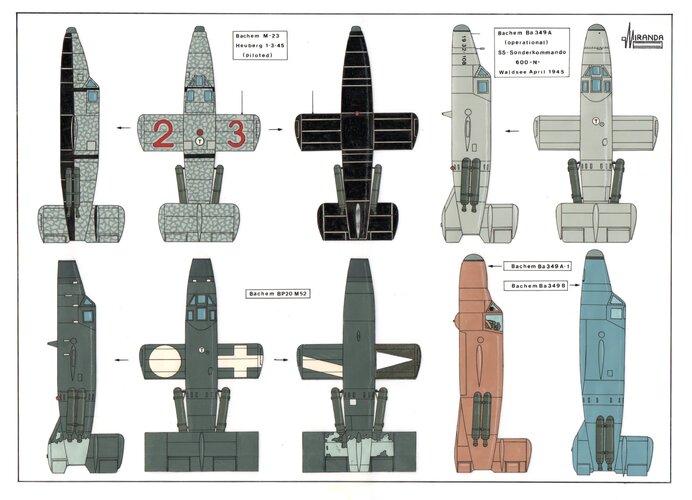
Bachem rocket fighter (16.7.44)

Bachem BP 20 Berak I

Bachem BP 20-04 (13.8.44)

Bachem BP 20-09 (10.7.44)

Bachem BP M1 glider (11.3.44)

Bachem Ba 349 A-1 (Operation Krokus)

Bachem Ba 349 B (11.27.44)

Bachem Ba 349 C (November 1944)

Air-to-air spin-stabilized rockets

Air-to-air fin-stabilized rockets

Wernher von Braun rockets

Russian Rocket-planes

Cheranovsky flying wing BICh-11

Korolev RP-318-1

Golovin IVS/ISF

Bereznyak-Isayev BI

Yakovlev Yak-7R

Tikhonravov I-302

Florov 4302

Polikarpov Malyutka

Lavochkin La-7R

Yakovlev Yak-3 RD

Mikoyan-Gurevich MiG I-270

Lavochkin I-162

Lavochkin I-162-I

Tsybin LL-1

Tsybin LL-3

DFS 346 P

DFS 346-3

Bisnovat “5-2”

COLD WAR

Mikoyan-Gurevich Ye-50A

Mikoyan-Gurevich MiG-19 SU (SM-50)

Mikoyan-Gurevich MiG-19 PU (SM-51)

Mikoyan-Gurevich MiG PMU (SM-12)

American Rocket-fighters

North American P-51 D-25-NA with Aerojet 1.3K rocket boost

Northrop N-1M

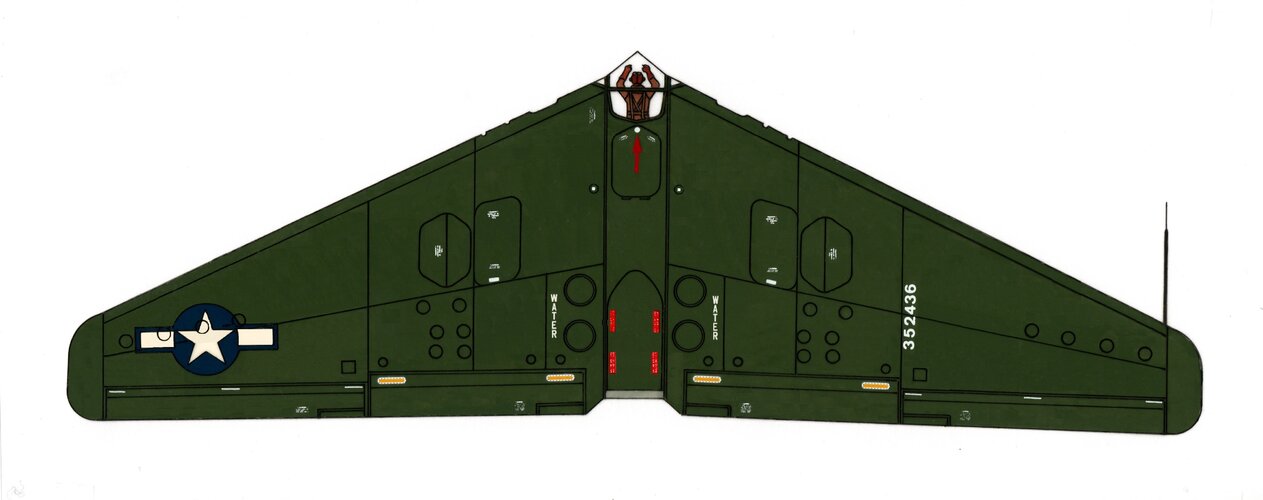
Northrop XP-79 with Rotojet rocket motor

Northrop XP-79B with two Westinghouse 19 B turbojets

Northrop MX-324

Northrop MX-334

Japanese Rocket-fighters

Mizuno Shinryu II

The ROTSU air-to-air rockets

Kakukyoku rammer

Kayaba Katsuodori

Mitsubishi J8M1 Model 19 Shusui

Mitsubishi Ki.200

Mitsubishi J8M2 Shusui-KAI Model 21

Mitsubishi J8M2 Model 22

Rikugun Ki.202

Yokosuka MXY8 Akigusa

Kugisho MXY9 Shuka

Yokoi Ku.13
 

Attachments

  • 301.jpg
    301.jpg
    52.5 KB · Views: 124
  • 302.jpg
    302.jpg
    82.1 KB · Views: 75
  • 303.jpg
    303.jpg
    132 KB · Views: 75
  • 316.jpg
    316.jpg
    101.1 KB · Views: 68
  • 317.jpg
    317.jpg
    114.4 KB · Views: 68
  • 318.jpg
    318.jpg
    129.8 KB · Views: 69
  • 319.jpg
    319.jpg
    254.1 KB · Views: 81
  • 327.jpg
    327.jpg
    1.3 MB · Views: 84
  • 329.jpg
    329.jpg
    1.1 MB · Views: 90
  • 523.jpg
    523.jpg
    1.2 MB · Views: 99
  • 524.jpg
    524.jpg
    778.5 KB · Views: 126
Last edited:
I be waiting this to come out from the publisher.
Fonthill has already accepted the publication and the contract has been formalized, but an 894-page manuscript (56,000 words) with 250 pages of line drawings and 30 pages in color needs time to be edited.
 
Is there a drawing with ramjet version?
No, I only have drawings of the same installation on the Yak-7R.

During ground test conducted in the spring of 1941, the Dushkin-Isayev D-1A-1100 nitric acid/kerosene rocket motor produced 1,100 kg peak thrust.

To achieve that power, the engine used fuel pumps that suffered serious corrosion problems due to acid, which could not be solved. It was necessary to reuse the old pressurization system by compressed air, thus reducing the powered endurance to just 15 minutes.

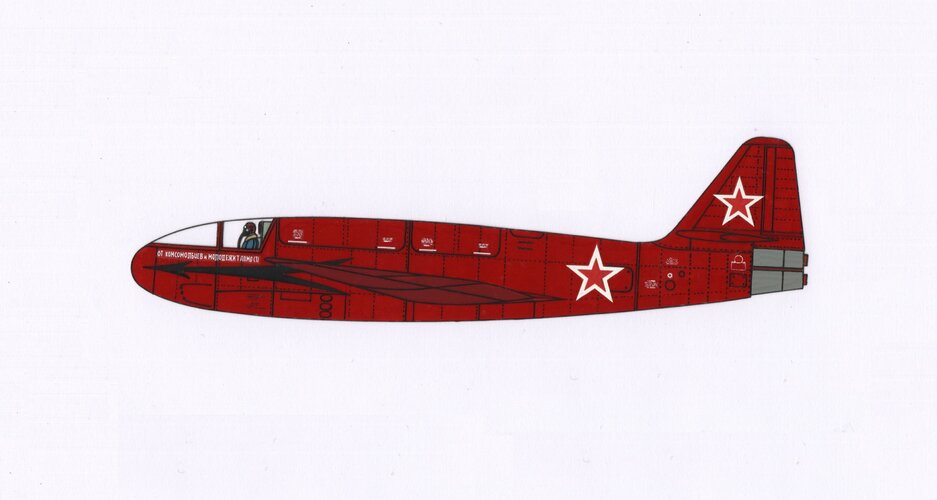
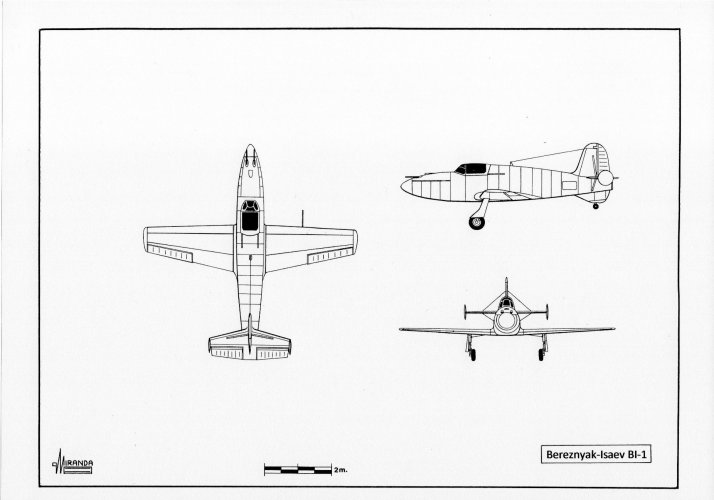
In June 1941 it was decided to use the D-1A-1100 for the propulsion of a small point-defense interceptor designed by the engineers A.Ya Bereznyak and A.A. Isayev.

The prototype BI-1 was flown, in glider configuration, on September 10, 1941.

The rocket engine exploded during ground test on February 20, 1942, due to the fragility of the combustion chamber and the first powered flight was conducted by the second prototype BI-2 on May 15, 1942. During this first flight the engine only worked for just under a minute.

The BI airframe was not properly designed to high-speed flight. On March 27, 1943, the BI-3 prototype suffered compressibility buffeting and was destroyed because of an uncontrollable nose-down pitch at 497 mph (800 km/h).

All the work on the 50 pre-production machines was abandoned but some flight testing was continued with the BI-6 and BI-7 prototypes until 1945.

Bereznyak-Isayev BI technical data

Wingspan: 21.2 ft. (6.48 m), length: 21 ft. (6.4 m), height: 6.8 ft. (2.06 m), wing surface: 75.35 sq. ft. (7 sq. m), take-off weight: 3,710 lb (1,683 kg), estimated maximum speed: 559 mph (900 km/h).

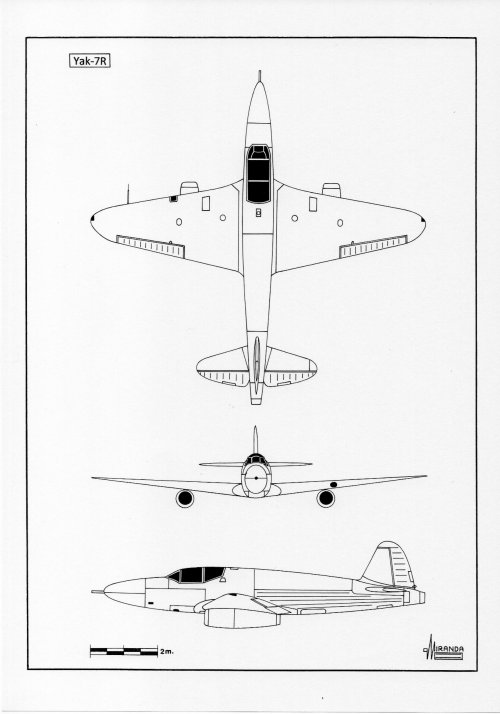
In the Yak-7R modification, proposed in 1942, the M-105 piston engine was replaced by the pilot cockpit and the nose armament. One D-1A rocket motor was mounted in the rear fuselage and two Merkulov DM-4C ramjets were fitted under the wings, but the GKO did not authorize the project and the airframe conversion was never completed.

Yak-7R technical data

Wingspan: 32.8 ft. (10 m), length: 31.4 ft. (9.58 m), height: 7.4 ft. (2.26 m), wing surface: 190.5 sq. ft. (17.15 sq. m).

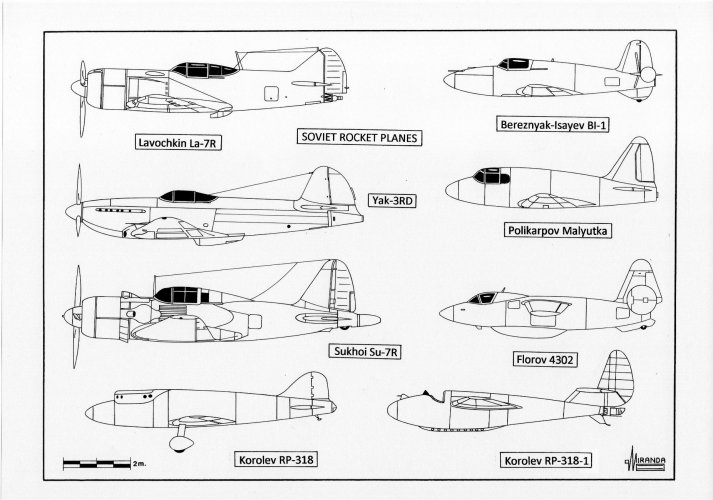
The loss of official interest in rocket interceptors also affected development of the Tikhonravov I-302, Florov 4302 and Polikarpov Malyutka projects.

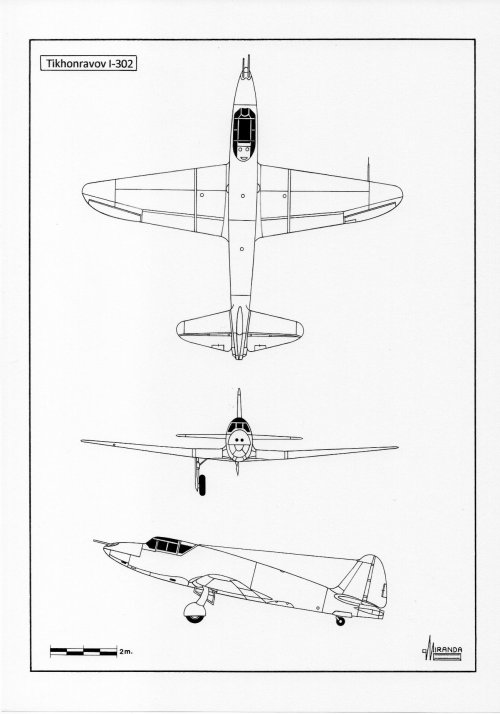
The I-302 was flight-tested as a glider from August 1943, but the project was cancelled in March 1944 before the rocket engine was installed in the prototype. The Dushkin/Shtokolov RD-2-M-3V rocket (kerosene + LOX) had a main combustion chamber rated at 1,100 kg thrust and a cruise chamber rated at 450 kg thrust.

Two DM-4C ramjets fitted under the wings of the second prototype I-302 P had been planned.

Tikhonravov I-302 technical data

Wingspan: 37 ft. (11.4 m), length: 26.2 ft. (8 m), height: 7.7 ft. (2.36 m), wing surface: 198 sq. ft. (17.8 sq. m), take-off weight: 19,205 lb (8,700 kg), estimated maximum speed: 559 mph (900 km/h).

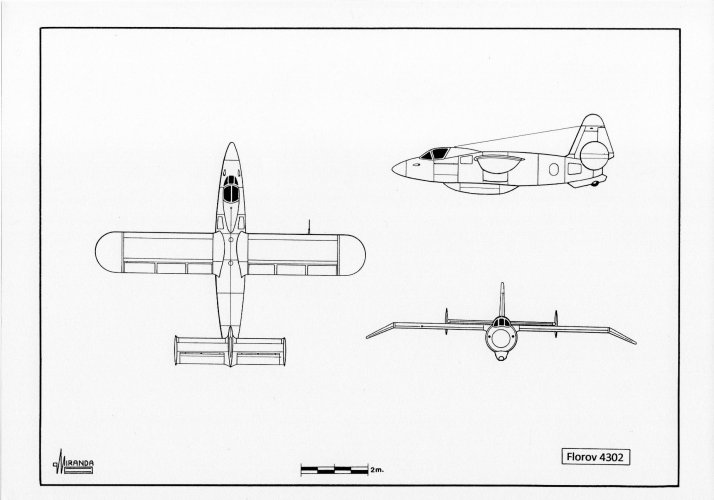
In 1943 a design team of the Air Force Research Institute (NIIVS), under the leadership of Ilya Florov, was tasked with developing an aerodynamic research rocket plane for testing high-speed wings and control systems.

In 1946, the first prototype, known as Aircraft 4302, was flight tested in glider configuration.

In August 1947, the second prototype was flown at 323 mph (520 km/h) powered by one RD-2M-3 rocket motor with two combustion chambers rated at 1,450 and 400 kg thrust.

The project was cancelled in favour of the MiG I-270.

Florov 4302-02 technical data

Wingspan: 22.7 ft. (6.93 m), length: 23.3 ft. (7.12 m), height: 7 ft. (2.12 m), take-off weight: 5,243 lb (2,398 kg), estimated maximum speed: 323 mph (520 km/h).

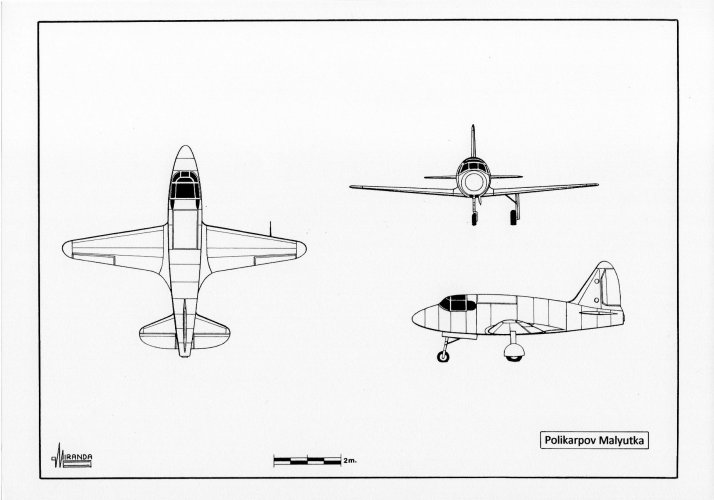
The Malyutka project had not yet reached the prototype stage when it was cancelled on July 30, 1944.

Polikarpov Malyutka technical data

Wingspan: 21 ft. (6.4 m), length: 20.7 ft. (6.3 m), height: 8.8 ft. (2.69 m), wing surface: 108 sq. ft. (10 sq. m), take-off weight: 5,622 lb (2,550 kg), estimated maximum speed: 544 mph (875 km/h).

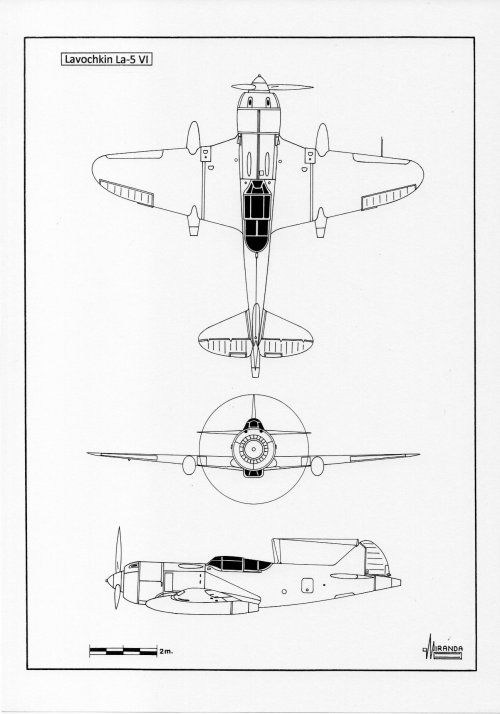
Sergei Korolev proposed a rocket-boosted version of the Lavochkin La-5 standard under the La-5 VI (Visotnyi Istrebitel) codename.

The modification consisted on three Glushko RD-1 Khz bipropellant rocket motors, with electric ignition system, mounted under the wings and in the rear fuselage.

It was expected a top speed of 590 mph (950 km/h) and 55,760 ft. (17,000 m) ceiling but the Lavochkin design bureau estimated that the rocket fuel could react with wood causing fires and decided to use a La-7, with metallic structure.

The prototype La-7R was flight tested in October 1944, reaching 461 mph (742 km/h) powered by one M-82 reciprocating engine and one acid/kerosene rocket motor RD-1 KhZ with 300 kg peak thrust.

The second prototype attained 494 mph (795 km/h) and 42,640 ft. (13,000 m) ceiling powered by one ZhRD-1 rocket with hypergolic chemical ignition.

On May 12, 1945, the engine exploded during ground test destroying the prototype. Operation with the ZhRD-1 was found to be extremely hazardous, with explosions a common occurrence.

Flight testing continued until February 1945.

Lavochkin La-7R technical data

Wingspan: 32 ft. (9.8 m), length: 28.4 ft. (8.67 m), height: 2.54 ft. (2.7 m), wing surface: 189.3 sq. ft. (17.59 sq. m), take-off weight: 7,704 lb. (3,490 Kg).

A third prototype named La-120 R was flown in January 1945 reaching 500 mph (805 km/h) powered by one RD-1 CH2-X3 rocket.

The Yak-3 RD prototype was flight tested on December 22, 1944, powered by one VK-105 PF2 piston engine and one RD-1 KhZ

The rocket engine proved to be unreliable and was replaced by a ZhRD-1. The Yak-3R attained 486 mph (782 km/h) flying at 25,590 ft. (7,800 m).

Rocket malfunction continued. On May 14, 1945, there was an explosion during the ground tests.

On August 16, 1945, during a 510 mph (820 km/h) run at 8,200 ft (2,500 m) the prototype suddenly entered a steep dive and crashed.

Yakovlev Yak-3 RD technical data

Wingspan: 30 ft. (9.2 m), length: 29.6 ft. (9.02 m), height: 7.9 ft. (2.42 m), wing surface: 159.6 sq. ft. (14.83 sq. m), take-off weight: 7,616 lb. (3,450 Kg).
 

Attachments

  • Picture1.jpg
    Picture1.jpg
    448.9 KB · Views: 25
  • Picture2.jpg
    Picture2.jpg
    454.4 KB · Views: 26
  • Picture5.jpg
    Picture5.jpg
    333.3 KB · Views: 23
  • Picture6.jpg
    Picture6.jpg
    340.5 KB · Views: 22
  • Picture7.jpg
    Picture7.jpg
    326 KB · Views: 21
  • Picture4.jpg
    Picture4.jpg
    467 KB · Views: 26
  • Picture3.jpg
    Picture3.jpg
    432.5 KB · Views: 29

Similar threads

Back
Top Bottom