- Joined
- 21 April 2009
- Messages
- 14,350
- Reaction score
- 9,432

I rather doubt Glide Breaker can be moved along any faster regardless of how much money Congress wants to throw at the project. I wonder if in stead there might be more utility in adding the PAC3 MSE/CRIs to Aegis/Mk41.


Looks like hydrolox.So was this specifically a rocket rotating pulse engine vs the recent success GE had with a jet engine? What fuel was used?
110% must be about the booster. Can't be anything else. US hypersonic research is so weird that the scramjets function but the SRMs don't.
1
110% must be about the booster. Can't be anything else. US hypersonic research is so weird that the scramjets function but the SRMs don't.
This can also be true. These guidance systems are in my opinion the hardest problem in hypersonic. Communication is so difficult at such temperature and speed.My read from the comment is that it was directed generally at the whole program. He mentioned specifically “operationalizing” the progress from HAWC, so my guess is that his concerns are more in regard to guidance and terminal effects than the proven propulsion stack.
This can also be true. These guidance systems are in my opinion the hardest problem in hypersonic. Communication is so difficult at such temperature and speed.

This proposal seeks to study, engineer, and prototype a modified SUU-67/A Pylon with MIL-STD-1760 aircraft interface. AFGSC is developing a new conventional High Speed, Air-breathing cruise missile capable of range >1000 miles. Such a missile carried by the B-52 will likely exceded the capacity of the existing conventional weapons pylon and Heavy Stores Adapter Beam (HSAB). AFGSC is exploring other means of missile carriage on the B-52. One option is repurposing the existing SUU-67/A Aircraft Pylon for conventional use. The SUU-67/A is currently used to carry the AGM-86/B Air Launched Cruise Missile (ALCM). Without this effort to repourpose the SUU-67/A, AFGSC will likely have diminished carriage cabability to carry cruise missiles on the B-52. Potential andversaries and conflicts in the Pacific region will need dozens of cruise missiles in mass attacks against hostile forces. The B-52 carries eight missiles internal and twelve missiles on external underwing pylons, each pylon carries six missiles. Without a capable external pylon, B-52 carraige is diminished 60%.
They should simply rebuild the entire center fuselage section. That would be way more simple.
They should not shy on this endeavor. It's plain straight through engineering work.

That's why it was posted in this thread.The interesting thing to me is that they mention they have a conventional high speed missile with a range of >1000 miles.
That's why it was posted in this thread.
General Electric Aerospace has successfully showcased a groundbreaking demonstration of a hypersonic dual-mode ramjet (DMRJ) rig, incorporating rotating detonation combustion (RDC) technology within a supersonic flow stream. This test, believed to be a world-first, has the potential to facilitate high-speed, long-range flights with enhanced efficiency.
The experiment took place at the Research Center in Niskayuna, New York, where the company is actively advancing a wide-ranging portfolio of technology initiatives aimed at advancing and expanding hypersonic capabilities which includes the development of high-temperature materials and high-temperature electronics.
This effort is also supported by DARPA, the Air Force Research Laboratory and the Missile Defense Agency.
In this video, Defense Updates analyzes how GE Aerospace's hypersonic dual-mode ramjet could give a big boost to the US military?
My money is on the word "conventional" meaning "conventional weapon" warhead.The SBIR specifically mentions "conventional" and "cruise" in the description of the weapon it is trying to accommodate*; perhaps this is what "CC" in HCCW stands for?
My money is on the word "conventional" meaning "conventional weapon" warhead.
Get hypersonic cruise missiles working first.
Then figure out how to make a nuke fit inside and not freak out from the heat.
The Missile Defense Agency confirmed that a national security space mission that had been projected to launch in December 2023 is being delayed until the second quarter of 2024 due to technical issues with one of the spacecraft.
…MDA’s national security mission, designated USSF-124, includes six satellites designed to track hypersonic missiles. Four of the satellites are missile-tracking sensors made by L3Harris for the Space Development Agency’s Tracking Layer constellation. The other two satellites — one made by L3Harris and the other by Northrop Grumman — are part of MDA’s Hypersonic and Ballistic Tracking Space Sensor (HBTSS) program.
…MDA did not disclose which of the two HBTSS payloads is having technical issues. A source close to SDA said “any delay at this point is not related to the L3Harris” Tracking Layer satellites.
https://spacenews.com/pentagon-agen...ing-launch-of-hypersonic-tracking-satellites/Some lawmakers have suggested SDA, which was established in 2019 to rapidly develop and launch next-generation space capabilities, should take over the mission entirely from MDA. Others argue MDA needs to retain that authority due to its decades of experience tracking ballistic missiles.
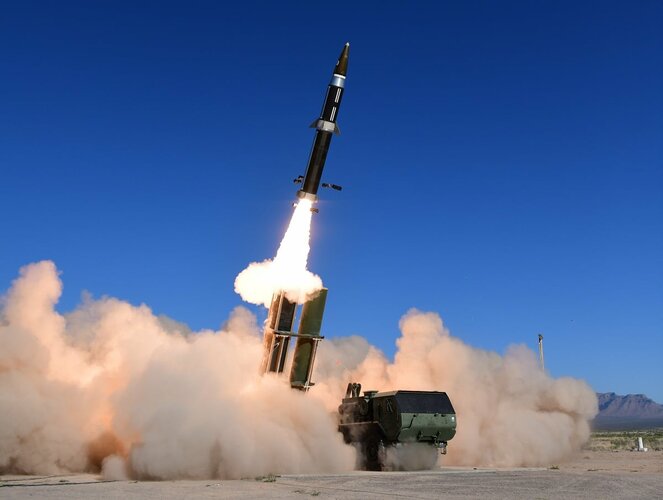
No your thinking of LRHW at 1750 miles...The training canisters had markings indicating a launch weight of 16,300 lbs (20,500 full, 4200 spent). A US Army statement indicated a range of 1750 miles, though that obviously is a gray area - absolute range would probably be when the entire glider fell out of controlled flight, which I would guess would not happen until subsonic speeds. So "range" probably is related to how fast you want the projectile to be moving over the target or even more likely was chosen to include Taiwan from Guam but not extend to the China for political reasons.

AGM-183 is air-launched?No your thinking of LRHW at 1750 miles...
"Dark Eagle"/Operational-Fires, formerly known as ARRW/AGM 183. The TBG vehicle itself is still being used for the Medium Ranged Tactical Hypersonic Weapon slot called "Operational Fires" which falls ~1000mi Range, and is fired from an Marine HIMARS like truck with 3 rounds..
Normally, when the name start with A, we know it is air launchedAGM-183 is air-launched?
No your thinking of LRHW at 1750 miles...
"Dark Eagle"/Operational-Fires, formerly known as ARRW/AGM 183. The TBG vehicle itself is still being used for the Medium Ranged Tactical Hypersonic Weapon slot called "Operational Fires" which falls ~1000mi Range, and is fired from an Marine HIMARS like truck with 3 rounds...View attachment 715145
SWERVE-based? Wasn't SWERVE the Pershing II MaRV?You seem to be confusing multiple systems. Dark Eagle is the U.S. Army’s LRHW, which shares tge same all up round as the USN IRCPS. Both use the SWERVE based biconic glider and are surface launched. The AGM-183 is the USAF weapon that uses the glider from DARPAs Tactical Boost Glide program. We don’t know its range either, though it is rumored to be ~1000mi. It seems unlikely it will enter production. OPFIRES is another DARPA project primarily focused on a throttling solid rocket motor. It is not a weapon development program. The project uses a pallerized platform which can be mounted by the pallet handling trucks of the U.S. Army or USMC (eg HEMMT M1120). It is not related to Himars.
SWERVE is an acronym of Sandia Winged Energetic Reentry Vehicle Experiment. As the pdf @bobbymike attached states, SWERVE was the predecessor for AHW (Advanced Hypersonic Weapon) and CHGB that was designed in the late 70s and early 80s and was test flown in the mid 80s. SWERVE was a carbon structure and was not weaponized after the test flights.SWERVE-based? Wasn't SWERVE the Pershing II MaRV?