AETP Three-stream VCE - GE XA100 and P&W XA101 engines

So basically F-135EEP give 10% improvement in range and thrust and 50% improvement in cooling
XA100 AETP gives 20% improvement in thrust, 30% improvement in range and 100% improvement in cooling.
Though to be fair, if they don't choose the XA100 then it likely stall the tech just like what happen to scramjet tech
Don’t forget the P&W XA101, which has also demonstrated the AETP performance goals.

But if the F-35 picks the XA101, doesn’t that also cause the same industrial base issue as retaining the F135 in EEP form?
I remember P&W said their XA101 can only fit inside F-35A but will have issue with F-35C that will need some development work and impossible to fit in F-35B
By contrast, GE said their XA100 can easily fit in F-35A and F-35C with no structural redesign of either aircraft is required, they also study the option to adapt it on F-35B
https://aviationweek.com/shownews/farnborough-airshow/ge-studies-xa100-adaptive-engine-option-f-35b
 
So basically F-135EEP give 10% improvement in range and thrust and 50% improvement in cooling
XA100 AETP gives 20% improvement in thrust, 30% improvement in range and 100% improvement in cooling.
Though to be fair, if they don't choose the XA100 then it likely stall the tech just like what happen to scramjet tech
Don’t forget the P&W XA101, which has also demonstrated the AETP performance goals.

But if the F-35 picks the XA101, doesn’t that also cause the same industrial base issue as retaining the F135 in EEP form?
I remember P&W said their XA101 can only fit inside F-35A but will have issue with F-35C that will need some development work and impossible to fit in F-35B
By contrast, GE said their XA100 can easily fit in F-35A and F-35C with no structural redesign of either aircraft is required, they also study the option to adapt it on F-35B
https://aviationweek.com/shownews/farnborough-airshow/ge-studies-xa100-adaptive-engine-option-f-35b
Remember that both the XA100 and XA101 are X engines - ground technology demonstrators. The 2024 down select, if they decide to proceed, will be based on proposals where the production configuration and development program will be described to achieve a flight and production capable engines by 2030. There is plenty of time for P&W to make the changes necessary to make their A101 engine fit the F-35C.

Of course GE will say they will study what it would take for their A100 engine compatible with the F-35B lift system. All it takes is money. Whether it is possible without re-engineering the entire system is unknown. You have to bend the three stream exhaust system through 95 degrees, tap off high pressure fan air (middle stream?) for the roll posts, and be able to coordinate the thrust from the front lift fan and engine exhaust, all while keeping weight low enough for the airframe to be supported by the combined lift of the system.

When the F136 was still a player for the F-35, it was still going to use the same augmentor duct and nozzle as the F135 for the F-35B, using the same FADEC controls, with P&W as the system integrator.
 
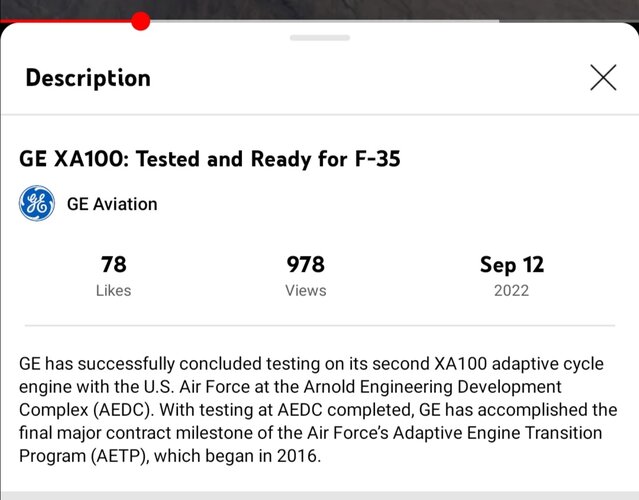
The XA100 ground demonstrator engine may have completed its contracted testing (although you are making that assumption from this GE video that says it has completed three rounds of testing), but the engine is a long way from production. It still needs to go through Engineering & Manufacturing Development (EMD) before it is ready for production, if it is chosen to proceed. F-35 has to chose to move forward with AETP, and the A100 has to beat the P&W A101 via a competitive RFP and contract award.
 
[snip]...and the A100 has to beat the P&W A101 via a competitive RFP and contract award.
Given the way P&W has really leaned hard into pushing EEP, 101 seemingly lagging a bit behind 100 in testing/development milestones, GE's decision to jump in with ceramic matrix composites, and the few morsels of comments by people in the know, it looks like winning a competitive RFP might be the one thing GE is most confident in.

Ultimately, going for an option from both companies may be desirable outcome. P&W's EEP upgrade may be the only workable option for F-35Bs (I can't imagine anyone wants the bill to re-engineer the nozzle for a three-stream turbine) and would be an accessible option for many of the hundreds of export F-35s whose owners may be looking for a more affordable upgrade down the road. Meanwhile, USAF and USN (plus spendier A/C operators) get the superior AETP performance via A100. Sure it costs more, but it also gives the overall program redundancy in case either engine suddenly experiences major issues. Or discovers more Chinese magnets.
 
[snip]...and the A100 has to beat the P&W A101 via a competitive RFP and contract award.
Given the way P&W has really leaned hard into pushing EEP, 101 seemingly lagging a bit behind 100 in testing/development milestones, GE's decision to jump in with ceramic matrix composites, and the few morsels of comments by people in the know, it looks like winning a competitive RFP might be the one thing GE is most confident in.

Ultimately, going for an option from both companies may be desirable outcome. P&W's EEP upgrade may be the only workable option for F-35Bs (I can't imagine anyone wants the bill to re-engineer the nozzle for a three-stream turbine) and would be an accessible option for many of the hundreds of export F-35s whose owners may be looking for a more affordable upgrade down the road. Meanwhile, USAF and USN (plus spendier A/C operators) get the superior AETP performance via A100. Sure it costs more, but it also gives the overall program redundancy in case either engine suddenly experiences major issues. Or discovers more Chinese magnets.
Regarding GE apparent “lead in testing”, you have to be aware that the third phase was altitude testing at AEDC in Tullahoma, TN. This government owned and run facility is the only one in the country capable of simulating inflight inlet and exhaust engine test conditions across the design flight conditions, with both GE and P&W decommissioning their altitude test cells many years ago. With GE scheduled to run their XA100 at AEDC first, P&W has to wait their turn until the facility configured for AETP test is available. The AEDC tests are scheduled months and years in advance.
 
[snip]...and the A100 has to beat the P&W A101 via a competitive RFP and contract award.
Given the way P&W has really leaned hard into pushing EEP, 101 seemingly lagging a bit behind 100 in testing/development milestones, GE's decision to jump in with ceramic matrix composites, and the few morsels of comments by people in the know, it looks like winning a competitive RFP might be the one thing GE is most confident in.

Ultimately, going for an option from both companies may be desirable outcome. P&W's EEP upgrade may be the only workable option for F-35Bs (I can't imagine anyone wants the bill to re-engineer the nozzle for a three-stream turbine) and would be an accessible option for many of the hundreds of export F-35s whose owners may be looking for a more affordable upgrade down the road. Meanwhile, USAF and USN (plus spendier A/C operators) get the superior AETP performance via A100. Sure it costs more, but it also gives the overall program redundancy in case either engine suddenly experiences major issues. Or discovers more Chinese magnets.
Regarding GE apparent “lead in testing”, you have to be aware that the third phase was altitude testing at AEDC in Tullahoma, TN. This government owned and run facility is the only one in the country capable of simulating inflight inlet and exhaust engine test conditions across the design flight conditions, with both GE and P&W decommissioning their altitude test cells many years ago. With GE scheduled to run their XA100 at AEDC first, P&W has to wait their turn until the facility configured for AETP test is available. The AEDC tests are scheduled months and years in advance.
The AEDC bottleneck is a fair point to raise, but GE's Phase 1 testing at their facility and AEDC wrapped up nearly a year of tests in November of last year, P&W's Phase 1 testing had only started in October of last year. GE now says they've completed Phase 2, but we haven't heard when Pratt's Phase 1 will end yet. This is not to say P&W is struggling or in a bad place with their design, I'm not saying its a dealbreaker. If you wish, you may dismiss the current state of the two companies' test programs entirely and my point still stands: GE seems more confident in their AETP and is making a good case for it, Pratt seems to favor their EEP.
 
Or, GE is beating the their XA100 horse (in their media releases) because it is their only hope…..
 
I am not sure that many foreign sale F-35A will see their engines swapped with the new 3rd stream ones. And that for various reasons. There is hence a chance that aside of the USMC, the non AETP fleet would be consequent.
Think at the F/A-18, the classic Hornet, the many countries that kept upgrading them aside of the USMC, created enough fleet size to be economically sustainable.
 
The War Zone has an interesting XA100-focused piece.

https://www.thedrive.com/the-war-zo...ion-adaptive-engine-could-now-power-f-35b-too
The headliner is that GE has concluded their study, which included F-35B liftfan-maker Rolls Royce, into whether an XA100 variant could work with the F-35B's lift fan, roll posts, and swiveling nozzle. They are claiming they have identified a technical solution which will make it work, one that a major F-35B customer had input on.

Also noteworthy is the claim that there will be "100% part-number commonality" between XA100s mounted on the A and C, and throw in a suggestion that they believe Pratt cannot claim the same with XA101.
 
Frankly, I do find these XA100 commonality and cost forecasts by GE to be rather aspirational and optimistic. The performance potential is great but some of the integration work is still formidable.

Of course, it’s not unprecedented for an aircraft fleet to have two engines options, such as with the F-16 and the F-15E/EX, but from a logistics standpoint it’s not ideal.
 
I’ve looked through various articles and read a few performance metrics based on “percentage better than…” has there been any hard numbers about dry and after burning thrust targets specifically?
 
The XA100 and XA101 are regarded as “45,000 lbf class” engines and having 10% more thrust than the CTOL F135-PW-100 while having a similar footprint, but this is simply the static thrust rating. The engines would also provide 18% faster acceleration, but part the envelope wasn’t specified. I’d be more interested in the dynamic thrust.
 

GE XA100 Will Fit STOVL F-35B, But Pratt Questions Practicality​


What the Captain er, PR Representative meant to say:

"I mean, after all, how could this possibly help our monopoly on this platform and raise the P&W EBITA?"

Edit: wordy stuff
 
Last edited:
One thing to remember with the F135 vs any potentially new engine such as the XA100 is that the production and support base for the F135 is largely already stood up. This is critical when one considers ideas such as introducing it for the F-35. Not only the US manufacturing and support base but also those around the world including depots in the IndoPac and European regions. To ignore that is fraught with danger.
 
It seems like GE might have possibly won the OEM contest, and the USAF is now giving them more than 300 million dollars (Specifically, 302,470,000 dollars). 203 million dollars will go to technology maturation and risk reduction services, while the remaining 99 million and 470 thousand dollars will go to cost. It may be possible that there will be more money involved as future developments continue so we gotta keep an eye out for any possible future developments that may happen to the ATEP and NGAP programs

However, please take this tweet with a grain of salt, as this may be kinda preliminary information, or outdated information. I already asked the author for a source, so should a source come up, I'll post it here too

View: https://twitter.com/MIL_STD/status/1607866968945885184
 
The NDAA had about $380m for AETP in 2023. So, even after the FY22 carry-over funds, it would seem more than half of the available funds just went to GE. But I don't think this is a quiet down-select just yet, Pratt will probably get a smaller amount of money toward EEP work.
 
The NDAA had about $380m for AETP in 2023. So, even after the FY22 carry-over funds, it would seem more than half of the available funds just went to GE. But I don't think this is a quiet down-select just yet, Pratt will probably get a smaller amount of money toward EEP work.
If that's true, the GE's engine might possibly go on to the NGAD or F/A-XX, while P&W's goes to the F-35
 
The NDAA had about $380m for AETP in 2023. So, even after the FY22 carry-over funds, it would seem more than half of the available funds just went to GE. But I don't think this is a quiet down-select just yet, Pratt will probably get a smaller amount of money toward EEP work.
If that's true, the GE's engine might possibly go on to the NGAD or F/A-XX, while P&W's goes to the F-35
Which P&W engine, 101 or EEP? Right at this moment, barring more data coming to light, I'd be pretty surprised if XA101 ends up in F-35. Pratt's EEP has a much better chance as the "lower cost but still moves the needle" engine option...but Congress, or specifically the membership who cares about this, is pushing for a full AETP engine (XA100 or 101) for F-35. The NDAA also includes a mandate for a report on getting an AETP engine fitted to F-35B and C, if GE's right and their design can do all three they're going to have a pretty significant base of support in the legislature. I think there's still potential for a split buy between XA100 and EEP, if F-35B is just too much of a hassle to fully upgrade.

NGAD's engine options are being designed using AETP work, but we haven't seen enough about them or the program as a whole to handicap any options. From an industry perspective, having two crewed NGAD programs plus multiple "loyal wingman" super drones would seem to offer a solid opportunity to see both GE and Pratt get work in the 6th generation.
 
Which P&W engine, 101 or EEP?
I meant the XE101, because that's what P&W were working on as an AETP for future fighters. I did not know about EEP, but now that I read it at P&W's website, it now looks like that it might be their ATEP package for the F-35, with the XE101 being their package for the NGAD and other future aircraft

Right at this moment, barring more data coming to light, I'd be pretty surprised if XA101 ends up in F-35. Pratt's EEP has a much better chance as the "lower cost but still moves the needle" engine option...but Congress, or specifically the membership who cares about this, is pushing for a full AETP engine (XA100 or 101) for F-35.
I see. A complete AETP engine would have far more fuel efficiency and the capability to be effective at several flight regimes. EEP would be at most, an upgrade to an already-existing engine that may or not have particial or complete Adaptive Engine capabilities. And while AETP can be used for the F-35 and possibly newer fighters, the EEP would be a far more economical choice as it might just be an upgrade package to the F-35's engines to make it far more fuel efficient, and have some limited Adaptive Cycle capabilities.

The NDAA also includes a mandate for a report on getting an AETP engine fitted to F-35B and C, if GE's right and their design can do all three they're going to have a pretty significant base of support in the legislature. I think there's still potential for a split buy between XA100 and EEP, if F-35B is just too much of a hassle to fully upgrade.
Assuming they would be able to go straight to full and pure AETPs for F-35s, no matter how expensive, it will be of benefit, that would be for sure. But potentially, a split buy is possible too.

NGAD's engine options are being designed using AETP work, but we haven't seen enough about them or the program as a whole to handicap any options. From an industry perspective, having two crewed NGAD programs plus multiple "loyal wingman" super drones would seem to offer a solid opportunity to see both GE and Pratt get work in the 6th generation.
Also given how Advanced the Next Generation Air Dominance would be, it's likely that they may be given far more advanced versions of the AETP instead. At most, the GE XA100 and the P&W XE101 could ultimately just be test engines, or those suited only for the F-35. The actual engines that will be made for the future fighters will be on a whole new level compared to those being studied now. Perhaps the same upgrades can be given to the B-21s as well, possibly the first production models, assuming that the first AETPs are made available by then.
 
Even more tweets from the same guy, and he still didn't give me source

There is however a Defense News Article regarding this event (Rather dated however, as it was posted on August 20):

https://www.defensenews.com/air/202...five-companies-to-prototype-next-gen-engines/
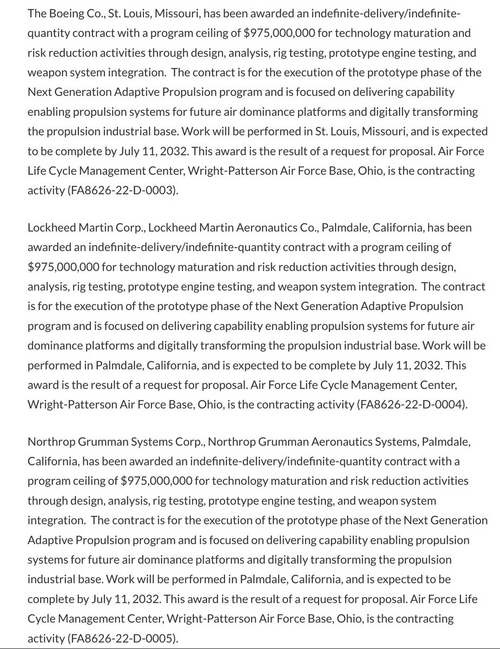
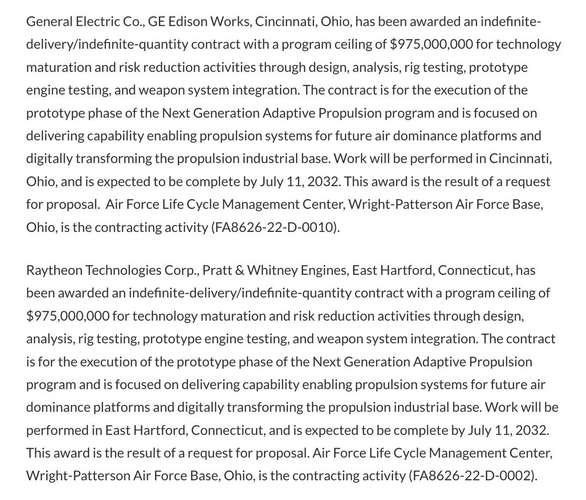
Based on what the pictures say, it implies that the USAF has awarded 5 contracts, worth almost 5 billion dollars, to 5 different companies, all for the purpose of developing the "Next Generation Adaptive Propulsion" or NGAP program. The 5 Companies are as listed:

1: Boeing
2: Lockheed Martin
3: Northrop Grumman
4: General Electric
5: Raytheon

As always, take these with a grain of salt

View: https://twitter.com/MIL_STD/status/1608097423871860737

FlEcDBxaAAAsDoV.png
FlEcDCRaEAABdSq.png
 
Last edited:
Even more tweets from the same guy, and he still didn't give me source

There is however a Defense News Article regarding this event (Rather dated however, as it was posted on August 20):

https://www.defensenews.com/air/202...five-companies-to-prototype-next-gen-engines/
Based on what the pictures say, it implies that the USAF has awarded 5 contracts, worth almost 5 billion dollars, to 5 different companies, all for the purpose of developing the "Next Generation Adaptive Propulsion" or NGAP program. The 5 Companies are as listed:

1: Boeing
2: Lockheed Martin
3: Northrop Grumman
4: General Electric
5: Raytheon

As always, take these with a grain of salt

View: https://twitter.com/MIL_STD/status/1608097423871860737

View attachment 690218
View attachment 690219
I think that guy is @bring_it_on
 
Last edited by a moderator:
I think that guy is @bring it on
Wait who? He's a member here?

Anyways, the guy just asked me to do some research, which I did earlier BTW, but I wasn't able to find the exact online document where he screenshot the pics. Just a Defense News Article saying the same thing but not showing their source, as well as a fruitless search attempt
 
Anyways, a kind person on Twitter shared to me the actual source, or maybe a copy-paste from the actual source, as it's still from Defense News. Even if it may be a possible copy-paste of the original contract documents (Or even if the website itself is an official government website, in this case), please treat this with a grain of salt, who knows what possible alterations may be present in the document, or what details regarding the project are actually omitted, not mentioned, or altered in the document

https://www.defense.gov/News/Contracts/Contract/Article/3134553/
 
In all those years, all over the web, BiO (BringItOn) has been reliable like a Swiss clockwork.
Believe us, you may want to dustoff the grains of salt. You won't need it. ;)
 
In all those years, all over the web, BiO (BringItOn) has been reliable like a Swiss clockwork.
Believe us, you may want to dustoff the grains of salt. You won't need it. ;)
I suppose so. But I'd rather keep my eye on things like these, because there may be more than meets the eye.
 
Isn't it pretty obvious that they've awarded the contracts to both the propulsion primes (GE, Raytheon/P&W) and the airframe primes (Boeing, LM, NG) because the scope of work includes integration that needs input from both propulsion and airframe parties. Its not as if Boeing are building their own engine.

The IDIQ contracts seem to be tool of choice comercially now. Everyone "wins" the competition, but you only fund the ones you want to actually do any work. Its a pretty blatant work around acquisition rules. Surely it'll be banned in time once GAO see it.
 
Isn't it pretty obvious that they've awarded the contracts to both the propulsion primes (GE, Raytheon/P&W) and the airframe primes (Boeing, LM, NG) because the scope of work includes integration that needs input from both propulsion and airframe parties. Its not as if Boeing are building their own engine.

The IDIQ contracts seem to be tool of choice comercially now. Everyone "wins" the competition, but you only fund the ones you want to actually do any work. Its a pretty blatant work around acquisition rules. Surely it'll be banned in time once GAO see it.
On what grounds does this contract break Acquisition Rules? Or perhaps the rules have been changed a bit to allow multiple companies to invest and work on the same technology? Air Force did say that they aren't gonna fllow traditional acquisition rules for future aircraft, or something similar to the effect
 
I would be sure it is legal, but my point more is that it seems like an obvious work around that is against the spirit.
 
I would be sure it is legal, but my point more is that it seems like an obvious work around that is against the spirit.
I see. I guess they're trying something new, and in order to do that, they might have to get around some things that may prove detrimental to the progress of the program
 

Similar threads

Back
Top Bottom