- Joined
- 19 July 2016
- Messages
- 4,814
- Reaction score
- 4,273
What would be the earliest adoption of a UCAV type? Could that be the target type?

If they are fielding a ucav to replace the hornets then goodbye and goodnight to NAVAIR. F35C is a slushdog for towing bombs to target and firing an aim120 along the way if needed.What would be the earliest adoption of a UCAV type? Could that be the target type?
Depends. Do you want 4 amraams like the 35 or to you want 8 like a raptor? Keep in mind the raptor is also light in fuel for naval missions. So yeah you need a big plane for internal fuel and internal aams. Have you seen the air force concepts? Do you want it to be fast as well? Then you need more fuel. If you want it fast with some super cruise ability to deal with new threats then you can't design a short pudgy 35 again and it will be long and slender for fineness ratio. In full military power at high altitude the 35 can't even break mach 1 clean. That's not the future of air superiority.Do you really need that much aircraft as a missile hauler?
It might be just as useful to have a drone around carrying the weapons load and leaving the 35 as clean/light as possible. That would work with just about any updated/future airframe.


That's what the original UCAS-D program was supposed to be, and a derivative of the X-47B/C could have been operational today.It might be just as useful to have a drone around carrying the weapons load and leaving the 35 as clean/light as possible. That would work with just about any updated/future airframe.

So an F-16XL then.F-36 it is Popular Mechanics so pre-apologies (subscription needed)
https://www.popularmechanics.com/mi... -- High Minus Dormant and 90 Day Non Openers

So an F-16XL then.F-36 it is Popular Mechanics so pre-apologies (subscription needed)
https://www.popularmechanics.com/mi... -- High Minus Dormant and 90 Day Non Openers


I assumed that the Air Force upgrading nearly all their F-16s to the “V” level was the fruition of their 4.5 gen idea.Whatever did happen to that Gen 4.5/5- idea that was floated last year? Dead on arrival, presumably?

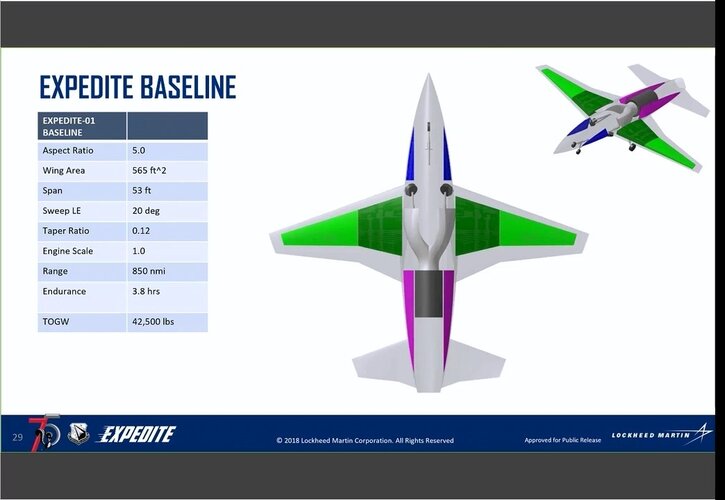
As part of internal research conducted in conjunction with the AFRL EXPEDITE program, ESTECO technology was deployed to develop an optimization workflow of a notional close air support vehicle and to exercise several optimization scenarios.

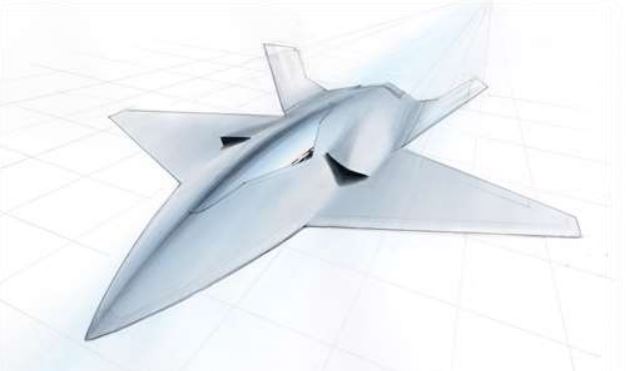

I hardly doubt this can easily pass as NGAD, too.Hi. Conceptual "CAS" vehicle, showing two different configurations, but could easily pass as NGAD too.
The price of the 35 is going to rise with inflation. We're seeing it in automotive where parts prices are going up rapidly. So I don't know the $ of the 35 but most certainly the ones not already paid for are going to rise sharply. So the 35 might be 80 million today and for the ones in contract but that's going to change.A new design will have less parts, modern and modular COTS systems. It will also have technology more in line with a 20 years old recruit.
All that is translating in lower sustainment cost, lower upgrade cost and nominal agility when it comes to adapt to new challenges.
The 4th Gen can compete, obviously, albeit by using their inherent mass effect to decrease fixed costs and seeking for a lower manpower cost. That is a direct challenge to reliability. Something, generally, of a strong point to a new design.
A new design will obviously comes with a development and procurement cost. But when an F-35 can be bought for 80M$, there is little doubts that the industry wouldn't be able to capitalize on that, for such a less advanced design, for an even lower price tag.
Now, as hinted above, F-16 upgrade have the benefits to strengthen allied resolve. F-16 are sustained all across the globe, in highly strategical area of the world. They are also the only fighter design that can reach a political consensus without the full drama of a new procurement circus.

How so?The F-35, pragmatically, thrives in a world where there are no economics barriers.
The United States is about to experience the post WWI/pre WWII period with Corporate America within the next couple years. It's the inevitable result with having a corporate enterprise so heavily invested in a foreign power.
Corporate America built up Germany post World War I. When Nazi Germany became more assertive pre-WW2 and into WW2, it took a lot anti-trust legislation to break that relationship apart. With China being an economic powerhouse and seeking to undermine US economic policy abroad, the F-35 program with its expansive foreign relationships is a prime target.How so?The F-35, pragmatically, thrives in a world where there are no economics barriers.
The United States is about to experience the post WWI/pre WWII period with Corporate America within the next couple years. It's the inevitable result with having a corporate enterprise so heavily invested in a foreign power.

So you are claiming the F-35 partner nations will be used by China somehow?With China being an economic powerhouse and seeking to undermine US economic policy abroad, the F-35 program with its expansive foreign relationships is a prime target.
It's not a claim, it's a fact. China has trade relationships with everyone, they can hurt or influence anyone they choose at the lowest levels of supply, which are often the overlooked factors.So you are claiming the F-35 partner nations will be used by China somehow?
I'd like to see your 'facts' in relation to the F-35 program. Supplying into this is not a simple thing and comes with many checks. In fact, i would hazard a guess that any perceived risks would impact US suppliers just as much, if not more so, any non-US suppliers.It's not a claim, it's a fact.
The F-35, pragmatically, thrives in a world where there are no economics barriers.
The United States is about to experience the post WWI/pre WWII period with Corporate America within the next couple years.
It's the inevitable result with having a corporate enterprise so heavily invested in a foreign power.
That's an interesting thought. Politically, I've been thinking this more mimics the pre-WW1 era. Please elaborate.

Did anyone estimate the dimensions of LockMart’s Lady Liberty?What about something like FB-23 RTA ?
Probably more like a f-23a than anything else. Tailless is still expensive with complicated and weighty and $$$ thrust vectoring and CAN kill the rear aspect LO and diminish mission capability rate. It still needs to be a fighter which means tail. Horizontal tail.... No. Probably 7 to 8 aim260 or combo with 9x\perrigrine\cuda. Probably capable of more than 700nm range supercuise with the new engine techI think its quite possible for the NGAD to be the size of an F-111. This is just my speculation, but perhaps it may be a tailless supersonic design, powered by two adaptive cycle engines scaled from the 45,000-lbf class XA100/101. This can have substantial range and persistence, while still allowing for a reasonable level of fighter-like maneuverability with a thrust/weight ratio of ~1 and +7.33 g at combat or loaded gross weight.

Bit late of a reply, but it's definitely not dead; the premise of the MR-X ("F-16 replacement") program is that there was a study being undertaken to look into what the USAF's future fleet should look like, and that the results of that study would inform the FY2023 budget request, which has since been released, with a lot of money going to R&D. The final decision on the MR-X program however is expected to take place in around 2028, as for now the USAF has other priorities (NGAD, B-21, AWACS, tankers, etc). The 2028 date will also give Lockheed a chance to try and enact the sustainment cost reductions that they claim can be achieved. If Lockheed gets their way the MR-X program might just turn into more F-35As.Whatever did happen to that Gen 4.5/5- idea that was floated last year? Dead on arrival, presumably?
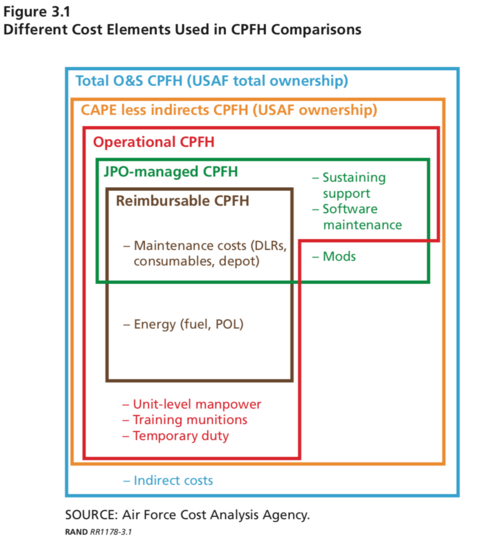
So first of all, there is no universal definition for cost per flight hour; there's a classic SAAB presentation for example where they claimed (around a decade ago IIRC) that the F-16C (when comparing it to the Gripen C) cost $7,000/hr. In contrast, the USAF generally claims the F-16C costs around $25,000K/hr. The vast difference between those two numbers comes from what's being included / excluded in those figures.
Here's a graphical comparison for example of CPFH types used with regards to the F-35; you can find a greater breakdown of these different cost elements in this CAPE document: https://www.cape.osd.mil/files/os_guide_v9_march_2014.pdf
Total ownership / total O&S can be a bit odd in that, while it does ultimately capture the total cost of operating a fleet, it includes things you might not have thought of, such as (under "Indirect costs" / "indirect support") medical support / services, initial recruit / officer training, etc.
View attachment 677102
For the SAAB $7K/hr F-16C figure, they'd be talking about something akin to the Reimbursable CPFH described above (and for comparison's sake, here's the FY2021 reimbursable figures for the US services' fleets), whereas the USAF and a number of other military services around the world are generally referring to ownership or total ownership CPFH.
As for how CPFH itself is calculated, it's generally just the annual sustainment cost for a fleet, divided by the annual flight hours. The "fleet" in equation can be individual squadrons / units, but generally it's for an entire service's fleet of that aircraft type. For the F-35A CPFH figures you see it's generally just the USAF's F-35A total ownership CPFH; other F-35A operators that publicly report sustainment costs (like Australia) have had fairly similar costs, sometimes lower.
And as for how Lockheed can claim a certain CPFH by a certain date; the short answer is that they can't be 100% certain, but with the F-35 and Lockheed they were awarded a 3-year sustainment contract by the US last year, and so now Lockheed has the power to tell their suppliers that X amount of work has been secured and certain efficiencies can be gained by optimising logistics, investing in tooling and equipment, etc. However, Lockheed and its contractors / suppliers / partners do not perform all F-35 maintenance.
Out of the $33K/hr CPFH that we see for an F-35A today, Lockheed only controls around 39% of that while Pratt & Whitney (who contract to the US independently of Lockheed) owns another 11% and the US military is responsible for the other ~50%. So when Lockheed says that it's going to drop the CPFH of an F-35A from $33K to $30K by 2023, they're talking about what they can achieve by reducing their 39% of sustainment costs. In contrast, the "$25K/hr by 2025" F-35A CPFH goal that Lockheed was talking about a year or two ago is what Lockheed claims is possible, but is reliant on both P&W and the USAF reducing their F-35A sustainment costs by around 15% (from around $20K/hr [of the $33K/hr total] today to around $17K/hr [of the $25K/hr total]). Lockheed can influence USAF costs a little bit (eg: if ALIS / ODIN is less buggy then the USAF spends fewer man-hours fixing the jet and can fly the jet more frequently), but it's mostly not up to them.

View: https://twitter.com/MIL_STD/status/1517722479615037440
Maybe that shiny coating we saw on the F-22 was actually a first hint of the surfacing we will see on the NGAD?
That skin looks mighty interesting, what does it do?View: https://twitter.com/MIL_STD/status/1517722479615037440
Maybe that shiny coating we saw on the F-22 was actually a first hint of the surfacing we will see on the NGAD?
That's the billion dollar question.That skin looks mighty interesting, what does it do?