
You are using an out of date browser. It may not display this or other websites correctly.
You should upgrade or use an alternative browser.
You should upgrade or use an alternative browser.
Lockheed Martin F-35 Lightning II Joint Strike Fighter (JSF)
- Thread starter Triton
- Start date
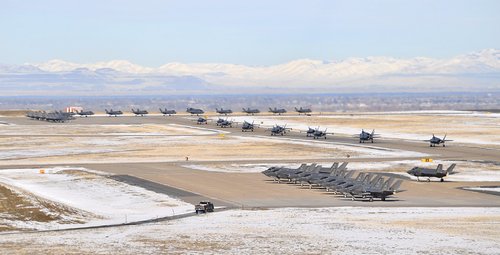
F-35 begin the new year with a massive elephant walk:
https://www.dailymail.co.uk/news/ar...F-35A-Lightning-II-stealth-fighters-Utah.html
https://www.dailymail.co.uk/news/ar...F-35A-Lightning-II-stealth-fighters-Utah.html
seruriermarshal
ACCESS: Top Secret
- Joined
- 4 May 2008
- Messages
- 1,180
- Reaction score
- 587

Dragon029
ACCESS: Top Secret
- Joined
- 17 March 2009
- Messages
- 881
- Reaction score
- 449
Full resolution version (with other images) here: https://www.dvidshub.net/image/6014486/hills-fighter-wings-conduct-f-35a-combat-power-exercise
Here's also the accompanying shots with them on the runway: https://www.dvidshub.net/image/6013682/hills-fighter-wings-conduct-f-35a-combat-power-exercise
Here's also the accompanying shots with them on the runway: https://www.dvidshub.net/image/6013682/hills-fighter-wings-conduct-f-35a-combat-power-exercise

panzerfeist1
ACCESS: Secret
https://www.bloomberg.com/news/arti...n-s-f-35-office-an-option-to-cut-upkeep-costs
I guess options for reducing maintenance costs.
I guess options for reducing maintenance costs.
F-35 MADL data link integration test with Army IBCS
http://www.asdnews.com/news/defense/2020/01/21/us-army-air-force-team-up-multidomain-operations
http://www.asdnews.com/news/defense/2020/01/21/us-army-air-force-team-up-multidomain-operations
Two U.S. Air Force F-35s were integrated with the U.S. Army Integrated Air and Missile Defense Battle Command System (IBCS), providing an airborne sensor capability to successfully detect, track and intercept near simultaneous air-breathing threats in a test at White Sands Missile Range, New Mexico.
seruriermarshal
ACCESS: Top Secret
- Joined
- 4 May 2008
- Messages
- 1,180
- Reaction score
- 587
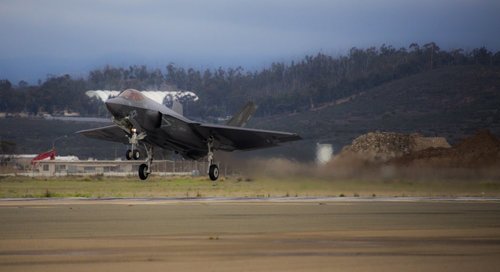
The @USMC’s first F-35C has arrived here @MCASMiramarCA! 5th Gen aircraft are finally here in the @CityofSanDiego
to stay!
Attachments

- Joined
- 21 April 2009
- Messages
- 14,350
- Reaction score
- 9,432
Dragon029
ACCESS: Top Secret
- Joined
- 17 March 2009
- Messages
- 881
- Reaction score
- 449
The DOT&E have released their 2019 (Jan 2020) report on the F-35 (and other programs):
https://www.dote.osd.mil/Portals/97/pub/reports/FY2019/dod/2019f35jsf.pdf
https://www.dote.osd.mil/Portals/97/pub/reports/FY2019/dod/2019f35jsf.pdf
Attachments
https://www.defensenews.com/global/...ks-46-billion-contract-for-f-35-fighter-jets/
From Su-22 to F-35 what a giant leap!
*From FlightGlobal:
https://www.flightglobal.com/defence/poland-signs-f-35-contract-worth-46bn/136476.article
With the delivery of the aircraft, which is scheduled to begin in 2024, Poland is to become the first user of the F-35s in the region, adding the aircraft to its fleet of 48 F-16 C/D Block 52+ fighters. Warsaw plans to replace the Air Force’s outdated Soviet-designed Sukhoi Su-22 and Mikoyan MiG-29 jets with its new fifth-generation jets.
*the Polish aircraft will be equipped with electronic warfare equipment, plus a braking parachute, to increase landing safety in poor weather conditions. Deliveries are scheduled for the 2024-2030 period, at an annual rate of between four and six examples.
From Su-22 to F-35 what a giant leap!
*From FlightGlobal:
https://www.flightglobal.com/defence/poland-signs-f-35-contract-worth-46bn/136476.article
Last edited:
Official press release of the Polish Ministry of National Defence (unfortunately only in Polish so far):
https://www.gov.pl/web/obrona-narodowa/f-35-dla-polski
https://www.gov.pl/web/obrona-narodowa/f-35-dla-polski
Last edited by a moderator:
https://www.airforcemag.com/lockheed-potentially-mixed-up-structural-fasteners-in-most-f-35s/
And at the bottom:
And at the bottom:
It could be the worst of the problem they could face with this: contamination leading to crack and localized delamination.A Pentagon official familiar with aerospace structures said it’s possible the titanium or Inconel bolts could be incompatible with the materials they’re attached to, causing a possible corrosion issue if left uncorrected.
Dragon029
ACCESS: Top Secret
- Joined
- 17 March 2009
- Messages
- 881
- Reaction score
- 449
That was a separate issue where in 2017 primer hadn't been applied to some of the holes for fasteners; fortunately the corrosion risk wasn't urgent, so it was just going to be addressed when the jets next went in for depot maintenance or upgrades. It's not a good look to have repeated quality control failures like this, but fortunately they should theoretically get reduced as the ramp-up of production flattens out again - I've heard stories about how Lockheed's rapid hiring of something like 500 new personnel at Fort Worth resulted in some people... not very experienced with sensitivities relating to aviation, being hired and causing minor mishaps on the plant floor (eg: cracking a composite flaperon by trying to move it via pulling hard on its trailing edge). As time goes on, the average experience of people on the floor should increase again.

Grey Havoc
ACCESS: USAP
- Joined
- 9 October 2009
- Messages
- 24,500
- Reaction score
- 18,170

- Joined
- 2 August 2006
- Messages
- 3,335
- Reaction score
- 1,846
Norway deploy's F-35s to Iceland for the NATO policing mission. It's the first time I've seen mentioned how the F-35 requires quite a lot more of resources to be deployed when compared to the F-16. Also, at the end of the video you get a good look at the drogue parachute system. I had thought it just tilted, but now I can see the entire fairing pops up.
Grey Havoc
ACCESS: USAP
- Joined
- 9 October 2009
- Messages
- 24,500
- Reaction score
- 18,170

What an idiotic way to take a comment and run with it. I believe he specifically expanded on the comment that humans should pilot the drone from his/her desk and the drone is doing the navigating, avoiding defenses, hairy multi G manuevers, sensing, and firing, which makes a lot of sense. He is no way advocating total human out of the loop.

- Joined
- 16 April 2008
- Messages
- 10,588
- Reaction score
- 18,127
What an idiotic way to take a comment and run with it. I believe he specifically expanded on the comment that humans should pilot the drone from his/her desk and the drone is doing the navigating, avoiding defenses, hairy multi G manuevers, sensing, and firing, which makes a lot of sense. He is no way advocating total human out of the loop.
He opened with "local autonomous" which pretty clearly excludes man-in-the-loop piloting. He said he would want to keep MitL weapon release authority for killing any target that is itself not an autonomous drone. But I question if that is feasible in air combat, where engagement windows may be fleeting.
Last edited:
Grey Havoc
ACCESS: USAP
- Joined
- 9 October 2009
- Messages
- 24,500
- Reaction score
- 18,170
Dragon029
ACCESS: Top Secret
- Joined
- 17 March 2009
- Messages
- 881
- Reaction score
- 449
The problem with that route, particularly if it's in the context of replacing all or most manned combat aircraft with RPAs (with regards to the "era of the fighter jet" being over) is that you then run into the issue of having to figure out a solution to the denial of communications. In some situations, today's available levels of autonomy could be sufficient, but for others (eg: the circumstances that led to the 2017 Syrian Su-22 shootdown by a Super Hornet) I think we're a decade away at minimum.He opened with "local autonomous" which pretty clearly excludes man-in-the-loop piloting. He said he would want to keep MitL weapon release authority for killing any target that is itself not an autonomous drone. But I question if that is feasible in air combat, where engagement windows may be fleeting.


- Joined
- 21 April 2009
- Messages
- 14,350
- Reaction score
- 9,432

- Joined
- 29 November 2010
- Messages
- 2,275
- Reaction score
- 5,186
wow 500 delivered. thats pretty good.
I am estimating that is almost double of Rafale deliveries
and perhaps this year it will surpass total Eurofighter deliveries?
I am estimating that is almost double of Rafale deliveries
and perhaps this year it will surpass total Eurofighter deliveries?
From the link above:
The actual cost of an F-35A in fiscal year (FY) 2021 is $79.2 million, and the cost will fall to $77.9 million in 2022 or $9.2 million cheaper than the government’s best estimate using current-year dollars. That’s the price of a new F/A-18 E/F, $9.8 million below the $87.7 million base price of an F-15EX, and $40 million less than the $118 million Eurofighter—jets that require additional equipment like multimillion-dollar targeting pods before they can employ in medium-threat combat environments. The F-15EX self-protection system is estimated to cost $7.5 million and the Sniper Targeting pod costs more than $1.7 million per jet, making the total cost for a combat-configured F-15EX $96.9 million—$19 million more than a combat-configured F-35A. And neither the FA-18E/F, the F-15E(X), nor the Eurofighter would survive in a modern high-threat environment.
Last edited:
Grey Havoc
ACCESS: USAP
- Joined
- 9 October 2009
- Messages
- 24,500
- Reaction score
- 18,170
Grey Havoc
ACCESS: USAP
- Joined
- 9 October 2009
- Messages
- 24,500
- Reaction score
- 18,170
Even more so than their Senate counterparts yesterday, HASC members cracked the whip on the need to bring down maintenance costs of the F-35 Joint Strike Fighter.
While not the only lawmaker to do so, Rep. John Garamendi was the most forceful on the issue — pointedly saying that the Air Force cannot solve the problem by giving the long-troubled Autonomic Logistics Information System (ALIS) system a new name, referring to Lockheed Martin’s decision in January to reinvent its approach under an effort called Operational Data Integrated Network (ODIN).
“Heads up, we’re not going to back off on this,” he warned. “The spurs are on and we’re gonna ride this hard until it’s resolved.”
Air Force Chief of Staff Gen. David Goldfein assured him that “ALIS to ODIN is not just a name change,” adding that he has seen “more movement on the program over the last six months than in the last two years.”
Garamendi quipped back: “Well, I think Lockheed Martin is in the audience and they know they are in deep trouble, and so do you.” Hello, Fort Worth and Orlando!
Grey Havoc
ACCESS: USAP
- Joined
- 9 October 2009
- Messages
- 24,500
- Reaction score
- 18,170
The F-35 final assembly and checkout plant in Cameri, Italy, will reopen Wednesday after a two-day temporary shutdown meant to help prevent the further spread of the new coronavirus.
[...]
The other international final assembly and checkout plant, run by Mitsubishi Heavy Industries and based in Nagoya, Japan, is also back to a normal work schedule after a temporary pause from March 9-13, the source said. Meanwhile, F-35 production at Lockheed Martin’s Fort Worth, Texas-based plant continues without interruption.
https://www.defensenews.com/coronav...reopen-tomorrow-after-precautionary-cleaning/
Similar threads
-
Lockheed Martin F-16 Fighting Falcon News and Developments
- Started by seruriermarshal
- Replies: 882
-

-

-
 Lockheed JSF evolution: ASTOVL, SSF, CALF, JAST
- Started by Antonio
- Replies: 176
-
 USAF/USN 6th Gen Fighters - F/A-XX, F-X, NGAD, PCA, ASFS News & Analysis [2008- 2025]
- Started by Matej
- Replies: 10K