Kawanishi K-200 Heavy Flying Boat Project.
byakin 05.08.2014 4
There are several Japanese aircraft from World War II, such as the Kugisho Tenga jet bomber, that remain shrouded in mystery to this day. Certainly, the Kawanishi K-200, a project that would have been the world's first turbojet flying boat, should be included in this category.
Very little is known about the origins of the K-200. Kawanishi management may have approached the IJN to start the project, or the company may have taken on the design itself to determine whether a flying boat could be built using the new jet engines being developed following the success of the Ne-20 turbojet. By the end of the war, Kawanishi was developing two other large flying boats, the Kawanishi K-60 and the Kawanishi H11K Soku. Both were built under IJN orders, so it would be reasonable to assume that the IJN also instructed Kawanishi to fit jet engines to the flying boat. It is not known when exactly Kawanishi began studying the K-200, but it was likely in 1945.
Depending on the source, it is said that the K-200 was intended to be either a replacement for all operational IJN flying boats or a carrier for Japan's atomic weapons. The former assumption most likely depended on the capabilities of the K-200 if it were built. Of course, the promise of the K-200 did not prevent other flying boat designs, such as the K-60 or an improved H8K, from being developed. If the K-200 was intended to be such a replacement for operational flying boats and to demonstrate superiority over them in performance, it would likely not have been accepted into service before 1946. As for the latter, the K-200 would have needed capabilities beyond both operational flying boat designs and those ordered for production to be a means of dropping an atomic bomb on US soil. It has been suggested that the Nakajima Fugaku was also designed to carry atomic weapons, but this view is not supported. The same can be said for the K-200. One can only speculate as to whether the K-200 would have had more success in penetrating US coastal defenses than a high-flying bomber. As we shall see, the K-200 may have had a flaw that would have made such a use virtually impossible.
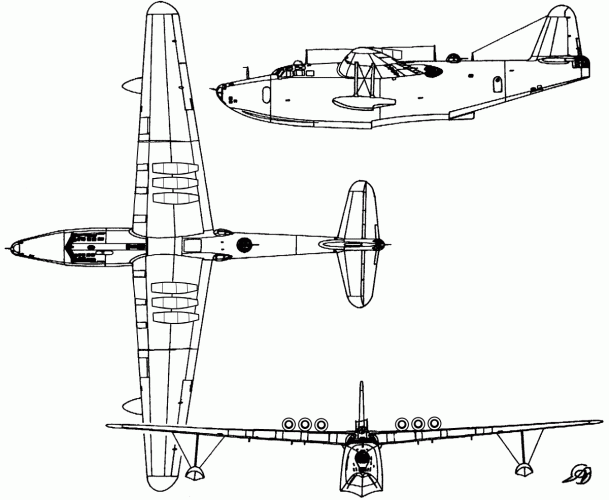
Kawanishi K-200 Flying Boat Schematics
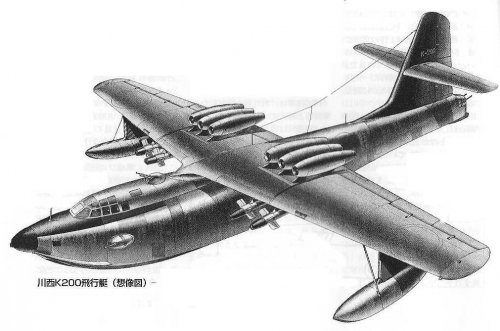
The final appearance of the K-200 was thus open to speculation. Certainly Kawanishi would not have shied away from using their successful H8K and (to a lesser extent) the Kawanishi H6K (Allied codename Mavis) as the basis for the K-200. It is therefore likely that the hull design would have been similar. One speculative illustration of the K-200 shows the hull to be fairly similar to the H6K but taller, though not to the same extent as the H8K. The conventional tail was akin to the H8K, but the horizontal stabilizer was raised and mounted at mid-height of the vertical stabilizer. The wing was very similar to the H8K and was connected to the hull in a similar position, being located at the top of the hull and, at least for the K-200, near its center. Interestingly, the K-200 was depicted with fixed underwing floats, which contrasts with the retractable floats used on the H8K3 as a means of increasing speed. It is possible that such a change would have been made to the K-200 as well.
The K-200 is shown as having an armament arrangement similar to that of the H8K1. If this were the case, the 20mm Type 99 cannon would have been mounted in a tail turret and a turret located forward of the wing. A blisters would have been mounted on either side of the nose of the aircraft, armed with either a Type 99 cannon or a 7.7mm Type 92 machine gun. Finally, a Type 99 cannon was mounted in the nose. The K-200 was also likely to have been able to carry a payload of bombs, depth charges and torpedoes.
The K-200 picture is based on contemporary Japanese illustrations of the flying boat, which are themselves hypotheses of what the K-200 might have looked like
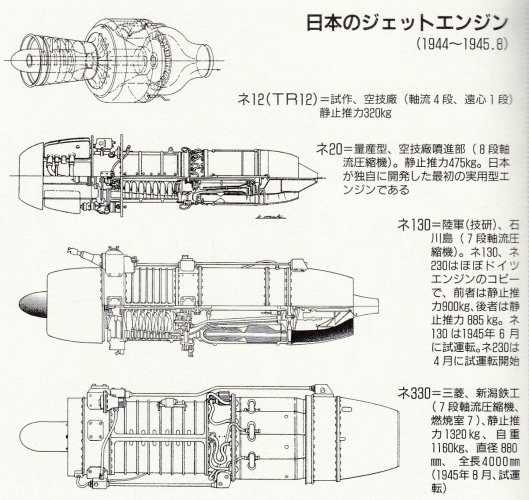
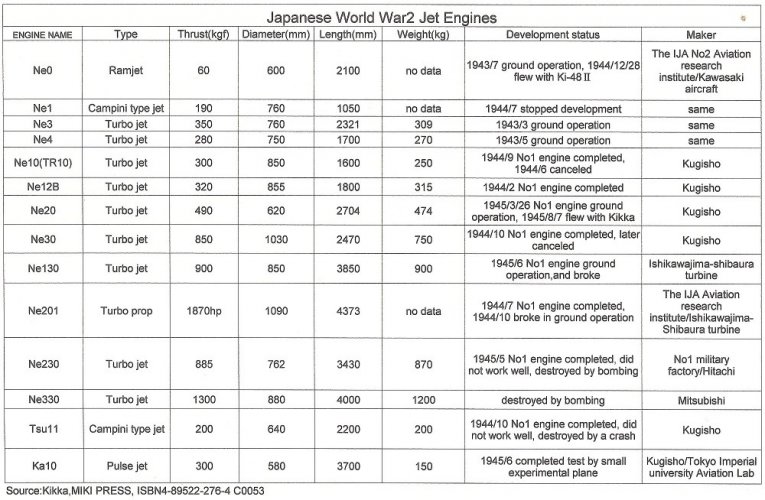
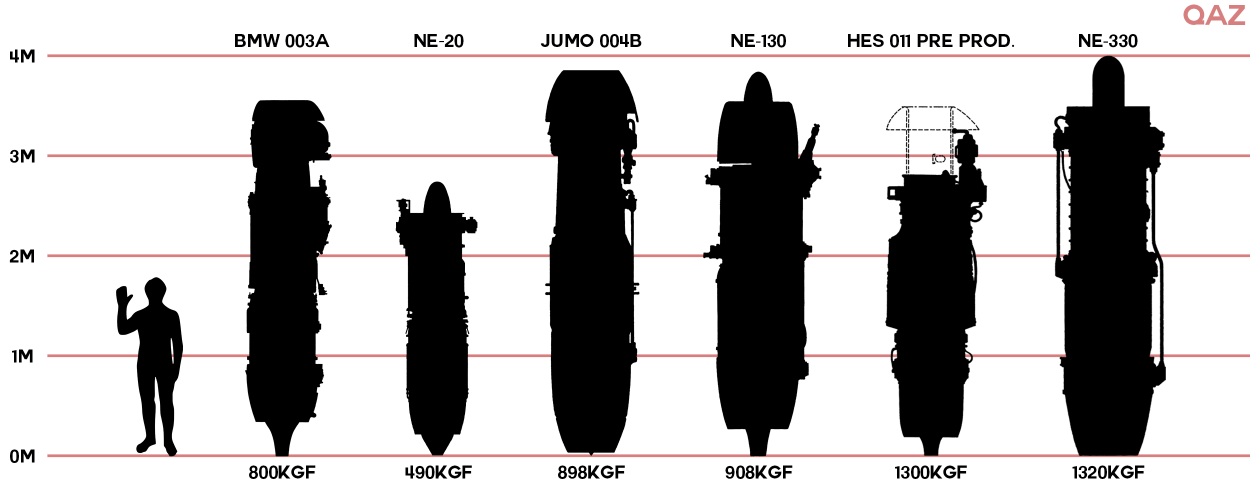
The K-200's powerplant was to have been six turbojet engines. They were to be mounted on top of the wing, with each engine in a separate nacelle. Three engines would be grouped on each console. The reason for this placement was to minimize the amount of sea spray entering the engines while they were running. If the K-200 was similar in size to the H8K, then with the turbojet engines the gross weight of the K-200 would be in the region of 24,548 kg. If the K-200 used Ne 330 turbojet engines, their combined thrust would be 7,800 kg. This would probably be enough to give the K-200 a higher speed than the H8K2, which could reach 467 km/h.
Where the K-200 may have failed was in terms of range. Six turbojets would have required a considerable amount of fuel to give the flying boat the required combat radius. As an example, the Ne 20 turbojets consumed 740 kg of fuel per hour. The Nakajima Kitsuka (Kikka), which had two Ne 20s, carried a maximum of 1,447 kg of fuel (and without drop tanks only 723.5 kg) and therefore had a range of only 824 km at cruising speed. If the NE330 consumed about 2,535 kg of fuel per hour at full thrust, then the six would require at least 15,028 kg of fuel for about an hour of operation at maximum speed. Cruising would of course increase the range. A weight saving measure could have been to remove all armor, defensive armament, and/or build the aircraft out of wood, as was planned for the H11K Soku. But even with such measures, the K-200 would have been hard pressed to reach, let alone exceed, the range of the H8K or other more conventional piston-engined flying boats.
It is not known how far Kawanishi had progressed in exploring the capabilities of the K-200, if at all. With resources devoted to the H8K, H11K Soku, and K-60 among other projects, Kawanishi designers could have placed the K-200 alongside these projects, provided turbojet engines were available, to justify the effort of developing a flying boat. In addition, the reliability of even turbojets like the Ne20 was only good for 4-5 hours of operation before the engine began to have problems. It could be seen that the preliminary performance estimates had not lived up to expectations and did not offer significant advantages over designs that are either currently in use or planned for service. Finally, the lack of materials needed to build the K-200 may have played a role in sidelining the project; Engine and material problems stalled the K-60's construction, and this may well have been the case with the K-200 as well. Regardless of the reasons, the K-200 never became more than a concept.
As a side note, there were plans to build a civilian version for use by Japan Airlines after the war.