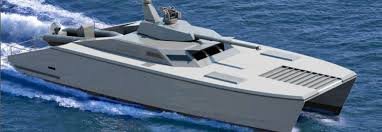
Supported by the Indonesian Ministry of Defense, the vessel is undergoing sea trials, builder trials, factory acceptance testing, and harbor acceptance testing. It is designed to perform operations in Indonesia’s rivers, coastal waters, and sea lanes. The boat is named “Antasena” by the Indonesian Army (TNI AD) and is intended to carry out troop transport, coastal surveillance, interdiction, support to amphibious operations, and Coast Guard tasks.
The X18 Tank Boat model displayed at IndoDefense 2025 is equipped with the Cockerill 3030 remotely operated turret manufactured by John Cockerill Defense. This turret integrates the 30mm XM813 electrically powered chain gun with a two-drum feed system containing 255 rounds of 30x173mm ammunition, including MK310 programmable airburst munitions. The turret also includes a 7.62mm coaxial machine gun and supports pintle mounts for 12.7mm heavy machine guns or 40mm grenade launchers. Elevation ranges from -10° to +60°, with a fully stabilized mount and dual hunter/killer sights for the gunner and commander. These sights are compatible with second-generation FLIR and offer detection, recognition, and identification ranges of 18/9/5 km (daylight) and 15/7/3.5 km (thermal). Ballistic protection for the turret reaches STANAG 4569 Level 5, and the configuration includes eight smoke grenade launchers and options for acoustic gunshot detection, laser warning systems, and active protection systems.
The Cockerill 3030 turret was previously tested under the U.S. Army DEVCOM Armaments Center Medium Caliber Armament System (MCAS) CRADA program. As part of this agreement, John Cockerill Defense America delivered a version of the 3030 equipped with the XM813 cannon for testing with DEVCOM-AC’s situational fire control system. Over 5,000 rounds were fired during trials, including programmable munitions. The program generated data for fire control integration and led to further CAD work for a future version compatible with the XM913 50mm cannon. The turret is optionally manned, supports both two- and three-person crew configurations, and features under-armor reloading and maintenance access. The modular architecture enables further upgrades in armament and fire control. This turret has also been integrated on the FNSS Pars Alpha 6x6 concept vehicle presented at FEINDEF 2025.
The X18 Tank Boat has a hull constructed from fire-retardant carbon fiber composite material, which is described by its manufacturer as ten times lighter and ten times stronger than steel. Its foil-assisted catamaran configuration gives it a shallow draft of less than one meter, enabling navigation in swampy or shallow waters. The standard configuration includes a length of 18.75 meters, a beam of 7.5 meters, and a displacement of 43 tons. The propulsion system consists of two MAN 1,200 hp diesel engines or two 1,700 hp MTU engines, each coupled with MJP450 waterjets, allowing for a maximum speed of 50 knots and an operational range of up to 600 nautical miles at a cruising speed of 9 knots. The Tank Boat can carry a five-person crew and between 20 and 60 troops, depending on the configuration and mission profile. The rear deck supports logistics transport and integration of additional modules, including a beach landing ramp, drone launch and recovery systems, and mortar plates.
Multiple configurations of the Tank Boat exist. The APC variant, known as APC-60, is intended primarily for troop transport. It is equipped with the Cockerill CPWS Gen 2 turret armed with a 25 or 30mm automatic cannon and 7.62mm coaxial machine gun. The CPWS turret is fitted with a panoramic day/night sight, allowing 360-degree observation and independent targeting. The vessel supports modular payloads such as drones, mortars, missile launchers, and RHIBs. NORTHSEADRONES quadcopters are being tested for ISR integration with the Cockerill turret. The navigation and communication suite includes two GPS receivers, two WECDIS consoles, a radar station, a conning station, five WECIDS trackballs, ten 24-inch monitors, a gyrocompass from iXblue, AIS, magnetic compass, autopilot, and a weather station. PT Len Industri supplies VHF and HF radios, while PT Hariff provides the battlefield management system. All electronics are integrated via redundant LAN networks to ensure operational continuity in case of failure.