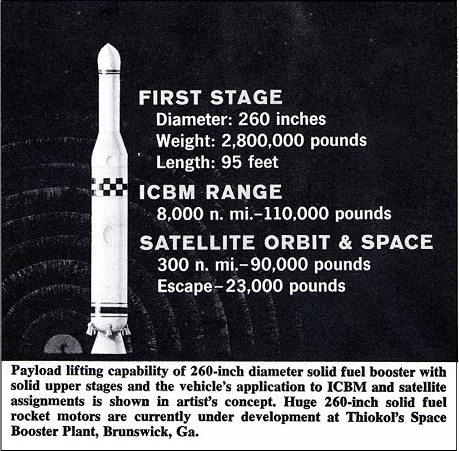
Question. The new Sentinel ICBM is fundamentally similar to MM III. I understand in advance that the U.S. has a completely different ICBM employment strategy than either Russia or China. Despite this fact, both countries continue to develop and field heavy ICBMS. If the US decided to develop an ICBM analog that meets or exceeds SARMAT (Satan 2) performance, what would its characters be? Over the decades, there were various previous proposals for systems significantly larger than Peacekeeper. Basing methodology was always a very disruptive factor in these proposals. Please ignore the basing debate. Assume this weapon system will be fixed and buried in large, super hardened silos (defended by a layered national missile defense system [Golden Dome]) and serve as a heavy-weight compliment to Sentinel (akin to MM II&III +Titan II into the early 80's). It should be able to serve as a FOBS, carry significant number of MIRVs, MARVs, HSGLs etc. + penetration aids or single, high yield warheads + penetration aids.
I'm curious to hear everyone's thoughts on design and characteristics. Thanks in advance for your commentary.
The "ICBM-X" concept refers to a proposed large-diameter intercontinental ballistic missile developed in the 1960s, which was larger than the Minuteman and Titan II missiles. It was part of the "Golden Arrow" study, which explored the idea of a mobile, multi-warhead force to serve as a more resilient deterrent than existing systems.Ultimately, the ICBM-X and its related concepts were deemed too expensive and were not pursued, in favor of the existing Minuteman II program.
Size:
The proposed ICBM-X was designed to have a massive 156-inch diameter, significantly larger than other missiles of the time.
Payload:
It was envisioned to carry a large number of warheads (20 or more) to ensure its survivability and deterrent capability.
Cost:
The project was considered extremely expensive, which was a major factor in its rejection by the Department of Defense, which was focused on resource efficiency.
Alternative:
The concept was ultimately shelved in favor of developing and deploying the less expensive Minuteman II missile.
Legacy:
The ICBM-X concept is an example of a proposed, but ultimately unsuccessful, weapon system that was designed to address the changing strategic landscape of the Cold War.
Remember that at least the Russian Avanguard HGV is huge. It's 2 tonnes, when a MIRV is maybe 500kg on the high end. So a Sarmat is only throwing 3-4x Avanguards when it could throw up to 16x MIRVs.
Similarly, FOBS means you need a lot more delta-vee out of the booster, so a much lower payload. If I'm reading this right, the completed W53 in Mk6 RV weighed in at 14,340lbs (6200lbs of warhead plus 8140lbs of RV), while a Titan II could only put 7900lbs into LEO.
I would argue that the US doesn't need FOBS as much as Russia does, because the US has good SSBNs able to travel to get to odd angles that would require FOBS to hit from the US.
However, assuming that the US HGVs are the same kind of size as Avanguard, the US would need a bigger missile to launch any strategic HGVs around.
Its also worth noting Titan II was not at limits of its development with regards to payload / throw weight:
The Department of Defense predicted that a Titan II missile could eventually carry a warhead with a 35 megaton yield, based on projected improvements. However, that warhead was never developed or deployed. This would have made this warhead one of the most powerful ever, with almost double the power-to-weight ratio of the B41 nuclear bomb.
This is from DOE: "RESTRICTED DATA DECLASSIFICATION DECISIONS1946 TO THE PRESENT"
I think any US "Titan IV" or whatever we want to call the US superheavy ICBM would primarily be for launching strategic HGVs.
It'd be quite an effort to make a nuclear-capable HGV small enough to fit onto Sentinel, and HGVs are not compatible with Trident II at all. The Trident II's 3rd stage actually protrudes through the bus section and the warheads are placed around the outside circle. There's no width for anything larger than the W88 warheads, and there's no length available in the tube for the biconic HGVs.
But IMO the better sales pitch is the asteroid-bumping mission, which requires a liquid-fueled bus or top stage to precisely match the incoming and then detonate an absolutely massive warhead to vaporize any rubble piles.
The US Sarmat equivalent is in service and is called the Trident II. If you want to wack asteroids a Falcon 9 should do the trick nicely. The US does not need Peacekeeper, neither does Russia, but that's another story.
The US Sarmat equivalent is in service and is called the Trident II. If you want to wack asteroids a Falcon 9 should do the trick nicely. The US does not need Peacekeeper, neither does Russia, but that's another story.
MM3 or Sentinel might be able to carry a single HGV, the Mk12A RV is 700-800lbs and 3 of those is right at 2200lbs. But Avanguard is ~4400lbs. The Alpha Draco biconic body shape is lighter but is also nearly 35ft long by itself. How deep does an MM3 sit in the silo?
FWIW I did some ROM calculations a while ago and landed on a Titan II-sized missile using Peacekeeper technology. It comes out to about a 486,000-pound missile throwing a payload of 22,400 lb to 6,000 nautical miles. Which, frankly, is more than enough missile for any practical purpose.
Oh, and the 35 megaton warhead for Titan II isn't comparable to, well, any other ICBM warhead. By design, it traded off heatshield thickness for warhead mass - the theory being that a Soviet lower-tier BMD system would prevent it from reaching the surface. Instead, it would burst at a high enough altitude that terminal defences couldn't engage it, so the high yield was needed to have the same effect on the targets as a 9 megaton groundburst.
MM3 or Sentinel might be able to carry a single HGV, the Mk12A RV is 700-800lbs and 3 of those is right at 2200lbs. But Avanguard is ~4400lbs. The Alpha Draco biconic body shape is lighter but is also nearly 35ft long by itself. How deep does an MM3 sit in the silo?
Trident doesn't have to throw HGVs, but Im sure it could if you replaced the 3rd stage. Russia is trying to defeat MDA/Golden Dome, we are not. C-HGB is alot smaller than 35ft, sure its shorter range but could be beefed up for longer ranges.
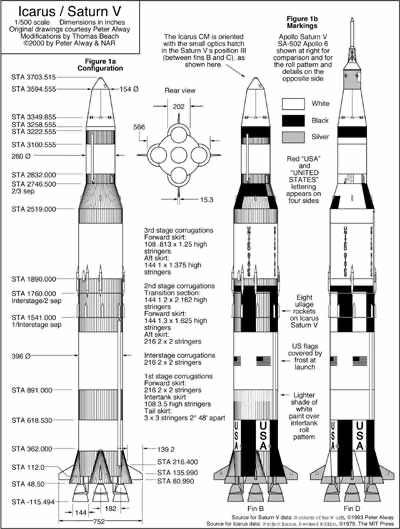
Not suggesting a SATURN V or STARSHIP/SUPER HEAVEY SLV-based ICBM. However, this is the back story on boosters, bombs, and asteriods:
Giant bombs on giant rockets: Project Icarus
Launch Complex 39C
The Icarus plan required a total of nine Saturn V rockets. Three were test flights and the remaining six were interceptors. At the time, NASA planned on having only six Saturn V’s available by April 1968, so the production schedule would have to be dramatically increased. In addition, another launch pad would have to be built at Cape Kennedy. Launch Complex 39C would have to be built in order to enable the high flight rate needed for the Saturn launches, all of which had to get off the ground in six weeks.
In addition to the nine Saturn Vs, the Icarus plan called for five Atlas Agena rockets carrying modified versions of the Mariner 2 deep space probe. Known as the Intercept Monitoring Satellite (IMS), these probes would be used to observe the actual detonation of the nuclear bombs when they reached the asteroid. Very little was known about how nuclear weapons would actually behave in space, let alone how the blast would affect an asteroid, and so the IMS was considered vital to the mission.
Launch Complex 39C would have to be built in order to enable the high flight rate needed for the Saturn launches, all of which had to get off the ground in six weeks.
In late February 1968, the first IMS spacecraft would lift off atop its Atlas Agena booster. It would linger in Earth orbit only a short time before being sent on its way to rendezvous with Icarus. A little over a month later, Interceptor One would thunder aloft on 33 million newtons of thrust. After a coast of one orbit or less, the S-IVB stage would fire, boosting the Icarus spacecraft out of Earth orbit and toward the asteroid. Soon after, the adapter shroud panels would peel back like the petals of a flower and the Icarus spacecraft with its 100-megaton bomb would separate. Its Service Propulsion System engine would fire, adding more velocity to the spacecraft.
After a coast of approximately 60 days, with several course corrections along the way, an optical sensor aboard the spacecraft would acquire Icarus only three hours before rendezvous. The spacecraft then entered the “terminal phase.” Four minutes before rendezvous the radar system would begin to supply range information for making final correction maneuvers. At five seconds before impact, a fusing radar would acquire the asteroid and arm the bomb. If all went as planned, detonation would occur within 100 feet of the surface of Icarus along the sunlit edge. The resulting explosion would either fragment or deflect the asteroid off its collision course.
From Icarus to NEAR
The planners proposed six bombs for the mission. But they faced huge unknowns. The biggest problem was that nobody knew exactly what asteroids in general, and Icarus in particular, were made of. Was Icarus dense or light? Exactly how big was it? How was it shaped?
In fact, thirty-seven years later we are not in a much better situation. Despite studying several asteroids up close with robotic probes and even landing on one with the NEAR spacecraft, planetary scientists are still unsure how they’re composed. One theory, known as the “rubble pile,” is that many asteroids are not really rocks, but bundles of rocks and dust. Hitting one with a nuclear explosion might accomplish little, as it would absorb the blast and not move very much. Compare trying to push a rock across the ground with one finger with about pushing a pile of peanuts across the ground with a finger.
The guys in the B612 Foundation could start by changing their name. “The Icarus Foundation” has a certain ring to it.
Furthermore, nobody was sure how a nuclear bomb would act in space or how it would affect Icarus—and because nuclear testing in space was effectively banned in the 1960s we still do not know. There was no way to get everything right on the first try and so several bombs would have to be detonated before planners even began to understand what they were doing.
The Icarus project’s legacy was primarily to spawn a lousy 1970s movie called Meteor! (complete with exclamation mark) which was not only scientifically ridiculous, but committed the grave sin of covering the beautiful Natalie Wood in mud.
Saving planet Earth
There are new ideas about how to do defend against deadly asteroids, but they require long advance warning. One current proposal comes from the awkwardly-named B612 Foundation. Their recommendation is to develop a spacecraft similar to that planned for the Jupiter Icy Moons Orbiter (JIMO) and send it to intercept, and move, a known asteroid. The spacecraft would settle down on the surface and then use its ion propulsion engine to alter the asteroid’s trajectory. This would be a demonstration mission, proving that we could defend the planet if needed, and would have an additional science benefit. But any actual saving of planet Earth would require detecting a killer asteroid a decade or more in advance.
Asteroid defense has managed to overcome much of the giggle factor that used to plague it. But it is still not respectable enough in Congress to get even relatively small amounts of funding to search for killer rocks with Earth’s name on them. It will probably be decades before it is seriously considered by the American government, unless a near miss by another asteroid scares some people into action.
The guys in the B612 Foundation could start by changing their name. “The Icarus Foundation” has a certain ring to it. Gently pushing a killer rock away is not as sexy as smacking it with giant nukes, but it is far more realistic. And it may be achievable with near-term technology.
Meteor is a 1979 American science fictiondisaster film directed by Ronald Neame and starring Sean Connery and Natalie Wood. The film's premise, which follows a group of scientists struggling with Cold War politics after an asteroid is detected to be on a collision course with Earth, was inspired by a 1967 MIT report, Project Icarus.
——————————————
If I recall there was a orbital base that held six or more rockets with 100Mt warheads on them.
This site uses cookies to help personalise content, tailor your experience and to keep you logged in if you register.
By continuing to use this site, you are consenting to our use of cookies.