Ship- and ground-borne AA missiles turned into anti-ship missiles?

tomo pauk

ACCESS: Top Secret
Joined
1 May 2011
Messages
1,122
Reaction score
891
... to be fired from any plausible platforms, like the ships, ground launchers, aircraft.
Some missiles will make more sense than the others, like the big missiles that can be guided on a target in any weather and on longer ranges, vs. the the small missiles with the guiding system not suited for this task. The platform limitations apply as ever - a big Terrier missile will be a worse fit on a small boat (let alone the Talos, with size & weight that of a small jet aircraft), where the smaller Tartar or non-boostered Standard will make for a better fit.
 
Most of shipborne surface-to-air missiles have secondary anti-surface mode. Barring beam-riders (which have problems with rotating beam reflection from water surface), most of guided missile fire control systems, capable of tracking aircraft, could track the enemy warship also. Or could simply be slaved to surface-search radar for that.

Some land-based SAM's - like Nike-Hercules, S-72, S-125 and S-200 - also have a secondary anti-surface mode, where SAM was basically used as short-range, high-precision tactical ballistic missile.
 
Standards were and still are cleared for anti surface used.
Sea Dart? Sparrows?

The Soviets were more worried about big capital ships. Maybe nuke tipping SAMs for dual use but that'd be pretty problematic for export control. If NATO had more small boat focus maybe. A ship to ship Tor would be pretty funny. Pretty much a FOG TV guided type missile without the fiber reel part.
 
Most of these SAM rockets would've been pretty dangerous with the anti-radiation guiding system, either as the main or the auxiliary guidance channel. Americans modded the Standard into an air-launched ARM, the AGM-78.

A combined passive RF + IR would've also been interesting, like the RIM-116 of today has. Mix in the inertial or GPS guidance, and basically every way of a dog-leg attack pattern is possible, with the target ship not easily knowing it is attacked. It also should not be picky wrt. the targets it can attack - ships, helos, fixed-wing A/C, missiles - everything goes.
 
There's the RGM-59 Taurus, which was designed to fit into a Terrier form factor to be fired from any Terrier platform. While a land-attack missile, it could've plausibly been refit for antiship use with a new seeker, and packed a 1000-lb warhead and a range of 90+ kilometers.
 
The Soviets were more worried about big capital ships. Maybe nuke tipping SAMs for dual use but that'd be pretty problematic for export control. If NATO had more small boat focus maybe. A ship to ship Tor would be pretty funny. Pretty much a FOG TV guided type missile without the fiber reel part.
The S-125 SAM could be used as anti-ship missile; albeit I'm not sure starting from which model. IRRC, the surface target was supposed to be tracked visually by infrared sight, and radar used only to determine range. The fuze was set to impact detonation.

M-11 Storm naval SAM and M-22 Uragan naval SAM both have anti-surface modes.
 
Barring beam-riders (which have problems with rotating beam reflection from water surface)
Seaslug was used against land targets in the Falklands, and per @SeaslugMk2's website the Mk 2 version had a mode in which a 45 degree dive could be programmed to strike targets below the guidance 'horizon'.
 
Seaslug was used against land targets in the Falklands, and per @SeaslugMk2's website the Mk 2 version had a mode in which a 45 degree dive could be programmed to strike targets below the guidance 'horizon'.
Yep, but this missile have a rather specific mode for this - when missile essentially stopped following the elevation command and just maintain the set pitch angle (while still guiding in azimuth). Elegant solution, I fully admit - but not very accurate one.
 
Yep, but this missile have a rather specific mode for this - when missile essentially stopped following the elevation command and just maintain the set pitch angle (while still guiding in azimuth). Elegant solution, I fully admit - but not very accurate one.
I had to go back to some basic trigonometry to check this, but for the minimum elevation of 0.5°, at 35,000 yards range the missile will be at an altitude of just under 1000 feet. Given a velocity of Mach 2 at this range it will take about half a second from the 'Dive' command to impact. Even if you assume Mach 1 and 2000 feet that's only 2 seconds; how far will your target move in that time?
Yes, I know the problem is knowing precisely when to give the Dive command, From the Dive Computer's point of view the range data from the Type 903/904 wasn't precise enough.

SRJ
 
I had to go back to some basic trigonometry to check this, but for the minimum elevation of 0.5°, at 35,000 yards range the missile will be at an altitude of just under 1000 feet. Given a velocity of Mach 2 at this range it will take about half a second from the 'Dive' command to impact. Even if you assume Mach 1 and 2000 feet that's only 2 seconds; how far will your target move in that time?
It's not about target movement, it's exactly as you mentioned -

Yes, I know the problem is knowing precisely when to give the Dive command, From the Dive Computer's point of view the range data from the Type 903/904 wasn't precise enough.

- it's the range data for target & missile, and subsequent trajectory calculations.
 
I think naval SAMs would only have secondary anti-surface capability because the requirements to sink ships and shoot air aircraft are fundamentally different.

This thread eventually did a deep dive on the early Western AShMs for things like guidance and warhead design and effects. Warheads that are effective against aircraft are drastically different to those that are effective against warships and the guidance required for each is also very different.
 
Warheads that are effective against aircraft are drastically different to those that are effective against warships and the guidance required for each is also very different.
A decently-sized AA missile does not just have the warhead to 'offer' to a job. It's warhead travels likely twice of thrice the speed of that of the Exocet or the Harpoon. And it is not only warhead, it is the rest of the missile that is also slamming at a ship at high speed.
We also have a thing of the ships that carried Standards or Sea Darts carrying big number of missiles, like 35-60 even on the ships of the modest size; yes, the early Type 42 batches carried a small number of missiles, but still. So a decision of chucking 2-3 missiles on a ship that is judged to be an imminent threat is not a big deal.
A missile that does 2.5 Mach on average cuts the enemy time to react by a factor greater than 2.5 vs. the Exocet. At 30 km distance, Exocet will need almost 100 seconds to hit the target, leaving time for the enemy to fire it's own missiles or to make a turn towards the nearby island, or to deploy countermeasures. A RIM 66 or the Sea Dart will do that at under 40 seconds.
The enemy anti-missile gun/rocket system(s) will have had a tougher time with a very fast target.
 
A decently-sized AA missile does not just have the warhead to 'offer' to a job. It's warhead travels likely twice of thrice the speed of that of the Exocet or the Harpoon. And it is not only warhead, it is the rest of the missile that is also slamming at a ship at high speed.
We also have a thing of the ships that carried Standards or Sea Darts carrying big number of missiles, like 35-60 even on the ships of the modest size; yes, the early Type 42 batches carried a small number of missiles, but still. So a decision of chucking 2-3 missiles on a ship that is judged to be an imminent threat is not a big deal.
A missile that does 2.5 Mach on average cuts the enemy time to react by a factor greater than 2.5 vs. the Exocet. At 30 km distance, Exocet will need almost 100 seconds to hit the target, leaving time for the enemy to fire it's own missiles or to make a turn towards the nearby island, or to deploy countermeasures. A RIM 66 or the Sea Dart will do that at under 40 seconds.
The enemy anti-missile gun/rocket system(s) will have had a tougher time with a very fast target.

I don't deny a Standard or a Sea Dart will make a mess of a warship, but the are limited by the limits of their target indication and target illumination radars. In contrast even the earliest western AShMs had active radar seekers capable of finding its target beyond the strict radar horizon without assistance from the launching ship.

As for the warhead, a SAM's warhead's purpose is to expand the continuous rod so that long pieces of steel can fly out and cut into aircraft. An AShMs warhead is designed to actually hit and penetrate the target with the warhead casing and then explode inside the ship, with some warheads having refinements to create more damage inside the ship.
 
I don't deny a Standard or a Sea Dart will make a mess of a warship, but the are limited by the limits of their target indication and target illumination radars. In contrast even the earliest western AShMs had active radar seekers capable of finding its target beyond the strict radar horizon without assistance from the launching ship.
That is both advantage and a disadvantage.
Israelis have deployed the chaff-dropping and ECM-doing helicopters in front of their missile ships in 1973, with the result that their ships suffered no hits. Their Gabriel missiles were semi-active guided, and trashed the Arab ships, end result being eight to zero.
Adding a passive mode of operation to the semi-active guided missile should be a trivial thing to do, with result of the rocket aiming towards the enemy radars. Later, the IR sensor can be incorporated, with both anti-air and anti-ship modes; ditto for the active radar.

As for the warhead, a SAM's warhead's purpose is to expand the continuous rod so that long pieces of steel can fly out and cut into aircraft. An AShMs warhead is designed to actually hit and penetrate the target with the warhead casing and then explode inside the ship, with some warheads having refinements to create more damage inside the ship.

A bespoke AShM will have it's advantages and shortcomings, while the SAM in an anti-ship mode will have it's own advantages and shortcomings.
 
That is both advantage and a disadvantage.
Israelis have deployed the chaff-dropping and ECM-doing helicopters in front of their missile ships in 1973, with the result that their ships suffered no hits. Their Gabriel missiles were semi-active guided, and trashed the Arab ships, end result being eight to zero.
Adding a passive mode of operation to the semi-active guided missile should be a trivial thing to do, with result of the rocket aiming towards the enemy radars. Later, the IR sensor can be incorporated, with both anti-air and anti-ship modes; ditto for the active radar.


A bespoke AShM will have it's advantages and shortcomings, while the SAM in an anti-ship mode will have it's own advantages and shortcomings.

The 1973 Arab-Israeli war, for all it's groundbreaking firsts, had its own peculiarities that don't necessarily translate to the likes of the Cold War USN or RN. It was small warships, close to shore packed with a lot of commercial shipping, to the extent that some missile boats were using them for cover. This is different to NATO open ocean operations against big ships, which requires longer range missiles with more powerful warheads, making semi-active guidance inappropriate.
 
The 1973 Arab-Israeli war, for all it's groundbreaking firsts, had its own peculiarities that don't necessarily translate to the likes of the Cold War USN or RN. It was small warships, close to shore packed with a lot of commercial shipping, to the extent that some missile boats were using them for cover. This is different to NATO open ocean operations against big ships, which requires longer range missiles with more powerful warheads, making semi-active guidance inappropriate.
I've already suggested the mods to the SAMs guidance systems that improve their usability in a shooting war, and against all the modern platforms - both ships and aircraft.
The targets for the SARH guidance systems can also be 'painted' by platforms other than the ships that is launching the missiles.
 
I've already suggested the mods to the SAMs guidance systems that improve their usability in a shooting war, and against all the modern platforms - both ships and aircraft.
The targets for the SARH guidance systems can also be 'painted' by platforms other than the ships that is launching the missiles.

What time-frame are you thinking, because those options might not be technically possible during the Cold War.
 
I don't deny a Standard or a Sea Dart will make a mess of a warship, but the are limited by the limits of their target indication and target illumination radars. In contrast even the earliest western AShMs had active radar seekers capable of finding its target beyond the strict radar horizon without assistance from the launching ship.
Yes, a SARH SAM versus a ship will be relatively short-ranged. Some 30-50km. Good for an "oh, crap" moment, however. And a whole lot faster than Harpoons or Exocets at those ranges. Witness what happened during Operation Praying Mantis. Having some missile boats or missile-armed FFGs pop around an island and shooting at you is best answered by a volley of SAMs. Some aimed at your incoming missiles, and some aimed at the ship shooting at you.

Now, ARH SAMs are effective anti-ship missiles at ~500km range, if the SM-6 is anything to go by.


As for the warhead, a SAM's warhead's purpose is to expand the continuous rod so that long pieces of steel can fly out and cut into aircraft. An AShMs warhead is designed to actually hit and penetrate the target with the warhead casing and then explode inside the ship, with some warheads having refinements to create more damage inside the ship.
Well, most missiles are blast-frag these days, not continuous-rod, but that warhead will still shred a large area.

Also, no SAM has much trouble penetrating a chunk of modern ship hull (6mm/0.25" to 12mm/0.5" plating) and exploding inside. It's functionally equivalent to hitting a ship with a 12"-14" shell. Better speed, even, which likely makes up for the weaker warhead construction.

The big SAMs like Sea Slug or Talos are closer to hitting a ship with an 18-20" shell at point blank range. At about 2x the impact velocity.
 
A missile that does 2.5 Mach on average cuts the enemy time to react by a factor greater than 2.5 vs. the Exocet. At 30 km distance, Exocet will need almost 100 seconds to hit the target, leaving time for the enemy to fire it's own missiles or to make a turn towards the nearby island, or to deploy countermeasures. A RIM 66 or the Sea Dart will do that at under 40 seconds.
The enemy anti-missile gun/rocket system(s) will have had a tougher time with a very fast target.
And now imagine how destructive would be a P-700 Granit - which have a terminal velocity of Sea Dart, combined with half-ton warhead, ability to evade defensive fire and onboard ECM set.
 
What time-frame are you thinking, because those options might not be technically possible during the Cold War.

1960s are ripe for SARH, passive RF homing, as well as active RF homing. The IR guidance against a relatively cold target that a ship is was probably possible by the 1970s.

And now imagine how destructive would be a P-700 Granit - which have a terminal velocity of Sea Dart, combined with half-ton warhead, ability to evade defensive fire and onboard ECM set.
One would imagine that a 7 ton self-sacrificing jet aircraft (okay, maybe 5 tons at the end of the range?) will do bad things to a ship when it slams in it at supersonic speed, even before we account for the warhead.
The 7 ton jet aircraft might've been a wee out of what the most of the navies would've been buying back in the Cold War, though.
 
The 7 ton jet aircraft might've been a wee out of what the most of the navies would've been buying back in the Cold War, though.
Yeah, but, if you need to kill a durable, very high value target (carrier, or LHD, or Aegis cruiser) - or swat away the annoying Iowa-class battleship - the heavy, smart and fast missiles are just better)
 
South Africa's Umkhonto SAM has also been adapted to play the anti shipping role if needed - mostly for smaller targets, however it's 23Kg warhead could cause some reasonable damage to a frigate type ship, especially if it's hit with multiple missiles.

Having a dual-band infrared (IR) seeker, and unusually, operates in a lock-on-after-launch (LOAL) mode, receiving mid-course guidance updates via a telecommand link from the launch platform's radar or fire control system - My understanding is that there might be the ability to select the target area in some shape or form (i.e. the bridge, or antenna mast)?
 
Yeah, but, if you need to kill a durable, very high value target (carrier, or LHD, or Aegis cruiser) - or swat away the annoying Iowa-class battleship - the heavy, smart and fast missiles are just better)
There is no doubt that something like the heavy Soviet/Russian missiles will be a dire threat to the ships it hits.
OTOH - such a missile was not in the cards for the 99% of the navies.

Hmm - the anti-ship version of the Talos would've been interesting. Half the weight of the P-700 already as-is, and as an anti-surface missile it should've worked with a smaller & lighter booster, so the launch weight is at about 2500 kg. It would've still been a threat to the helicopters and non-supersonic aircraft. Being a sizable rocket, it might've been relatively easy to install the active radar seeker in the nose.

South Africa's Umkhonto SAM has also been adapted to play the anti shipping role if needed - mostly for smaller targets, however it's 23Kg warhead could cause some reasonable damage to a frigate type ship, especially if it's hit with multiple missiles.

Having a dual-band infrared (IR) seeker, and unusually, operates in a lock-on-after-launch (LOAL) mode, receiving mid-course guidance updates via a telecommand link from the launch platform's radar or fire control system - My understanding is that there might be the ability to select the target area in some shape or form (i.e. the bridge, or antenna mast)?

The RIM-116, both the early versions as well as teh ones with the RF seeker, have the anti-ship mode added to the electronics. Granted, the puny warhead will not be a threat to a serious warship, but it will make a mess out of some small crafts that a small military might be using.
 
Hmm - the anti-ship version of the Talos would've been interesting. Half the weight of the P-700 already as-is, and as an anti-surface missile it should've worked with a smaller & lighter booster, so the launch weight is at about 2500 kg. It would've still been a threat to the helicopters and non-supersonic aircraft. Being a sizable rocket, it might've been relatively easy to install the active radar seeker in the nose.
Thought about it many times, yes (in fact, I'm working on alternate history material about Talos-delivered ASM right now...). For air-launched missile, it's easily doable - both the beam-riding & semi-active guidance could work perfectly fine from the plane, as long as it stays above horizon for the target. But for ship-launched, there would be a big problem of developing a completely new over-the-horizon guidance. Neither beam-riding nor semi-active guidance would work well for the target beyond the horizon; some autonomous guidance would be required. And installing an autonomous guidance on Talos would be... problematic. There is little space to fit any kind of gimballed antenna seeker in missile nose.

So far I brainstormed several ideas:

* Passive radar seeker (like on RIM-8H anti-radiation missiles). Advantages - simple to introduce (all required hardware was developed), reliable. Disadvantages - won't work if enemy gone full EMCON, could be duped by imitation jammers;

* Active radar seeker with existing polyrod antenna. Some kind of transmitter antenna would be required - compact enough, to fit in the missile nose, and likely of non-parabolic type. Advantages - could seek target that didn't emit anything. Disadvantages - the seeker would inevitably be low-power and short-ranged (polyrod interferometer receiver isn't very efficient), likely easy to jam;

* Passive infrared seeker. Advantages - would require far less space than radar one, would work regardless of target emissions, could work with ground targets as well. Disadvantages - drastically reduced performance in adverse weather conditions (might be problematic for supersonic missile);
 
For air-launched missile, it's easily doable - both the beam-riding & semi-active guidance could work perfectly fine from the plane, as long as it stays above horizon for the target. But for ship-launched, there would be a big problem of developing a completely new over-the-horizon guidance. Neither beam-riding nor semi-active guidance would work well for the target beyond the horizon; some autonomous guidance would be required. And installing an autonomous guidance on Talos would be... problematic. There is little space to fit any kind of gimballed antenna seeker in missile nose.

That was the same challenge the designers of the 'true' anti-ship missiles' faced. We can recall that the French installed a radar seeker on the rather small Exocet missile.

So far I brainstormed several ideas:

* Passive radar seeker (like on RIM-8H anti-radiation missiles). Advantages - simple to introduce (all required hardware was developed), reliable. Disadvantages - won't work if enemy gone full EMCON, could be duped by imitation jammers;

* Active radar seeker with existing polyrod antenna. Some kind of transmitter antenna would be required - compact enough, to fit in the missile nose, and likely of non-parabolic type. Advantages - could seek target that didn't emit anything. Disadvantages - the seeker would inevitably be low-power and short-ranged (polyrod interferometer receiver isn't very efficient), likely easy to jam;

* Passive infrared seeker. Advantages - would require far less space than radar one, would work regardless of target emissions, could work with ground targets as well. Disadvantages - drastically reduced performance in adverse weather conditions (might be problematic for supersonic missile);

Having the active seeker to also have the passive mode should be a no brainer. I'd try the 'normal' antenna set-up.
As for the IR seeker - probably the best is to have also the passive RF seeker aboard, too. Improves the ECCM properties of the missile, and it will still work in the clouds and fog.

BTW - shutting down the radars could mean that the defending ship is pretty much blind, opening itself to the other threat to itself, like the 'proper' anti-ship missiles with active seekers. Sorta damned if you do, damned if you don't.
The IR cameras were not a thing on ships until well into the 1980s, to help out when the radars are inoperative.
 
That was the same challenge the designers of the 'true' anti-ship missiles' faced. We can recall that the French installed a radar seeker on the rather small Exocet missile.
Yeah, but Exocet was rocket-powered. It's frontal part could be fully occupied by seeker. No problem for antenna.

For the Talos the situation is far more complicated:

1766232990094.png

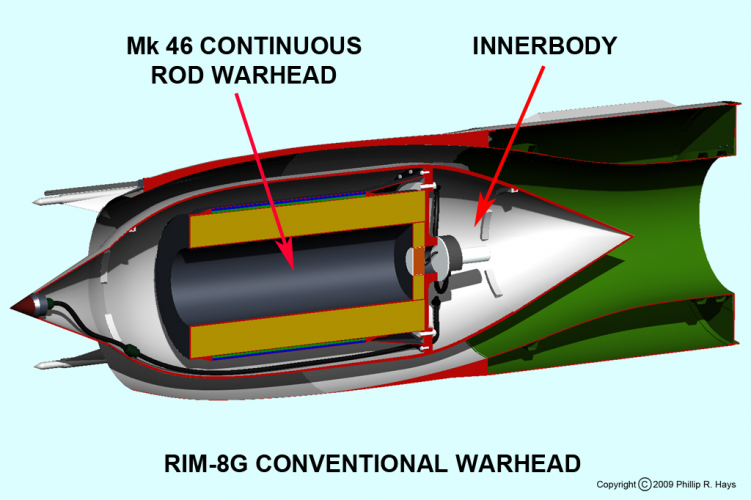
Look how small & limited the space in front of the warhead is. The nose cone of the missile's interbody is really compact, and left very little space for even small antenna - which must be placed forward of the ramjet intake edges, otherwise it would suffer the problem of sidelobes reflection from them. It's a challenging tech solution.

Having the active seeker to also have the passive mode should be a no brainer. I'd try the 'normal' antenna set-up.
Not so simple. The active seeker is designed to work with its specific set of frequences on receive - discriminate everything else and amplify only them.

The passive seeker need to be able to detect & analyze frequences, that might fell far outside the seeker working range - simply because enemy radars did not work on same frequences as missile seeker.

The IR cameras were not a thing on ships until well into the 1980s, to help out when the radars are inoperative.
Yeah?

1766233230930.png

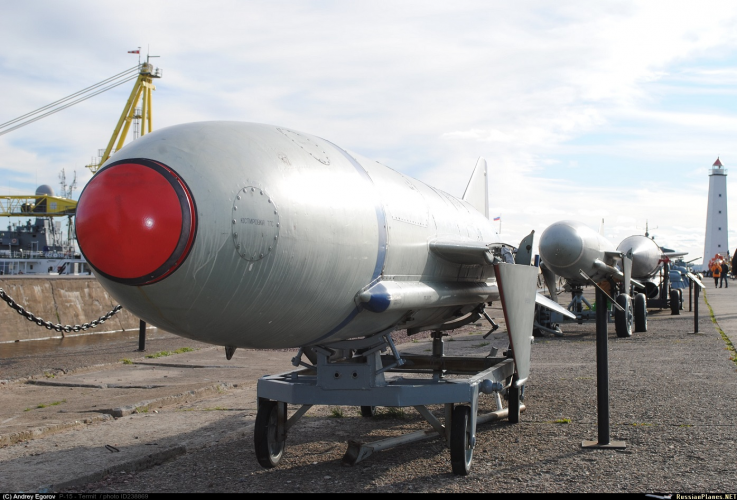
What do you think is behind this red cover on the P-15 Termit missile nose? And why the next missile didn't have such? It's because the forward missile is IR-homing version, the P-15UT (T means, "teplovaya", i.e. "heat-seeking"), and its nose is fitted with infrared seeker. Not camera; merely a device that could detect heat source on the cooler background.
 
Yeah, but Exocet was rocket-powered. It's frontal part could be fully occupied by seeker. No problem for antenna.

For the Talos the situation is far more complicated:

Look how small & limited the space in front of the warhead is. The nose cone of the missile's interbody is really compact, and left very little space for even small antenna - which must be placed forward of the ramjet intake edges, otherwise it would suffer the problem of sidelobes reflection from them. It's a challenging tech solution.
Engineers should play a bit with the 'corn', so the volume inside is better used.

Not so simple. The active seeker is designed to work with its specific set of frequences on receive - discriminate everything else and amplify only them.

The passive seeker need to be able to detect & analyze frequences, that might fell far outside the seeker working range - simply because enemy radars did not work on same frequences as missile seeker.
The home-on-the-jammer modes of operation were a know thing back in the Cold War.

Yeah?

What do you think is behind this red cover on the P-15 Termit missile nose? And why the next missile didn't have such? It's because the forward missile is IR-homing version, the P-15UT (T means, "teplovaya", i.e. "heat-seeking"), and its nose is fitted with infrared seeker. Not camera; merely a device that could detect heat source on the cooler background.

That is a missile, not a ship. I was referring to the IR cameras on the ships.
 
Engineers should play a bit with the 'corn', so the volume inside is better used.
The volume inside didn't matter much; it's how nosecone is protruging out that matters.

The home-on-the-jammer modes of operation were a know thing back in the Cold War.
Home-on-jammer. Not "anti-radiation". You see, the jammer is by definition working in the same frequency range as missile seeker - otherwise it won't be able to jam it! So homing on jammer did not require any additional capabilities from the seeker; the jammer signals are coming exactly in the range that seeker is designed to function in, fine-tuned to it.

Homing on enemy radar is much more complicated, since enemy radar is not working in the same frequency range as missile seeker. The missile needed specific equipment to carefully filter out and amplify the radar signal, about which it have little understanding what exactly it could be.

So no, it's not the same thing.

That is a missile, not a ship. I was referring to the IR cameras on the ships.
And I was referring to IR seekers on missiles. We are talking about missiles, after all?
 
Home-on-jammer. Not "anti-radiation". You see, the jammer is by definition working in the same frequency range as missile seeker - otherwise it won't be able to jam it! So homing on jammer did not require any additional capabilities from the seeker; the jammer signals are coming exactly in the range that seeker is designed to function in, fine-tuned to it.

Homing on enemy radar is much more complicated, since enemy radar is not working in the same frequency range as missile seeker. The missile needed specific equipment to carefully filter out and amplify the radar signal, about which it have little understanding what exactly it could be.

So no, it's not the same thing.
Okay.

And I was referring to IR seekers on missiles. We are talking about missiles, after all?
We were also talking about the sensors on the ships.
Once the radars are shut down (in order to prevent the anti-radiation seeker to find the ship in question), something better than the Eyeball Mk.1 will be needed to feed the data to the ship's combat C&C room.
 
Back
Top Bottom