Paul Deville designs: Salmson D. series ("Cri-Cri", "Phrygane", etc.)

Avimimus said:
Anyone know how many Salmson Moineau S.M.1 were completed? Sources vary between a couple of prototypes and all 155 ordered. Some sources even have them in operational use as night bombers in 1918!
A bit late answering this. According to 'French Aircraft of World War One' by Davilla & Soltan, at least 155 aircraft were built.
At least one machine, belonging to AR 289, was still in use in 1918. This S.M.1 flew reconnaissance in support of the 66e Division des Chasseurs a Pied until late 1918.
 
Salmson in wellknown of its aeroplanes and watercooled engine of the WWI period and after that of its 7 and 9 cylinder aircooled engines.
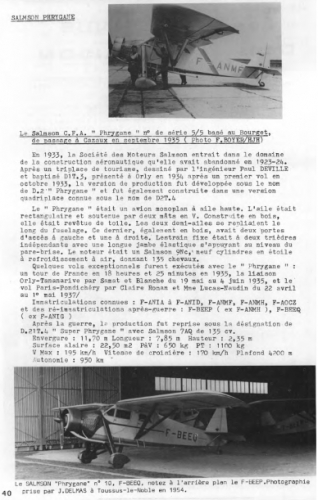
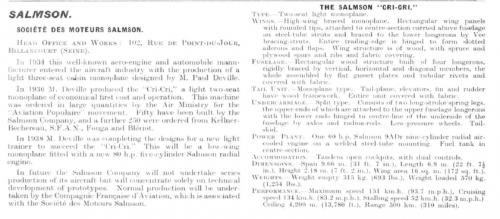
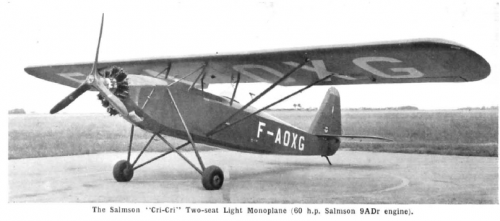
There are two types of aeroplanes which were designed and build at the Salmson factory, the Cricri and Phtygane.
Both were designed for the civil market, some were sold to the France airforce.
The first was an open parasol and the second a high wing cabin aeroplane.
So much material there is to find of the WWI period aeroplanes so little there is about these two aeroplanes.
There are several pictures and a list with the versions, but no historical information, technical details, drawings etc.etc.
Who can help to give a better view of these two types?
Thanks
Jjr
 
Hi Jjr,

for Salmson Cri cri,please see;
https://en.wikipedia.org/wiki/Salmson_Cricri

And I will try to find a more technical details in my files.
 

Attachments

  • 1.png
    1.png
    216.1 KB · Views: 164
And;
 

Attachments

  • 1.png
    1.png
    201 KB · Views: 145
  • 2.png
    2.png
    197.1 KB · Views: 139
Hi Jjr,

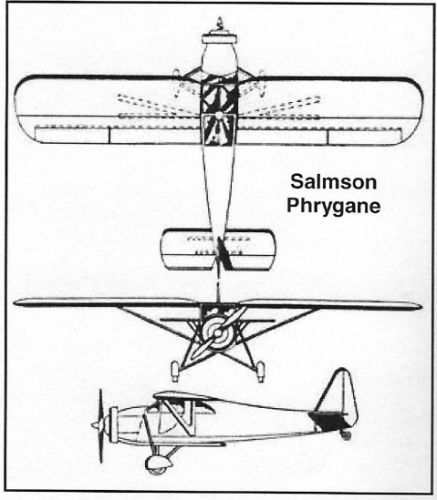
the Salmson of this series began with D.1 up to D.8,except D.4,and here is
a 3-view to Phrygane.
 

Attachments

  • a.png
    a.png
    217.9 KB · Views: 85
Nice drawing, who can hel with Cricri?
 
does anyone hear about Salmson D-55,a two-seat light aircraft Project,which was powered by one 60 hp Salmson 9 Adr engine ?.

The short answer is 'no'. But it is an intriguing designation!

It would be tempting to suggest that this D 55 might relate to the 1950 D 57 Phryganet. The problem is that the 1937 D 56 Lycène was a low-winged trainer project for Aviation populaire. So, why did the D 55 not appear until seven years later? Very odd.

BTW: A lycène is a gossamer-winged butterfly (Lycaenidae family). Can any Francophone explain phryganet? I'm guessing that its is a coinage meaning 'little caddisfly'?
 
The D.57 Phryganet was powered by a 90 hp Salmson 5AQ-01 engine. According to Pierre Gaillard (Les Avions Français de 1944 à 1964), none of the CFA post-war 'Cri-cri' variants was powered by a 60 hp engine. I haven't yet had the chance to look to see what Charles Claveau (Les Constructeurs Français 1919-1945) has to say on the subject. As to the derivation of the name 'Phryganet', I would agree with Apophenia, the D.57 being the smaller brethren of the four seat D.21 Phrygane (Caddis Fly).
 
The D.57 Phryganet was powered by a 90 hp Salmson 5AQ-01 engine. According to Pierre Gaillard (Les Avions Français de 1944 à 1964), none of the CFA post-war 'Cri-cri' variants was powered by a 60 hp engine. I haven't yet had the chance to look to see what Charles Claveau (Les Constructeurs Français 1919-1945) has to say on the subject. As to the derivation of the name 'Phryganet', I would agree with Apophenia, the D.57 being the smaller brethren of the four seat D.21 Phrygane (Caddis Fly).
In Les Constructeurs Français 1919-1945 neither the entries for Salmson (which is extensive) nor CFA (which is not brief) contain any mention of a D.55 or any other member of the Cri-cri family with 60 hp engine.
 
The D.57 Phryganet was powered by a 90 hp Salmson 5AQ-01 engine. According to Pierre Gaillard (Les Avions Français de 1944 à 1964), none of the CFA post-war 'Cri-cri' variants was powered by a 60 hp engine. I haven't yet had the chance to look to see what Charles Claveau (Les Constructeurs Français 1919-1945) has to say on the subject. As to the derivation of the name 'Phryganet', I would agree with Apophenia, the D.57 being the smaller brethren of the four seat D.21 Phrygane (Caddis Fly).
In Les Constructeurs Français 1919-1945 neither the entries for Salmson (which is extensive) nor CFA (which is not brief) contain any mention of a D.55 or any other member of the Cri-cri family with 60 hp engine.

It's from TU magazine,but the problem is that,if there were any designations D.51, D.52 or D.53 ?!.
 
According to http://fandavion.free.fr/salmson_entreprise.htm the D.55 existed only on the drawing board:

Pendant la guerre, alors que le D 56 Lycène à aile basse, également destiné à l'Aviation populaire, n'avait pu être construit, la société Salmson fut contrainte de produire, sous contrôle allemand, des éléments pour les avions Junkers. [Paul] Deville conçut encore le D8 T4 et le D55 de 60 ch qui restèrent sur la planche à dessin.

[my italics]
 
According to http://fandavion.free.fr/salmson_entreprise.htm the D.55 existed only on the drawing board:

Pendant la guerre, alors que le D 56 Lycène à aile basse, également destiné à l'Aviation populaire, n'avait pu être construit, la société Salmson fut contrainte de produire, sous contrôle allemand, des éléments pour les avions Junkers. [Paul] Deville conçut encore le D8 T4 et le D55 de 60 ch qui restèrent sur la planche à dessin.

[my italics]

For D8T4,it was called Phrygane Major,and it was powered by one 150 hp Salmson
7 AQ-03 engine of 1941,all of them were a civil aircraft.
 
According to http://fandavion.free.fr/salmson_entreprise.htm the D.55 existed only on the drawing board:

Pendant la guerre, alors que le D 56 Lycène à aile basse, également destiné à l'Aviation populaire, n'avait pu être construit, la société Salmson fut contrainte de produire, sous contrôle allemand, des éléments pour les avions Junkers. [Paul] Deville conçut encore le D8 T4 et le D55 de 60 ch qui restèrent sur la planche à dessin.

[my italics]

For D8T4,it was called Phrygane Major,and it was powered by one 150 hp Salmson
7 AQ-03 engine of 1941,all of them were a civil aircraft.

By the way,

Mr. Paul Deville had studied many military Projects from 1935 to 1937,but no
more details are known,and I suggest one of them at least was from D4 S2,a
twin boom airplane project ?.
 
Mr. Paul Deville had studied many military Projects from 1935 to 1937,but no more details are known,and I suggest one of them at least was from D4 S2,a twin boom airplane project ?.

I've seen the D4 S2 described as a biplace de tourisme. Not sure what military utility such a design might have.

I'm not sure but I suspect that the 'S' in the S.2 suffix was for Sport.
 
Mr. Paul Deville had studied many military Projects from 1935 to 1937,but no more details are known,and I suggest one of them at least was from D4 S2,a twin boom airplane project ?.

I've seen the D4 S2 described as a biplace de tourisme. Not sure what military utility such a design might have.

I'm not sure but I suspect that the 'S' in the S.2 suffix was for Sport.

My dear Apophenia,

that suggesting to be more smoothly fusdelage with minor changes of course,but
I am niot sure,here is its description;

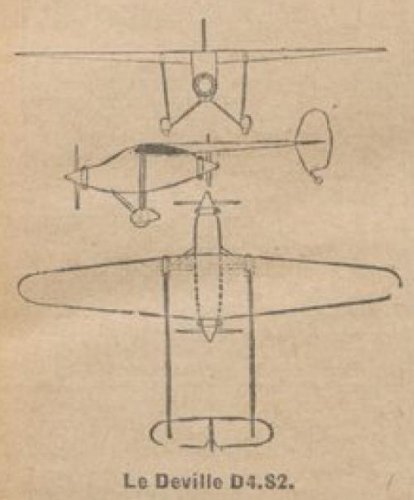
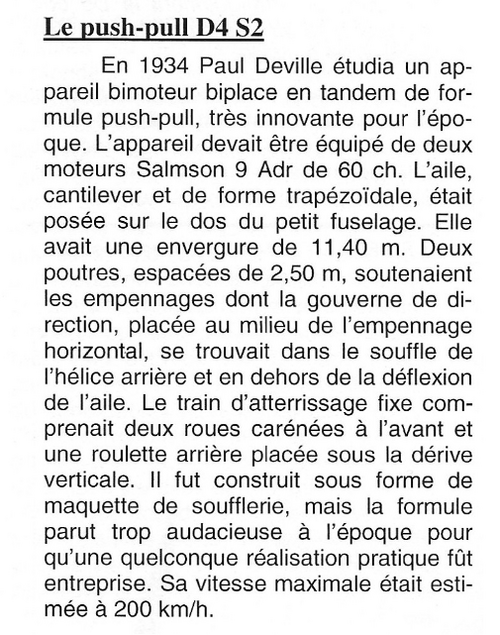
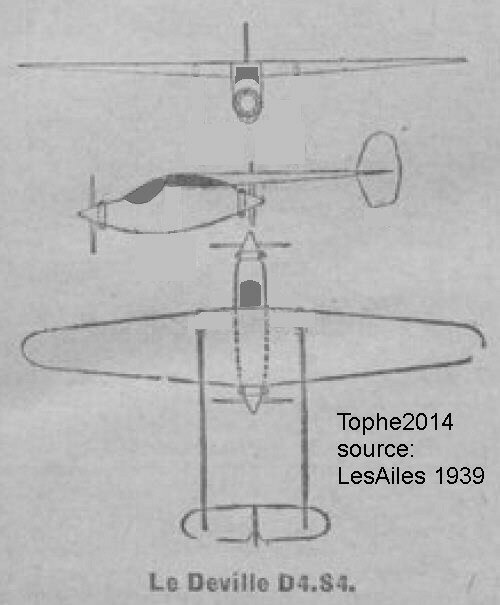
The D4 S2 push-pull

In 1934 Paul Deville studied a two-seater twin-engine aircraft in tandem with a push-pull formula, very innovative for the time. The aircraft was to be equipped with two Salmson 9 Adr 60 hp engines. the wing,cantilever and trapezoidal in shape, was placed on the back of the small fuselage. She had a wingspan of 11.40 m. Two beams, spaced 2.50 m apart, supported the empennages whose rudder, placed in the middle of the horizontal tail, was in the blast of the rear propeller and outside the deflection of the wing.
The fixed landing gear included two cased wheels at the front and a rear wheel placed under the vertical stabilizer. It was built as a wind tunnel model, but the formula seemed too audacious at the time for any practical realization to be undertaken. Its maximum speed was estimated at 200 km/h.
 

Attachments

  • 1.png
    1.png
    279.9 KB · Views: 67
It would be tempting to suggest that this D 55 might relate to the 1950 D 57 Phryganet. The problem is that the 1937 D 56 Lycène was a low-winged trainer project for Aviation populaire. So, why did the D 55 not appear until seven years later? Very odd.
Perhaps not so odd. There were quite a number of projects that were halted in 1939-40 because of the war, then restarted after it. It's not impossible that the whole D.5 sequence was considered at some point in the mid-thirties. Remember that the D.6, for instance, was a 1936 aircraft, but it's D.6.3 "Cri-Cri" development only occurred in 1948. Besides, the name "Phrygane" was not just used in 1949 for the D.21; it was already in use as early as 1933 for the D.1.
 
From my dear Tophe.
Better share the entire article about both the D.4 and D.5 projects.
Please note that it was the D.4 S2, NOT "S4" as the file's title claims.
Also, it's DEVILLE, not "Le Deville". Paul Deville was the man behind all "Salmson" types between 1933 and 1950 (hence the "D." prefix). Originally his company was labeled "Avions-Deville à moteurs Salmson" but eventually everyone called them Salmson since that company no longer produced aircraft. It was part of the Compagnie Française d'Aviation (C.F.A.).

Considering the fact that Deville produced eight different types of aircraft and had at least five identified unbuilt projects, I really believe there should be a separate Paul Deville aircraft (Salmson D. series) topic.
 

Attachments

  • D.4 et D.5.jpg
    D.4 et D.5.jpg
    394.7 KB · Views: 143
By the way,

Mr. Paul Deville had studied many military Projects from 1935 to 1937,but no
more details are known,and I suggest one of them at least was from D4 S2,a
twin boom airplane project ?.

By the way,two types of Salmson Cri-Cri were entered military service,but
still nothing to Paul Deville projects up to now,and of course they were
not related to Cri-Cri.
 
By the way,two types of Salmson Cri-Cri were entered military service,but
still nothing to Paul Deville projects up to now,and of course they were
not related to Cri-Cri.

From my own database, here are all the Deville Salmson types that I know:

1760109425327.png
To: Tourism – X: Experimental – Rc: Racer – Tr: Trainer – e/o: enclosed/open – t/pp: tractor/push-pull
 

Similar threads

Back
Top Bottom