Italian battlecruiser projects of the 1930s

Torsionbar

ACCESS: Restricted
Joined
9 January 2022
Messages
28
Reaction score
68
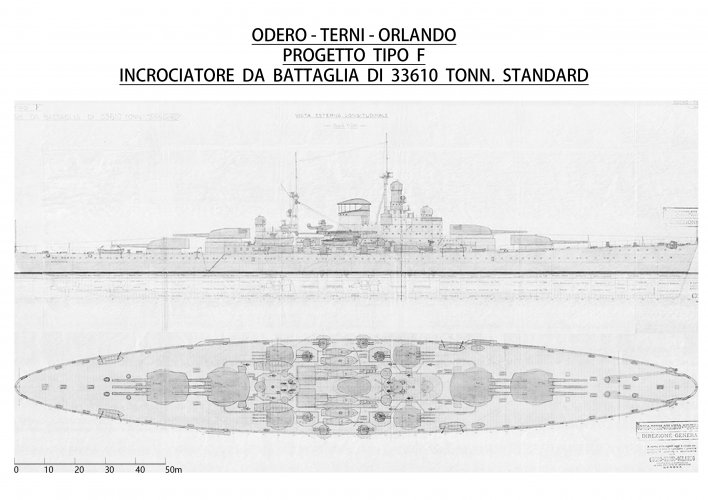
Michel Cosentino showcased some previously unseen OTO battlecruiser designs in Warship 2025 , and he also published a new article on the same topic in STORIA MILITARE, issue 394 (July 2026). Has anyone read this new article? Did Cosentino supplement his Warship article, for example, regarding Ansaldo?

OTO F.jpg 26500t 1933 - 1m=15px.jpg QQ20260730-102742.png
 
Last edited:
Beautiful ships! I take it, the first project is also from early 1930s? What kind of guns they were supposed to be armed with?

It is a development of an OTO battlecruiser project, dated to February 1933. It is probably a development of a smaller - 27,200 tons standard - battlecruiser design from from November 1932. As an aside - it is interesting to note that OTO is the only entity that actually developed any designs explicitly as 'battlecruisers' in Italy in the interwar period, with all other designs developed by the RM or MARICOMINAV being battleships, even if small ones.

The main gun is a 343mm/53 - though it is hard to say more about the gun than that. The 343mm caliber was popular with many of the Italian 'intermediate' battleship concepts of the early 1930s, when they were exploring smaller capital ships as contingences for any of the international treaty negotiations that might have barred the favored 35,000-ton type (such as the British proposal to limit battleships to 25,000 tons, or the negotiations to the French for a potential cap of 26,500 tons).

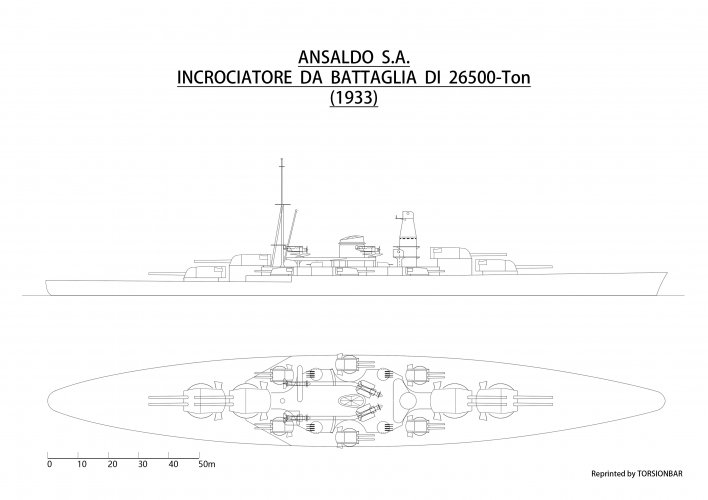
In particular, it was a feature of several of the battleship concepts that were put forward as a potential purpose-built response to the French construction of Dunkerque, until the definitive decision to rebuild the Conte di Cavour-class battleships (in November 1932). Though the gun caliber chosen for the RM's in-house battleship design (29,500 tons standard) is not known, both private industry offerings - the Design 770 battleship and the 26,500 ton battleship (not battlecruiser), also shown in the OP's post - were armed with a 343mm gun. Design 770 came from Ansaldo, unfortunately it is not clear where the 26,500-ton design came from - but it would have to be either OTO or CRDA.

Given OTO was developing its own battlecruiser project (the aforementioned Type F) in this period, I would tend to assume the 26,500-ton battleship would have been CRDA's effort? It's not impossible that it is an OTO design either, however, and it seems OTO was developing multiple designs in this period - there is for example another project of theirs, also explicitly called a battlecruiser (26,670 tons, 3xIII 381mm guns), that survives as a model at the Naval Technical Museum of La Spezia. It is another design that, according to the placard, was developed between 1930 and 1935 in relation to ongoing efforts to rebuild the Cavour-class or the construction of new battleships.

Regardless, neither the Type F / Design 134/1 or it's 27,200-ton predecessor were offered as an alternative in the November 1932 discussions for the Dunkerque counter, and nor was the 26,670 ton design.

 
I produce a model of the OTO battlecruiser in 1/1200 scale.

ptd-oto-italian-battlecruiser-1929.jpg
 
It is a development of an OTO battlecruiser project, dated to February 1933. It is probably a development of a smaller - 27,200 tons standard - battlecruiser design from from November 1932. As an aside - it is interesting to note that OTO is the only entity that actually developed any designs explicitly as 'battlecruisers' in Italy in the interwar period, with all other designs developed by the RM or MARICOMINAV being battleships, even if small ones.

The main gun is a 343mm/53 - though it is hard to say more about the gun than that. The 343mm caliber was popular with many of the Italian 'intermediate' battleship concepts of the early 1930s, when they were exploring smaller capital ships as contingences for any of the international treaty negotiations that might have barred the favored 35,000-ton type (such as the British proposal to limit battleships to 25,000 tons, or the negotiations to the French for a potential cap of 26,500 tons).

In particular, it was a feature of several of the battleship concepts that were put forward as a potential purpose-built response to the French construction of Dunkerque, until the definitive decision to rebuild the Conte di Cavour-class battleships (in November 1932). Though the gun caliber chosen for the RM's in-house battleship design (29,500 tons standard) is not known, both private industry offerings - the Design 770 battleship and the 26,500 ton battleship (not battlecruiser), also shown in the OP's post - were armed with a 343mm gun. Design 770 came from Ansaldo, unfortunately it is not clear where the 26,500-ton design came from - but it would have to be either OTO or CRDA.

Given OTO was developing its own battlecruiser project (the aforementioned Type F) in this period, I would tend to assume the 26,500-ton battleship would have been CRDA's effort? It's not impossible that it is an OTO design either, however, and it seems OTO was developing multiple designs in this period - there is for example another project of theirs, also explicitly called a battlecruiser (26,670 tons, 3xIII 381mm guns), that survives as a model at the Naval Technical Museum of La Spezia. It is another design that, according to the placard, was developed between 1930 and 1935 in relation to ongoing efforts to rebuild the Cavour-class or the construction of new battleships.

Regardless, neither the Type F / Design 134/1 or it's 27,200-ton predecessor were offered as an alternative in the November 1932 discussions for the Dunkerque counter, and nor was the 26,670 ton design.
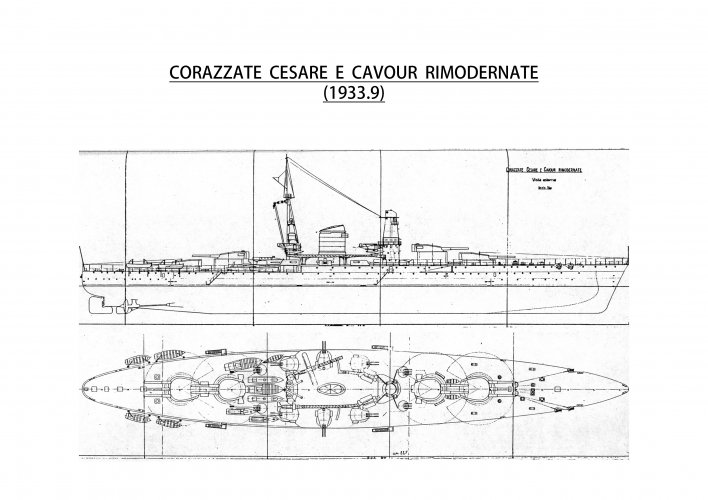
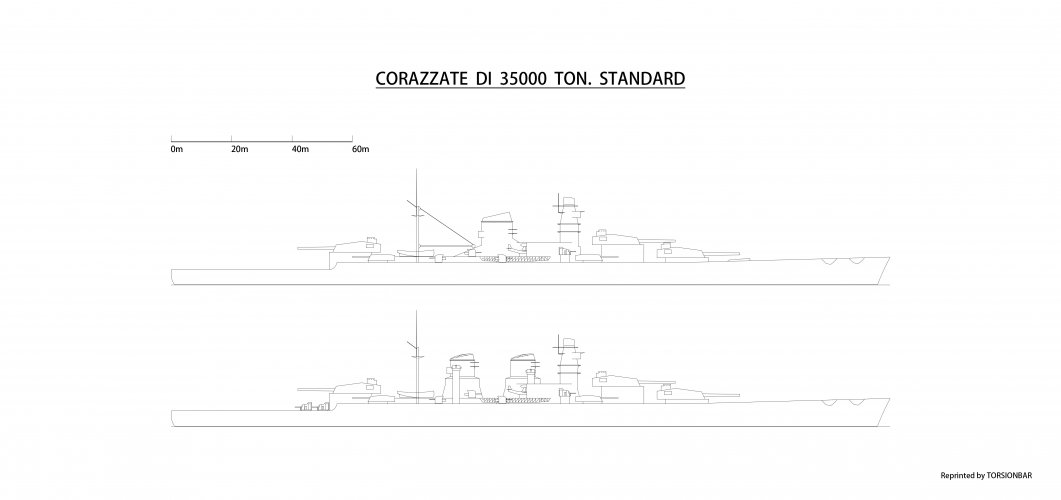
Regarding the 26500t design, Garzke and Dulin used the term "battlecruiser," which I believe is not a typo. Its iconic Pugliese tower and other features are consistent with the original design of Cavour Rimodernate and Littorio.Clearly, their design style differs from OTO's. CORAZZATE  CESARE  E  CAVOUR  RIMODERNATE.jpg 利托里奥原案.jpg
 
Beautiful ships! I take it, the first project is also from early 1930s? What kind of guns they were supposed to be armed with?
Yes, they belong to the same period, and it was the emergence of the OTO project that convinced me Garzke that his choice of terminology was correct. On the other hand, RM officially used the term *Navi da Battaglia* in 1931 ( reverted to *Corazzate* in the late 1930s), which may have prompted these designs to use *Incrociatore da Battaglia*.
 
Regarding the 26500t design, Garzke and Dulin used the term "battlecruiser," which I believe is not a typo.

I'm aware of how Garzke and Dulin term the ships - I also don't believe that is a typo, but rather that it is an assumption on their part, or a desire to fit the ships within their own conception of classification. Garzke and Dulin also consistently refer to the Dunkerque-class as battlecruisers in their work, and that is also flatly incorrect. They were trying to apply their own lenses of ship classification onto these navies, when this simply did not reflect how these navies saw or discussed these ships. You often see this with Anglo-American authors when they approach smaller treaty battleships of the interwar era (another example would be the Scharnhorst-class), preferring to call them 'battlecruisers' simply because they are not built to the maximum treaty limits set by the WNT. This is simply not correct, however, and in some cases these ships featured armor as heavy or heavier than ships of a greater displacement. They were simply smaller fast battleships.

The Regia Marina itself fundamentally had vanishingly little interest in battlecruisers, as they were generally fairly redundant to most Italian battleship designs (which with few exceptions had always aimed to strike the balance of a fast battleship since the ironclad era).

It also must be noted that Garzke and Dulin were limited by the sources available to them at the time of their writing (1980s), and while I greatly respect their work, their understanding of Italian battleship development in the interwar period was limited. Their entire chapter on designs leading up to the Littorio-class is, accordingly, not especially reliable as a narrative. They spend much time looking at smaller battleship designs and tracing a line from them up to Littorio, which is unfortunately incorrect. Most of these were separate projects entirely, to explore smaller alternatives if international agreements prevented them from pursuing their desired 35,000-ton design. The Littorio-class are very much direct developments of the original 35,000-ton concept of 1928, with preliminary design work starting in 1932.

Its iconic Pugliese tower and other features are consistent with the original design of Cavour Rimodernate and Littorio.Clearly, their design style differs from OTO's.

Both OTO's and Ansaldo's, for that matter. It makes sense in both cases as either firm was likely leaning into the previously preferred superstructure arrangement that was being used on the recent Italian large light cruisers (subsequently heavy cruisers) of the time (OTO for the Zara-class and Ansaldo for Bolzano) for whom they had lead detailed design. CRDA did not have that legacy, so it makes more sense that they would look to embrace the new conning tower design (which the RM was aiming to make standard for all armored ships).
 

Similar threads

Back
Top Bottom