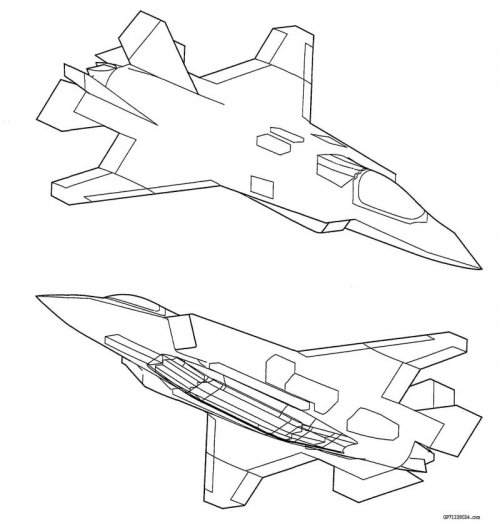
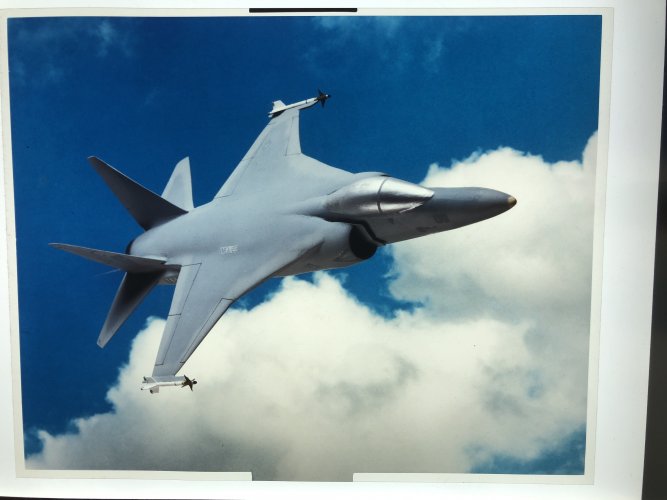
Harrier 21 what-ifs

zen

ACCESS: Above Top Secret
Top Contributor
Senior Member
Joined
15 July 2007
Messages
5,731
Reaction score
6,312
So assuming a go ahead in the early 90's this would draw RAF, FAA and USMC away from the process that led to the JSF.
We can envision Spain and Italy also joining the program.

The merit in this is a more direct successor to Harrier and one that retains a greater affordability. Albeit less Lo optimised. The long-term potential is a more rugged machine of more 'modern' rates of availability than the JSF.

This leaves USAF and USN to pursue something less compromised.

Ironically I suspect this next generation STOVL machine might have seen wider use such as in Lybia and Syria.
 
I was also wondering if going ahead with the Harrier 21 would have threatened the need for the Eurofighter Typhoon?

If Typhoon was binned in favour of Harrier 21 it could have allowed for the RAF to get the FOAS Tornado replacement they really wanted.
 
RAF needed to replace the Jaguar, Harrier, and Tornado F3 (assuming IDS soldiers on until FOAS). If you can fit Harrier 21 with Blue Vixen and AIM-120, and achieve a reasonable level of maneuverability and range, then I don't see an issue in principle.
 
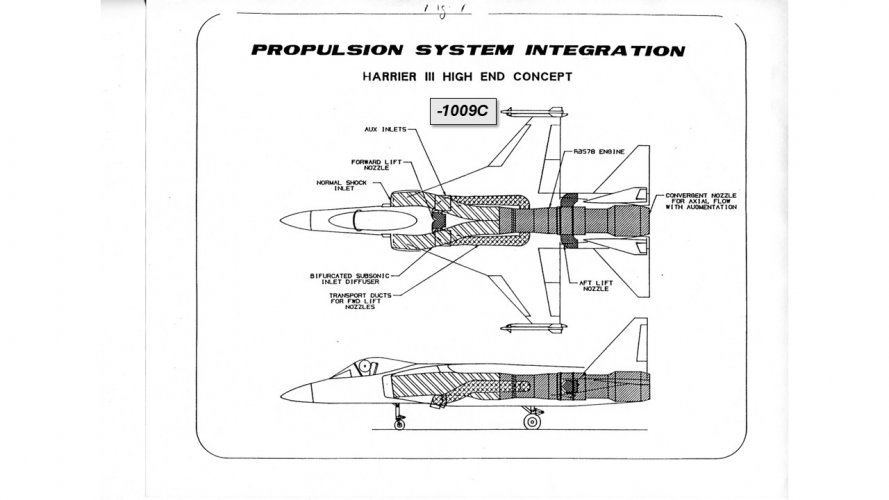
If the engine is essentially a big core version of the EJ200 with a Pegasus style fan section, then it's relevance to FOAS is greater than the Eurojet as we know it.

Certainly as with the P.1216, had the UK gone ahead with Harrier 21, we're likely looking at it eating up Jaguar roles, killing Eurofighter and leaving the next big thing as a general Tornado successor.

We're also likely looking at India getting onboard, as both Sea Harrier and Jaguar successor.
 
If the Harrier 21 got the VAAC Harrier control laws like the JSF did then training would have been easier and safer for the basic handling take off and landing requirements.

I also wonder if the USN would have got the Harrier 21 to replace the early F/A-18 Hornets . It could have allowed them to concentrate on a more capable A-6 Intruder and F-14 Tomcat replacement rather than the F/A-18E/F/G Super Hornet!

The Blue Angels could have added a bow into their routine :D

Might have freed up funding for the Common Support Aircraft too.
 
Last edited:
I think what we'd see a Joint Force Harrier of about 10 squadrons (including to OCU, split 8 RAF (ex-Harrier II, ex-Jag), 2 FAA) by 2005 (caveat, maybe up to 12 squadrons if there is a third CVF authorised).
The UK Harrier 21s would likely be swing-role but ground optimised (I'm thinking Jaguar with better self-defence capability and radar, full-suite of guided air-ground ordnance) but with AMRAAM capability the FAA would still have a modern interceptor.
Exports wise it would probably be a dead-end realistically beyond a handful for the Spanish and Italian navies, perhaps a couple of other navies like Australia. And if McD still exists in this AH, then any exports are likely to boost St Louis coffers and not Warton.

That would leave the Tornado F.3 fleet for air defence - fully CSP'd.
The question would then be how best to proceed with FOAS to replace Tornado in the early 2010s - i.e. whether to have a strike platform or whether to combine both roles into a common airframe. As I pointed out in here the cost would be anything up to £15 billion or more.
But such a project without the Typhoon experience to lean on would be expensive, without EJ200 you need to factor in a new engine too. The UK would need international partners which might be hard to find by the time FOAS is authorised (circa 1999) - although Germany and Italy would probably be keen to replace their Tornado IDS fleets. Treasury/MOD wags likely to look at F-22 or Rafale as off-the-shelf options.

If money is tight as historical - then Cameron's axe in 2010 would likely fall on the Tornado fleet rather than the Harrier fleet given the latter would be far more embedded into Middle East operations, while still offering a credible air defence option but at the expense of long-range strike.
My only concerns would be that Harrier 21 as a VSTOL aircraft will likely be less-optimal performance wise than Typhoon and by today's standards Harrier 21 would be looking obsolete even if the avionics remain upgraded. Likely by 2020 there would be another USMC drive to replace their Harriers and perhaps the UK would tag along again for 'Harrier 31' given FOAS ate/eating most of the budget for the 2010s and 2020s.
 
I'm trying to get a total understanding of the PCB system.....

Outside the obvious thrust augmentation for supersonic flight, I never totally understood if it was meant to be used for vertical flight, where there are definitely a whole host of issues (Hot gas ingestion, ground destruction). Also, were the hot nozzles in a 4-poster meant to be equipped with PCB, or just the cold?

From a practical standpoint, seems like PCB could be great for STO where the take off surface won't get the full 90 degree brunt of hot thrust, but basically unusable for true VTOL operation. Brings to mind if any kind of practical outside air entrainment system could be built into the hot nozzles to cool the thrust down.
 
Last edited:
By the early 90s then UK has already let the main contract for Eurofighter development and production so it's difficult to see where the money comes from. Industrially then UK is also committed to Eurofighter at this point, e.g. on the airframe side then everything has consolidated to Warton.

Maybe cancelling Eurofighter production frees up enough money to buy some Harrier 21s, but the UK will very much be a minor partner to USMC / MDD. Maybe get a local assembly line at Warton? But the design and development skills are gone.

I wonder how long it would have taken to bring Harrier 21 into service? Very much in the peace dividend era and later start than F-22, Eurofighter etc. Maybe best case is initially in service mid 2000s? At about the same time as an alt-JSF without STOVL

Germany, Italy and Spain end up with F-18Cs instead of Eurofighter?
 
Last edited:
True the real moment of decision is the mid-80's and Harrier 21 came around too late.

So really the concept needs to be devised much earlier.
 
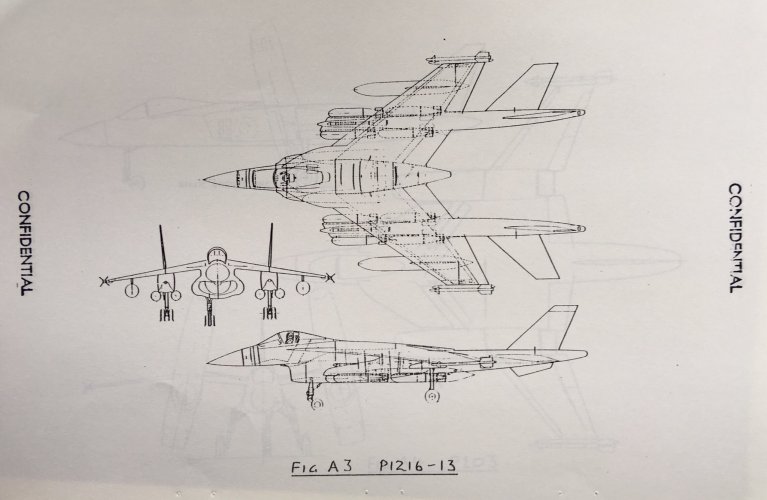
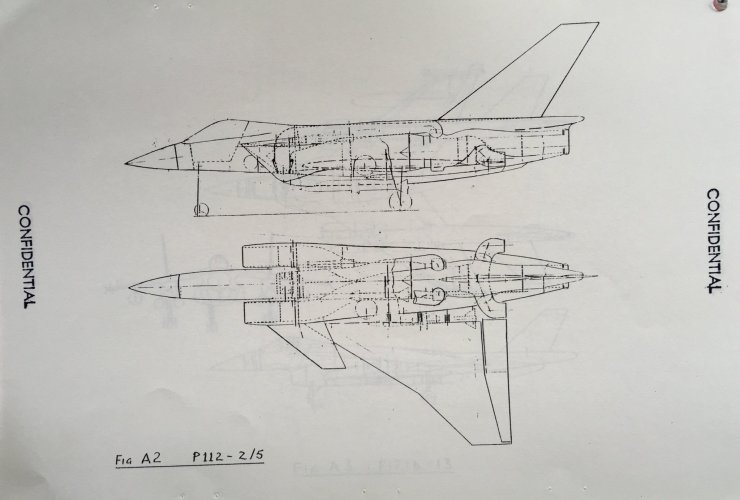
The Sea Harrier replacement Naval Staff Target 6464 was a 1984-1986 study (if I looked it up correctly) which included the PCB engined P1216 and P112 whose engine configuration was on the way to the Harrier 21s.

If the UK MOD got more excited about it and an engine demonstrator was built perhaps something along the lines of the Harrier 21 would have been thought of earlier and threatened the need for Eurofighter.

I think the H21 does win on looking more conventional than the P1216 and P112.
 

Attachments

  • IMG_0351.jpeg
    IMG_0351.jpeg
    244.8 KB · Views: 82
  • IMG_0349.jpeg
    IMG_0349.jpeg
    257.5 KB · Views: 70
  • IMG_0367.jpeg
    IMG_0367.jpeg
    112.4 KB · Views: 86
I think the issue is really on the Industrial side. By the early 80s then BAE were running down all the other units to consolidate towards Warton and Salmesbury. They were heavily invested in Eurofighter going ahead so I just don't see a substitution happening. Which then needs a lot of additional money from somewhere.

There was already P.1216 as a "next gen" STOVL aircraft at this point. I'm not sure how H21 is better than this. If sticking with external weapons, non-LO and more fighter -biased performance then I'd just be sticking with the simpler direct lift approach
 
Yes, realistically H21 wouldn’t have been an alternative to Eurofighter.

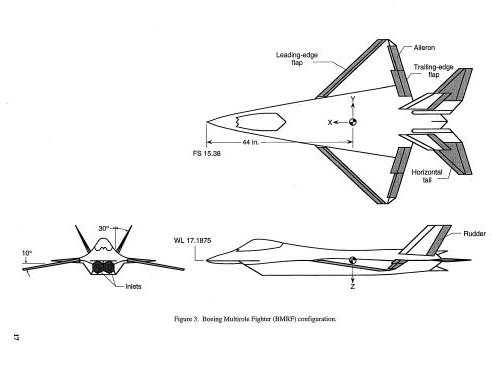
Maybe the engine configuration could have been used on the McDD and Boeing JASF/JSF concepts if the H21 project hadn’t upset management.

A longed out, finer, sleeker F-32 would have been nice :)
 

Attachments

  • Boeing Multi-Role Fighter configuration.jpeg
    Boeing Multi-Role Fighter configuration.jpeg
    33.8 KB · Views: 52
  • IMG_3866.jpeg
    IMG_3866.jpeg
    73.1 KB · Views: 48
Last edited:
Back
Top Bottom