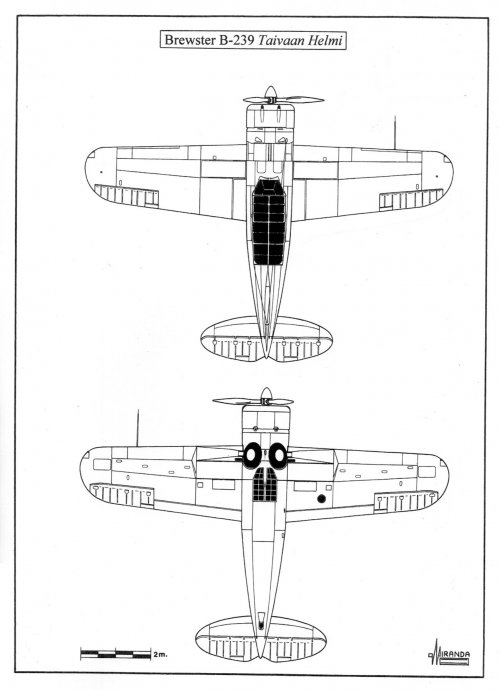
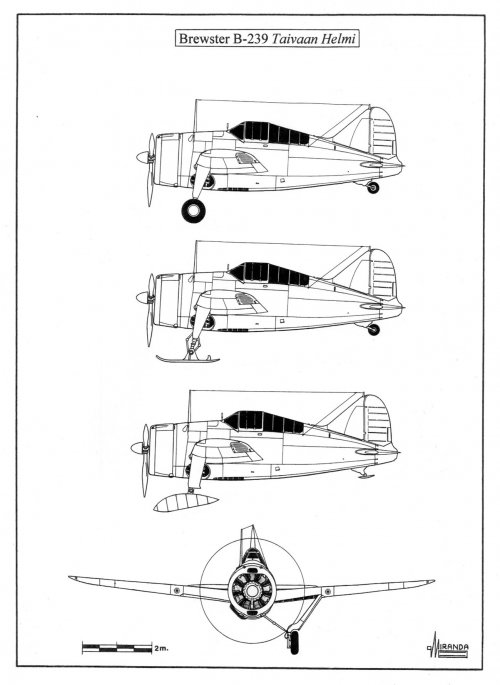
Brewster B-239 Taivaan Helmi
On November 30, 1939, the Soviets attacked the Finland eastern border with 450,000 men (20 divisions), 2,000 tanks, 2,050 cannons and 3,250 aircraft from types Polikarpov I-152, I-153, I-16, R-5, R-Z and U-2, Tupolev SB-2M103 and TB-3, Ilyushin DB-3 M and Beriev MBR-2.
The Finnish Armed Forces had 327,000 men (5 divisions), 20 tanks, 425 cannons, 2 armoured ships and 5 submarines. The Ilmavoimat strength was 135 aircrafts: thirty-six Fokker D.XXI, ten Bristol Bulldog Mk. IVA, seventeen Bristol Blenheim Mk. I, thirty-two Fokker C.X, seven Fokker C.VE, fourteen Blackburn Ripon IIF, four Junkers F.13, three de Havilland Moth, three V.L. Saaski and one V.L. Kotka.
The Finns fought fiercely, causing so many losses to the Soviets that they were forced to sign an armistice on March 13, 1940. The international community condemned the aggression by expelling the Soviet Union from the League of Nations on December 14, 1939, and offering military aid to Finland.
The Ilmavoimat received two-hundred-and-ten new planes: thirty Gloster Gladiator Mk. II, twenty-two Bristol Blenheim Mk. IV, thirty Morane-Saulnier M.S.406, thirty-two Fiat G.50, forty-four Brewster B-239, twenty-five Gloster Gauntlet Mk. II, ten Hawker Hurricane Mk. I, one Douglas DC-2, twelve Westland Lysander Mk. I, three Fokker C.V and one Fokker F. VII a. Many of these models were technologically superior to the Soviets, as were the tactics used by the Finnish pilots, as proved in combat.
On December 16, 1939, forty-four export machines B-239 (c/ns 18 to 62) were sold to Finland. The type 239 was a de-navalized version of the F2A-1 without arrester hook, catapult bridle hook, life raft container and telescopic gunsight. The tailwheel was modified, and armour plates were installed in the head rest and seat back.
These airplanes were shipped to Stavanger-Norway, assembled by SAAB at Trollhättan-Sweden facilities and ferried to Finland-Bromma between March and May 1940.
The Aldiss gunsight was replaced in route by a simplified bead and ring device; in 1941 it was replaced by one Väisäla T.h.m. 40 homemade gunsight and in 1942 it was replaced by one German reflector gunsight Revi 3/c taken from Messerschmitts Bf 109s.
The engine was also replaced by the civil version R-1820-G5 with Hamilton Standard propellers taken from DC-3 airliners.
In December 1939 the Finnish fighters shot down 60 Soviet airplanes and the Ilmavoimat lost 14. In January 1940, the Soviets lost 53 aircraft in air-combat against 10 Finnish loses. In February, the Soviets changed their aerial tactics, using formations of up to 350 bombers and fighter escorts, to air support the land forces and bomb the population centres.
During the Winter War, these fighters carried out 2,000 sorties and 300 aerial combats, shooting down 71 Soviet aircrafts.
Out of the forty-four Brewsters, six arrived in Finland before the Winter War ended.
During the Continuation War these fighters shot down 75 Polikarpov I-153, 66 Polikarpov I-16, 59 Hawker Hurricane Mk. I, 51 MiG-1/3, 46 LaGG-3, 39 Yak-1/7/9, 32 La-5, 28 Tupolev SB 2M 103 medium bombers, 25 Peltyakov Pe-2, 15 Supermarine Spitfire Mk. V, 13 Ilyushin DB-3, 9 Polikarpov R-5, 9 Polikarpov I-152, 7 Curtiss Tomahawk, 5 Ilyushin Il-4, 4 MBR-2, 3 Arado Ar-2, 3 Junkers Ju 87, 2 Bell P-39 Airacobra, 1 Heinkel He 111, 1 Junkers Ju 88 and one Li-2 cargo (DC-3 soviet version).
Fifteen Brewsters were lost in aerial combat, three by ground fire, two in bombing raids and four in accidents. Kill ratio: 67.5 to 1.
The B-239 did a full circle in 14 seconds, flying at 1,000 meters altitude, the Polikarpov I-16 Type 24 only do it in 16-17 seconds and the biplane Polikarpov I-153 in 13.3 seconds.
The type was used by the fighter squadrons LeLv 22, LeLv 24, LeLv 26 and LeLv 31.
Paint scheme between March 1940 and June 1941: Natural metal overall with Finnish blue swastikas (adopted in 1918) in six positions, black serials in fuselage sides and wing undersurfaces.
In 1941, these planes were camouflaged with ex-Luftwaffe German paints: RLM 70 Schwarzgrün (Black-Green FS 34050)/RLM 71 Dunkelgrün (Dark Green FS 34079) upper surfaces sometimes over sprayed with Wintertarnung washable winter camouflage Whitewash paint, RLM 65 Hellblau (Bright Blue FS 35414) under surfaces, RLM 04 Gelb (Yellow FS 23538) engine cowling, fuselage identification band and ventral wingtips, Finnish swastikas in six positions, Black/Green serials (BW-351 to BW-394).
Six aircraft were equipped with captured Russian M-63 engines and several fighters from LeLv 24 based at Tiiksjärvi were fitted with skis for winter operation.
Brewster B-239 technical data
Wingspan: 10.67 m, length: 8.3 m, height: 3.66 m, wing area: 19.41 sq. m, max weight: 2,415 kg, max speed. 480 km/h, climb rate: 930 m/min, service ceiling: 9,800 m, range: 1,700 km, power plant: one Wright R-1820-G5 air cooled radial engine rated at 950 hp, armament: two wing mounted 0.5-in Colt-Browning MG 53 machine guns with 400 rpg, and two engine mounted 0.5-in Colt-Browning MG 53 machine guns with 200 rpg.
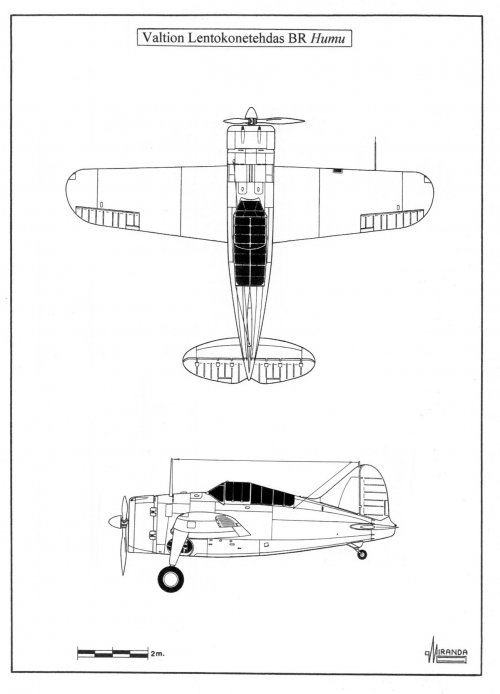
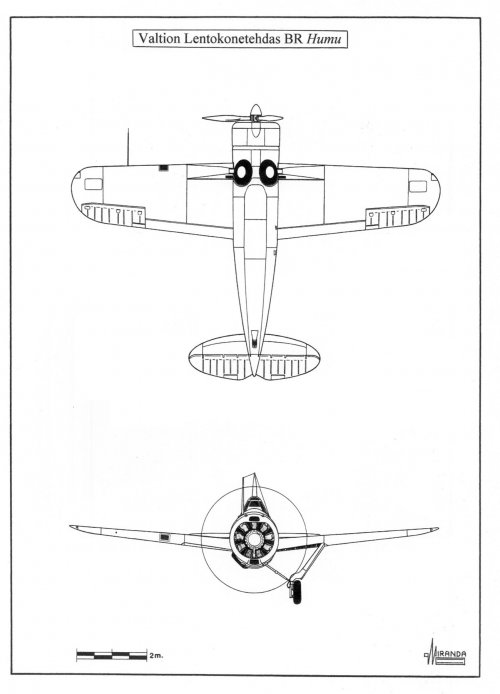
Valtion Lentokonetehdas BR Humu
On June 8, 1939, the Finnish Ministry of Defence instructed State Aircraft Factory Valtion Lentokonetehdas to design a new single-seat fighter powered by a Bristol Taurus III engine.
V.L. just didn't have experience with high-speed aircraft, there wasn't any dialuminium production in Finland and nobody would sell aluminium in 1939. The Taurus engine was not available due to war and a 1,065 hp (with 87 octane fuel) Swedish-built civilian version of the Pratt & Whitney R-1830 was chosen. V.L. then decided to use the same construction system of the Fokker D.XXI. The wings and tail surfaces were made of wood/plywood, and the fuselage structure was welded chrome-molybdenum steel tube with fabric and plywood coating.
The prototype was flown on December 23, 1941, manifesting serious yaw to port, excessive wing loading and engine problems. On May 30, 1942, the Department of War Supplies had placed an order for three pre-production aircraft called Myrsky I.
Built between April and June 1943, the three planes suffered accidents and two of them were destroyed, during diving tests, for fractures of the wing attachment bolts and plywood skinning under stress, due to defective bonding.
The investigation board confirmed that flutter had caused the wings to break up and recommended that they be strengthened.
The construction of the Myrsky II complicated when the availability of the German Tego-film glue ended, after the destruction of its manufacturing plant in 1943. It was replaced by bad Finnish glues based on casein.
Maximum permissible diving speed was raised to 650 km/h and maximum engine revolutions were restricted to 3,060 rpm. The armament consisted of four engine- mounted 12.7 mm VKT LKk/42 machine guns.
After the entry of United States into war against Germany, the supply of spare parts for fighters and engines were cut.
At the end of 1942, the V.L. tried to negotiate a full reparation license for the Messerschmitt Bf 109 G-2, but complete sets of drawings and tools were never delivered.
The Ilmavoimat had been particularly concerned with the debut in some numbers of the Lavockin La-5 Soviet fighter and the possibility of the Germans to suspend the supply of fighters.
The panic fighter program Humu began in October 1942, when V.L. was instructed to design a homemade copy of the Brewster 239 fighter, adapted to make use of locally available materials and captured equipment that should be built in wood/plywood/steel with the same technique used in the Myrsky.
Because of shortage of aluminium alloys, the single-spar wing should be built in wood/plywood, with metal-framed, fabric-covered ailerons, electrically operated metallic flaps and landing light mounted in the port wing leading edge.
It was expected to build a series of 55 aircraft, without armour, using instrument and M-63 engines from captured Polikarpov I-16 Type 24 Soviet airplanes, three blades variable pitch propellers VLS.8003/W.22 with wooden blades captured from several Tupolev SB-2 bombers, fuselage fuel tanks and without ventral window, local manufacture Sperry artificial horizon, Hollsman compass, Vaisala reflector gunsight and three fuselage mounted 12.7-mm LKk/42 heavy machine guns (Colt-Browning M2).
The fantastic agility of the Nakajima Ki.27b Japanese fighters had been a surprise for the Brewster pilots in 1941 because its ‘climb and turning’ ability made it difficult to shot down. After studying one of these fighters captured by the RAF, the Allies could devise more effective tactics of combat.
The Humu design, without armour, should adapt to the new fighter tactics of the Ilmavoimat, which was considered outdated the dog fight, preferring the ‘zoom and climb’ to either repeat the attack, or break off the contact with an advantage in speed and climb.
On August 8, 1944, the prototype HM-671 was flown, powered by a 930/1,000 hp Shvetsov M-63, reaching the 420 km/h. At this time the Finns lacked an instruction manual for the Soviet engine and could not adjust it to get the maximum power.
A surplus Brewster fuselage had been used for its construction, but the HM-671 turned out to be too heavy (2,895 kg) manifesting problems of longitudinal stability, because the transfer of fuel tanks and guns from the wing to the fuselage, and the initiation of series production was delayed pending results of flying tests. The proposed armament were three 12.7 mm LKk / 42 machine guns.
The project was cancelled in the summer of 1944 in favour of the V.L. Pyörremyrsky.
Prototype paint scheme: RLM 70 Schwarzgrün (Black-Green FS 34050)/RLM 71 Dunkelgrün (Dark Green FS 34079) upper surfaces, RLM 65 Hellblau (Bright Blue FS 35414) under surfaces, RLM 04 Gelb (Yellow FS 23538) engine cowling, fuselage identification band and ventral wingtips, Finnish swastikas in six positions, Black/Green serial.
VL Humu technical data
Wingspan: 10.67 m, length: 8.3 m, height: 3.66 m, wing area: 19.41 sq. m, max weight: 2,563 kg, max speed. 430 km/h, service ceiling: 8,000 m, rate of climb: 10.16 m/s, range: 980 km, power plant: one Shvetsov M-63 (Wright Cyclone G.5 R-1820) nine-cylinder, single row, air cooled, radial engine rated at 1,000 hp, armament: three engine mounted 12.7-mm LKk / 42 machine guns.