73 years ago: Proposal for the construction of a large commercial aircraft
Escher-Wyss ‘Turboliner’
Article by Roland Eichenberger.
Towards the end of the Second World War, the research departments of Brown Boveri (Baden), Sulzer (Winterthur) and Escher-Wyss (Zurich) in Switzerland were working on the development of gas turbines (jet engines) for aircraft construction. All three companies had already gained extensive experience in this field thanks to the construction of industrial turbines. In addition to its engine projects, Escher-Wyss also proposed the construction of a commercial aircraft with propeller turbine propulsion. The company believed that engine and aircraft development belonged together. However, due to poor prospects for development loans, further work on the project was abandoned.
Engine development. Since Switzerland had missed the boat on building powerful aircraft engines during the Second World War, Escher-Wyss believed that Switzerland, as a leading country in the turbine industry, should at least explore the possibility of participating in the further development of aircraft turbines.
Escher-Wyss saw two paths: A) The development of turbo engines (jet engines for fast military aircraft) and B) The development of turbine engines (propeller turbines for powering large commercial aircraft).
Jet engines for commercial aircraft were not considered urgent at the time. According to Escher-Wyss, it would also have been a unique opportunity to allow the Swiss aircraft industry to participate in the further development of the new era, as it was already faced with the task of finding new employment opportunities since military orders were no longer expected on a large scale.
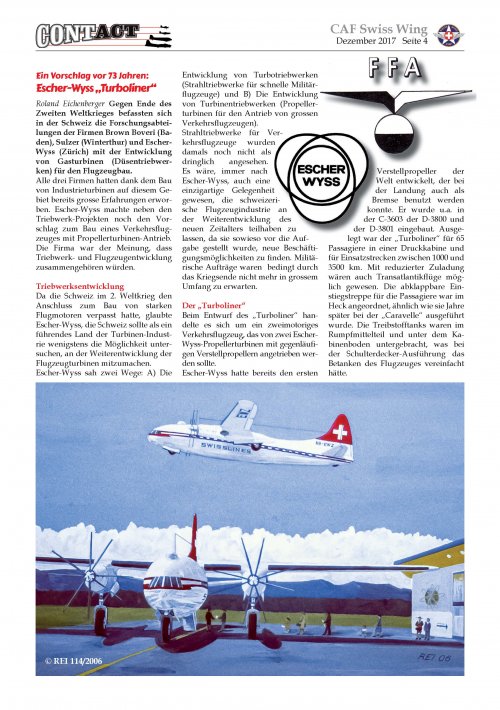
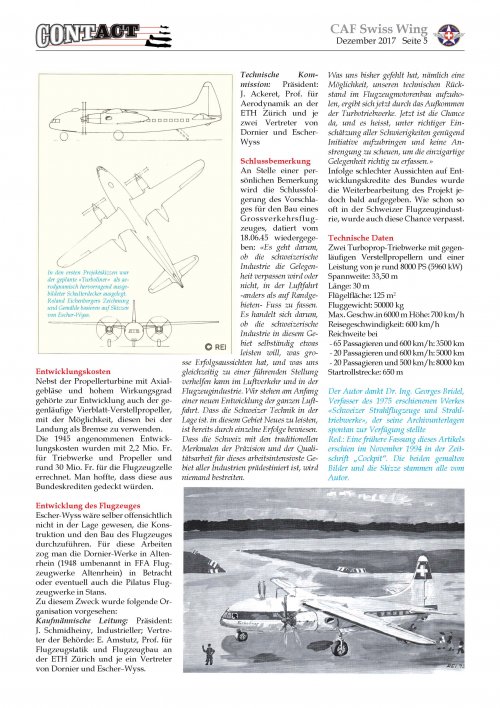
‘Turboliner’ This design was for a twin-engine commercial aircraft powered by two Escher-Wyss propeller turbines with counter-rotating variable-pitch propellers: Escher-Wyss developed the world's first variable-pitch propeller that could also be used as a brake during landing. It was installed in the C-3603, D-3800 and D-3801, among others. The Turboliner was designed for 65 passengers in a pressurised cabin and for routes between 1,000 and 3,500 km. With a reduced payload, transatlantic flights were also possible. The folding passenger boarding stairs were located at the rear, similar to the design used years later on the Caravelle. The fuel tanks were located in the centre of the fuselage and under the cabin floor, which made refuelling easier in the shoulder-wing design.
Development costs In addition to the propeller turbine with axial fan and high efficiency, the development also included the counter-rotating four-blade variable-pitch propeller, which could be used as a brake during landing. The costs accepted in 1945 were calculated at CHF 2.2 million for engines and propellers and around CHF 30 million for the airframe. It was hoped that these would be covered by federal loans.
Development of the aircraft Escher-Wyss would not have been in a position to carry out the design and construction of the aircraft itself. The Dornier works in Altenrhein (renamed FFA Flugzeugwerke Altenrhein in 1948) or the Pilatus aircraft works in Stans were considered for this work. The following organisation was planned for this purpose.
Commercial management: President: J. Schmidheiny, industrialist Representative of the authorities: E. Amstutz, Professor of Aircraft Statics and Aircraft Construction at ETH Zurich One representative each from Dornier and Escher-Wyss
Technical Commission: President: J. Ackeret, Professor of Aerodynamics at ETH Zurich Two representatives each from Dornier and Escher-Wyss
Final remark: Instead of a personal comment, the conclusion of the proposal for the construction of a large commercial aircraft, dated 18 June 1945, is reproduced below:
"The question is whether Swiss industry will miss the opportunity to gain a foothold in aviation – unlike in peripheral areas. The question is whether Swiss industry wants to achieve something independently in this field, something that has great prospects of success and that can simultaneously help us to achieve a leading position in air transport and the aircraft industry. We are at the beginning of a new development in aviation as a whole. Individual successes have already proven that Swiss technology is capable of achieving new things in this field. No one will dispute that Switzerland, with its traditional characteristics of precision and quality workmanship, is predestined for this most labour-intensive of all industries. What we have lacked until now, namely an opportunity to catch up in the field of aircraft engine construction, is now emerging with the advent of turbo engines. The opportunity is there, and it is now a matter of taking sufficient initiative, while correctly assessing all the difficulties, and sparing no effort to seize this unique opportunity." Like so many other things, this opportunity was also missed.
I would like to thank Dr Georges Bridel, author of the 1975 publication ‘Schweizer Strahlflugzeuge und Strahltriebwerke’ (Swiss jet aircraft and jet engines), who spontaneously made his archive documents available.
Published in COCKPIT November 1994 / translated to English 2025

 Eight years ago I got the permission of Roland eichenberger to "re-use" his paintings and an article he wrote for "Cockpit" (a Swiss aviation magazine) in 1994. Unfortunately I could not find any further information about this project - but who knows, maybe more documents and drawings are still "sleeping" under a thick layer of dust domewhere in an archive.