Avro WS606A

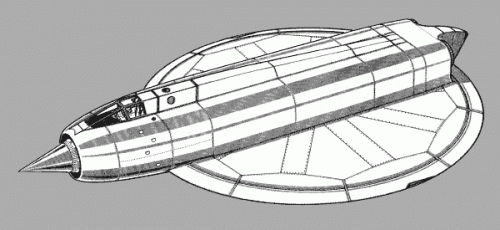
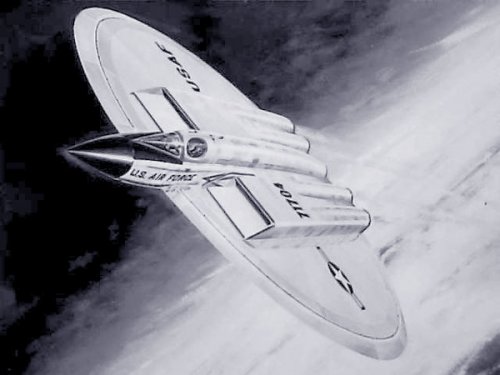
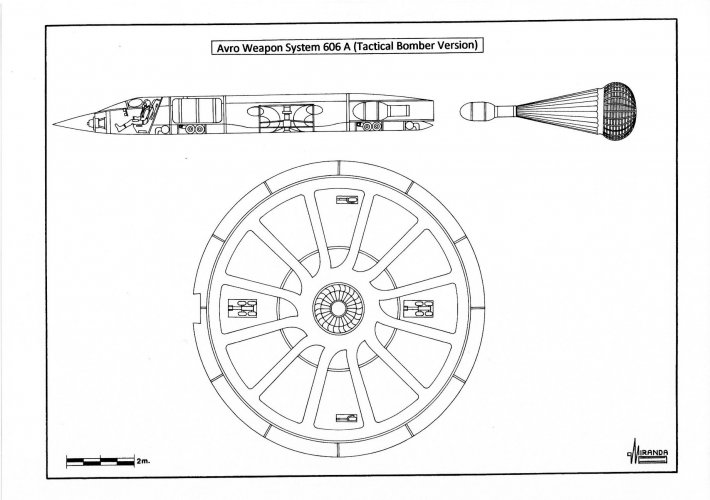
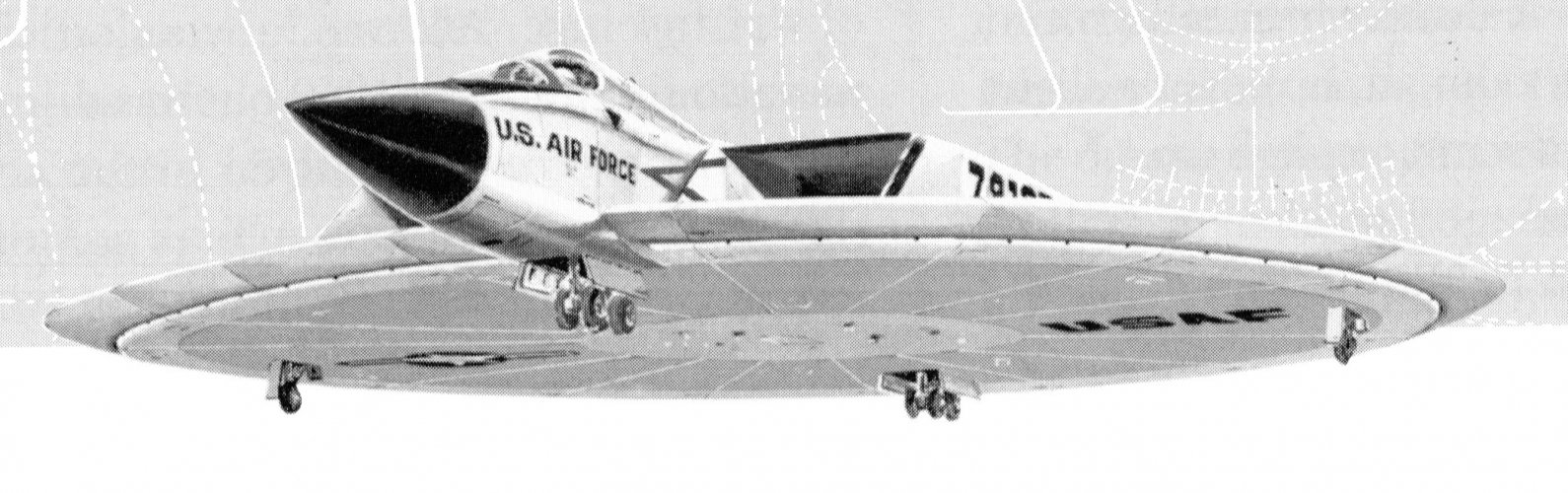
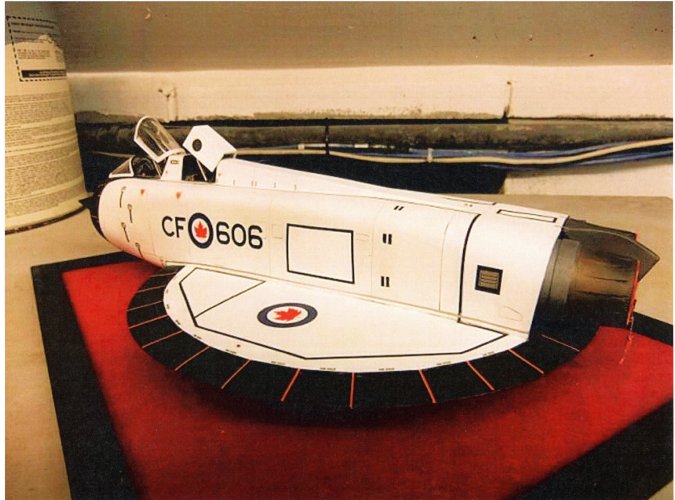
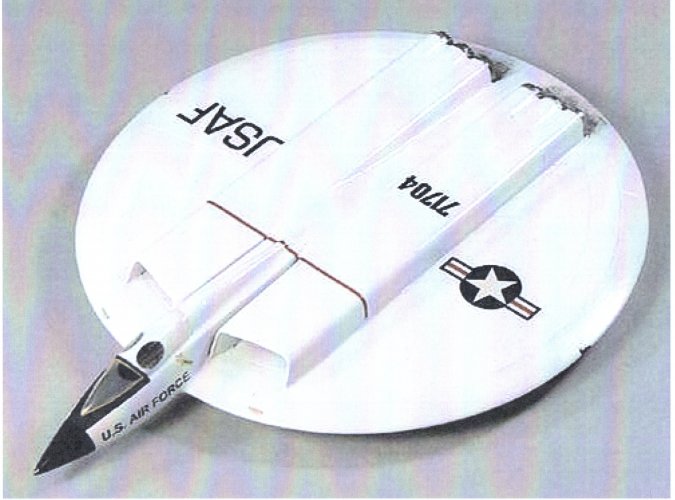
It would appear that, if the program hadn't fallen victim to both budgetary and political shenanigans, the version depicted in the first image would have being the most likely to have been flown, as a proof of concept aircraft.
 
Weapons System 606A came in two versions. The first was designed to convince the Soviets we could not build a circular aircraft. The second version had the words (Supersonic Application) on the document cover sheet. AVRO had an internal designation for the latter, PV.704. PV stood for Private Venture.
 
- On March 27, 1957, USAF extended Project 1794 through October 1958 under the codename Weapons System WS-606A. The new research program was based on the GETOL (Ground Effect Take-off and Landing) concept that promised a fuel consumption rate 35 per cent lower than the VTOL system.

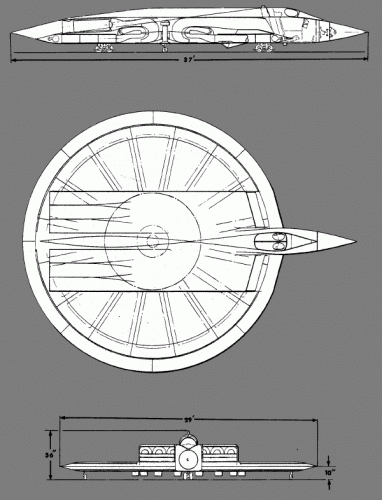
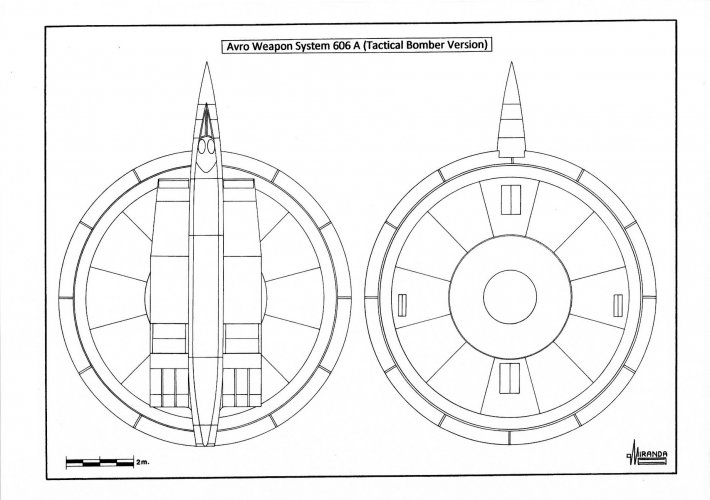
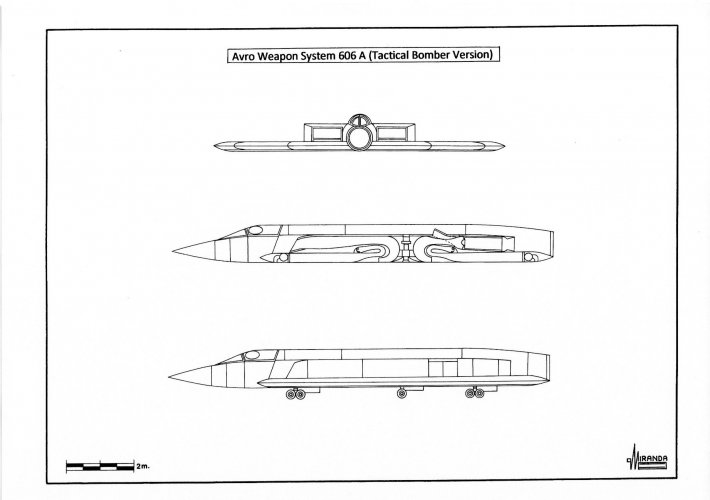
In January 1959 Avro issued Technical Report Nº 276 with preliminary performance calculations of a single seat Mach 3 tactical bomber, with GETOL and VTOL capabilities, known as ‘Configuration A’.

Propulsion was provided by one radial-flow turbine, twelve combustion chambers and six Marquardt ramjet engines. Exhaust from the turbine was ducted radially outwards to the combustion chambers and to the propulsive nozzle system mounted around the wing periphery. Vertical take-off was achieved by diverting the thrust downward and forward flight acceleration was achieved by diverting the flow aft. This was sufficient to reach the ignition velocity of the ramjets, for the supersonic cruise.

The nozzle system was also used for control purposes but the manufacturing difficulties of obtaining accurate flow passages were severe.

One reconnaissance version was considered as successor of the Lockheed U-2 spy plane. It was expected that the jet control would be more efficient at high-altitude than the conventional control surfaces, but the Lockheed Blackbird was finally selected.

Configuration A technical data


Airframe: steel, titanium and light alloy, 37 ft (11.28 m) length, 4.7 ft (1.42 m) height, wing: laminar flow with boundary layer control by surface suction, 28.8 ft (8.79 m) of diameter and 653 sq. ft surface, thickness-chord ratio 3.47 per cent, estimated top speed: Mach 2.5 at 80,000 ft and Mach 3.0 at 95,000 ft, estimated climb rate: 354 m/sec, empty weight: 11,100 lb., max weight: 20,000 lb., range with 7,500 lb. fuel: 806 miles (supersonic) and 1,375 miles (subsonic), tactical range with one Mk 28 nuclear bomb: 600 miles, fire control, navigation and communications were based on the General Electric Bantam system.


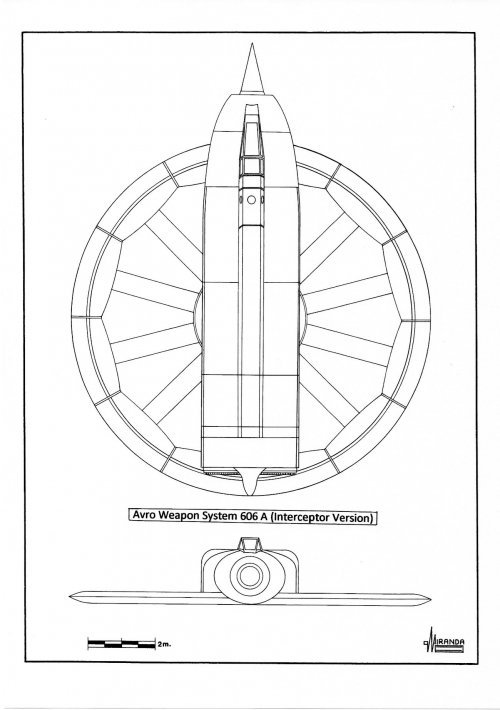
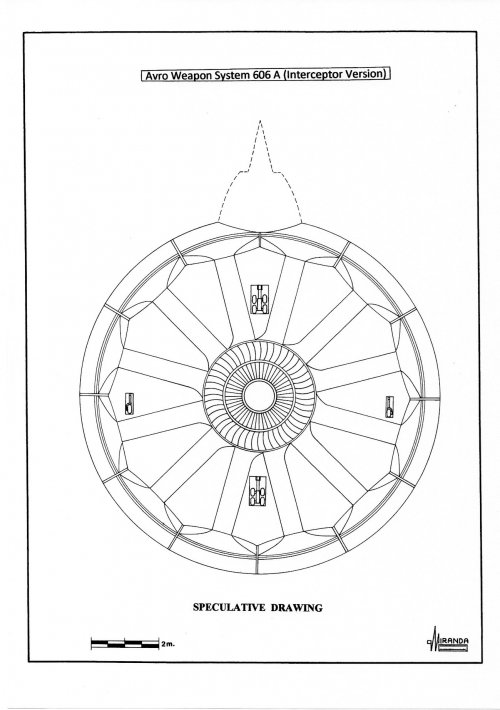
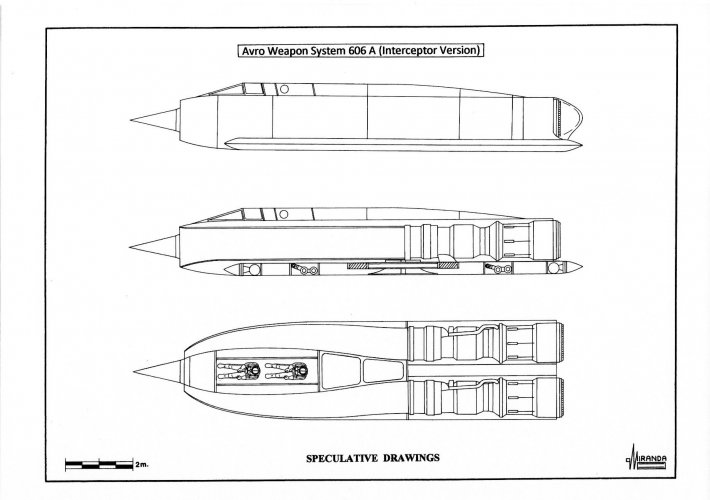
A second two seat design, known as ‘Configuration B’, was a Mach 2 all-weather interceptor powered by two Pratt & Whitney J58 turbojets, with 46,000 lb. combined thrust, and one radial-flow turbine located in the center of circular wing.

Configuration B technical data


Diameter: 35.3 ft (10.74 m), length: 44.7 ft (13.6 m), height: 6.5 ft (1.97 m), wing surface: 978 sq. ft, estimated max speed: Mach 2, estimated ceiling: 65,000 ft, max weight: 65,500 lb. (29,670 kg), combat radius (VTOL): 500 miles (805 km), combat radius (GETOL): 700 miles (1,126 km), proposed armament: two air-to-air missiles.


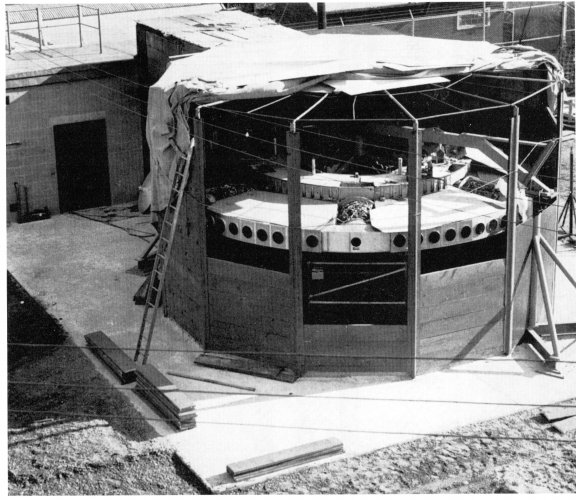
During test-rig trials conducted in October 1956 the turbine blew so hot (1,750º K) it melted the steel structure, and its violent shaking would pop the rivets, causing three fires, hazardous oil leaks and nearly a catastrophic incident occurred with a Viper turbojet running out of control.

Noise and vibrations made the prospects of a manned vehicle frightening. The Lundström compressor produced a dangerous sonic boom at the point that observers were afraid of the machine.

During the flight tests of XF-84F performed in July 1955 the USAF had bad experiences with the sonic waves produced by the supersonic propeller of the prototype. The ground crews were incapacitated getting nauseous and suffering headaches.

The wind tunnel tests suggested that the GETOL configuration had severe stability problems, and the craft was in constant danger of flipping over during take-off. The circular wing displayed none of the theoretical advantages and a lot of practical shortcomings.

The WS-606A configurations were simply too advanced and the technical challenges too great: a dead-end project with insurmountable problems of overheating, ball-bearing over-speed, and gyroscopic effect. By March 1958, USAF recommended that all work on the GETOL concept and their radial-flow turbine should be halted. There is no evidence that anyone has engineered an example of a radial-flow turbo-disc engine.


Canadian Flying Saucers Bibliography

​

‘Canada’s Flying Saucer’, by Bill Zuk, The Boston Mills Press, 2001.

‘Flying Saucers Avro’s Secrets’, by Bill Rose, Air Pictorial, May 2001.

Air Intelligence Digest, December 1954, Volume 7, Nº12.

‘Man-made Flying Saucers’, Royal Air Force Flying Review Nº1, October 1955.

‘The Project Silver Bug Report: ATIC TR-AC-47, 15 February 1955’, by Roger D. Cook, SD Publications, June 2000.

‘The (almost) Flying Saucer’, by Ernest Ball, Air Enthusiast International/June 1974.

‘The Pentagon Flying Saucer Problem’, by Graham Chandler, Air & Space, April/May 2003.

‘Is this real Flying Saucer?’ by Thomas Turner, Look Magazine, Volume 19, June 1955.

‘Flying Saucers are real’, People Today Magazine, September 1952.

‘The Secret Saucer’, Product Engineering, December 15, 1958.

J.C.M. Frost Patents - 3,024,966 (March 13, 1962), 3,020,002 (February 6, 1962), 3,022,963 (February 27, 1962), 3,018,068 (January 23, 1962), 3,062,482 (November 6, 1962), 3,124,323 (March 10, 1964), 3,051,414 (August 28, 1962).

‘Project Omega’ New York Times, September 17, 1953.

Toronto Daily Star, Mach 13, 1953.

Toronto Daily Star, April 21, 1953.

‘Avro Canada’s Omega’, Aeroplane, January 5, 1954.

London Times, April 22, 1953.

London Times, April 23, 1953.

Ali Nº 12, May 17, 1953.

Ali Nuove, June 1953.

‘Canada Builds Flying Saucers’, Fate magazine, October 1953.

‘How the Flying Saucer Works’, by Willy Ley, Mechanix Illustrated, March 1956.

‘Cold War Tech War’ by Randall Whitcomb, Apogee Books, 2008.

‘The UFO Files: The Canadian Connection Exposed’ by Palmiro Campagna, Toronto: Stoddart Publishing, 1998.

‘Saucer Attack (pop culture in the golden age of flying saucers)’, Eric & Leif Nesheim, General Publishing Knc. CA.1997.

https://www.amazon.com/-/es/Justo-M...to+Miranda&s=books&sr=1-42&xpid=NhS2zPgpEEYz8
 

Attachments

  • x.jpg
    x.jpg
    249.3 KB · Views: 61
  • xx.jpg
    xx.jpg
    244.4 KB · Views: 52
  • xxx.jpg
    xxx.jpg
    165.7 KB · Views: 52
  • xxxx.jpg
    xxxx.jpg
    264.1 KB · Views: 54
  • xxxxx.jpg
    xxxxx.jpg
    296.2 KB · Views: 50
  • xxxxxx.jpg
    xxxxxx.jpg
    220.2 KB · Views: 57
  • portada.jpg
    portada.jpg
    2.3 MB · Views: 65
- On March 27, 1957, USAF extended Project 1794 through October 1958 under the codename Weapons System WS-606A. The new research program was based on the GETOL (Ground Effect Take-off and Landing) concept that promised a fuel consumption rate 35 per cent lower than the VTOL system.

In January 1959 Avro issued Technical Report Nº 276 with preliminary performance calculations of a single seat Mach 3 tactical bomber, with GETOL and VTOL capabilities, known as ‘Configuration A’.

Propulsion was provided by one radial-flow turbine, twelve combustion chambers and six Marquardt ramjet engines. Exhaust from the turbine was ducted radially outwards to the combustion chambers and to the propulsive nozzle system mounted around the wing periphery. Vertical take-off was achieved by diverting the thrust downward and forward flight acceleration was achieved by diverting the flow aft. This was sufficient to reach the ignition velocity of the ramjets, for the supersonic cruise.

The nozzle system was also used for control purposes but the manufacturing difficulties of obtaining accurate flow passages were severe.

One reconnaissance version was considered as successor of the Lockheed U-2 spy plane. It was expected that the jet control would be more efficient at high-altitude than the conventional control surfaces, but the Lockheed Blackbird was finally selected.

Configuration A technical data


Airframe: steel, titanium and light alloy, 37 ft (11.28 m) length, 4.7 ft (1.42 m) height, wing: laminar flow with boundary layer control by surface suction, 28.8 ft (8.79 m) of diameter and 653 sq. ft surface, thickness-chord ratio 3.47 per cent, estimated top speed: Mach 2.5 at 80,000 ft and Mach 3.0 at 95,000 ft, estimated climb rate: 354 m/sec, empty weight: 11,100 lb., max weight: 20,000 lb., range with 7,500 lb. fuel: 806 miles (supersonic) and 1,375 miles (subsonic), tactical range with one Mk 28 nuclear bomb: 600 miles, fire control, navigation and communications were based on the General Electric Bantam system.


A second two seat design, known as ‘Configuration B’, was a Mach 2 all-weather interceptor powered by two Pratt & Whitney J58 turbojets, with 46,000 lb. combined thrust, and one radial-flow turbine located in the center of circular wing.

Configuration B technical data


Diameter: 35.3 ft (10.74 m), length: 44.7 ft (13.6 m), height: 6.5 ft (1.97 m), wing surface: 978 sq. ft, estimated max speed: Mach 2, estimated ceiling: 65,000 ft, max weight: 65,500 lb. (29,670 kg), combat radius (VTOL): 500 miles (805 km), combat radius (GETOL): 700 miles (1,126 km), proposed armament: two air-to-air missiles.


During test-rig trials conducted in October 1956 the turbine blew so hot (1,750º K) it melted the steel structure, and its violent shaking would pop the rivets, causing three fires, hazardous oil leaks and nearly a catastrophic incident occurred with a Viper turbojet running out of control.

Noise and vibrations made the prospects of a manned vehicle frightening. The Lundström compressor produced a dangerous sonic boom at the point that observers were afraid of the machine.

During the flight tests of XF-84F performed in July 1955 the USAF had bad experiences with the sonic waves produced by the supersonic propeller of the prototype. The ground crews were incapacitated getting nauseous and suffering headaches.

The wind tunnel tests suggested that the GETOL configuration had severe stability problems, and the craft was in constant danger of flipping over during take-off. The circular wing displayed none of the theoretical advantages and a lot of practical shortcomings.

The WS-606A configurations were simply too advanced and the technical challenges too great: a dead-end project with insurmountable problems of overheating, ball-bearing over-speed, and gyroscopic effect. By March 1958, USAF recommended that all work on the GETOL concept and their radial-flow turbine should be halted. There is no evidence that anyone has engineered an example of a radial-flow turbo-disc engine.


Canadian Flying Saucers Bibliography

​

‘Canada’s Flying Saucer’, by Bill Zuk, The Boston Mills Press, 2001.

‘Flying Saucers Avro’s Secrets’, by Bill Rose, Air Pictorial, May 2001.

Air Intelligence Digest, December 1954, Volume 7, Nº12.

‘Man-made Flying Saucers’, Royal Air Force Flying Review Nº1, October 1955.

‘The Project Silver Bug Report: ATIC TR-AC-47, 15 February 1955’, by Roger D. Cook, SD Publications, June 2000.

‘The (almost) Flying Saucer’, by Ernest Ball, Air Enthusiast International/June 1974.

‘The Pentagon Flying Saucer Problem’, by Graham Chandler, Air & Space, April/May 2003.

‘Is this real Flying Saucer?’ by Thomas Turner, Look Magazine, Volume 19, June 1955.

‘Flying Saucers are real’, People Today Magazine, September 1952.

‘The Secret Saucer’, Product Engineering, December 15, 1958.

J.C.M. Frost Patents - 3,024,966 (March 13, 1962), 3,020,002 (February 6, 1962), 3,022,963 (February 27, 1962), 3,018,068 (January 23, 1962), 3,062,482 (November 6, 1962), 3,124,323 (March 10, 1964), 3,051,414 (August 28, 1962).

‘Project Omega’ New York Times, September 17, 1953.

Toronto Daily Star, Mach 13, 1953.

Toronto Daily Star, April 21, 1953.

‘Avro Canada’s Omega’, Aeroplane, January 5, 1954.

London Times, April 22, 1953.

London Times, April 23, 1953.

Ali Nº 12, May 17, 1953.

Ali Nuove, June 1953.

‘Canada Builds Flying Saucers’, Fate magazine, October 1953.

‘How the Flying Saucer Works’, by Willy Ley, Mechanix Illustrated, March 1956.

‘Cold War Tech War’ by Randall Whitcomb, Apogee Books, 2008.

‘The UFO Files: The Canadian Connection Exposed’ by Palmiro Campagna, Toronto: Stoddart Publishing, 1998.

‘Saucer Attack (pop culture in the golden age of flying saucers)’, Eric & Leif Nesheim, General Publishing Knc. CA.1997.

https://www.amazon.com/-/es/Justo-M...to+Miranda&s=books&sr=1-42&xpid=NhS2zPgpEEYz8
Excellent information. This clarifies the issue. Although I find it odd that there were still photos of the prototypes and wind tunnel models; they were probably lost when the company was shut down.
 
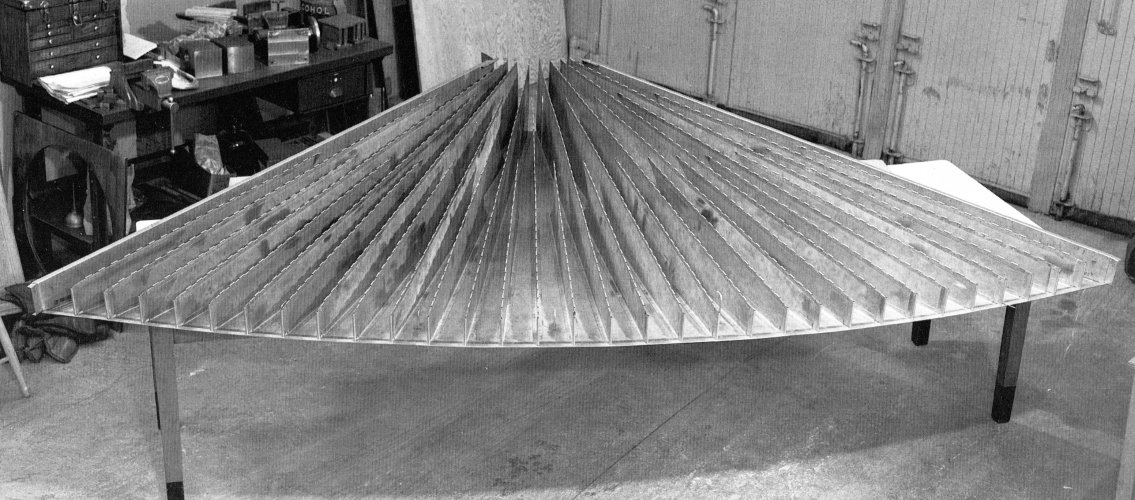
The project was canceled before prototypes were built, and as far as I know, no mock-ups were built either. Only photos of the test-rig and the diffuser exist.

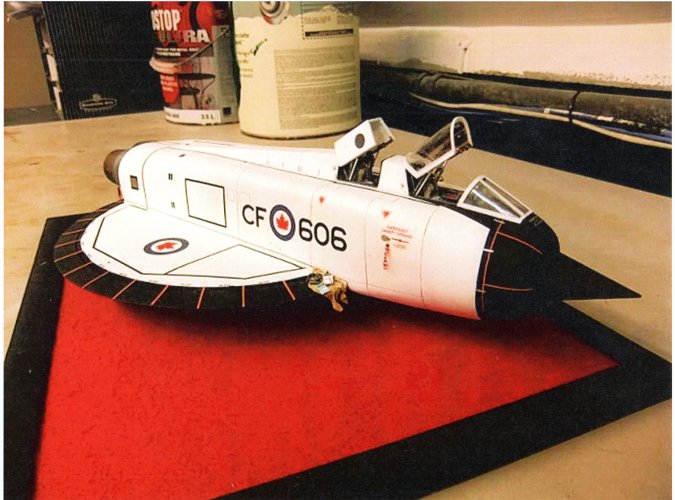
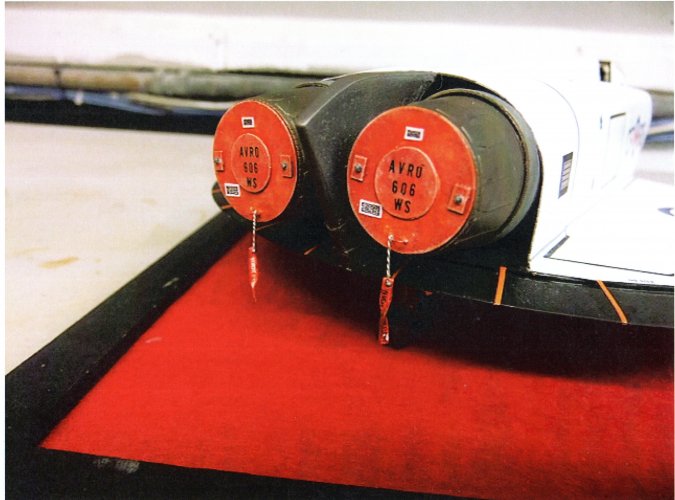
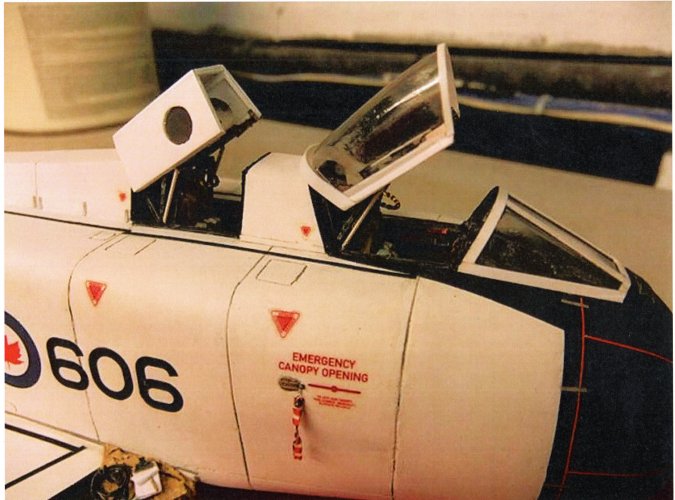
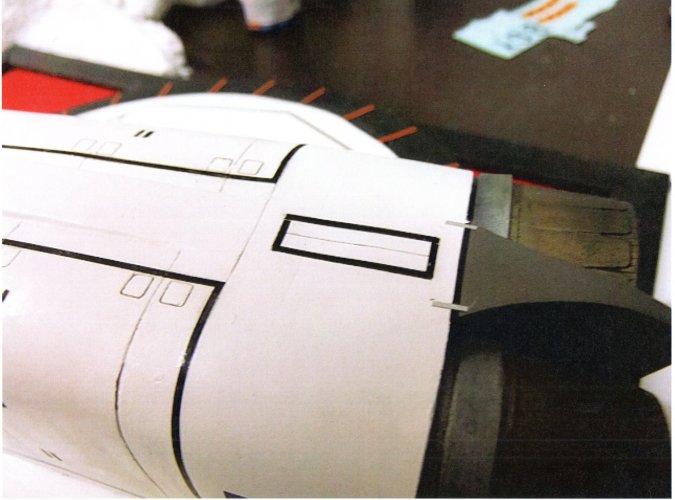
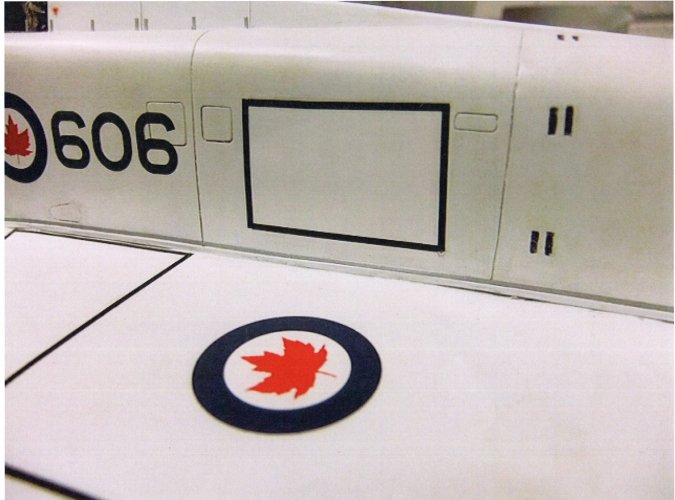
In Canada there are good modelers who have built excellent models, I attach some photos.
 

Attachments

  • 864.jpg
    864.jpg
    3.9 MB · Views: 49
  • 865.jpg
    865.jpg
    5.2 MB · Views: 47
  • 862.jpg
    862.jpg
    581.4 KB · Views: 56
  • 855.jpg
    855.jpg
    2 MB · Views: 58
  • 856.jpg
    856.jpg
    1.7 MB · Views: 50
  • 857.jpg
    857.jpg
    2.2 MB · Views: 43
  • 858.jpg
    858.jpg
    2.1 MB · Views: 44
  • 859.jpg
    859.jpg
    1.9 MB · Views: 42
  • 860.jpg
    860.jpg
    2.2 MB · Views: 49
  • 861.jpg
    861.jpg
    1.4 MB · Views: 60

Similar threads

Back
Top Bottom