American Flying Torpedo Designs

hesham

ACCESS: USAP
Senior Member
Joined
26 May 2006
Messages
38,285
Reaction score
20,424

Attachments

  • 3.png
    3.png
    529.8 KB · Views: 316
  • 4.png
    4.png
    158 KB · Views: 288
Last edited:
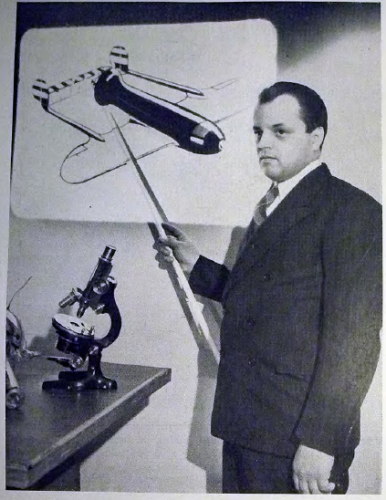
The man in the photo at the top is the inventor, Ulises A. Sanabria. This image was reproduced in:
Chicago: Historia de Nuestra Cominidad Puertorriqueña by Manuel A Martinez, Reyes and Sons, Chicago, 1989.

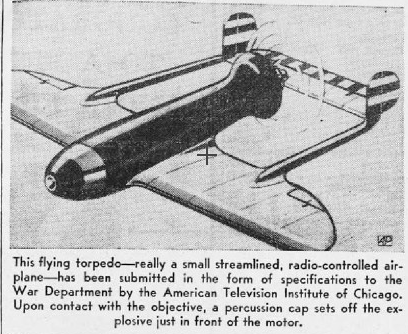
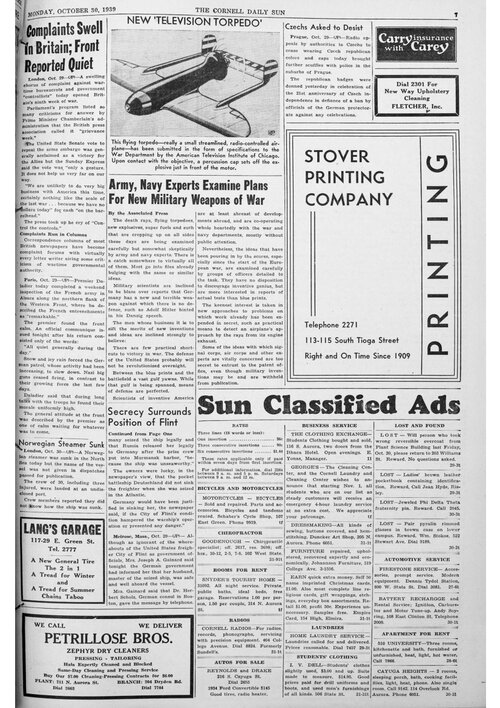
The drawing of the 'Television Torpedo' came from from a 1938 issue of the Collaborator, the American Television Institute journal.

"In 1938, Sanabria's Collaborator journal (an ATI publication) included his description of a new weapon. This weapon is the 'Television Torpedo,' a television-guided cruise missile. A wire antenna across its twin tales receives control signals from the mother plane. An iconoscope tube in the nose of the missile allows the remote pilot to spot the target. In World War II, RCA actually manufactured such a missile for the US Army. At the time when Sanabria published, the Television Torpedo was already a proven technology."

http://www.hawestv.com/mtv_chicago/mtv_cgo.htm
 
Another mystery ?.

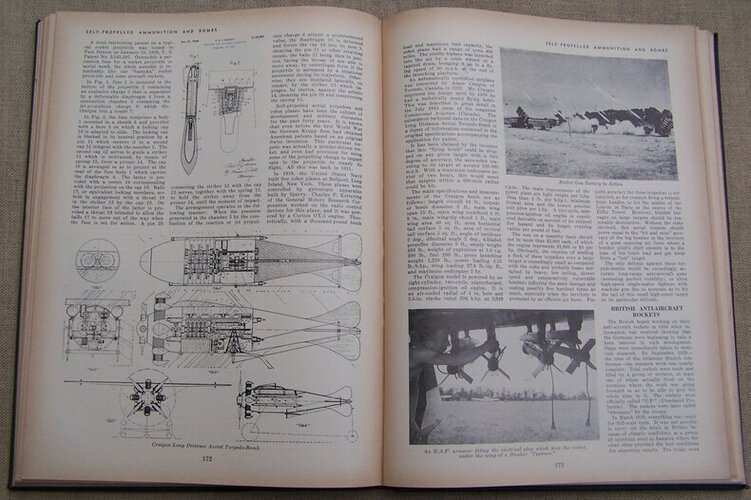
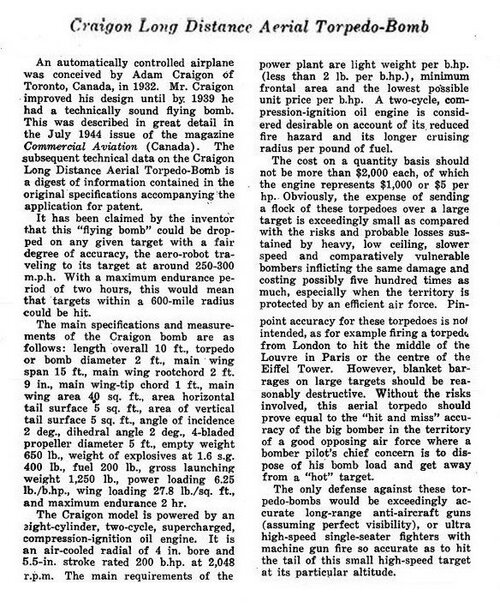
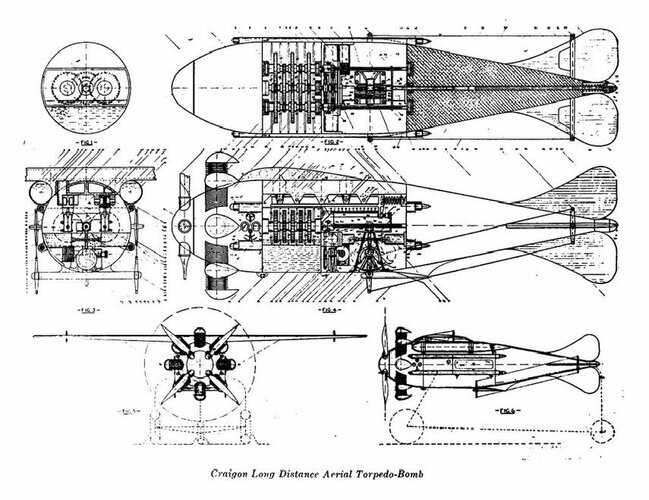
FWIW, a bit of bio on the designer of that Long Distance Aerial Torpedo-Bomb - Adam Craigon ...

Craigon was an aeronautical engineer based in Ontario. He may have begun in Quebec (since he settled a lawsuit there with Lancashire Land & Construction Co. Ltd. of Sherbrooke in 1929). In his 1930 fuel injection patent, he is listed as being from Toronto - although the assignee is Craigon Engines Limited of Hamilton, Ontario.

In 1939, [1] Craigon formed International Aeronautical Corporation Ltd. in Toronto. Craigon became President and Chief Engineer. A.F. ('Sandy') MacDonald was VP. The address is given as #910, the Concourse Building (whose street address was/is 100 Adelaide St W, Toronto).

The Aeroplane, Volume 58 (March 22 1940), page 409

According to Canada's Dominion Bureau of Statistics, Department of Trade and Commerce (1945 Census of Industry), International Aeronautical Corporation Limited still existed in 1945. By then, the corporate address had moved from the Concourse Building 3 km east to 10 Sword Street, Toronto.

In its Index to Volume LXVI (July-Dec 1954) Commonwealth Directory (page 305a), Flight listed this firm as InAerCo, Ltd. But, by this time, Craigon and MacDonald were gone - replaced by Ian S. Filsche as President and a Col. S.C. Cook as VP.

________________________________

[1] Most sources say the International Aeronautical Corporation was formed in 1940. However, an incorporation notice was given in American Aviation Vol.3, No.1 (June 1 1939), page 26.
 

Attachments

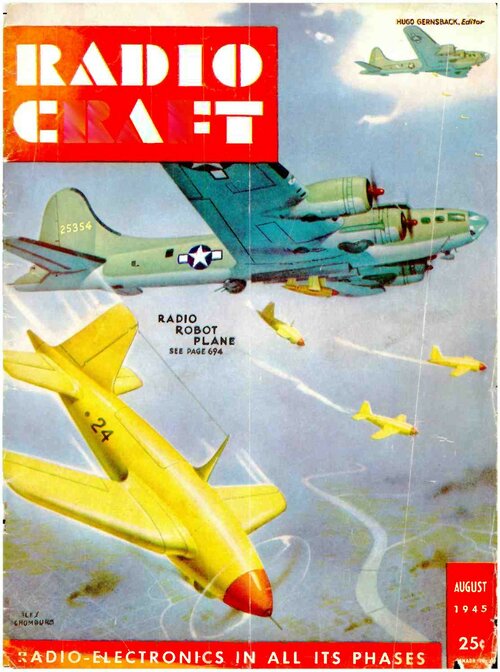
  • Radio-Craft_1945_08-001-001.jpg
    Radio-Craft_1945_08-001-001.jpg
    501.1 KB · Views: 61
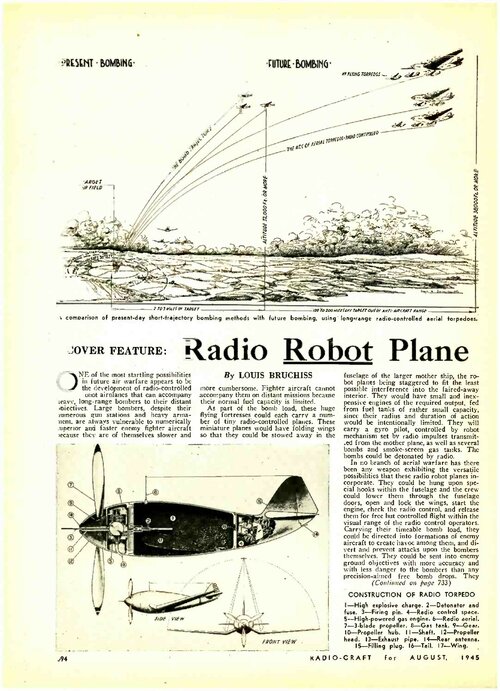
  • Radio-Craft_1945_08-018-018.jpg
    Radio-Craft_1945_08-018-018.jpg
    883.7 KB · Views: 52
  • Radio-Craft_1945_08-057-057.jpg
    Radio-Craft_1945_08-057-057.jpg
    1.1 MB · Views: 48
Hi,

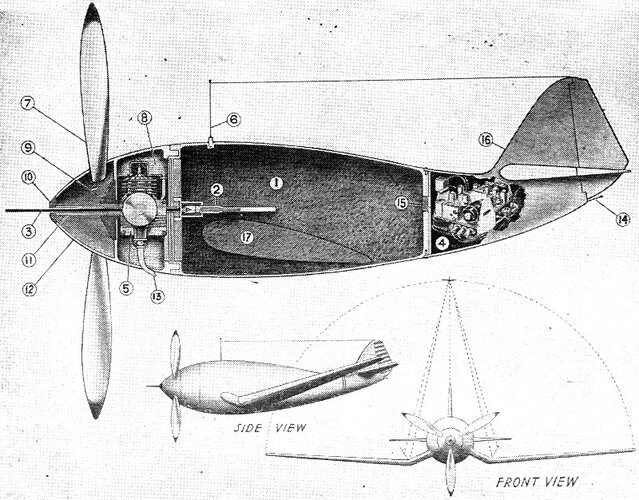
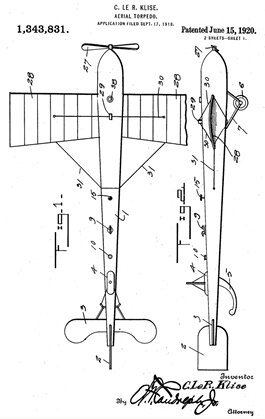
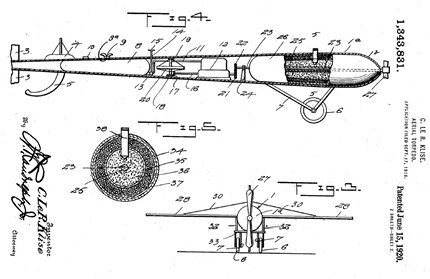
Clayton Le Roy Klise, from Yankton South Dakota US, filed an application for a patent for a flying torpedo in 1918. The propulsion would be by a propeller that would draw its power from a motor running on compressed air. For stability, the device would be equipped with gyroscopes. The altitude and direction would be monitored by a control system. A combination of timer and fuse would cause the device to explode at a preset time.
 

Attachments

  • 23.jpg
    23.jpg
    53.3 KB · Views: 29
  • 24.jpg
    24.jpg
    63.8 KB · Views: 29
The Kettering Flying Torpedo.
 

Attachments

  • 2.png
    2.png
    311.8 KB · Views: 20
  • 3.png
    3.png
    399.6 KB · Views: 29
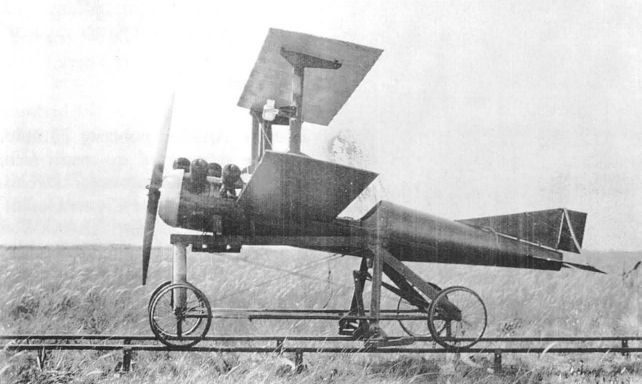
The Kettering Flying Torpedo.
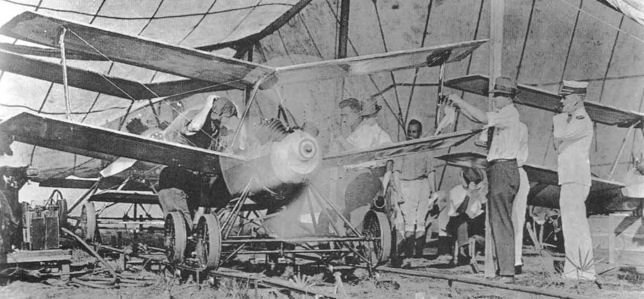
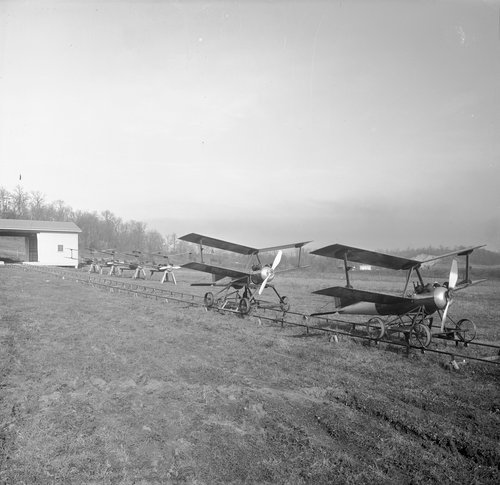
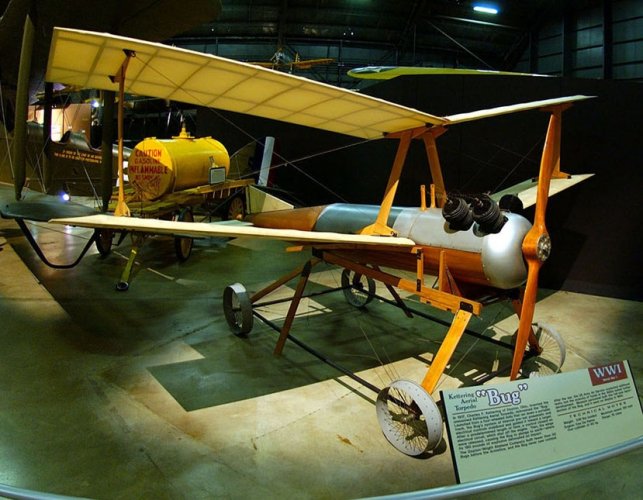
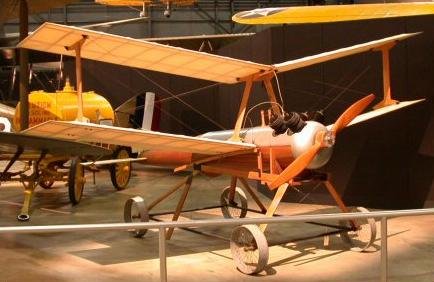
Better known as the "Bug" or the "Kettering Bug" (after its designer, Charles F. Kettering), its real name was actually the Liberty Eagle and it was produced by the Dayton-Wright Airplane Co. in 1917.

Dayton-Wright was officially founded that same year (although it existed informally since 1916) at the Army's Wright Field by Edward R. Deeds and Charles F. Kettering (from Dayton Engr. Laboratory Co/DELCO), H. E. Talbot and H. E. Talbot, Jr. (from Dayton Metal Products, Co.) and Orville Wright (though he departed soon after). The company was tasked with building De Havilland DH-4, Engineering Division XB-1, and Standard J-1 types, but the "Bug" was the first original product of the company.

The "Bug" started off as a single-seat biplane with a 37 hp Kettering/Morehouse motor which served as a factory test-bed for production pilotless aerial torpedoes. About 20 were built, also the type was also tested by the Navy in Pensacola. A decision to convert the prototype for the civil market never implemented.

Over 20 years later, Kettering associated with General Motors to create the A-1 aerial torpedo in 1939.

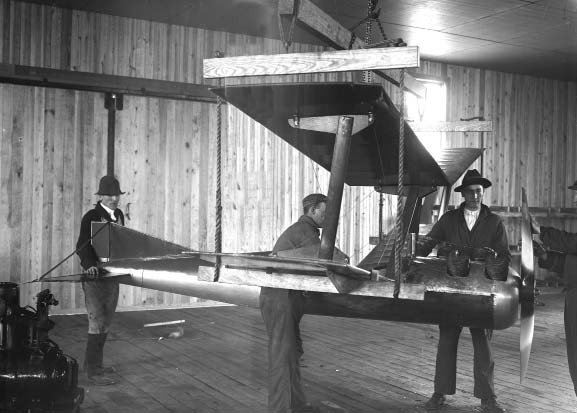
Construction of the "Bug":

Workers moving a fully assembled Kettering “Bug”.jpg
1760879283390.png

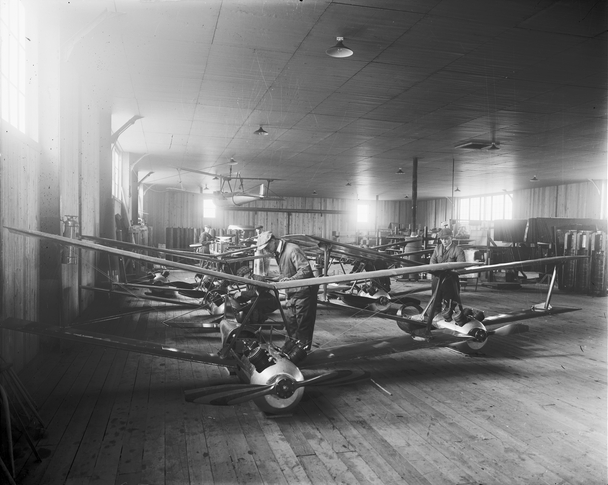
Preparation of the "Bugs" on launch rails:

36-2.jpg
36-1.jpg
Two Kettering Bugs on a rail track ready for launch at the Dayton-Wright Airplane Company.jpg

Artwork
(presumably the manned prototype and the unmanned production version):

Kettering Bug.gif
Kettering Bug art.jpg

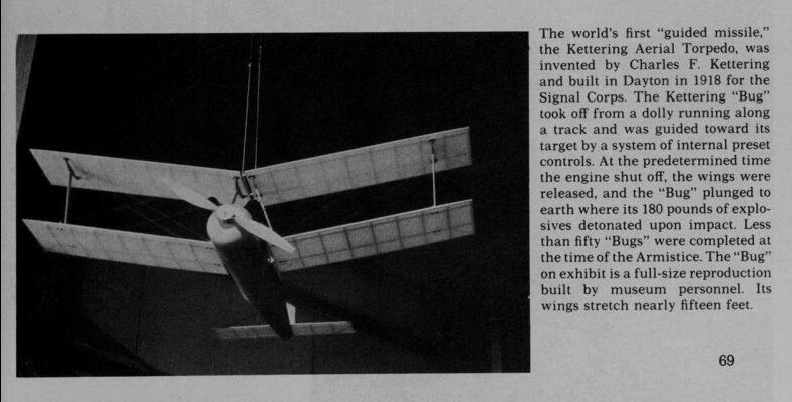
The "Bug" in museum display:

Kettering Bug in museum.jpg kettering-bug.jpg
 

Similar threads

Back
Top Bottom