The NGF goes it alone.
According to the 2027 budget documents, the Ministry of the Armed Forces will launch the phase aimed at getting a prototype of the Rafale’s successor airborne in 2027, followed by the development of the production aircraft in 2029. France is now leading this project alone, following Germany’s withdrawal in June.
It has been official since 8 June: there will be no joint fighter aircraft between France and Germany under the SCAF programme (Future Air Combat System, in which Spain is also participating), as Berlin has chosen to withdraw from the project. France, however, still needs an aircraft to succeed the Rafale.
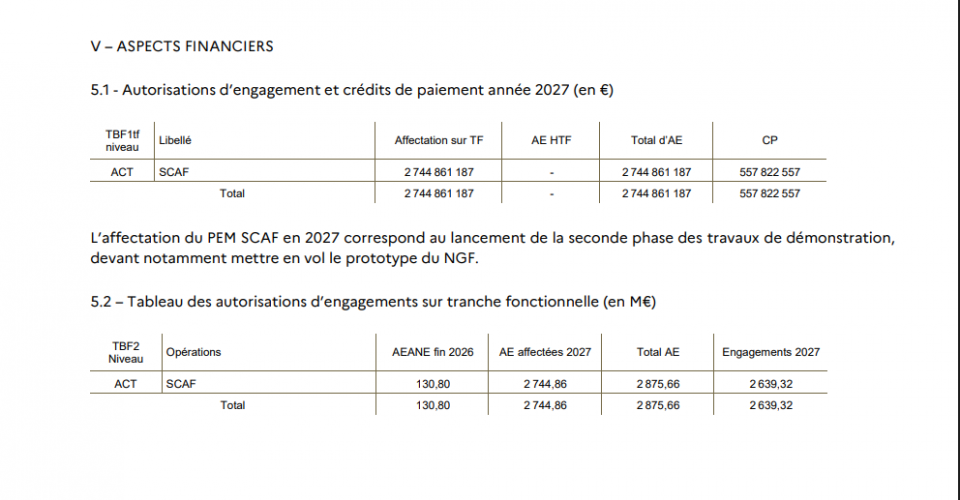
The Ministry of the Armed Forces is therefore pressing ahead with its plans for a new-generation fighter, without Germany. As noted on Thursday 8 October by the specialist website Zone Militaire, which cites an annex to the draft Finance Bill for 2027 devoted to military equipment, preparations for the post-Rafale era are set to begin in the coming years.
“The core of the SCAF programme (including the New Generation Fighter) […] will therefore be carried out in a new format, either at national level or within a new framework,” states the budget document. As for the rest, “only certain work currently being carried out in cooperation, mainly on the combat cloud, could continue as a joint effort between the two countries. ”
The document sets out two dates for this NGF, which will now be a national programme. In 2027, the second demonstration phase will begin, during which a prototype is due to take flight. In 2029, development of the operational aircraft will commence. However, it should not be assumed that this NGF will be in service by that time.
On Thursday 8 October, during a hearing at the National Assembly, the Minister for the Armed Forces, Catherine Vautrin, confirmed that the programme had once again become a national one. As early as July, the Ministry had begun work on the NGF independently in order to meet the original timetable, which aims for operational capability ‘in the early 2040s’. The studies carried out in cooperation with other partners will be reused, and “we have not lost any money”, she assured.
In the meantime, the Rafale continues to evolve to remain effective in combat. Recently, the aircraft was upgraded to the F4 standard, with two further upgrades: F4.1 (in 2023) and F4.2 (in 2025). The next upgrade, F4.3, is currently under evaluation. The biggest leap forward will come with the Rafale F5, which is being billed as a genuine breakthrough.
Éric Trappier, CEO of Dassault Aviation, has often stated that his company could design a next-generation fighter (NGF) from scratch on its own, highlighting the Rafale, which was developed without any foreign partners. But if international cooperation were to be established, with which nation could France forge an agreement? Options are beginning to run out.
The United States has its own programme, Boeing’s F-47, which was selected in March 2025. The United Kingdom, Italy and Japan are tied to a rival programme, the GCAP, which Germany is considering joining: the German Ministry of Defence has confirmed preliminary discussions. Berlin has also opened talks with Madrid to develop a fighter aircraft together.
But there has also been talk of an alliance between France and Sweden… or with India.