Royal Netherlands Navy 1945-1990 formerly Nuclear Powered Submarines for the Royal Netherlands Navy

NOMISYRRUC

ACCESS: Top Secret
Joined
28 September 2008
Messages
2,719
Reaction score
4,468
The short answer is that De Zeven Provinciën was replaced by Jacob Van Heemskerck. I don't have time to do the long answer, which would have begun with this extract of the Dutch 1974 White Paper on Defence.
The Royal Netherlands Navy's equipment plans
Guided missile frigates.
Both guided missile frigates, the Tromp and the De Ruyter, have been launched and will be added to operational strength in 1977 and 1978, respectively, following their sea trials and guarantee voyages. With this, the two escort groups operating in the Atlantic Ocean will have their central element at their disposal. It is currently intended to remove HNLMS De Zeven Provinciën from operational strength in mid-1977.
For the third escort group, a 'modified standard frigate' will be built to replace HNLMS De Zeven Provinciën. This frigate will be equipped with command facilities and medium-range air defense capability. It is the first of the third series of standard frigates. For budgetary reasons, it is accepted that a gap of approximately 6½ years will arise between the decommissioning of the cruiser and the commissioning of the frigate.
 
The RNLN considered building nuclear-powered submarines? :eek:
 
@Hobbes
Deugdelijke Schepen - Marinescheepsbouw 1945-1995 by S.G. Nooteboom, Europese Bibliotheek 2001, chapter 5: De nucleaire optie 1956-1972 describes how studies and planning for RNLN nuclear-powered submarines evolved.
Initially aiming for cooperation with the US Navy, with promises made by the Eisenhower administration. During the early sixties, financial difficulties for the scheme, as well as marked reluctance developing on the US Navy's part to share information with the RNLN. Later in the sixties, cooperation with the French Navy became a real possibility, but lack of funds ended that.
The scheme was dead in the water by 1972.
 
Last edited:
Looks like it really was buying some Skipjack-class boats.
The plan was always for nuclear submarines to be built in the Netherlands, most likely by Wilton-Feijenoord or RDM, both companies had considerable experience building submarines.
An initial proposal was for building Skate-like submarines. I do not know which kind of designs resulted from cooperation with France.
When did the USN get a stick up its butt about sharing information
Sometime in the early sixties, with Rickover playing a large role.
 
Last edited:
The plan was always for nuclear submarines to be built in the Netherlands, most likely by Wilton-Feijenoord or RDM, both companies had considerable experience building submarines.
An initial proposal was for building Skate-like submarines. I do not know which kind of designs resulted from cooperation with the French
Surprising, because for a short time the US was actively offering the Skipjack type.

Any records as to who was providing the reactor? US design, French design, local design?
 
US, French, even a Dutch reactor design was considered.
The ones eventually built, diesel-electric Zwaardvis and Tijgerhaai, were based on Barbel, considerably modified.
 
Last edited:
Richard Burton once said begin at the beginning, but in this thread I'm beginning at what AFAIK is the end, with these extracts from the Dutch White Paper on Defence from 1974.
The Royal Netherlands Navy and the Pilotage Service
The Royal Netherlands Navy
The maritime expansion of the traditionally continentally oriented Soviet Union, which began in the recent past, continues unabated. Any potential threat this poses to the security of maritime connections must be recognized immediately. Therefore, the movements of Warsaw Pact naval forces are continuously monitored through surveillance operations involving ships and aircraft. Maritime units are capable of responding quickly and effectively. Consequently, their presence at sea is of great significance in the context of war prevention and crisis management.
In order to safeguard its interests at sea both in peacetime and under crisis and war conditions, the Netherlands must make an adequate contribution to the joint maritime effort of NATO.
The eastern part of the Atlantic Ocean, the English Channel, and the North Sea constitute the Royal Netherlands Navy's primary operational area. The composition of our maritime NATO contribution is tailored to operating in these sea areas.
Tasks and resources.
The following tasks flow directly from or are closely related to the contribution to NATO:
  • participating in crisis management actions within the NATO framework; units of the Royal Netherlands Navy are part of permanent NATO squadrons, both with destroyers or frigates in the 'Standing Naval Force Atlantic' and with mine countermeasures units in the 'Standing Naval Force Channel'; maritime units, including amphibious units of the Marine Corps, are part of the joint forces capable of rapid intervention in the event of crises. To this end, these units may, if necessary, take action under NATO command even in peacetime;
  • conducting coordinated reconnaissance; the Royal Netherlands Navy participates in reconnaissance with aircraft, submarines, and surface vessels;
  • providing support to land forces on NATO flanks by making amphibious units available for flank operations;
  • contributing to conventional maritime deterrence and maintaining maritime connections; the extensive submarine fleet and the still growing surface fleet of the Soviet Union underscore the importance of this task;
  • mine countermeasures; this comprises the entirety of measures necessary to keep shipping lanes, coastal waters, and port entrances free of mines and obstacles; although the primary task of mine countermeasures lies in national waters, international cooperation in this area is also a prerequisite for efficient task execution;
  • organization and security of coastal convoys;
  • maritime port defence;
  • storage, transport, and distribution of supplies for the escort groups.
For the execution of these tasks, the following composition of the Royal Netherlands Navy is considered optimal. This strength is the best possible contribution to alliance defence, in harmony with NATO plans and also realistic in light of national capabilities:
  • 2 escort groups for the eastern Atlantic
    • and
  • 1 escort group for the Channel,
    • each consisting of
      • a guided missile frigate providing command facilities and medium-range air defence,
      • 6 frigates with good anti-submarine and surface combat capabilities,
      • and a supply ship;
  • 1 escort group for the North Sea,
    • consisting of 4 frigates with the same configuration as those mentioned for the above escort group;
  • 6 conventionally propelled submarines;
  • 21 long-range maritime patrol aircraft;
  • 36 helicopters for the ships and the shore squadron;
  • 2 groups of mine countermeasures vessels, each consisting of 12 ships,
    • and
  • 1 group of mine countermeasures units, consisting of 7 ships;
  • A Marine Corps with 2 amphibious combat groups and a 'cold-weather' company, operationally integrated with the British Marines;
  • 3 hydrographic and oceanographic vessels;
  • a number of smaller units.
There's a lot more after that until we finally reach.
Submarines.
These will be deployed for reconnaissance in the context of crisis management. After all, they can enter areas where surface units cannot operate unseen. Furthermore, they serve to combat surface vessels in wartime. This role is becoming of great importance again in the era of guided missiles. In wartime conditions, the submarine plays a very significant role in combating other submarines. Finally, submarines are indispensable for navies possessing anti-submarine groups to get these groups operationally proficient and keep them that way.
The submarines can be either conventionally or nuclear-powered vessels. Acquiring and operating nuclear-powered boats is such a costly and personnel-intensive undertaking that it is only feasible for the major navies (United States, England, France, and the Soviet Union).
The Netherlands currently possesses six ocean-going conventional boats. HNLMS submarines Zwaardvis and Tijgerhaai are currently operational and represent a major qualitative improvement to the submarine service. The replacement of the two oldest three-cylinder type submarines will have to take place around 1981 due to their lifespan. Significant funds have been raised for this project since 1979. However, it is the firm conviction of the government that efforts must be made to find possibilities for this within the framework of the international division of tasks. If this proves possible, no new submarines will be built, and the funds raised will remain available for other naval projects.
Operational cooperation with the British submarine service has proven to be a great success. A Dutch submarine regularly operates from a British submarine base under British operational command.
So the short answer is that IOTL the RNLN didn't have any SSNs because a navy of its size didn't have enough money and didn't have enough people.

OTOH the percentage of GNP spent on defence by the Netherlands declined from about 5% in the early 1960s to about 3.5% in the early 1980s and the regular personnel of the RNLN (including marines and the naval air force) declined from about 23,000 to 16,900 over the same period.

Footnote

Re the supply ship for the third escort group. The White Paper also says.
The second supply ship – Zuiderkruis – will be added to the fleet in 1975. This represents a significant improvement in the logistical support of the fleet. A supply ship for the third escort group will not be built. In wartime, this need will be met by chartering or requisitioning a tanker.
 
Last edited:
I'll have to dig out Friedman's British Submarines Vol.2 out again, but I'm sure he mentions that the US did share/were willing to share their Skipjack powerplant with the Netherlands and France. So it might not be impossible - assuming of course the Dutch had enough Guilders to pay for it.
 
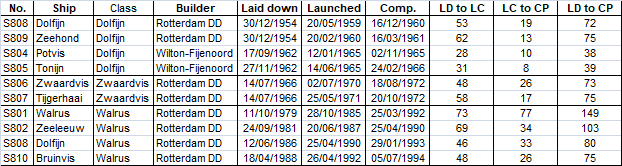
According to Conway's 1947-1995 these are the construction dates of the 10 submarines built for the RNLN in the period being discussed.

Dutch Submarines built 1945-1995.png

The Dolfijn class was analogous to the British Porpose/Oberon and French Narval classes that were built around the same time. The first pair replaced the Dutch-built submarines O 21 and O 27. The second pair replaced Tijgerhaii (ex-Tarn) and Zwaardvis (ex-Talent) which were British T class boats transferred from the RN to the RNLN when they were under construction.

The Zwaarvis and Walrus classes were analogous to the American Barbel class. The Zwaardvis class was built to replace Walrus (ex-Icefish) and Zeeleeuw (ex-Hawksbill) which were Balao class boats transferred from the USN to the RNLN in 1953. The Walrus class was built to replace the Dolfijn class.
 
The Dolfijn class

According to the copies of Jane's that I have access to the 4 Dolfijns were voted for by the Dutch Parliament in 1949 for completion in 1954.

However, as can be seen the two boats ordered from Rotterdam DD weren't laid down until the end of 1954 and weren't completed until 1960-61 while the pair ordered from Wilton-Fijenoord wasn't laid down until 1962 and completed 1965-66.

The first pair of Dolfijns took so long to build for financial reasons. The second pair took so long to build, first for financial reasons, second because they were cancelled in the late 1950s and third because they were reinstated in the early 1960s. They were cancelled because the RNLN wanted to build a pair of SSNs (probably with US supplied nuclear reactors) in their place.

As @Arjen wrote in Message 77 of the Sea Dart Success thread the SSNs to be built when Potvis and Tonijn were suspended are likely to have been analogues of the USN's Skate class at first, but I think that analogues of the Skipjack would have actually been built, because that's what the British built with Dreadnought and her successors.
 
I'll have to dig out Friedman's British Submarines Vol.2 out again, but I'm sure he mentions that the US did share/were willing to share their Skipjack powerplant with the Netherlands and France. So it might not be impossible - assuming of course the Dutch had enough Guilders to pay for it.
FWIW what I semi-remember from Friedman's US Submarines Vol.2 is that at first Rickover thought the technology was so obvious that the USA had nothing to loose by sharing it with its allies. Then he discovered that he had some secrets that were worth keeping which is why he changed his mind about supplying reactors to France, the Netherlands and IIRC Italy. AFAIK it was too late to stop the sale of the reactor for Dreadnought and/or the British had submarine propulsion secrets of their own like (IIRC) rafting which they could trade for a nuclear reactor.
 
Message 74 from the Sea Dart Success thread.
@Hobbes
Deugdelijke Schepen - Marinescheepsbouw 1945-1995 by S.G. Nooteboom, Europese Bibliotheek 2001, chapter 5: De nucleaire optie 1956-1972 describes how studies and planning for RNLN nuclear-powered submarines evolved.
Initially aiming for cooperation with the US Navy, with promises made by the Eisenhower administration. During the early sixties, financial difficulties for the scheme, as well as marked reluctance developing on the US Navy's part to share information with the RNLN. Later in the sixties, cooperation with the French Navy became a real possibility, but lack of funds ended that.
The scheme was dead in the water by 1972.
If a copy of that (preferably in English) available online?
 
From the Sea Dart Success thread.
US, French, even a Dutch reactor design was considered.
The ones eventually built, diesel-electric Zwaardvis and Tijgerhaai, were based on Barbel, considerably modified.
Does your source say why they didn't think about buying British?
No mention at all. Possible explanation: Rickover had given in to the UK receiving US technology, the Netherlands receiving US technology directly, or via the UK was a step too far.
France had its own technology to offer.
That surprises me. Especially because they cooperated closely with the RN on other matters. E.g. the Van Speijk class frigates, Olympus-Tyne machinery for the Tromp & Kortenaer classes, buying the Lynx helicopter, integrating their Royal Marines with the British Royal Marines and what the Dutch 1974 White Paper on Defence said about submarine cooperation with the RN.
 
Last edited:
Message 74 from the Sea Dart Success thread.
@Hobbes
Deugdelijke Schepen - Marinescheepsbouw 1945-1995 by S.G. Nooteboom, Europese Bibliotheek 2001, chapter 5: De nucleaire optie 1956-1972 describes how studies and planning for RNLN nuclear-powered submarines evolved.
Initially aiming for cooperation with the US Navy, with promises made by the Eisenhower administration. During the early sixties, financial difficulties for the scheme, as well as marked reluctance developing on the US Navy's part to share information with the RNLN. Later in the sixties, cooperation with the French Navy became a real possibility, but lack of funds ended that.
The scheme was dead in the water by 1972.
FWIW this is what editions of Jane's Fighting Ships from 1964-65 to 1972-73 said.

1964-65 P.183
Projected Nuclear Powered Type
On 24 June 1964 the Minister of Defence announced that the Royal Netherlands Navy plans to build at least two nuclear powered submarines. The first will be ready in 1972. The cost is estimated at £17,000,000.
1965-66 P.185
Projected Nuclear Powered Type
In the ‘‘defence note’’ issued in June 1964 the construction of nuclear powered submarines was announced. A first instalment for the construction of the first nuclear powered submarine was approved in the 1965 Navy Estimates. The cost is estimated to ammount to £17,000,000.
1966-67 P.186
Projected Nuclear Powered Type
In the ‘‘defence note’’ issued in June 1964 the construction of nuclear powered submarines was announced. A first instalment for the construction of the first nuclear powered submarine was approved in the 1965 Navy Estimates. The cost is estimated to ammount to £17,000,000.
1967-68 P.194
Projected Nuclear Powered Type
In the ‘‘defence note’’ issued in June 1964 the construction of nuclear powered submarines was announced. A first instalment for the construction of the first nuclear powered submarine was approved in the 1965 Navy Estimates. The cost is estimated to ammount to £17,000,000.
1968-69 P.194
Projected Nuclear Powered Type
In the ‘‘defence note’’ issued in June 1964 the construction of nuclear powered submarines was announced. A first instalment for the construction of the first nuclear powered submarine was approved in the 1965 Navy Estimates. The cost (revised estimate) is £18,000,000.
1969-70 P.217
Projected Nuclear Powered Type
In the ‘‘defence note’’ issued in June 1964 the construction of nuclear powered submarines was announced. In the defence note 1968 it was still considered that the nuclear vessel is the submarine of the future, but when one can be obtained is uncertain in view of presently available defence funds and required overall investments, and nuclear submarines are not considered within the present short term plans (official).
1970-71 P.227
Projected Nuclear Powered Type
In the "defence note" issued in June 1964 the construction of nuclear powered submarines was announced. In the defence note 1968 it was still considered that the nuclear vessel is the submarine of the future, but when one can be obtained is uncertain in view of presently available defence funds and required overll investments, and nuclear submarines are not considered within the present short term plans (official).
1971-72 P.232
Projected Nuclear Powered Type
In the "defence note" issued in June 1964 the construction of nuclear powered submarines was announced. In the defence note 1968 it was still considered that the nuclear vessel is the submarine of the future, but when one can be obtained is uncertain in view of presently available defence funds and required overall investments, and nuclear submarines are not considered within the present short term plans (official).
1972-73 P.230
Projected Nuclear Powered Type
In the "defence note" issued in June 1964 the construction of nuclear powered submarines was announced. In the defence note 1968 it was still considered that the nuclear vessel is the submarine of the future, but when one can be obtained is uncertain in view of presently available defence funds and required overall investments, and nuclear submarines are not considered within the present short term plans (official).
There was no such entry in Jane's 1973-74.
 
Message 74 from the Sea Dart Success thread again.
@Hobbes
Deugdelijke Schepen - Marinescheepsbouw 1945-1995 by S.G. Nooteboom, Europese Bibliotheek 2001, chapter 5: De nucleaire optie 1956-1972 describes how studies and planning for RNLN nuclear-powered submarines evolved.
Initially aiming for cooperation with the US Navy, with promises made by the Eisenhower administration. During the early sixties, financial difficulties for the scheme, as well as marked reluctance developing on the US Navy's part to share information with the RNLN. Later in the sixties, cooperation with the French Navy became a real possibility, but lack of funds ended that.
The scheme was dead in the letter by 1972.
FWIW this is what editions of Jane's Fighting Ships from 1964-65 to 1972-73 said in the New Construction Programme for the RNLN on the first pages of the Netherlands section. The last message was what the submarines page of the Netherlands section said.

1964-65 P.178
New Construction Programme
6 frigates of the British "Leander" class design powered by steam turbines
2 conventional submarines of the triple-hulled ocean-going type
2 conventional submarines, ocean-going type
1 fleet replenishment tanker and supply ship [Poolster]
1965-66 P.180
New Construction Programme
6 frigates of the British "Leander" class design powered by steam turbines
2 conventional submarines of the triple-hulled ocean-going type
2 conventional submarines, ocean-going type
1966-67 P.184
New Construction Programme
6 frigates of the British "Leander’’ class design powered by steam turbines.
1 nuclear powered submarine, hunter-killer type.
2 conventional submarines, ocean-going type.
1967-68 P.192
New Construction Programme
6 frigates of the British "Leander" class design powered by steam turbines
1 nuclear powered submarine, hunter-killer type
2 conventional submarines, ocean-going type.
1968-69 P.192
New Construction Programme
1 nuclear powered submarine, hunter-killer type
2 conventional submarines, ocean-going type.
1969-70 P.215
New Construction Programme
1 nuclear powered fleet submarine, building postponed
2 diesel powered submarines, ocean-going type
2 guided missile frigates, DDG type.
1970-71 P.225
New Construction Programme
1 nuclear powered fleet submarine, building postponed
2 diesel powered submarines, ocean-going type
2 guided missile frigates, DDG type
4 ASW frigates
1 Survey ship
1 Accommodation vessel (Boatel).
1971-72 I don't remember the page number
New Construction Programme
1 nuclear powered fleet submarine, building postponed
2 diesel powered submarines, ocean-going type
2 guided missile frigates, DDG type
4 anti-submarine warfare frigates
1 fast combat support ship [Zuiderkruis]
1 oceanographic ship
2 small survey ships.
1972-73 P.228
New Construction Programme
1 nuclear powered fleet submarine, building postponed
2 diesel powered submarines, ocean-going type
2 guided missile frigates, DDG type
4 anti-submarine warfare frigates
1 fast combat support ship [Zuiderkruis]
1 oceanographc ship
2 North Sea survey ships.
Notes
  • The conventional submarines, ocean-going type and diesel powered submarines, ocean-going type are the Zwaardvis class.
  • The conventional submarines of the triple-hulled ocean-going type are Potivs and Tonijn.
  • The guided missile frigates, DDG type are the Tromp class.
  • The anti-submarine warfare frigates became the first 4 Kortenaer class.
 
I'll have to dig out Friedman's British Submarines Vol.2 out again, but I'm sure he mentions that the US did share/were willing to share their Skipjack powerplant with the Netherlands and France. So it might not be impossible - assuming of course the Dutch had enough Guilders to pay for it.
FWIW what I semi-remember from Friedman's US Submarines Vol.2 is that at first Rickover thought the technology was so obvious that the USA had nothing to loose by sharing it with its allies. Then he discovered that he had some secrets that were worth keeping which is why he changed his mind about supplying reactors to France, the Netherlands and IIRC Italy. AFAIK it was too late to stop the sale of the reactor for Dreadnought and/or the British had submarine propulsion secrets of their own like (IIRC) rafting which they could trade for a nuclear reactor.
From Page 127 of "U.S. Submarines Since 1945" by Norman Friedman.
The S5W proved extremely successful. The British tried to develop their own submarine nuclear reactor but lacked sufficient technological manpower; the Magnox civilian power reactors had higher priority. In negotiations with the U.S. Navy in 1958, Britain was offered the Skate reactor but ended up with the more powerful S5W. HMS Dreadnought, the prototype British SSN, had, in effect, a Skipjack tail welted onto her slightly larger-diameter British front end. The British believed that they returned the favour by providing the U.S. Navy with the rafting (silencing) technology that proved crucial at about the same time. All later British submarine reactors incorporate some S5W technology, although how much is a matter of dispute.
The sale to Britain was approved partially because the British submarine power plant was already well advanced. In mid-1958, the Royal Netherlands Navy thought that it had a similar agreement in train. Admiral Rickover apparently believed that the overall submarine reactor technology was so obvious that it could not be kept secret. Reportedly, he changed his mind after a visit to the new Soviet nuclear-powered icebreaker Lenin, the detail of whose powerplant appalled him. He obviously had secrets worth keeping, and the Dutch agreement was scuttled. The Royal Canadian Navy tried to buy nuclear submarines at this time; Rickover personally approved an offer, valid for a year of the Skipjack design. When the Canadians could not decide (they became interested in the superior Thresher), the offer was allowed to lapse. The French many have approached the U.S. government about 1959 after their liquid metal reactor failed. If so, the proposal was rejected. Reportedly, the power plants of the French strategic submarines closely resemble S5W but without permission. Most recent French nuclear power plants have a quite different native design.
 
MacNamara was known for opposing independent nuclear deterrents of Britain and France, did this opposition extend to nuclear submarine powerplants? How did the McMahon Act affect the sharing of nuclear submarine powerplants? IIUC got the specific exception to the McMahon Act in 1958 because after the Grapple H-bomb tests the US decided there wasn't much point denying the UK access to knowledge they'd developed independently for themselves, but this doesn't apply to France and it certainly doesn't apply to the Netherlands looking at SSNs.
 
FWIW what I semi-remember from Friedman's US Submarines Vol.2 is that at first Rickover thought the technology was so obvious that the USA had nothing to loose by sharing it with its allies. Then he discovered that he had some secrets that were worth keeping which is why he changed his mind about supplying reactors to France, the Netherlands and IIRC Italy. AFAIK it was too late to stop the sale of the reactor for Dreadnought and/or the British had submarine propulsion secrets of their own like (IIRC) rafting which they could trade for a nuclear reactor.
I'm inclined to argue that the way to bypass this is... Rickover having his way also with the British, forcing them to complete development of PWR.1 on their own. This way exporting the reactor to Italy or the Netherlands can't be vetoed...
 
FWIW what I semi-remember from Friedman's US Submarines Vol.2 is that at first Rickover thought the technology was so obvious that the USA had nothing to loose by sharing it with its allies. Then he discovered that he had some secrets that were worth keeping which is why he changed his mind about supplying reactors to France, the Netherlands and IIRC Italy. AFAIK it was too late to stop the sale of the reactor for Dreadnought and/or the British had submarine propulsion secrets of their own like (IIRC) rafting which they could trade for a nuclear reactor.
I'm inclined to argue that the way to bypass this is... Rickover having his way also with the British, forcing them to complete development of PWR.1 on their own. This way exporting the reactor to Italy or the Netherlands can't be vetoed...
FWIW the message you replied to is obsolete because I found what Friedman actually wrote in U.S. Submarines Vol.2 and quoted it verbatim in Message 12 above.
 
I don't think so.
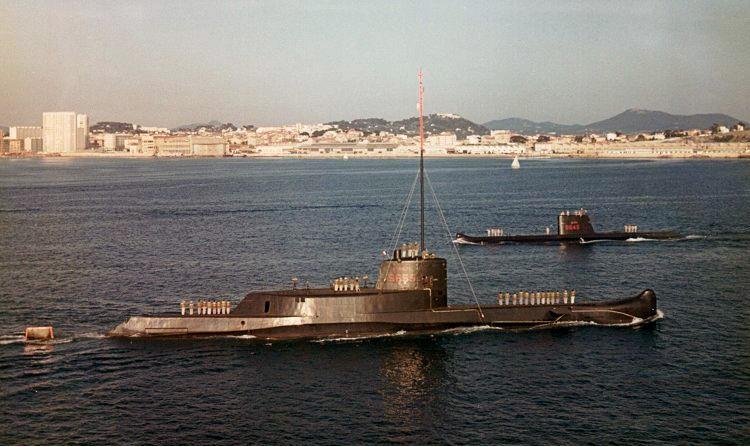
The hull for Q244 was eventually finished as Q251, later S655 Gymnote, a diesel-electric SLBM trials submarine.
https://en.wikipedia.org/wiki/French_submarine_Gymnote_(S655)
Image source:
https://alabordache.fr/marine/espacemarine/sousmarin/diesel/gymnote/newphoto.php
I knew about Gynmnote already. See this from the Sea Dart Success thread.
FWIW
  • The first British SSN, Dreadnought had an American reactor.
  • In the late 1950s the French laid down the SSN Q244 which AFAIK was to have had an American reactor. The project was abandoned and the hull was completed in 1966 as the diesel-electric powered ballistic missile boat Q251 Gymnote which was used to test French SLBMs.
  • I can't remember where I read it, but IIRC the US Government considered supplying nuclear submarine reactors to Italy in the late 1950s.
 
So a UK provider AH relies on the PWR-1 being a UK only technology.
About a year later than history.

But the chief impediment is provision of scale production.
Supplying France, Italy and the Netherlands radically increases production.
 
Rudolf & Robert Das, Netherlands futurologist proposed in early 1980s.
For Netherlands Navy the use Nuclear power submarine,
also as Submarine Aircraft Carrier and submarine emergency shelter for Government in case of World War III.
and Commando Submarine for Navy, Airforce and Army

Source:
Zicht op the de Toekomst
page: 121, 130-131
By Rudolf Das, Robert Das 1983
ISBN 90 10 04793
 
Missed that, apologies.
From what I have read, a nuclear powered Q244 would have fulfilled the same purpose for France as Nautilus for the USA.
Fair enough.

FWIW I didn't know that Q244 was to have a French reactor and that the project was abandoned because (at the time) they couldn't make a reactor that was small enough until I read the Wikipedia article. I'd always assumed that Q244 was designed around an American reactor and that the project was abandoned because the USA changed its mind about supplying one.
 
So a UK provider AH relies on the PWR-1 being a UK only technology.
Not according to this paragraph from Friedman that was part of Message 12.
The S5W proved extremely successful. The British tried to develop their own submarine nuclear reactor but lacked sufficient technological manpower; the Magnox civilian power reactors had higher priority. In negotiations with the U.S. Navy in 1958, Britain was offered the Skate reactor but ended up with the more powerful S5W. HMS Dreadnought, the prototype British SSN, had, in effect, a Skipjack tail welted onto her slightly larger-diameter British front end. The British believed that they returned the favour by providing the U.S. Navy with the rafting (silencing) technology that proved crucial at about the same time. All later British submarine reactors incorporate some S5W technology, although how much is a matter of dispute.
If that is true there may have been restrictions on the UK selling US secrets to third parties, which is a pity because I like your thinking and it would explain why the RNLN didn't consider buying a British reactor IOTL because @Arjen wrote.
US, French, even a Dutch reactor design was considered.

But the chief impediment is provision of scale production.
Supplying France, Italy and the Netherlands radically increases production.
I don't see France buying British reactors because France could build its own by the time Britain could. OTOH the UK completed 15 nuclear powered submarines 1966-81 at an average of nearly one a year, so as you wrote supplying 2 to the Netherlands for the 2 Zwaardvis class would be a significant addition. Unfortunately, IOTL Italy completed 8 submarines over the same period and I think due to the larger number submarines combined with Italy being a bigger and richer country than the Netherlands the Italian Government would want the reactors to be built in Italy under licence.
 
UK had it's reactor program and it was delayed, due to various issues.
US reactor was a single example to keep the RN's first SSN on schedule. There was a technology package involved in that, but since then arguments over how much was fed into PWR-1 is still....speculation.

It's clear a change in steel was influenced by US practice.

But UK practice on reducing connections between various pipes by virtue of using continous pipes as much as possible. This reduced points of failure.

The estimated delay of the indigenous design was about a year at the point the US option became real enough to switch planning efforts.

So had that American option been held up long enough or stopped for some reason. The indigenous effort would continue and all being well about a year delay in the first SSN.

The first SSN was priority to work out the kinks before the SSBN force was built.
 
How would the Netherlands etc. get around SecDef MacNamara's strong opposition to the sharing of nuclear submarine propulsion technology?

Apparently, he believed it provided an unacceptable pathway to nuclear proliferation, which he strongly opposed in favour of tight centralised US control of nuclear weapons.
 
Errr understand the Netherlands was also talking of UK nuclear depth charges at one point.

They had US weapons stationed there.

And then grasp the centrifuges for enrichment the likes of North Korea and Pakistan started out with were Dutch designs.

They've been um-ing and ah-img over military nuclear for a long time.
 
Errr understand the Netherlands was also talking of UK nuclear depth charges at one point.

They had US weapons stationed there.

And then grasp the centrifuges for enrichment the likes of North Korea and Pakistan started out with were Dutch designs.

They've been um-ing and ah-img over military nuclear for a long time.

Apparently, Mac supported US owned dual-key nukes because it gave the US centralised control.

How would UK WE177A depth charges be controlled? Would they be owned by the British and require British crew on Dutch ships? Or would they be owned outright by the Dutch and therefore present a massive proliferation risk as they could be converted into bombs?

I don't doubt that the Dutch had a good civilian nuclear industry, but if it was easy to translate that into submarine propulsion then they wouldn't need to bother with the US.
 
if it was easy to translate that into submarine propulsion then [the Dutch] wouldn't need to bother with the US
When the Dutch were not progressing much with obtaining US naval reactor tech, they turned to the French. That eventually went nowhere because of funding.
See also early retirement of Terrier-equipped HNLMS De Zeven Provinciën (C802). Not because of reduced defence funding - choices had to be made.
 
When the Dutch were not progressing much with obtaining US naval reactor tech, they turned to the French. That eventually went nowhere because of funding.
See also early retirement of Terrier-equipped HNLMS De Zeven Provinciën (C802). Not because of reduced defence funding - choices had to be made.

I think the first British SSNs were 4 or 5 times the unit cost of the contemporary Oberon class diesel subs.
 
See also early retirement of Terrier-equipped HNLMS De Zeven Provinciën (C802). Not because of reduced defence funding - choices had to be made.
The following isn't to support or refute the above. It's background information.

From the 1974 White Paper on Defence
The Royal Netherlands Navy's equipment plans
Guided missile frigates
Both guided missile frigates, the Tromp and the De Ruyter, have been launched and will be added to operational strength in 1977 and 1978, respectively, following their sea trials and guarantee voyages. With this, the two escort groups operating in the Atlantic Ocean will have their central element at their disposal. It is currently intended to remove HNLMS De Zeven Provinciën from operational strength in mid-1977.
For the third escort group, a 'modified standard frigate' will be built to replace HNLMS De Zeven Provinciën. This frigate will be equipped with command facilities and medium-range air defense capability. It is the first of the third series of standard frigates. For budgetary reasons, it is accepted that a gap of approximately 6½ years will arise between the decommissioning of the cruiser and the commissioning of the frigate.
Approximately 6½ years after mid-1977 is the end of 1983/beginning of 1984.

According to Conway's 1947-1995 Jacob Van Heemskerck was laid down on 21.01.81, launched on 05.11.83 and completed on 15.01.86.

Meanwhile, Jane's 1975-76 said De Zeven Provinciën was converted in was converted in 1962-64 by Rotterdamsche Droogdok Mij, Rotterdam with "Terrier" intallation by NV Dok en Werf Mij Wilton-Schiedam and that she was again refitted and modernised in 1971-72. It also said she was for disposal in mid-1977, which matches the 1974 White Paper. Jane's 1976-77 says that she went into reserve on 17.10.75 and that disposal would follow the commissioning of both De Ruyter and Tromp.

Therefore, De Zeven Provinciën paid off nearly 2 years earlier than planned in 1974 and her replacement Jacob Van Heemskerck was completed 2 years later than planned in the White Paper. Together they increased the interval between her decommissioning and the commissioning of her replacement from the planned 6½ years to 10½ years.

Jane's 1975-76 and 1976-77 said nothing about the sale of De Zeven Provinciën to Peru in their Netherlands sections or in their Peruvian sections. However, my copy of Jane's 1986-87 says on Page 407 that Aguirre (ex-De Zeven Provinciën) was bought in August 1976. It also says.
After sale Aguirre was taken in hand by her original builders for conversion into a helicopter cruiser. The Terrier missile system has been returned to the USA and a helicopter flight deck with a hangar has been built from midships to the stern. Conversion completed 31st October 1977. Sailed March 1978.
 
Last edited:
I think the first British SSNs were 4 or 5 times the unit cost of the contemporary Oberon class diesel subs.
I've still got my copy of Jane's 1986-87 out. According to that the cost of the 2 Valiants and 3 Churchills ranged from £24 million (Warspite) to £30 million (Conqueror).

On the next page it says that the cost of Oberon was £2.43 million and Onyx was £3.6 million. Oberon (completed 1961) was the second Oberon built for the RN and Onyx (completed in 1967) was last.

According to my RN submarines spreadsheet, the costs of the first 6 British SSNs (in order of completion) were as follows.
£18,455,000 Dreadnought​
£25,300,000 Valiant​
£21,455,000 Warspite​
£24,780,000 Churchill​
£29,319,000 Conqueror​
£24,858,000 Courageous (ex-Superb)​

I don't remember whether I got them from copies of Jane's or Wikipedia or a combination of both. However, Conqueror was built by Cammell Laird and the others were built by Vickers, which AFAIK is her cost was about £5 million (20%) more than Churchill and Courageous.

Dreadnought (completed 1963) is the closest to Oberon and cost 7.5 times more. Warspite was completed the same year as Onxy and cost 6 times more. Valiant (completed 1966) cost 6 times more than Onyx.

Edit

According to the extracts from Jane's that I quoted earlier in the thread the estimated cost of the Dutch SSN was £17 million in the 1964-65 to 1967-68 editions and £18 million in 1968-69. Furthermore, 1964-65 said that the navy planned to built at least two nuclear powered submarines and that the first would be ready in 1972.
 
Last edited:
Thanks @NOMISYRRUC , I was thinking Warspite £21 million but had it in my head that an Oberon was like £4-5 million.

It's a great example of what cancelled for financial reasons actually means. We're not talking about 20 million or whatever project needing another 5 million to get it over the line, we're talking about an entire flotilla of diesel subs for a single SSN, and the minimum viable SSN capability of ~5 boats costing the same as CVA01 and CVA02.
 
See also early retirement of Terrier-equipped HNLMS De Zeven Provinciën (C802). Not because of reduced defence funding - choices had to be made.
The following isn't to support or refute the above. It's background information.

Jane's 1959-60 to 1961-62 say that both De Ruyter class cruisers were to be refitted with Terrier. However, Jane's 1962-63 says
Guided Missile Notes: It is officially stated "Of the two cruisers of this class only De Zeven Provincien will be rearmed with with "Terrier" guided missiles. Rearmament of de Ruyter could only be carried out after work on De Zeven Provincien has finished. It is considered that the remaining life of the ship after conversion would then be too short to justify the heavy expenditure involved in rearmament".
Later editions say she was to be replaced by the DDGs Tromp and De Ryuter in 1975. However, she was actually paid off on 12.10.72, transferred by purchase to Peru on 07.03.73. commissioned into the Peruvian Navy as Almirante Grau on 23.05.73 and sailed for Peru on 18.06.73. Which is about 2 years earlier than planned.
 

Similar threads

Back
Top Bottom