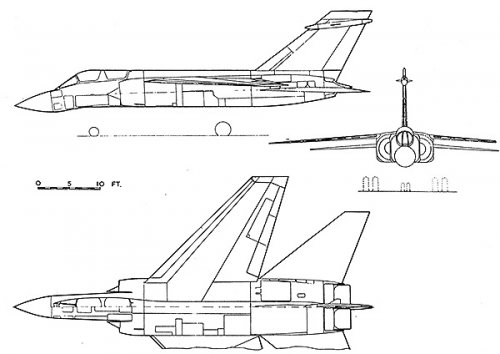
What-if mid-1970s twin-engined air superiority fighter

tomo pauk

ACCESS: Top Secret
Joined
1 May 2011
Messages
1,122
Reaction score
891
The aircraft needs to be a fighter from the get-go, armed with BVR and WVR missiles + a gun. 2-engined, big and heavy (but not overweight nor too big), fixed wings, with as good a radar & other electronics the industry can make. Wing and other refinements need to serve both to outright performance as well as the maneuverability, so the good compromise is wanted. Generous wing area and fuel tankage. Engine can be a turbojet for starters, until a good turbofan is made. Service entry preferably in the mid-1970s.
It will end up as an expensive project, like the Mirage 4000, MiG-25, MRCA or the Tornado, so cancel what needs to be cancelled.
 
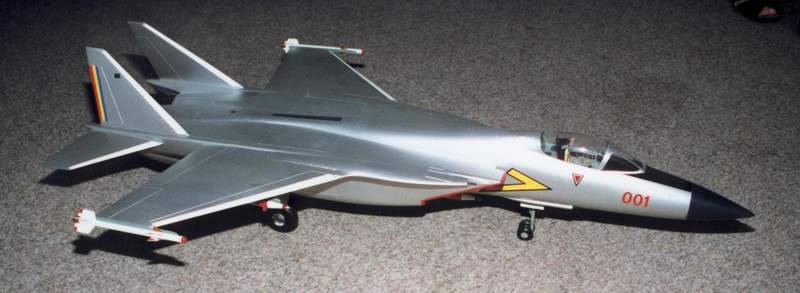
In another universe... this is Romania's F-15, it is unclear if it is one of the preliminary IAR-95 studies, or parallel /different (IAR-97?). Engines probably Spey and/or R-29 later. One can imagine a RSR-PRC joint venture to build this, evolving steadily since the 1980s to closer times.
1764261596015.jpeg
 
It even looks the part :)

Soviet-only types:
- A less ambitious sibling of the MiG-25, that does not have the ambitions for Mach 3. Less steel used, more light alloys. Engines - the ones from MiG-23 seem like just fine, later switch to the turbofans of 110-120 kN
- Su 15 getting the wing of greater area and the better engines
- People at Yakovlev get to their senses early enough, any whip up a modern fighter to compete with other Soviet designs instead of the outdated jets with underwing engines
 
In my mind where the UK makes good decisions from the 57 DWP the 16-18 sqn strong Lightning interceptor/fighter-bomber fleet will need to be replaced by something akin to an F15 or Super Hornet. With the TSR2 under their belt the British would be the senior partner and design leader in any consortium, which might include any of the MRCA partners.
 
For the British, perhaps a scenario where they keep the carriers, so there is no glut of the Phantoms upon the RAF? So RAF embarks earlier on the program to counter the improved Soviet aircraft (like MiG-25 and swing-wing Tupolev), and, say, make a big Jaguar with engines all they way to the tail? Gets them a land-based all-weather fighter that has, depending on the fuel load, still a very high rate of climb or the great range & endurance.
Bonus points - offer this as an off-the-shelf solution to the MRCA problem.
 
For the British, perhaps a scenario where they keep the carriers, so there is no glut of the Phantoms upon the RAF? So RAF embarks earlier on the program to counter the improved Soviet aircraft (like MiG-25 and swing-wing Tupolev), and, say, make a big Jaguar with engines all they way to the tail? Gets them a land-based all-weather fighter that has, depending on the fuel load, still a very high rate of climb or the great range & endurance.
Bonus points - offer this as an off-the-shelf solution to the MRCA problem.
So essentially an alternative to the Spey VG concept touted in the early 60’s.
By ditching the VG wing on cost/complexity grounds perhaps as a comparison study. Decision to proceed by mid-60's and IOC by early to mid-70's.
Driven as a counter to MiG-25 and supersonic bombers.
Earlier AI.24 (FMICW but not Foxhunter) and either licence AIM-47 Falcon (as per YF12) or domestic options HSD 'Family' or BAC solution.
Some 165 in varying marks.

Alternatively bigger beast piggybacks on a pair of TSR.2 Olympuses and totes larger radar.
 
So essentially an alternative to the Spey VG concept touted in the early 60’s.
By ditching the VG wing on cost/complexity grounds perhaps as a comparison study. Decision to proceed by mid-60's and IOC by early to mid-70's.
Driven as a counter to MiG-25 and supersonic bombers.
Earlier AI.24 (FMICW but not Foxhunter) and either licence AIM-47 Falcon (as per YF12) or domestic options HSD 'Family' or BAC solution.
Some 165 in varying marks.

Alternatively bigger beast piggybacks on a pair of TSR.2 Olympuses and totes larger radar.

I think by the late 60s new generation engines would be possible, in particular RR's 3 shaft turbofans. An RB.199 but in the 15,000lb dry - 25,000lb wet thrust class.

I agree about the radar and think in an ideal world the British by the early 70s would have SRAAM and Radar Red Top, which if developed like the Sparrow would be viable for years.
 
Is there a very good reason (or more of them?) for RR to insist on 3-shaft design for turbofans?
It allows each section of the engine (fan, LP compressor, and HP compressor) to spin at the ideal rpm for any given flight condition.

Is there some numbers about that?
RB211 versus JT9D as installed on 747-100s meant about 7% less fuel burned on the same flights.
 
It allows each section of the engine (fan, LP compressor, and HP compressor) to spin at the ideal rpm for any given flight condition.
Thank you for an informative answer.
There is a clear advantage of, at least RB.199 vs. the F-404 - the former is/was shorter by almost 70 cm than the later. On aircraft where the engines hang in the breeze that might not be important, but on the military aircraft where every liter of volume matters, this will, well, matter.

RB211 versus JT9D as installed on 747-100s meant about 7% less fuel burned on the same flights.

I've looked at RB.199 and F404. The early 199 was heavier than the early 404 by about 65 lbs (~6.5%), while making a much lower dry thrust (40.7 kN vs. 47.15 kN), and also having a much better specific fuel consumption by a large margin, like 1/4 lower.
The A/B thrust was the same, however, and the 404 has better SFC by a large margin - 1/4 lower.

The latest comparable marks, like the 404-GE-402, and the Mk.104 and 105 on the last of the Tornadoes show the greater weight of the 404, and lower weight of the 199 (??). Thrust slightly improved on the .199 (by up to 2.2 kN dry, 3.2 A/B), while it improved for the -402 by 6kN dry and by 7.5 A/B. Seems like the RB.199 have had less of a stretch?

Europeans (basically RR) didn't went with the 3-shaft design for the EJ200.

IMO: a 3-shaft design scores points on it's physical properties, mostly the length. On other properties, there seems not to be an advantage, especially in a military application where a lot of thrust is required, thus negating the benefits of the lower SFC at low regimes. Downside also might be that the 3-shaft engine is more complicated and more expensive.

 
IMO: a 3-shaft design scores points on it's physical properties, mostly the length. On other properties, there seems not to be an advantage, especially in a military application where a lot of thrust is required, thus negating the benefits of the lower SFC at low regimes. Downside also might be that the 3-shaft engine is more complicated and more expensive.

What about when you add in the time factor? The 3-shaft engine may be better in 1970 but improvements in design, materials and construction may remove that advantage in 1990.

I'd suggest that a British F15/Super Hornet analogue entering service in the mid-late 70s would have 3-shaft engines, and they'd be good for the time period.
 
What about when you add in the time factor? The 3-shaft engine may be better in 1970 but improvements in design, materials and construction may remove that advantage in 1990.
I've added the time factor when comparing the RB.199 with it's closest-sized rival.

I'd suggest that a British F15/Super Hornet analogue entering service in the mid-late 70s would have 3-shaft engines, and they'd be good for the time period.
Okay.
We'd probably want a 3-shaft engine that does some 100 kN with A/B for the starters? Scaling up the RB.199 figures, the early "RB.299" would've been about 40% heavier than the RB.199 for the same t/w ratio, that means about 1400 kg - a ballpark of the early P&W F100 as installed on the early F-16s and -16s. Length of 4-4.2m instead of 3.23m (and 4.85m for the F100)?
Diameter probably similar to the F100?
 
100kN = 22,500lb
55.6kN = 12,510lb
The latter roughly scales the difference between reheat and dry thrust of RB.199.

Based on area scaling up at same ratio of mass flow.....

33 and a quarter inches (848mm) diameter ought to deliver 12,510lb dry and 22,500lb reheated at similar s.f.c figures to RB.199.

Weight should only increase by roughly 200lb at worse to 2,350lb or 1,066kg.
If obedient to the same ratios of mass to performance.
 
33 and a quarter inches (848mm) diameter ought to deliver 12,510lb dry and 22,500lb reheated at similar s.f.c figures to RB.199.

Weight should only increase by roughly 200lb at worse to 2,350lb or 1,066kg.
100 kN with A/B on a 1066 kg engine, in the 1970s?
 
Thank you for an informative answer.
There is a clear advantage of, at least RB.199 vs. the F-404 - the former is/was shorter by almost 70 cm than the later. On aircraft where the engines hang in the breeze that might not be important, but on the military aircraft where every liter of volume matters, this will, well, matter.


I've looked at RB.199 and F404. The early 199 was heavier than the early 404 by about 65 lbs (~6.5%), while making a much lower dry thrust (40.7 kN vs. 47.15 kN), and also having a much better specific fuel consumption by a large margin, like 1/4 lower.
The A/B thrust was the same, however, and the 404 has better SFC by a large margin - 1/4 lower.
As well as three shafts versus two, the RB.199 has a higher bypass ratio. This gives it more oxygen available for afterburner thrust, for a bigger thrust boost in afterburner, at a cost in fuel. Nothing to do with three shafts,

The latest comparable marks, like the 404-GE-402, and the Mk.104 and 105 on the last of the Tornadoes show the greater weight of the 404, and lower weight of the 199 (??). Thrust slightly improved on the .199 (by up to 2.2 kN dry, 3.2 A/B), while it improved for the -402 by 6kN dry and by 7.5 A/B. Seems like the RB.199 have had less of a stretch?

Europeans (basically RR) didn't went with the 3-shaft design for the EJ200.
For a predominately fighter mission, cruise SFC is not the determining factor, you need to balance thrust to weight and thrust for supersonic flight and manoeuvring. EJ200 is much closer to the F404 in bypass ratio and cycle.

IMO: a 3-shaft design scores points on it's physical properties, mostly the length. On other properties, there seems not to be an advantage, especially in a military application where a lot of thrust is required, thus negating the benefits of the lower SFC at low regimes. Downside also might be that the 3-shaft engine is more complicated and more expensive.
Heavier, more complex. If longest range at economic cruise speed isn't a primary design driver, probably not worth the tradeoff.
 
Whereas now I'm able to look at my book....
Advanced scaled up RB.199 in place of Spey 5R concept circa '67-'71 likely the later post '69 HS.146 for carrier operations.

14,130lb dry
24,700lb reheated

Presumably in a similar diameter of engine (35" ?) and reheat chamber (42"?) to Spey. Though what weight is not stated. But we can assume no worse than Spey and probably lighter.

A good degree of cruise loitering capability due to it's superior s.f.c. Though it would depend on what optimisation for what speed and the capabilities of the inlets.
 
RB.199 thrust to weight being circa 7.7 would suggest 1,325 kg weight for 100kN, assuming the same basic level of technology.
 
For UK design there was in late '68 a fixed wing study of the UKVG/MRCA by BAC designated P.53
A picture of which is available on the relevant thread.
This gives us a vague example of a real world concept that might fit the bill.

HSA had P.1179X circa 1969 as an alternative. At that point still very F4-esque but considering how HSA concepts evolved onwsrd from Brough P.146 to P.153 and onwards to P.159 and ultimately P.163. Something a lot more like a F15 is quite plausible.
 
What the respective countries loose, with the F-15-equivalent entering service in the 1970s, as well as what comes next?
Soviets can start replacing the Su-15s and Tu-28s much earlier? The MiG-25 gets exported more freely? This might've delayed them either the MiG-31 or the Su-27 (or both), that is both a blessing and a curse.
French - there is no Mitage 2000 as we know it, since the pre-M4000 is in service. The 1980s might've see an 1-engined design, both for the domestic needs (to start replacing the Jaguars and 1-engined Mirages), as well as for export, since the big fighter will be a hard sell.
Other Europeans - there is no Tornado (the big fighters gets the fighter-bomber version, in the fashion of the F-15E), and there is actually a chance that F-16 and/or F-18 get even more sales? Lightnings end up onthe 2nd hand market? Here also an 1-engined design might've also emerged by the mid-1980s? So Europe might've ended up with their own Lavi or J-10 (the big engine will be now 110-120 kN?), together with the Gripen - gets them a more viable commercial product for the lean years of 1991-2010?
 
The aircraft needs to be
...basically the F-15.

This is the closest thing to your specifications, both in timeline and in aircraft description.

In my mind where the UK makes good decisions from the 57 DWP
It seems to me that the only reasonable decisions in this vein are:
1) Develop the Lightning to its limits, with every gimmick English Electric can fit into it (including SARH illumination).
2) Develop something out of either the Fairey ER.103C or the Hawker P.1121 as the Lightning successor, with a solid nose that can take a bigger, better, SARH-illuminating radar. OTL Lightning Mk1/Mk 2 holds the line until the new aircraft is ready in the mid 60s, then is shut down without mercy and EE is compensated with service contracts until the aircraft run out of hours and with the P.17 contract as the Canberra successor.

This latter option especially stops the development cycle of manned fighters, high-performance engines (e.g. full size Gyron) and newer, better AAMs/radars being interrupted the way it was in 1957, while at the same time not wasting work that had already been done. A sane, safe and sensible RAF fighter with built-in growth potential emerges in the early to mid 60s, and the development team has continuity and experience to roll on to the next generation 10-15 years later, i.e. the concept fighter the OP wants.
 
1) Develop the Lightning to its limits, with every gimmick English Electric can fit into it (including SARH illumination).

Apparently the AI23 could have incorporated SARH illumination from the 200th production unit, but the Lightning was never planned to get to that level of production. If the Lighting was supported heavily by the British government and developed with all the gimmicks then 200 AI23s is assured so the F3/F3A/F6 analogues would have been fitted with SARH illumination. I'd suggest the 'radar Red Top' would be a good missile, likely fitted to Lighting wing pylons.

2) Develop something out of either the Fairey ER.103C or the Hawker P.1121 as the Lightning successor, with a solid nose that can take a bigger, better, SARH-illuminating radar. OTL Lightning Mk1/Mk 2 holds the line until the new aircraft is ready in the mid 60s, then is shut down without mercy and EE is compensated with service contracts until the aircraft run out of hours and with the P.17 contract as the Canberra successor.

If the Lightning was supported and developed there would be no reason to replace it in the 60s. By 1964 the plan was to fly them until the mid-late 70s and I think by the late 60s with a mid-life avionics update it could serve into the 80s quite credibly. Its replacement wouldn't have to start serious development until the TSR2 development had finished in the late 60s/early 70s, which clears the way for the TSR2 to be developed to production. Indeed, the TSR2 used a solid-state version of the AI23 first used in the Lightning, so the Lightning's late 60s-early 70s mid-life avionics update could be incorporating more or less off the shelf TSR2 gear into the Lightning.
 
For UK design there was in late '68 a fixed wing study of the UKVG/MRCA by BAC designated P.53
A picture of which is available on the relevant thread.
This gives us a vague example of a real world concept that might fit the bill.

I'm blind or stupid, but I can't find anything on the BAC P.53, do you know the thread it was in?
 
To be honest we can see quite a bit of Tornado in this and it's obviously a comparison study.
In this we can assume a final design being more Tornado like in the fuselage and probably inlets.

So a true air-to-air fighter would have a larger wing.
 
To be honest we can see quite a bit of Tornado in this and it's obviously a comparison study.
In this we can assume a final design being more Tornado like in the fuselage and probably inlets.

So a true air-to-air fighter would have a larger wing.

To replace an all-in Lightning fleet some 8 fighter-bomber/fighter-recce sqns and 8 fighter/interceptor sqns of this 'British teen series' fighter would be needed. Would much compromise be needed from the air-to-air version to accommodate the fighter-bomber role? The F16 and F/A18 were pretty uncompromising air-to-air fighters that discharged their air-to-ground role very well from the get-go, so it likely shouldn't be much compromise.
 
Well I'm not sure how much compromise is needed. Though obviously with more wing area for better performance at altitude, as a fighter. It would make for a less comfortable ride a low level.

Not much of a compromise if instead of a focus on low level, there had been more focus on SEAD/DEAD capability.
Spending VG money on EW, ECM and ARMs etc....

As it was Tornado was cleared for more weapons than any other European aircraft bar today's Typhoon and arguably it was cleared for more.

We can envision this AH Fighter-Bomber 4 recessed Sparrows, and wingtip Sidewinders or SRAAM/Taildog. Still potentially using wing pylons to tote air-to-ground ordinance, or drop tanks, or various podded systems.
 
Well I'm not sure how much compromise is needed. Though obviously with more wing area for better performance at altitude, as a fighter. It would make for a less comfortable ride a low level.

Not much of a compromise if instead of a focus on low level, there had been more focus on SEAD/DEAD capability.
Spending VG money on EW, ECM and ARMs etc....

As it was Tornado was cleared for more weapons than any other European aircraft bar today's Typhoon and arguably it was cleared for more.

We can envision this AH Fighter-Bomber 4 recessed Sparrows, and wingtip Sidewinders or SRAAM/Taildog. Still potentially using wing pylons to tote air-to-ground ordinance, or drop tanks, or various podded systems.

With a good number of TSR2s (~10 sqns) and a small number of P1127 Harriers (3 or 4 sqns) in service there wouldn't be a large requirement for long transits are very low level, so the big wing at low level should be manageable. Other than that, I agree but for Radar Red Top Mk2 instead of Sparrows, although the aircraft would be compatible with Sparrow for the export market.
 
Well by this point in time, we'd really be talking a next generation AAM and the technologies of Skyflash applied. Rather than Red Top mkII.

Exactly what that would look like is an open question.
 
Well by this point in time, we'd really be talking a next generation AAM and the technologies of Skyflash applied. Rather than Red Top mkII.

Exactly what that would look like is an open question.

IIRC it was you that said something like the RN's acquisition of the Sparrow and Sidewinder short-circuited British AAM development.

So, in my Middle Earth/Westeros/Blade Runner post 57 DWP fantasy Britain that's something that needs to be addressed and having the Red Top morph into Britain's sparrow analogue via the Radar Red Top route seems to be the path of least resistance.
 
The F16 and F/A18 were pretty uncompromising air-to-air fighters that discharged their air-to-ground role very well from the get-go, so it likely shouldn't be much compromise.
What would you mean under the F-16 and F-18 "discharged their air-to-ground role very well"?

As it was Tornado was cleared for more weapons than any other European aircraft bar today's Typhoon and arguably it was cleared for more.

Can you elaborate a bit on this passage?
 
What would you mean under the F-16 and F-18 "discharged their air-to-ground role very well"?

The F16 and F/A18 were highly manoeuvrable and highly effective air to air fighters. The F16 being able to sustain high G turns so long that the pilot seat had to be reclined back so they wouldn't black out. The F/A18 had the highest Angle of Attack capability of the teen series, it could lift the nose 55 degrees compared the F16's 29 degrees.

These impressive air to air combat capabilities did not impinge on these aircraft ability to conduct attack missions, which they have done well throughout their careers. This is in contrast to 2nd (and 3rd?) Gen fighters whose air-to-ground capability was often limited in order to make these aircraft effective air-to-air fighters.
 
So, in my Middle Earth/Westeros/Blade Runner post 57 DWP fantasy Britain that's something that needs to be addressed and having the Red Top morph into Britain's sparrow analogue via the Radar Red Top route seems to be the path of least resistance.
FWIW, I get Blue Dolphin Mk.4 as a direct Skyflash equivalent entering service in 1978.
 
Back
Top Bottom