Late 70s RN fleet carrier design?

I really like the Type 988, the RNs post 984 radar path was a dogs breakfast despite promising research whereas the SPS-01 was a real beast for the era and actually entered service.

I certainly think it would be fitted to CVA01 and 2 Type 82s and likely refitted to the 52 carrier into the bargain. Beyond that, I suspect the Type 42 would have it designed in as the Batch 3 were a similar displacement to the Tromp class.

Where that leaves this radar in the late 70s I can't say. It started production in the late 60s so by the late 70s a seriously upgraded version or an entirely new radar would be on the cards. The requirement would be for the 78 carrier itself as well as it's ~2 DLGs and another ~2 DLGs for the 52 carrier, replacing the command capability of at least some of the Counties.
 
To take this topic in a slightly different direction. What if this late 70s carrier wasn't a follow-on to CVA01, but a new, budget-constrained carrier to replace Ark Royal circa 1979-80?

This carrier would operate either as a complement to the Invincible helicopter carrying cruisers (whose numbers would have been cut to only 1 or 2 hulls), or lead to Invincible's cancellation circa 1975. Also Sea Harrier likely wouldn't have moved forward (ordered 1975), though a greater emphasis on operating RAF Harrier GR 3s might have partially offset this.

So given budget constraints, no Sea Harrier, and the need to operate the existing crop of Phantoms and Buccanneers, how do you take cost out of CVA-01? Or start from scratch? e.g. No Sea Dart, lower top speed to reduce propulsion size? Keeping in mind that around the same timeframe (1975), the USN was studying ~33,000t VSS designs with 2 C13 catapults, a 100,000shp steam plant giving ~26.5 knots (sustained), and over 30 aircraft, costing roughly 1/3rd of a CVN.
I've been doodling with my idea of a minimum-size CTOL carrier for the late 70s, somewhat similar to Clemenceau or some of the VSS designs being studied by the USN, but capable of operating F-4 Phantoms.

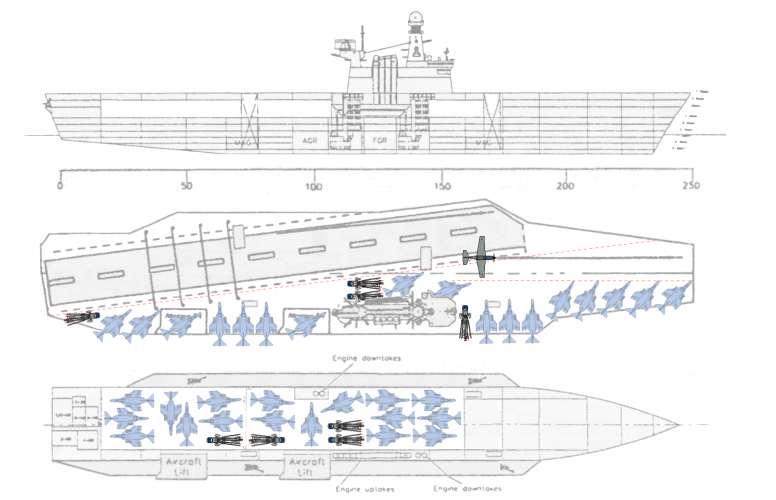
Figured it might be interesting to use the CVF tradeoff studies from the 1990s for inspiration, as they are distinctly British and share some design lineage with the Invincibles. Here is the result... a ~35,000 ton carrier with ~30 F-4 Phantoms (34 spots) and 8-9 Sea Kings ASW/AEW. A mix of Phantoms and Buccaneers would also be possible, as would Gannet AEWs if their service life could be extended (or E-2 Hawkeyes down the road and likely F/A-18s eventually).

CV 35000t 2px=1ft F-4 spotting.png

The early CVF tradeoff studies are interesting because they all had 4 gas turbines but managed to keep fairly compact uptakes and island footprints. They also came in a range of sizes (20 - 26 - 40 aircraft in the hangar), so I was able to take the "20 VSTOL" design and convert it to CTOL by adding elements from the larger "26 CTOL" design, including an angled deck, sponsons, catapults, moving the island forward to make room for deck edge elevators etc.

My design has the same overall length, hull depth and hangar size as Clemenceau, but with a slightly beamier, fuller hull form to add more hull volume and stability, which increases displacement from ~32,000t to ~35,000t full load (guesstimate). This also allows for a larger deck park and longer angled deck, but the result is not as extreme as Charles de Gaulle. With 4 Olympus GTs and 95-100k shp a speed of 28-30 knots should be possible.
 
Last edited:
Not to say it can't be done, and it's been years since I read Hobbs, but iirc not only was the 53-58,000t size the maximum the British could build but it was also the minimum size needed for tactical utility. However, I can't recall why this was, perhaps it was tied up with the RNs Tactical Air Unit of 2 carriers needing 64 (?) Phantoms and Buccaneers to face the toughest opposition. I believe there was equations like X sorties to protect the carrier needs Y fighters, which allows Z strike aircraft to do the carrier's real job of attack.

When the RAN took it abortive look at an Essex in 1964 or so the proposed CAG was 16 F4Bs, 12 S2Es and helicopters. Even with a 70s design all the improvements this implies I suspect this is still a good indication of a CAG for a carrier in the mid 30k tonnage range carrying big aircraft like Phantoms.

Another reference point would be the 1 or 2 carriers (Ranger and JFK I think) that carried 'Grumman Air Groups' in the early-mid 80s during the refit cycle converting to the Hornet. These were 2 x F14 and 2 x A6E sqns for a total of 48 combat aircraft on these massive USN supercarriers. Granted they had to use Marine A6 sqns to make up the CVWs, but going from a medium sized A7 to the big A6 led to a drop in numbers.
 
Not to say it can't be done, and it's been years since I read Hobbs, but iirc not only was the 53-58,000t size the maximum the British could build but it was also the minimum size needed for tactical utility. However, I can't recall why this was, perhaps it was tied up with the RNs Tactical Air Unit of 2 carriers needing 64 (?) Phantoms and Buccaneers to face the toughest opposition. I believe there was equations like X sorties to protect the carrier needs Y fighters, which allows Z strike aircraft to do the carrier's real job of attack.
Well, also it was the smallest size that could fit two 250-foot catapults needed to launch 70,000-lb aircraft.
 
Well, also it was the smallest size that could fit two 250-foot catapults needed to launch 70,000-lb aircraft.

With the RAN Essex investigation most of the questions were around F4Bs with extended more oleos on C11 cats, but there was mention of fitting 250-foot C7 cat (or cats). Air Chief Marshall Scherger, Chairman Chief Of Staffs Committee had to pull them up and ask if this was even physically possible.

Scherg was right, you can't just throw big cats into small carriers, even if they had enough steam to run them.
 
TAU of 64 strike-attack aircraft and 32 CAP Fighters plus 8 AEW aircraft.
Divided by two carriers each with 2 SAR helicopters and 6 ASW helicopters.
 
Well, also it was the smallest size that could fit two 250-foot catapults needed to launch 70,000-lb aircraft.
Charles de Gaulle with 2x 250ft C13s proved that isn’t true. Original displacement was only 36,000t (though that increased somewhat with additional radiation shielding to meet increased nuke safety standards).

And it’s not a matter of CdG being a nuke either, as DCN offered a gas turbine conventional CdG to India with the same catapults.

And CdG was designed for 36x F/A-18s. I expect 36 F-4s would work too on that displacement, given similar spot factor.
 
Last edited:
Charles de Gaulle with 2x C13s proved that isn’t true. Original displacement was only 36,000t though that increased somewhat with additional radiation shielding to meet increased nuke safety standards.
*shrugs*

That was not the conclusion the CVA-01 design studies came to. There's a pretty clear crossing point where they go from 225-foot to 250-foot catapults. And in fact looking at De Gaulle's deck layout I'd say the French only managed that by making compromises the British were unwilling to - notably, De Gaulle's bow catapult intrudes on her landing path, which would make it difficult if not impossible to run full-cycle simultaneous air operations. CVA-01 does not have this issue, and is in fact quite well laid-out to make sure landing and taking-off aircraft don't intrude on each other.
 
Last edited:
TAU of 64 strike-attack aircraft and 32 CAP Fighters plus 8 AEW aircraft.
Divided by two carriers each with 2 SAR helicopters and 6 ASW helicopters.

That's 48 combat aircraft per carrier, I didn't think the CVA01 could operate that many? However I expect that the 78 carrier could likely operate more aircraft on a similar displacement, but not 48.
 
De Gaulle's bow catapult intrudes on her landing path, which would make it difficult if not impossible to run full-cycle simultaneous air operations
True but that’s a very debatable requirement.
USN cyclic ops almost never rely on simultaneous launch & recovery. The point of cylic ops is to be able to launch, recover and turnaround large deck loads sequentially, which is more efficient.

Plus recovery and catapult phases are a lot shorter on a carrier with 30-40 jets vs 70-80. When your typical recoveries last less than 10 minutes, the need for simultaneous ops basically disappears.
 
That's 48 combat aircraft per carrier, I didn't think the CVA01 could operate that many? However I expect that the 78 carrier could likely operate more aircraft on a similar displacement, but not 48.
She most likely could. The 18 Phantom/18 Buccaneer air wing is likely a reversion to prior RN practice of leaving space open for an extra wartime squadron.

This is backed up by the CVA-01 studies. Study 24, an 870-footer, was credited as carrying 53 Buccaneer-sized aircraft; the 920-foot Study 53, which evolved into CVA-01, was credited with only 36. It's the best way I can think of squaring this discrepancy.

I also have my own spot factor calculations, and the math checks out on those.
 
That's 48 combat aircraft per carrier, I didn't think the CVA01 could operate that many? However I expect that the 78 carrier could likely operate more aircraft on a similar displacement, but not 48.
CVA-01 planning factor was 36 jets normal and 42 jets maximum.

https://www.secretprojects.co.uk/threads/hms-hermes-info.10284/post-680625
max-png.729324
 
The 36 (18 S and 18F) figure is for a reduced airwing for less stressing missions as a single carrier.

The full TAU (of 64 S and 32 F) is for the most stressing mission as a pair of carriers.

Obviously in all likelihood the lower figure is going to be more common throughout the lifespan of the carrier.
 
In a perfect world (nurse the screens!) CVA 01 would have been ordered in 1966 and entered service in 1974 after lengthy trials with the first T82 (HMS Bristol) had validated CF299Seadart.
Her initial airgroup would have been a new F4 Squadron, and Buccaneer, Gannet AEW COD, and Seaking squadrons from Hermes.
CVA 02 would be laid down in 1973 and enter service in 1979 allowing HMS Eagle to decommission.
By 1979 the UK planned to have a VG fighter/attacker in service (something like AFVG) with both the RAF and RN. An Anglo French AEW aircraft was also planned.
In 1980 faced with Kiev and Kirov class units entering service the Thatcher government orders CVA 01 for delivery in 1986.
This third ship would have learnt lessons from the first two and might have included different armament and propulsion.
By 1991 CVA 01 is reaching the end of her planned life but is still able to take part on Operation Desert Storm with CVA 03.
Options for Change decides to sell CVA01 to India with her airgroup. CVA 02 and CV03 will be phased out during the 90s to be replaced by a multi-role LCVA modelled on the US Wasp and Tarawa classes operating a new STOVL aircraft or
a new CV design able to operate US F18 and A12 aircraft.

Now let us leave the world of dreams. HMS Invincible and Illustrious enter service by the end of 1982. But Ark Royal is modified and stretched to carry Seawolf instead of Seadart and allow less cramped operation of Sea Harriers and Seakings. She enters service in 1984.

Work on a new class of stovl carriers for the RN is in hand by 1990. Looking much more like the Italian Garibaldi but significantly larger they are also envisaged as Commando Ships for limited warfare.
 
Now let us leave the world of dreams. HMS Invincible and Illustrious enter service by the end of 1982. But Ark Royal is modified and stretched to carry Seawolf instead of Seadart and allow less cramped operation of Sea Harriers and Seakings. She enters service in 1984.

That decision needs to be taken before Ark is laid down in Dec 1978, two years before any experience had been gained with Invincible. Alternatively its a "cut and shut" job sometime after her launch in June 1981. Either way her her commissioning is going to be pushed back beyond the historical Nov 1985.

Unless of course you are just thinking about extending the flight deck forward to the extreme bow and adding an overhang at the stern. That might get you more flight deck but does next to nothing for additional hangar space.

So you have still not left the world of dreams!
 
In a perfect world (nurse the screens!) CVA 01 would have been ordered in 1966 and entered service in 1974 after lengthy trials with the first T82 (HMS Bristol) had validated CF299Seadart.
Her initial airgroup would have been a new F4 Squadron, and Buccaneer, Gannet AEW COD, and Seaking squadrons from Hermes.
CVA 02 would be laid down in 1973 and enter service in 1979 allowing HMS Eagle to decommission.
By 1979 the UK planned to have a VG fighter/attacker in service (something like AFVG) with both the RAF and RN. An Anglo French AEW aircraft was also planned.
In 1980 faced with Kiev and Kirov class units entering service the Thatcher government orders CVA 01 for delivery in 1986.
This third ship would have learnt lessons from the first two and might have included different armament and propulsion.
By 1991 CVA 01 is reaching the end of her planned life but is still able to take part on Operation Desert Storm with CVA 03.
Options for Change decides to sell CVA01 to India with her airgroup. CVA 02 and CV03 will be phased out during the 90s to be replaced by a multi-role LCVA modelled on the US Wasp and Tarawa classes operating a new STOVL aircraft or
a new CV design able to operate US F18 and A12 aircraft.

Now let us leave the world of dreams. HMS Invincible and Illustrious enter service by the end of 1982. But Ark Royal is modified and stretched to carry Seawolf instead of Seadart and allow less cramped operation of Sea Harriers and Seakings. She enters service in 1984.

Work on a new class of stovl carriers for the RN is in hand by 1990. Looking much more like the Italian Garibaldi but significantly larger they are also envisaged as Commando Ships for

I'm aware that the premise is flimsy at best I'm more interested in the technology of such a carrier than how to plausibly bring it into service. That said, handwaving the 1952 carrier into service does totally change the CVA01 saga.

Speaking of technology, IIUC the 250' BS6 cats were F111B compatible, which was the looming USN interceptor in 1966. By 1978 the F14 was in service and F/A18 in development, would the new carrier need more powerful cats? Given the consensus seems to think the 78 carrier would be closely related to CVA01 would there be room for longer cats? Perhaps the RN might like what the RAN did lengthening the Melbourne's xat from 103' to 112' with the same power in order to reduce the stress of each launch by about 8%, and give the 78 carrier's cats a few extra feet.
 
The 36 (18 S and 18F) figure is for a reduced airwing for less stressing missions as a single carrier.

The full TAU (of 64 S and 32 F) is for the most stressing mission as a pair of carriers.

Obviously in all likelihood the lower figure is going to be more common throughout the lifespan of the carrier.

Sure, but the doc in the post above says that CVA01 mixed out at 42 jets not 48. Realistically for the RN to have a full TAU it would need 3 carriers.

That said, RN 55,000t carriers would be the most powerful non USN ships in the world. Even the Phantom refitted Eagle would be capable of intervention in most Cold War crises.
 
Realistically for the RN to have a full TAU it would need 3 carriers.
That’s been my contention for 20 years. The numbers don't stack up for two CVA-01 type carriers. That the Treasury saw through the rouse and hit the roof.

Actually that might support your view view that CVA-02 or -03 might be slightly bigger.

But we also need to pay attention to expected successor aircraft. OR.346, F111B and F14 eventually offer greater capability per plane and their size reduces the airwing you can squeeze onto the carrier.
So 32 fighter can be replaced by 12-18 advanced fighters able to simultaneously engage multiple targets at range.
More importantly they can swing from one role to another rapidly. Reducing numbers at the cost of higher utilisation rates.

Example the 42,000ton CV study had room for 32 aircraft of Buccaneer size. But only 18 OR.346 would fit.

F4 bought time in the form of something more viable than Sea Vixen and more 'on-time' than the then projected wonderplanes of the future. Time to actually achieve such capabilities. In fact set the FAA up for this expected future better.

Said incrementally improved CVA-01 type design might embody higher shp plant, props and shafts. Higher pressure catapults, etc...

But...
If 1952 CV was built with Y300 (low risk incremental improved plant as planned), then the next generation would be the moment to fund improved testing establishment and allow CVA-01 to be bigger being based on plant delivering 60-70,000shp.
This means the three shaft layout but delivering between 180,000shp to 210,000shp.
 
Last edited:
The problem of an airgroup for a UK carrier fleet in the 1980s can be solved by a joint RN/RAF fighter and strike aircraft along the lines of AFVG.
If the UK had wanted such an aircraft I am sure W Germany and Italy would not have objected to Tornado looking like it.
Cancelling the CVA 01 seems to have been welcomed by the designers who saw it as too compromised by innovations.
The Ark Royal or Eagle single ship option could have bought time for a fresh look at a three carrier fleet for the 1980s.
Instead of the through deck cruiser a more open analysis of what the new carriers should do for our NATO commitments would have produced the following:

ASW in the North Atlantic using helicopters coordinated with frigates , submarines and RAF Nimrods.

Maritime Air Defence against missiles and Soviet Bears, Badgers and Blinders plus the Backfire.

Surface attacks against Soviet cruisers including the new Kiev class

Support for Allied operations out of NATO area such as Five Power Malaysia.

Design work going on in the US and France would have been examined.

The largest possible platform should be adopted.

Gas turbine or mixed like the County Class

The first ship to enter service in 1981 replacing Ark/Eagle which would already have carried out trials with Tornado.

All three ships to enter service by 1985
 
Cancelling the CVA 01 seems to have been welcomed by the designers who saw it as too compromised by innovations.
Yet in order to meet restrictions on displacement, supposedly to keep costs down, riskier and potentially costlier innovations were the only way forward.
This is where the conflating of tonnage with cost fell down comprehensively.
A higher displacement for the same capability was potentially cheaper per ton. The main cost increase is down to the propulsion system.
Again that takes us to the testing equipment limitations.
 
That’s been my contention for 20 years. The numbers don't stack up for two CVA-01 type carriers. That the Treasury saw through the rouse and hit the roof.

Actually that might support your view view that CVA-02 or -03 might be slightly bigger.

But we also need to pay attention to expected successor aircraft. OR.346, F111B and F14 eventually offer greater capability per plane and their size reduces the airwing you can squeeze onto the carrier.
So 32 fighter can be replaced by 12-18 advanced fighters able to simultaneously engage multiple targets at range.
More importantly they can swing from one role to another rapidly. Reducing numbers at the cost of higher utilisation rates.

Example the 42,000ton CV study had room for 32 aircraft of Buccaneer size. But only 18 OR.346 would fit.

F4 bought time in the form of something more viable than Sea Vixen and more 'on-time' than the then projected wonderplanes of the future. Time to actually achieve such capabilities. In fact set the FAA up for this expected future better.

Said incrementally improved CVA-01 type design might embody higher shp plant, props and shafts. Higher pressure catapults, etc...

I can't shake the feeling that the TAU was an ideal for planning purposes and/or that the RN hoped/expected to get there not solely with it's own resources. For example EoS a pair of RN carriers could expect HMAS Melbourne to add to the numbers if needed, in the Med an RN carrier could pair with the French, in the North Atlantic with HMCS Bonny or HNLMS Karel Doorman in the 60s. Then of course there's the USN carriers, with the RN being the lesser or even equal partner depending on the ships at the time.

If 1952 CV was built with Y300 (low risk incremental improved plant as planned), then the next generation would be the moment to fund improved testing establishment and allow CVA-01 to be bigger being based on plant delivering 60-70,000shp.
This means the three shaft layout but delivering between 180,000shp to 210,000shp.

This is an interesting point, even with a little as 55,000shp the CVA01 picks up some displacement flexibility on the low-cost, 3-shaft propulsion option without reverting to spend an extra 5-6 million on a 4th shaft to get to ~58,000t.
 
Last edited:
Cancelling the CVA 01 seems to have been welcomed by the designers who saw it as too compromised by innovations.

This seems to have been grabbed by the revisionist historians in the decades following the cancellation, much like the TSR2s problems have been, to justify cancellation after the fact. I don't doubt the CVA01 spec was challenging and the project was tough to manage with problems like there not being enough naval draughtsmen and the like. However it wasn't impossible, if it was the project wouldn't have progressed o the point where 3.5m worth of long lead items being ordered by late 1965.
 
Yet in order to meet restrictions on displacement, supposedly to keep costs down, riskier and potentially costlier innovations were the only way forward.
This is where the conflating of tonnage with cost fell down comprehensively.
A higher displacement for the same capability was potentially cheaper per ton. The main cost increase is down to the propulsion system.
Again that takes us to the testing equipment limitations.

Which is my motivation for the thread, would the same or similar limitations be easier to achieve with 1978 technology? For starters 6 Olympus GTs offers ~140-160,000shp, so the power issue seems to be addressed somewhat.
 
Had to dig the book out.
CVA-01 study 1962.
58,000tons
L 970ft
BWL 120ft flight deck width 190ft
8 degree angled deck
2 250ft catapults
2 lifts 70ft by 32ft
180,000shp/4 shafts for 29kts D&D
Aircraft weight 70,000lb
24 F4 Phantom
24 S2 Buccaneer
4 AEW
2 SAR
cost £60-65 million
Strike/VF 40 Aircraft. (Possibly OR.346 at this stage)

Assuming this is revisited for new carriers for '78.
So getting plant, shafts and props to 60,000shp allows a cut to 3 sets for the same output.
Aircraft weight could be increased to 80,000lb for greater flexibility, especially for F14. Maybe a third lift and catapult depending on the details.
 
Had to dig the book out.
CVA-01 study 1962.
58,000tons
L 970ft
BWL 120ft flight deck width 190ft
8 degree angled deck
2 250ft catapults
2 lifts 70ft by 32ft
180,000shp/4 shafts for 29kts D&D
Aircraft weight 70,000lb
24 F4 Phantom
24 S2 Buccaneer
4 AEW
2 SAR
cost £60-65 million
Strike/VF 40 Aircraft. (Possibly OR.346 at this stage)

That ship is 50% of the TAU in a WW3 or Falklands scenario, but the ~53,000t ship gets 7/8 of that max capability but with only 3/4 of the propulsion and less steel to cost ~6m pounds less. The you run into the issue that the RN will never buy enough aircraft to sustain the '50% TAU CAG', or enough personnel, or sustainment funds to utilise it enough days. So they risk-manage it and buy the 3-shaft carrier suited to operate 36 jets over 30 years and peaking at 42 in an emergency rather than overkill 4th shaft and 5,000 extra tons to get an extra 6 jets in the most extreme emergency.

Assuming this is revisited for new carriers for '78.
So getting plant, shafts and props to 60,000shp allows a cut to 3 sets for the same output.
Aircraft weight could be increased to 80,000lb for greater flexibility, especially for F14. Maybe a third lift and catapult depending on the details.

I'm inclined to agree. While a bunch of factors drove the RN to the 3-shaft, 53,000t ship the march of technology is likely to allow a 58,000t ship with the 'cheap' 3-shaft propulsion by 1978. Maybe the RN will not operate bigger CAGs with the bigger ship, but they'll be able to if the situation demands it.
 
The easiest way to approximate would probably be taking some of the very, very preliminary and early projects of the CVF program and downgrading them to appropriate tech level. At least they reveal the feverish dreams thinking of the naval command about what they would want given enough resources.

Something like this one, replacing F/A-18 with Typhoons -

View attachment 785408

(the image is from one of the CVF threads here, I just can't remember which one)

3 catapults, 4 lifts, 40 aircraft in hangar, long and narrow hull indicating desire for high speed.

What are dimensions and displacement of this design?
 
With so many paper and computer wargames around it ought to be possible to game scenarios to show the impact of UK carriers of various designs.

Has anyone tried this?
 
For what it's worth, I don't think CVA-01 could realistically operate more than ~36 fighters without locking the deck. (Plus 8-10 Sea King helos or Gannets for ASW/AEW). Anything more than that would significantly impact aircraft turnaround times and sortie rates.

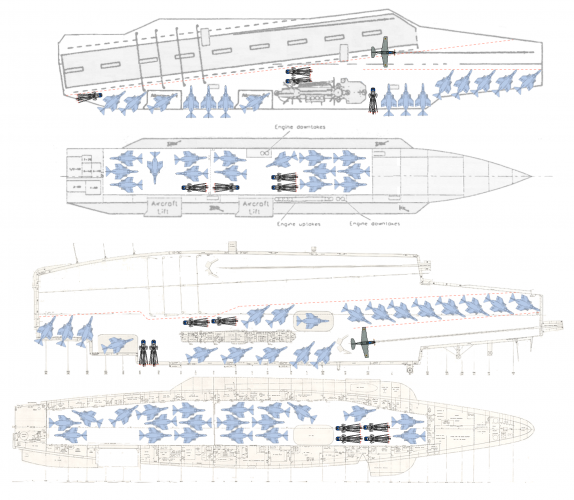
Here's CVA-01 (bottom) with 40x F-4 Phantoms and 8 Sea Kings. The bow catapult and Alaskan taxiway are locked, making aircraft movements difficult until after the first launch. You really don't get the benefit of simultaneous launch & recovery until you launch a half dozen aircraft (at least) and clear both sides of the island. Moreover, the bow deck park is very tight - barely suitable if you need to launch a Gannet (56' span), let alone an E-2 Hawkeye (80' span)... these would have to use the port catapult on the angled deck.

Personally I prefer a conventional layout like my notional 35,000t carrier (top). Even with 30x F-4 Phantoms the layout is very flexible and deck/hangar movements straight forward, even though this is optimized for more traditional cyclic operations (aside from deck launched interceptors and buddy tankers which can be launched at any time).

Top: 35,000t CV with 30x Phantoms (15 on flight deck + 15 in hangar)
Bottom: 54,000t CVA-01 with 40x Phantoms (20 on flight deck + 20 in hangar)

CVA-01 vs 35000t CV 2px=1ft.png
 
Last edited:
For what it's worth, I don't think CVA-01 could realistically operate more than ~36 fighters without locking the deck. (Plus 8-10 Sea King helos or Gannets for ASW/AEW). Anything more than that would significantly impact aircraft turnaround times and sortie rates.

Here's CVA-01 (bottom) with 40x F-4 Phantoms and 8 Sea Kings. The bow catapult and Alaskan taxiway are locked, making aircraft movements difficult until after the first launch. You really don't get the benefit of simultaneous launch & recovery until you launch a half dozen aircraft (at least) and clear both sides of the island. Moreover, the bow deck park is very tight - barely suitable if you need to launch a Gannet (56' span), let alone an E-2 Hawkeye (80' span)... these would have to use the port catapult on the angled deck.

British experience lead them to the conclusion that they'd never be able to operate more than 2/3 of the CAG at any one time with 1/3 down in the hangar un-serviceable and at times 2/3 of the CAG would be down in the hangar un-serviceable and only 1/3 flyable. It was around these numbers that they calculated their sortie rates, deck movements and the like. Cramming in those extra 6 jets to go from 36 to 42 gives the CAG that extra buffer for defence when 2/3 of the CAG is U/S and an all out effort some extra power when 2/3 of the CAG is serviceable and flying.

FWIW I don't think this 1/3-2/3 thing would be alien to the USN for much of the Cold War. I've heard an anecdote that F14 squadrons would ready 3 aircraft for a 2 aircraft sortie in case of a late unservicability or mission abort. The 1968 Ault report faulted USN F4 sqns for considering aircraft with U/S weapon systems as "up" aircraft and launching them when an A6 with an U/S weapon system was considered "down" and not launched. While the USN may not have had 2/3 of the CVW in the hangar for maintenance at times I imagine that like the RN they could only ever operate 2/3 of their aircraft at any one time.
 
While it's nice to see the effort at trying arrangements. I doubt it would look like that HK. But I appreciate you had go and it certainly used to be fun puzzle.
 
While it's nice to see the effort at trying arrangements. I doubt it would look like that HK. But I appreciate you had go and it certainly used to be fun puzzle.
My arrangements are based on standard USN spotting patterns, with also a look at Royal Navy practice and French spotting on Clemenceau & CdG. They are as close as I can make to the real world.

This involves making sure as many aircraft as possible can be moved around without having to shift others, eg. leaving 1-2 empty spots in each hangar bay, leaving clear taxi lanes on the flight deck to spot the aircraft for launch, space for mobile cranes, tractors, munitions etc. If anything I’m being generous as often parts of the hangar are taken up by maintenance gear, ships boats and other things that take up space and reduce the achievable density.

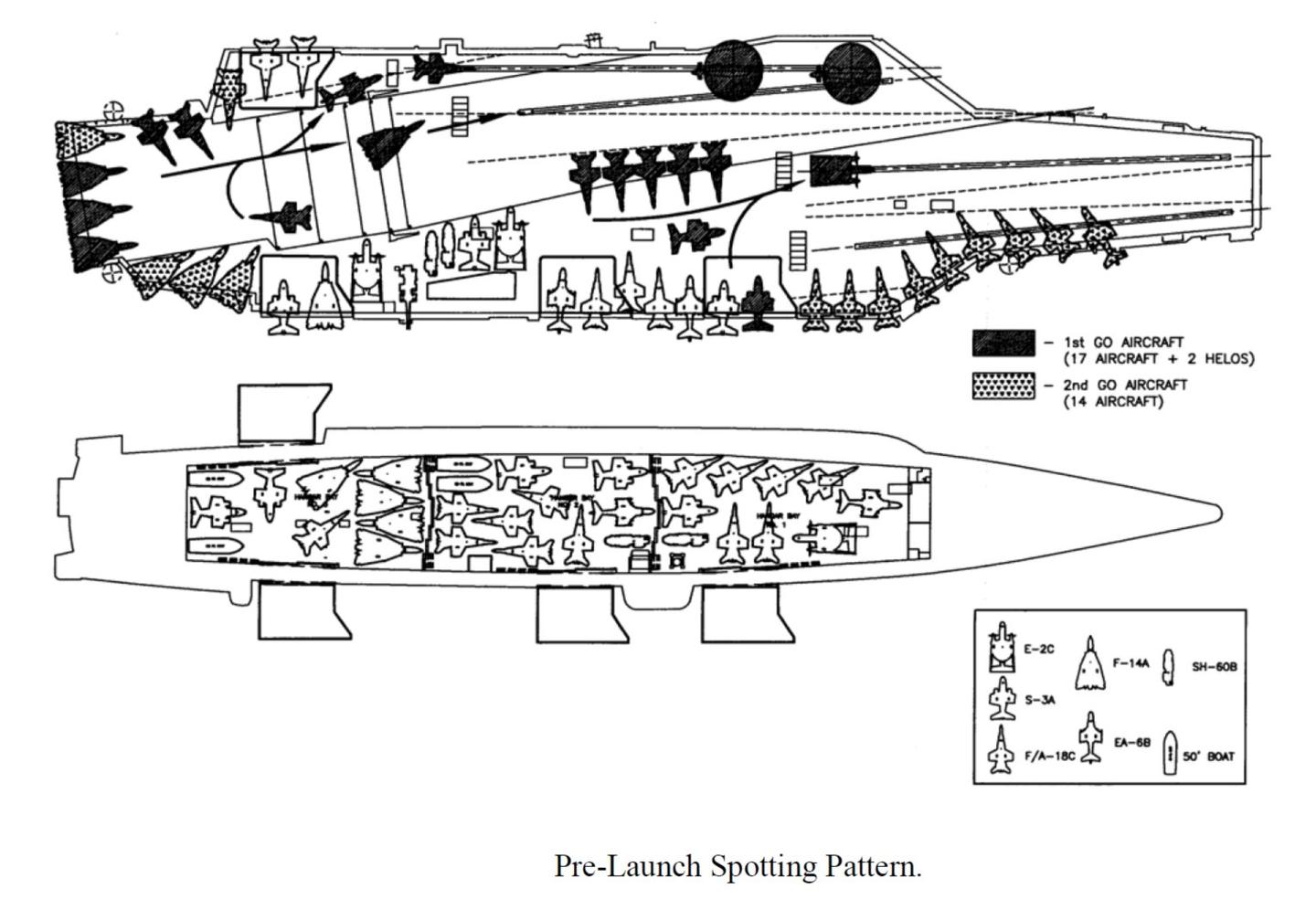
@Rule of cool The ratios you quote are highly theoretical... in practice it's rare to be able to fit more than two dozen jet aircraft in the hangar. So any large air wing will have the majority of aircraft on deck. If you look at my example, you can't fit more than ~20 fighters in CVA-01's hangar, maybe 22-24 maximum if you lock the hangar (which would be OK practice in stormy weather, but not for typical flying days). Even a USN supercarrier would typically have only 25-30 aircraft in the hangar, with 40+ ranged on the flight deck.

So basically with 20 fighters in the hangar, CVA-01 would need to carry half its air wing on the flight deck. Which isn't typical RN practice and which makes the stated air wings (36 fighters normal, 42 surge, 48 TAU + 10 Gannet/Sea Kings) look optimistic.

v2-82a52cdbe208c40de8b3f7d048efca37_1440w.jpg
 
Last edited:
@Rule of cool The ratios you quote are highly theoretical... in practice it's rare to be able to fit more than two dozen jet aircraft in the hangar. So any large air wing will have the majority of aircraft on deck. If you look at my example, you can't fit more than ~20 fighters in CVA-01's hangar, maybe 22-24 maximum if you lock the hangar (which would be OK practice in stormy weather, but not for typical flying days). Even a USN supercarrier would typically have only 25-30 aircraft in the hangar, with 40+ ranged on the flight deck.

So basically with 20 fighters in the hangar, CVA-01 would need to carry half its air wing on the flight deck. Which isn't typical RN practice and which makes the stated air wings (36 fighters normal, 42 surge, 48 TAU + 10 Gannet/Sea Kings) look optimistic.

The ratios were derived from RN experience in WW2, Korea, Suez and the like, practical experience rather than purely theoretical. They represent the left and right of arc; the CVA01 must be able to strike down 24 jets, not all 36 or a mere 18 as recent operational experience had shown all 36 to be unnecessary but only 18 to be insufficient. I don't believe when they crammed in those extra 6 jets, they expected to be able to strike 4 of them down in the hangar, more likely they expected them to be lost to attrition reasonably quickly.

IIRC all of these calculations and ratios 'proved' that not only was the ~53-58,000t carrier the maximum Britain could build but also the minimum required to undertake the missions envisaged in the 60s.
 
The ratios were derived from RN experience in WW2, Korea, Suez and the like, practical experience rather than purely theoretical
Sure but like I said USN practice (as illustrated by the pic above) was closer to 40/60, with the majority of aircraft on deck.

So there’s a range of reasonable practices and also physical constraints which means you can’t fit more than 20-24 fighters in a CVA-01 sized hangar so anyone hoping for more than 36 jets will need to load up the flight deck, with closer to a 50-50 ratio or even a 40-60 ratio like the USN. Which is fine except that locks CVA-01’s flight deck due to the unconventional design choices like the bow catapult location and Alaskan taxiway.
 
Sure but like I said USN practice (as illustrated by the pic above) was closer to 40/60, with the majority of aircraft on deck.

So there’s a range of reasonable practices and also physical constraints which means you can’t fit more than 20-24 fighters in a CVA-01 sized hangar so anyone hoping for more than 36 jets will need to load up the flight deck, with closer to a 50-50 ratio or even a 40-60 ratio like the USN. Which is fine except that locks CVA-01’s flight deck due to the unconventional design choices like the bow catapult location and Alaskan taxiway.

The RN and USN do have significant differences in the way they operate carriers, use of deck parks is one of them and I suspect that is the end point of a bunch of other small factors where the USN is different to the RN.

Bear in mind that the 2/3 of the CAG in the hangar is an edge of the envelope requirement, it likely won't be used most of the time, but when it is needed it is really needed.
 
Back
Top Bottom