
Grey Havoc
ACCESS: USAP
- Joined
- 9 October 2009
- Messages
- 24,420
- Reaction score
- 17,879
A pop-up can be as simple as a 'dumb' sub-orbital booster lofting a load of scrap into a particular LEO orbit. Indiscriminate, but effective.


Sub-orbital surely means not capable of putting something in orbit? Space LVs typically aren't cheap either, especially when non-re-usable.A pop-up can be as simple as a 'dumb' sub-orbital booster lofting a load of scrap into a particular LEO orbit. Indiscriminate, but effective.
That might work against one satellite but the missile would still need sufficiently accurate guidance to hit a small starlink satellite even with a shotgun KKV, which means it would still cost SM-3 money and that only downs one satellite and there are 6,350 of them and they only weigh 260kg each and cost only $500k each. A single Falcon 9 reusuable launch costs $15m and can launch ~75 of them, bringing the total launched cost per unit to $700k each. Good look developing an ASAT missile for less than that. This is the sole reason Putin has resorted to nuclear ASAT capabilities - even though nukes are expensive it still works out cheaper overall (assuming the satellites aren't radiologically and EMP-hardened military units).The scrap doesn't have to stay in orbit, just to be in a certain part of the target/s orbit at a certain point in time. A very loose analogy would be a roadblock.


Starlink Now Being Deployed On U.S. Navy Warships
Starlink is part of the Navy's ambitious SEA2 program that aims to provide high-bandwidth resilient global connectivity for U.S. warships that will have major operational and morale benefits.www.twz.com

 www.navytimes.com

 www.telegraph.co.uk

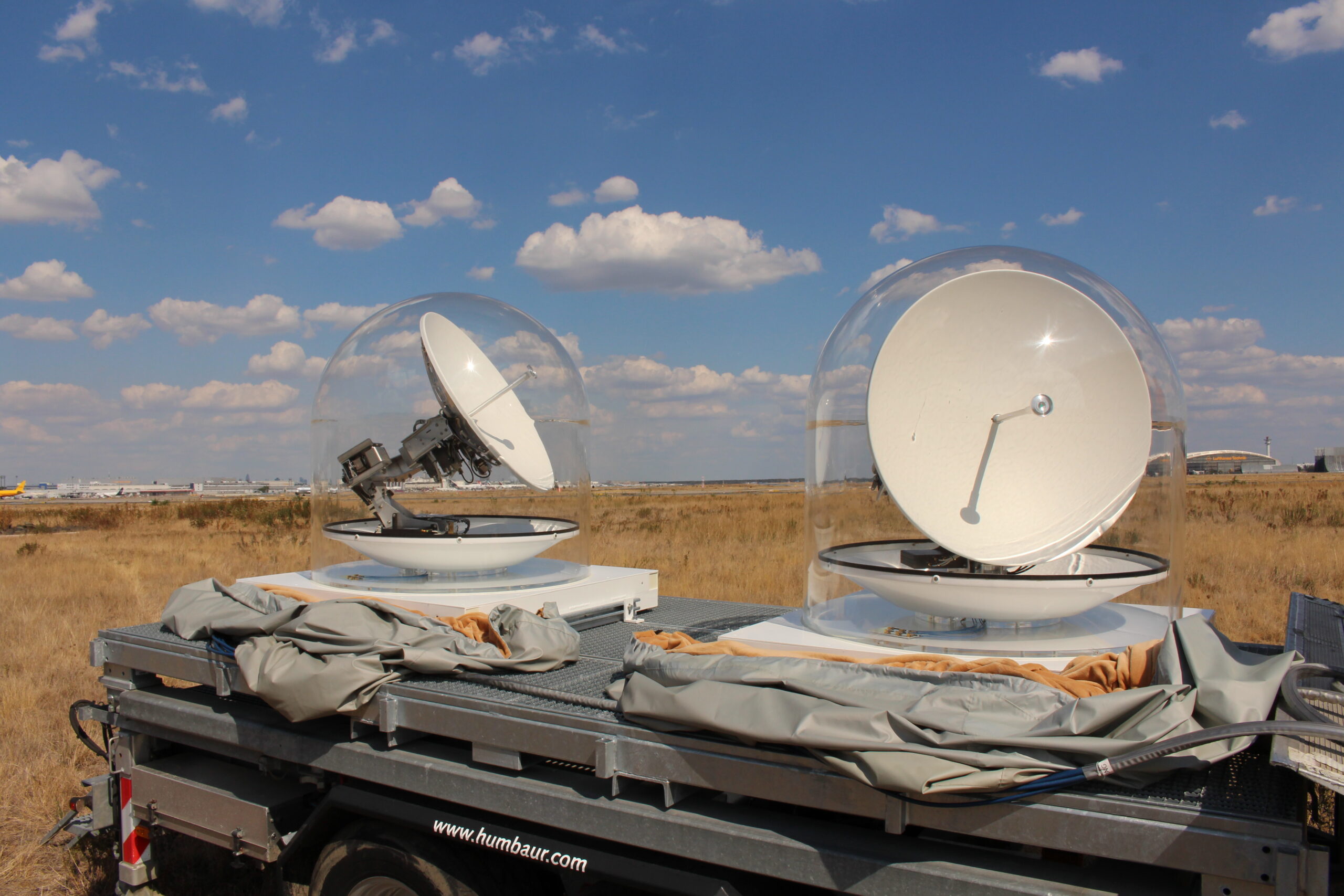
The German Fraunhofer Institute is doing a lot of research in this area with the Sabbia 2.0 project:-Ku Band non-cooperative Bi/Multi-Static radar for low altitude gap filler radar
 euro-sd.com
Using Starlink in this way is not merely a theoretical idea. Research is advancing to employ Starlink downlink signals as an RF source for passive radar. In late January 2024, Germany’s Ministry of Defence announced that the country was developing a passive radar which could exploit Starlink’s signals. The work is being performed by Germany’s Fraunhofer Institute for High Frequency Physics and Radar Techniques (FHR). Reports stated that the system uses a reference antenna which follows Starlink satellites as they cross the sky. The reference antenna detects and copies the signal’s characteristics as these are beamed down to Earth. A second antenna is pointed towards the area of interest the radar is monitoring. The reference signal is compared with those signals coming into the second antenna. This process ascertains if these signals are being altered by targets in the antenna’s field of view.
[...]
The abundance of terrestrial RF tends to diminish in frequencies above ten gigahertz. However, satellite downlink frequencies exist in X-band (7.25-7.75 GHz), Ku-band (10.9-12.75 GHz) and Ka-band (18-20 GHz). As Starlink is showing, some of these wavebands could soon have ubiquitous global availability. Employing satellite RF sources is particularly attractive when you want to use a passive radar over the oceans.
[...]
The movement of the RF transmitter means that imagery of still and moving targets can be processed. When coupled with the characteristics of Starlink’s downlink frequencies, this movement helps provide a target resolution of circa one metre.
[...]
The entire Sabbia-2.0 architecture can weigh as little at 60 kg (132 lb), meaning that it can be easily accommodated on a vehicle. Other applications are being considered for the technology. For example, Sabbia-2.0 could be configured to outfit a ship or aircraft.

 breakingdefense.com
A previously unreported order by Elon Musk to cut satellite communications over a portion of Ukraine disrupted a counteroffensive by Kyiv in the autumn of 2022. Reuters investigated the billionaire's order and its implications for countries increasingly reliant on his Starlink internet service.
KYIV, July 25 (Reuters) - Starlink systems used by Ukrainian military units were down for two and a half hours overnight, a senior commander said, part of a global issue that disrupted the satellite internet provider.
Ukraine's forces are heavily reliant on thousands of SpaceX's Starlink terminals for battlefield communications and some drone operations, as they have proved resistant to espionage and signal jamming throughout the three and a half years of fighting Russia's invasion.
Starlink experienced one of its biggest international outages on Thursday when an internal software failure knocked tens of thousands of users offline.
"Starlink is down across the entire front," Robert Brovdi, the commander of Ukraine's drone forces, wrote on Telegram at 10:41 p.m. (1941 GMT) on Thursday.
Starlink, which has more than 6 million users across roughly 140 countries and territories, later acknowledged the global outage on its X account and said "we are actively implementing a solution."
Brovdi updated his post later to say that by about 1:05 a.m. on Friday the issue had been resolved. He said the incident had highlighted the risk of reliance on the systems, and called for communication and connectivity methods to be diversified.
[snip]


Said booster needs a throttlable bus stage, really good guidance and timing, plus a bursting charge/lethality enhancer with a rough guess of 100kg of silica sand.A pop-up can be as simple as a 'dumb' sub-orbital booster lofting a load of scrap into a particular LEO orbit. Indiscriminate, but effective.
 .
.Apparently the Iranians were able to jam starlink successfully during the recent troubles. Scuttlebutt has it that this was achieved with Russian assistance based on their Ukraine experience.
I can't speak to the accuracy of reporting on the mechanism but one description I've seen involved targeting the individual sats as they pass overhead and blasting them with a jamming signal.
View: https://x.com/i/status/2011047830677279044
View attachment 799251
Yes, apparently there are software upgrades already in the works.Charge of the Russian brigade
And no doubt Starlink will be very busy working on suitable ECCM for its' Starlink terminals.


