FighterJock
ACCESS: Above Top Secret
- Joined
- 29 October 2007
- Messages
- 6,694
- Reaction score
- 7,915
We already had committed money to the Eurofighter Typhoon project so we could not afford the F-22 sadly.


I thought the F-22 was politically restricted from being sold to other countries.Not actually true, the UK were offered it but turned it down for cost reasons.

In most cases that was true but the UK and US tend to have better cooperation. For instance, the UK MoD found out about the F-117A officially in 1983, 5 years before its reveal.I thought the F-22 was politically restricted from being sold to other countries.

I thought the F-22 was politically restricted from being sold to other countries.
This video explores USAF unmanned collaborative combat aircraft that are being developed, to serve from 2028 onward. What do they look like? How smart are they? Size, specs and weapons are detailed as well
00:00 Intro to topic
03:11 What is a CCA?
04:59 Control issues
07:50 CCA competition
10:49 Increment 1 requirements
12:59 General Atomics’ design
16:03 Anduril and its drone
19:20 Increment two CCAs
Link to our NGAD video:• US 6th generation fighter is closer t...
Quick Sidebar but do you have anything else on that concrete carrier?In the 80s study were conducted around massive floating landing strip, autonomously sailed (hence not a barge but a very large aircraft carrier) made out of concrete blocks to be unsinkable.
This is what China has been doing, turning every south China sea shoals into (albeit static).
Maybe something similar should be used in your scenario to counter the threat (I personally do not think it being the best use of money; WWII has shown us that fortified islands do get invaded).

It will never see the lightQuick Sidebar but do you have anything else on that concrete carrier?
like a project name or something?
Cause that sounds interesting.

Quick Sidebar but do you have anything else on that concrete carrier?
like a project name or something?
Cause that sounds interesting.

It could be something like the F/B-23 ...I'm already picturing a plane about the size of an F-111F, some 100klbs MTOW, how much bigger are they planning on making it?!? The only bigger "fighter" ever contemplated was the YF-12 Blackbird, at 140klbs MTOW...
It was be a good new if Northrop could come back in the NGAD game...but ...The USAF's problem is that it really needs two new manned fighters, plus a range of UCAVs, but between Lockheed, Boeing, and Northrop it has maaybe 1.5 companies it can trust.
The two manned fighters are:
1. STOL fighter (Tornado ADV-esque? Gripen STOL-lite?) for operating inside the first island chain from dispersed airbases in Japan and Philippines.
2. Long range F-111 sized fighter for open-ocean missions from second Island chain.
And then a collection of UCAVs to support those two mission sets.
But, there is neither money nor aerospace talent to do that, which leaves the USAF in a bad place.
The USAF's problem is that it really needs two new manned fighters, plus a range of UCAVs, but between Lockheed, Boeing, and Northrop it has maaybe 1.5 companies it can trust.
The two manned fighters are:
1. STOL fighter (Tornado ADV-esque? Gripen STOL-lite?) for operating inside the first island chain from dispersed airbases in Japan and Philippines.
2. Long range F-111 sized fighter for open-ocean missions from second Island chain.
And then a collection of UCAVs to support those two mission sets.
But, there is neither money nor aerospace talent to do that, which leaves the USAF in a bad place.
F-35 is bad born fo me it was better to cancel it years ago , now it is too late and realy I hope that Lockheed don't receive the NGAD contract since the F-22 they don't built something well. Flying computer is good but built a good airplane it is better. They have problem after problem and don't solve it. I don't think that the F-35 become cheaper a day...The USAF could simply buy F-35 for work inside the first chain. I believe Singapore bought some Bs for the same reason. I am aware of your feelings regarding the F-35 - I agree it is an example in how not to run an acquisition program. However it’s a 5th gen STOVL aircraft in production now, and the much delayed but quite improved blk4 is nevertheless far cheaper in terms of both time and money than absolutely anything else.
F-35 is bad born fo me it was better to cancel it years ago , now it is too late and realy I hope that Lockheed don't receive the NGAD contract since the F-22 they don't built something well. Flying computer is good but built a good airplane it is better. They have problem after problem and don't solve it. I don't think that the F-35 become cheaper a day...

DEW is good for slow drones, but it cannot stop fast flying missile as last line of defense. It cannot reliably replace kinetic projectile. It has quite short range and it need to be placed on an airplane to overcome earth's curvature. Maybe once we get an operational railgun. However, you want multilayered defense. At the end of the day, you gonna need a missile on an airplane. The airplane allows your missile to be smaller and cheaper. Launching it from a ship for the same capability gonna make the missile very expensive.Intercepting a missile/drone with a much more expensive missile is exactly the problem we have today in the Middle East. DEWs are presented as a solution. Are they? At relatively short range, apparently so.
Yes, the ecosystem of drones I propose will include large, supersonic types. You're right, something needs to launch them. Is it a carrier as currently conceived though? In the Falklands war, the UK started using container ships as offensive vessels. Today's expeditionary sea base ships converted from civilian designs would have been laughed at a decade ago. Could the future drone-launching successor to today's supercarriers be like them? Iran is trying to do so:
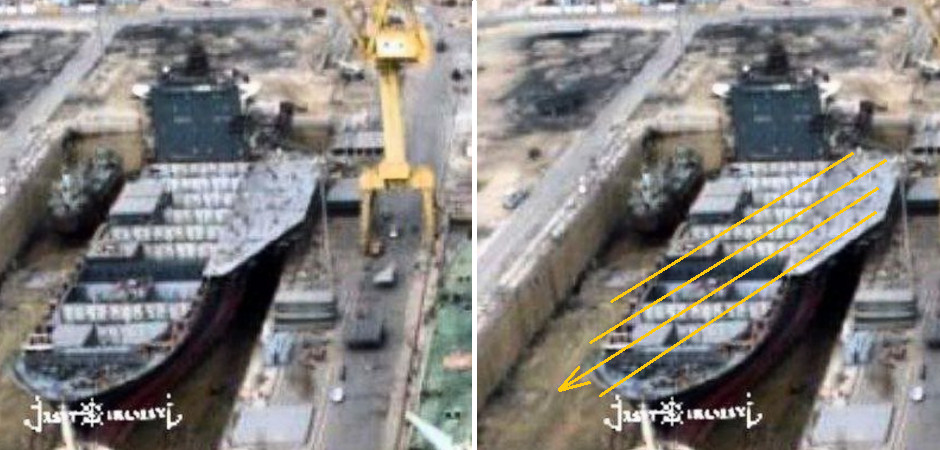
Iran Building Drone Aircraft Carrier from Converted Merchant Ship, Photos Show - USNI News
In a dry dock near the entrance to the Persian Gulf, Iran’s sectarian naval force is converting a former merchant container ship into a drone aircraft carrier, according to satellite and open source photos published last week by USNI News contributor H I Sutton. Iranian Revolutionary Guard Corps...news.usni.org
Sure, they might be very pathetic front-line warships, but as cheap drone-launching assets, they might be a viable concept.
Co-ordination between services is going to be crucial, I think. The Nato and European forces have practical experience in co-ordinating differing national forces. Naval aviation overcomes range restrictions by putting carriers forward. Air Force planes are designed for range or are less willing to sacrifice it at least. Battle planning should have navies able to call upon assets from other services and exploit their advantages. If a carrier devolves into being a floating landing strip derived from a civilian type, interservice co-ordination has to be developed following the model of international co-operation (yes, there's an obvious joke in interservice co=operation being the same as, if not even more difficult than international co-operation). Also, If navies are willing drones (IF!), MQ-25 like drones operating off these relatively fragile landing strip vessels well behind the line could support frontline supersonic drones if a new naval doctrine tilts that way.
I am aware that I can wave my magic wand here but doing so in the real world is another matter, but there are precedents and possibilities.
By the way, a 'capital ship' is one on which an admiral hoists their flag. It doesn't have to be a supercarier; it has to be a vessel with wide area awareness and command capability. An air defence destroyer could fill that role if carriers as we conceive them now become unsustainable.
As I said, it's a random walk, so looking any more than a couple of steps ahead would be self-deluding.
(Scatter these around the above: if, if, if, if, if, if,)
Point of order!DEW is good for slow drones, but it cannot stop fast flying missile as last line of defense. It cannot reliably replace kinetic projectile. It has quite short range and it need to be placed on an airplane to overcome earth's curvature. Maybe once we get an operational railgun. However, you want multilayered defense. At the end of the day, you gonna need a missile on an airplane. The airplane allows your missile to be smaller and cheaper. Launching it from a ship for the same capability gonna make the missile very expensive.
Unless the projectiles are very small, as per a particle beam.Point of order!
A railgun IS NOT a Directed Energy Weapon, it's a kinetic weapon.
When the particles are individual atoms or chemical compounds, yes, that's a directed energy weapon.Unless the projectiles are very small, as per a particle beam.
poorly worded on my part. I was speaking in the context of the post I was responding to, different alternatives to expensive SAM. Didn't mean to categorize railgun as DEWPoint of order!
A railgun IS NOT a Directed Energy Weapon, it's a kinetic weapon.
It is sure , but I don't realy understand the advantage of STOVL plane ?I think F-35 is a decent aircraft that has amazing avionics and signature reduction and mediocre kinetic performance. Never the less, it is one of a kind at a reasonable fly away price - none of the existing J-20s are super cruising circles around it, and there will never be enough Su-57s to mater.
How we got to the F-35 was bad. An incredibly bad procurement process brought us here. But throwing it away is even worse. Especially the STOVL part; no one is ever going to make a 5th or 6th gen STOVL ever again. Read that last sentence carefully: No one is ever producing an advanced manned STOLV fighter ever again. Not China, Not Europe, certainly not Russia. If that is the goal, buy in now.

Yes, good points. However, to continue this game:DEW is good for slow drones, but it cannot stop fast flying missile as last line of defense. It cannot reliably replace kinetic projectile. It has quite short range and it need to be placed on an airplane to overcome earth's curvature. Maybe once we get an operational railgun. However, you want multilayered defense. At the end of the day, you gonna need a missile on an airplane. The airplane allows your missile to be smaller and cheaper. Launching it from a ship for the same capability gonna make the missile very expensive.
A large converted container is extremely vulnerable. Sure, it will be cheap but if it's gonna carry a dozen or so supersonic drones with stealth to penetrate enemy's defense and EW to survive contested EW environment then the cost of what this ship carries gonna be quite expensive. In the end you end up with a supercarrier again to protect these high end drones while they are parked on this platform.
DEW when mounted on surface platforms have very short range. Its engagement window is extremely limited against a low flying supersonic moving target. How many seconds a mach 3 missile can go from horizon to the target vs how many seconds the DEW can degrade the missile to the point of ineffectiveness? That's just for against cruise missile. Against hypersonic glide vehicle or reentry ballistic projectiles, not a fat chance.Yes, good points. However, to continue this game:
The DEWs considered so far, such as Dragonfire, are ship-mounted and meant to defend against drones, missiles, and boats. True, they do not kill instantaneously like Star Wars weapons but track their targets and keep them continually illuminated until they disintegrate. I do not think that they cannot be used against fast-moving targets, especially if their angular movement is low. In addition, their chief advantage is that each shot is very, very cheap.
Of course pods could be mounted on aircraft. No question there.
Also, I agree that layered defence is essential.
I agree that carriers, and supercarriers are magnificent weapons. However, they are extremely expensive and individually represent such a concentration of both force and money that they are highest priority targets and will certainly be attacked in the very first stages of any major conflict, with their loss being catastrophic. Whole classes of subs, planes and missiles are dedicated to destroying them.
The people making decisions to fund development and production are going to look at the concentration of costs in single hulls and start asking which capabilities can be shared amongst the rest of a battle group or fleet.
The British, due to lack of available resources did use unconverted civilian container ships to carry Harriers in the Falklands War to supplement their dedicated carriers. Better historians than me (i.e., all) can say how effective that experiment was and what it could lead to. An el cheapo conversion would indeed be pretty pathetic compared to a Nimitz or Ford, but there could be more of them, they'd be of some use if held back and protected by a screen of other assets and individual losses would not be as catastrophic.
I'm certainly not advocating for the elimination of any capabilities but rather their separation and redistribution. I don't imagine any vessel operating alone, and now I don't think it so likely that any service will operate alone either. Getting that to work, well... maybe not in this generation.
Don't think cheap , insteed you will have a cheap Air Force, the priority in material must be made , the Bomber , now it is B-21 time divest B-52 budget on the B-21, ICBM weapon are a zero need with submarine and nuclear Bomber, divest the budget on the NGAD, USAF can't stand rely just with F-35 , if problem with it and must be grounded you will have nothing in the sky for the fight. Invest in hypersonic technologies for missile and futur reusable hypersonic. invest in space weapon too for deterence.DEW when mounted on surface platforms have very short range. Its engagement window is extremely limited against a low flying supersonic moving target. How many seconds a mach 3 missile can go from horizon to the target vs how many seconds the DEW can degrade the missile to the point of ineffectiveness? That's just for against cruise missile. Against hypersonic glide vehicle or reentry ballistic projectiles, not a fat chance.
As for a cheaper alternative to carriers, I don't see how they will fall down priority list of targets for the enemy. So now you're talking about a less capable and vulnerable platform that have to stay even further back, costing more dedicated surface platforms to protect them that enemy will have the same concentration of force from enemy. And because they stay further back from the fight, whatever air assets they carry now need to be even bigger and more expensive.
Not to say that your idea doesn't have merit, I do think that consideration for reduced supercarriers supplemented by cheaper drone carrier fleet need to be considered and has and is considered.
DEW when mounted on surface platforms have very short range. Its engagement window is extremely limited against a low flying supersonic moving target. How many seconds a mach 3 missile can go from horizon to the target vs how many seconds the DEW can degrade the missile to the point of ineffectiveness? That's just for against cruise missile. Against hypersonic glide vehicle or reentry ballistic projectiles, not a fat chance.
As for a cheaper alternative to carriers, I don't see how they will fall down priority list of targets for the enemy. So now you're talking about a less capable and vulnerable platform that have to stay even further back, costing more dedicated surface platforms to protect them that enemy will have the same concentration of force from enemy. And because they stay further back from the fight, whatever air assets they carry now need to be even bigger and more expensive.
Not to say that your idea doesn't have merit, I do think that consideration for reduced supercarriers supplemented by cheaper drone carrier fleet need to be considered and has and is considered.
Using only 600 feet/200 meters of runway, which is something many straight pieces of road could probably accommodate for a launch or two (admittedly the engine would trash a normal untreated road).It is sure , but I don't realy understand the advantage of STOVL plane ?
China does not have the luxury to fall back on an already large and established carrier force and doctrine while figuring out what the future holds. If they want carrier aviation to project power, it makes a ton of sense to build up a small force now to provide the capabilities they want and help shape their views of what carrier aviation will look like in the future.While doubts linger in the western press, Chinese Navy is still collecting aircraft carrier unabated by the sophisticated arguments of tomorrow will see better.

I'm not seeing much talk of the "super chaff" and where that will slot into carrier group survival. It's a mile wide radar blob made out of carbon nanotube chaff, has an 8+ hour hang time, and is fairly lethal against hypersonic weapons that attempt to go through it. I dunno how its deployed or how much time you'd need to get it deployed though.Yes, good points. However, to continue this game:
The DEWs considered so far, such as Dragonfire, are ship-mounted and meant to defend against drones, missiles, and boats. True, they do not kill instantaneously like Star Wars weapons but track their targets and keep them continually illuminated until they disintegrate. I do not think that they cannot be used against fast-moving targets, especially if their angular movement is low. In addition, their chief advantage is that each shot is very, very cheap.
Of course pods could be mounted on aircraft. No question there.
Also, I agree that layered defence is essential.
I agree that carriers, and supercarriers are magnificent weapons. However, they are extremely expensive and individually represent such a concentration of both force and money that they are highest priority targets and will certainly be attacked in the very first stages of any major conflict, with their loss being catastrophic. Whole classes of subs, planes and missiles are dedicated to destroying them.
The people making decisions to fund development and production are going to look at the concentration of costs in single hulls and start asking which capabilities can be shared amongst the rest of a battle group or fleet.
The British, due to lack of available resources did use unconverted civilian container ships to carry Harriers in the Falklands War to supplement their dedicated carriers. Better historians than me (i.e., all) can say how effective that experiment was and what it could lead to. An el cheapo conversion would indeed be pretty pathetic compared to a Nimitz or Ford, but there could be more of them, they'd be of some use if held back and protected by a screen of other assets and individual losses would not be as catastrophic.
I'm certainly not advocating for the elimination of any capabilities but rather their separation and redistribution. I don't imagine any vessel operating alone, and now I don't think it so likely that any service will operate alone either. Getting that to work, well... maybe not in this generation.
As I have said already, if the stringent question is to be able to distribute planes all over the Pacific area, the Air Force is better recommending a Taiwan preemptive invasion or buying out Aircraft Carriers from the Navy.
The apparent lack of cognitive agility is only akin to the 1930 Army Air corps and their multi-engine fighter programs...
yes, you will always need reach at range, that's what the tactical battle plan is for. As a palliative, simpler airframe can host higher tankage and fly longer. Maybe the reported search for a plane that do-it-all is not the most appropriate.

China does not have the luxury to fall back on an already large and established carrier force and doctrine while figuring out what the future holds. If they want carrier aviation to project power, it makes a ton of sense to build up a small force now to provide the capabilities they want and help shape their views of what carrier aviation will look like in the future.
 aviationweek.com
the option possible is to rebuild all the fleet of F-22 but they have only 150 of it.....

 www.defensenews.com
The kinetics performance of the F-22 are very awesome so renovated all the fleet could be an option to awaiting the 6th gen fighterIf the US DoD goes that route then they need to rebuild ALL 187 surviving airframes and very seriously reconsider reestablishing and restarting the F-22 production line which would be rather expensive but as far as I know all of the production jigs and tooling are in a secure, controlled storage guarded by the US army.
I wonder what China was working on to counter NGAD?
This shit is dead
https://www.defensenews.com/global/...lose-combat-advantage-french-army-chief-says/ End of the trail 

 • US 6th generation fighter is closer t...