Welcome, Guest. Please login or register.
Secret Projects Forum
Pages: [1] 2  All   Go Down
  Print  
Author Topic: Project Habakkuk  (Read 2911 times)
Triton
Senior Member
CLEARANCE: Top Secret
**
Offline Offline

Posts: 2195


Deep Blue to Wild Blue


« on: October 18, 2009, 11:28:29 pm »

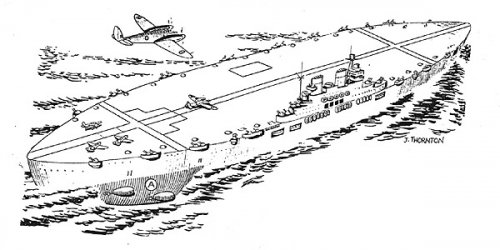
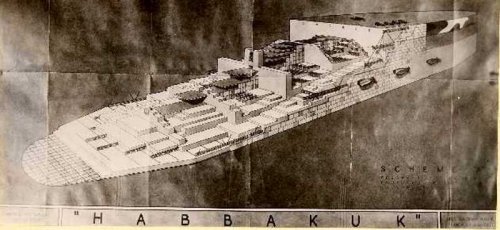
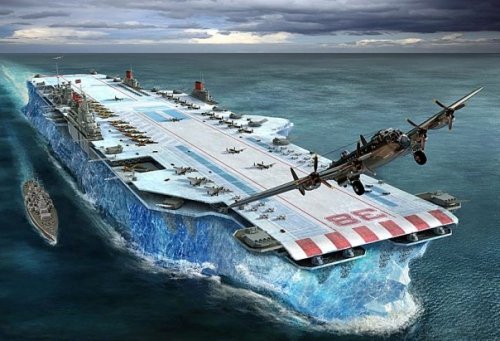
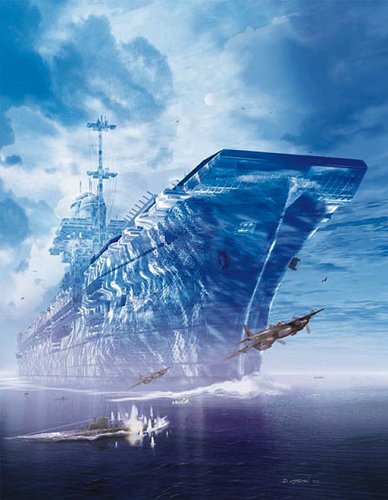
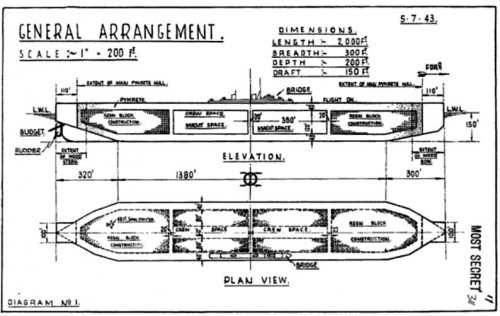
Project Habakkuk was a plan by the British in World War II to construct an aircraft carrier out of 280,000 blocks of pykrete (a mixture of wood pulp and ice), for use against German U-boats in the mid-Atlantic, which was out of range of land-based planes.

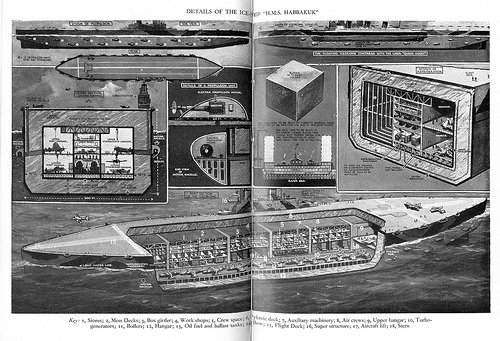
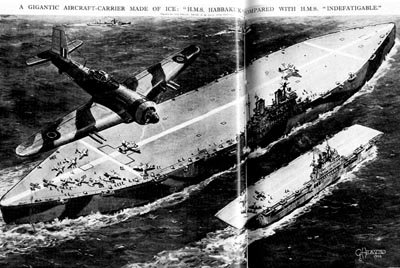
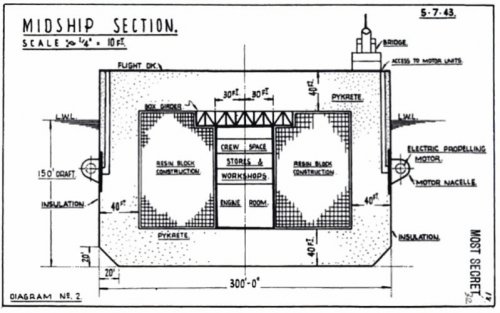
This gigantic aircraft carrier, 2,000 feet long, 300 feet across the beam and 200 feet in depth, was projected as the War was entering its third year. This floating airfield would have had hangar capacity for 200 Spitfire fighters or 100 Mosquito bombers, complete with every facility in the shape of operational and repair shops, etc. It would have been propelled at a speed of seven knots by Diesel-electric machinery with a normal consumption of 120 tons a day. Fuel capacity for 5,000 tons was to be provided, which would have given the ship a radius of action of 7,000 miles. The complement was to have been 404 officers and 3,216 petty officers and men. Displacement was to be around 2,000,000 tons.

Project documents consistently misspell the name Habakkuk as Habbakuk. The name is a biblical reference to the project's ambitious goal: "...be utterly amazed, for I am going to do something in your days that you would not believe, even if you were told." (Habakkuk 1:5, NIV)

For more information:

http://en.wikipedia.org/wiki/Project_Habakkuk

http://www.royalnavalmuseum.org/info_sheets_Habbakkuk.htm
http://www.thewarillustrated.info/230/strange-story-of-hms-habbakuk.asp
http://www.darkroastedblend.com/2007/12/giant-iceberg-aircraft-carrier.html
« Last Edit: October 19, 2009, 01:32:03 am by Triton » Logged
Avimimus
CLEARANCE: Secret
****
Offline Offline

Posts: 331


« Reply #1 on: October 19, 2009, 12:54:16 am »

First time I've seen a picture of it. Thanks.
Logged
Abraham Gubler
Senior Member
CLEARANCE: Top Secret
**
Offline Offline

Posts: leet


« Reply #2 on: October 19, 2009, 04:40:38 am »

Myth Busters recently looked at pykrete and an enhanced pykrete (using newspaper rather than bulldust). They found that the stuff was certainly strong enough but their small boat did not last that long in the water, even cold water.
Logged

"There is a tendency in our planning to confuse the unfamiliar with the improbable." Thomas Schelling
Triton
Senior Member
CLEARANCE: Top Secret
**
Offline Offline

Posts: 2195


Deep Blue to Wild Blue


« Reply #3 on: October 19, 2009, 06:00:47 am »

Myth Busters recently looked at pykrete and an enhanced pykrete (using newspaper rather than bulldust). They found that the stuff was certainly strong enough but their small boat did not last that long in the water, even cold water.

The Mythbusters program did not create the refrigeration plant and ducting system intended for Project Habakkuk that would maintain the structure against melting. The Pykrete would have been further protected from melting or erosion by an insulating skin.

Not that the idea was practical. The 280,000 40-foot-thick Pykrete cubes needed for construction would take eight months and 8,000 workers to make in Canada. The ship's deep draft would have kept it out of most harbors. The cost of each ship was estimated at £10,000,000.
« Last Edit: October 19, 2009, 11:00:09 pm by Triton » Logged
Jemiba
Global Moderator
CLEARANCE: Top Secret
****
Online Online

Posts: 2888


« Reply #4 on: October 19, 2009, 07:41:09 am »

It's only TV, of course ....   Wink

<a href="http://www.youtube.com/v/99iiGApF4Zc&rel=1" target="_blank">http://www.youtube.com/v/99iiGApF4Zc&rel=1</a>
Logged

It takes a long time, before all mistakes are made ...
XP67_Moonbat
Senior Member
CLEARANCE: Top Secret
**
Offline Offline

Posts: 947


« Reply #5 on: October 19, 2009, 03:05:08 pm »

Trit,

You rock ,dude! I'm surprised we haven't had a thread on this before! I wish I still had the Air & Space article on Habakkuk from around 1989. Lost it years ago. That was my introduction to Habakkuk.

Here's a little quick something on this project:

http://www.mondolithic.com/?p=719
« Last Edit: October 19, 2009, 04:11:24 pm by XP67_Moonbat » Logged

In God we trust, all others we monitor. :-p
XP67_Moonbat
Senior Member
CLEARANCE: Top Secret
**
Offline Offline

Posts: 947


« Reply #6 on: October 19, 2009, 03:12:50 pm »

Hey I just did some backtracking and I guess we did have something on here about Habakkuk, under the name Project Tentacle. Check it out:
http://www.secretprojects.co.uk/forum/index.php/topic,1719.0.html

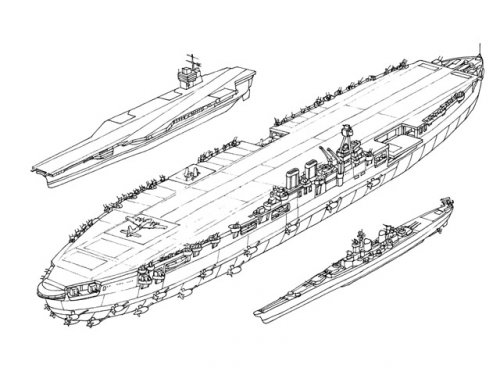
BTW, seeing the illustration of Habakkuk alongside a Nimitz Class carrier makes me shake my head. Having served five years on the Truman, I have a good idea of how big Habakkuk would have been. But I'm still amazed.

Moonbat

From that previous thread:
« Last Edit: October 19, 2009, 03:20:00 pm by XP67_Moonbat » Logged

In God we trust, all others we monitor. :-p
TomS
Senior Member
CLEARANCE: Secret
**
Offline Offline

Posts: 245


« Reply #7 on: October 19, 2009, 03:47:36 pm »

Myth Busters recently looked at pykrete and an enhanced pykrete (using newspaper rather than bulldust). They found that the stuff was certainly strong enough but their small boat did not last that long in the water, even cold water.

The Mythbusters program did not create the refrigeration plant and ducting system intended for Project Habakkuk that would maintain the structure against melting. The Pykrete would have been further protected from melting or erosion by an insulating skin.

I was really disappointed in that show.  They also claimed they were the first people to build a boat using Pykrete, which is totally untrue.  The original proponents of the concept built a 1,000-ton testbed on Patricia Lake, Alberta, Canada in 1943.  It lasted a whole (northern) summer even without the installed refrigeration plant running.


Logged

I'm riding 100 miles to fight blood cancer: Please give to the Leukemia and Lymphoma Society.
archipeppe
Senior Member
CLEARANCE: Top Secret
**
Offline Offline

Posts: 723


« Reply #8 on: October 19, 2009, 10:51:55 pm »

As far I know the "artificial ice" was really tested during 1942-44.
The project was abandoned due to the decreasing of U-Boot menace in 1944 and the fall of III Reich in 1945.

Anyway it would feaseble, even with the technology of that times, but rather really expensive.
« Last Edit: October 20, 2009, 07:05:34 am by flateric » Logged
airman
CLEARANCE: Top Secret
*****
Offline Offline

Posts: 538


WWW
« Reply #9 on: October 19, 2009, 11:31:26 pm »

It's only TV, of course ....   Wink

oh yes, in Italy there was an episode of "Atlantide :Storia di uomini e di mondi" about this project, on italian tv network : La7!
 Roll Eyes
It was funny project with touch of geniality ! Cheesy
« Last Edit: October 20, 2009, 07:04:50 am by flateric » Logged
phil gollin
CLEARANCE: Restricted
**
Offline Offline

Posts: 14


« Reply #10 on: October 20, 2009, 12:36:49 pm »


As the author of the original post linked to on the warships board re. Project Tentacle, I thought I would post the whole of the original (I have emboldened the relevant bit) :


Project Tentacle (sort of)

Well as I was popping into the PRO today, I put “Tentacle” into the search catalogue and got “ADM 116/4882” which is staffnotes covering Project Habbukuk and Tentacle.

HEALTH WARNING – This is only one file and is only part of the story, still it is interesting.

First, the file covers minutes and minor correspondence from June to November 1943

The vast majority of the file covers Habbukuk, only two pages and one refernce to “Tentacle” is in the file.

I learnt a lot more about Habbukuk, it wasn’t just the pyecrete vessel, it was a whole range of options.

The initial specification was for a floating airfield due for delivery by Spring 1944 with approximate dimensions 1,500 ft by 250ft and capable of being towed at approx. 2 knots.

Later the spec changed in various iterations to increase the length to 2,000 ft, width to 300 ft and a self-propelled speed of, variously, 7 and then 10 knots, all depending upon the proposed function of the vessel.

Five different vessel types were proposed ;

1:  Pure Ice

2:  Pykrete

3:  Steel (est. 50,000 tons)

4:  Concrete (see below)

5:  Timber (quoted at different places at 47,000 tons and 100,000 tons)

Originally the Timber version was recommended.

In relation to the concrete version, two types (sub-types Huh?) are mentioned, Habbukuk II intended as a staging post for bombers and transports, 2,200 ft long with a speed of 7 knots.  Habbukuk III was meant as support for amphibious landings, operating fighters and light bombers, 1,000 to 1,200 ft long with a speed of 12 knots.


----------------------------


Well that’s Habbukuk, what about Tentacle ?

Tentacle is mentioned right at the beginning of the file XXXXXXXXX

In addition there is a memo dated 10th November 1943 from “J.S.M. Washington” addressed to “W.C.C. London”.

It notes that “flying test on steel pontoon type 1800 ft long on November 6th highly successful.  ……..  16 Hellcats, 9 Avengers and 9 Dauntless landed in 20 minutes without practice ………   33 planes took off in under 14 minutes   ……  Outboard motors at 2 diagonal corners successful in keeping platform head to a changing wind which increased to 10 knots.  Anchor cable was brought to centre of contraption.   ……  Strip rigid and free from tendency to wave motion under load.  Has withstood waves up to 4 foot high with 45 m.p.h. wind for three days.  …….  All U.S. and British observers very pleased with results. ……. It seems doubtful however if even with the best boat drill it could be assembled in much under two days, and this makes its tactical use questionable.”   The last comment reads “11. We have encountered obstacles and obstinacy in the way of HABBUKUKS made out of cement.”

It is also noted that films were taken of the test.

-------------

The comment earlier in the file is a sort of “index” to the file and reads (in its entirety :-

“Tentacle Airfield
(Floating Steel Pontoon)
Reports of flying trials conducted in U.S.A.
Anglo/US co-operation

------------------------------------


Make of that what you will.


I never did find out any more about project tentacle.

.
Logged
smurf
Senior Member
CLEARANCE: Top Secret
**
Offline Offline

Posts: 546


« Reply #11 on: October 20, 2009, 07:37:24 pm »

There is an article on Habbakuk in Warship V, and
http://www.google.co.uk/imgres?imgurl=http://mx.geocities.com/sonambuloismo/b/blog/habb.jpg&imgrefurl=http://mx.geocities.com/sonambuloismo/b/2003_06_01_archive.html&h=132&w=130&sz=3&tbnid=sqDSUbuGvpxm6M:&tbnh=86&tbnw=84&hl=en&start=54&prev=/images%3Fq%3D%2B%2522habbakuk%2522%26start%3D40%26svnum%3D10%26hl%3Den%26lr%3D%26safe%3Doff%26sa%3DN

go to the bottom and click um protótipo.
Logged
royabulgaf
CLEARANCE: Confidential
***
Offline Offline

Posts: 80


« Reply #12 on: October 20, 2009, 08:36:06 pm »

A few thoughts-  Properly insulated, ice will survive through warm weather.  The trick is to keep the ice away from the water.  Water is a poor insulator, and is about 1000 times denser than air.  That is why you can run around all day in a t-shirt in 60 degree weather, and be dead in an hour were you in 60 degree water.  I remember ice houses in Wisconsin that were insulated with a foot or so of straw, and the ice kept all summer.  As I recall, in the 1860s the clipper ships that brought tea to the west coast would carry ice on the return trips to tropical areas.  Luxury goods, granted but still feasible.  With a foot of airy insulation between the surface of the ice and the water (a simple double hull would work easily) not all that much refrigeration equipment would be needed.

Also- is it just an artifact of the drawings trying to keep typical aircraft carrier proportion, but the ship's island is almost as large as the battleship escort. 
Logged
JohnR
CLEARANCE: Secret
****
Offline Offline

Posts: 194


« Reply #13 on: October 20, 2009, 10:17:46 pm »

I like the AI posted by Moonbat, the multiple heavy gun turrets amuse me; sponsoned out 14"guns with no barbettes.

Regards
Logged
RLBH
CLEARANCE: Confidential
***
Offline Offline

Posts: 22


« Reply #14 on: October 21, 2009, 09:51:32 pm »

A few thoughts-  Properly insulated, ice will survive through warm weather.  The trick is to keep the ice away from the water.  Water is a poor insulator, and is about 1000 times denser than air.  That is why you can run around all day in a t-shirt in 60 degree weather, and be dead in an hour were you in 60 degree water.  I remember ice houses in Wisconsin that were insulated with a foot or so of straw, and the ice kept all summer.  As I recall, in the 1860s the clipper ships that brought tea to the west coast would carry ice on the return trips to tropical areas.  Luxury goods, granted but still feasible.  With a foot of airy insulation between the surface of the ice and the water (a simple double hull would work easily) not all that much refrigeration equipment would be needed.

Given that the ice would be the structure, I doubt that's a feasible approach. However, assuming an intention to use the vessel on the North Atlantic and Russian convoy routes, the water ought to be cold enough to reduce the melt to an acceptable level. In northern waters, the sea temperature can actually fall below zero at times: this would reduce the melt to zero. Timber cladding, combined with the poor thermal conductivity of water (not insulation: water is a fairly good insulator compared to air, largely because it doesn't conduct heat well) would probably go a long way to a very low melt rate.
Logged
Pages: [1] 2  All   Go Up
  Print  
 
Jump to:  

Powered by SMF 1.1.11 | SMF © 2006-2009, Simple Machines LLC
XHTML | CSS | Aero79 design by Bloc
Page created in 0.084 seconds with 21 queries.